We’re living in a time when data is being created at an incredible pace, and businesses are depending on analytics more than ever to turn their data into meaningful insights. By 2025, the global AI market is expected to exceed $243 billion, highlighting how important data has become in driving business success. Data-driven companies are proving to be leaders in their industries—23 times more likely to excel in customer acquisition, 19 times more likely to stay profitable, and nearly 7 times more likely to keep their customers coming back. But what’s the real game-changer that connects raw data to impactful outcomes? The answer is business analytics.
Business analytics (BA) is what ties together the power of AI and big data with smart decision-making. It takes raw numbers and transforms them into stories, trends, and actionable insights that shape the future of industries. In this blog, we’ll explore how business analytics is fueling innovation in AI and big data, the key skills you need to thrive in this field, and how Quantic’s Master of Science in Business Analytics (MSBA) program is uniquely designed to prepare you for success in this ever-changing landscape.
What is Business Analytics and Why Does It Matter?
Business analytics refers to the practice of using data, statistical analysis, and advanced techniques such as machine learning to uncover patterns and insights that drive better decision-making and strategic planning. While traditional business intelligence primarily focuses on reporting historical data, business analytics emphasizes forward-looking approaches, such as predictive and prescriptive analytics, to anticipate trends and shape future strategies.
Given the rapid evolution of the data landscape, businesses can no longer rely solely on intuition or guesswork. Business analytics empowers leaders to make evidence-based decisions that enhance productivity, reduce costs, and uncover new opportunities for growth.
How Business Analytics Drives Success
Optimized Operations: Predict supply chain disruptions or streamline manufacturing processes to ensure smooth and efficient operations.
Actionable Insights: Prescriptive analytics provides recommendations, helping businesses allocate resources more effectively and minimize risks.
Customer Personalization: Leverage behavioral insights to tailor personalized marketing campaigns and improve customer satisfaction, loyalty, and retention.
Driving Innovation: Use predictive modeling to identify emerging market trends and uncover untapped opportunities for developing new products or services.
For example, companies like Netflix have mastered using AI-driven analytics to recommend personalized content, keeping users engaged and increasing retention. This kind of success is only possible when business analytics bridges technical data insights with strategic decisions.
Quantic’s MSBA program is designed to equip students with the tools to excel in such scenarios. The curriculum combines technical expertise with strategic leadership, enabling graduates to become the analytical leaders organizations need.
How Business Analytics Powers AI and Big Data
Business Analytics Fuels AI Innovation
AI depends on data for growth. Without structured, meaningful insights from analytics, AI algorithms cannot deliver accurate results. As a result, business analytics plays a pivotal role in:
Training AI Models: Identifying relevant data patterns to train machine learning models through predictive analytics.
Improving Accuracy: Ensuring AI systems adapt and improve over time through continuous analysis.
Driving Business Value: Aligning AI initiatives with organizational goals to drive business value.
For instance, the integration of AI and business analytics in the healthcare sector has revolutionized patient care. Doctors now diagnose diseases earlier using predictive models driven by analytics, while prescriptive analytics guides treatment options. Therefore, the combination of AI and analytics significantly enhances outcomes.
Quantic’s MSBA program equips students with tools like machine learning and AI-enhanced analytics, offering a comprehensive understanding of how to leverage these technologies to create real-world business value.
Big Data and Analytics in Decision-Making
Big data refers to massive volumes of structured and unstructured data generated continuously from various sources, including businesses, social media, IoT devices, and more, often in real-time. However, the true value of big data lies in how it’s analyzed and used to inform decisions. Thus, business analytics enables organizations to:
Leverage insights from the 3Vs of Big Data: Volume, Velocity, and Variety.
Predict Trends: Forecast demand or market shifts by analyzing consumer behavior.
Visualize Data: Present complex insights in an understandable format using platforms like Tableau and Power BI.
For example, Amazon uses big data analytics to optimize its supply chain and predict consumer purchasing patterns. This data-driven approach saves billions of dollars annually and cements Amazon’s competitive edge.
Quantic’s MSBA program emphasizes hands-on learning with big data tools like Tableau and cloud-based platforms. Graduates leave the program ready to tackle big data challenges in any industry.
5 Key Skills for Success in Business Analytics, AI, and Big Data
To thrive in the intersection of business analytics, AI, and big data, professionals must possess a blend of technical, analytical, and leadership skills. Specifically, below are the core competencies:
1. Data Analysis and Interpretation
Why It’s Important: The ability to process and interpret complex datasets is foundational for analytics and AI projects.
Example: Identifying customer churn patterns to implement data-driven retention strategies.
2. Programming Skills
Why It’s Important: Knowledge of programming languages like Python, SQL, and R is crucial for tasks such as cleaning data, querying databases, and building machine learning models.
Example: Writing algorithms to process unstructured data from social media feeds or analyzing customer sentiment.
3. Data Visualization
Why It’s Important: Clear visuals enable stakeholders to make informed decisions quickly.
Example: Using Tableau to present quarterly sales trends or Power BI for real-time operational dashboards.
4. Strategic Thinking
Why It’s Important: Beyond technical expertise, professionals must align analytics with broader business objectives to ensure measurable impact.
Example: Leading cross-functional teams to implement an AI-driven marketing campaign or using predictive analytics to guide product launches.
5. Communication and Storytelling
Why It’s Important: Analytics professionals must translate data insights into compelling narratives for non-technical stakeholders.
Example: Presenting a data-backed pitch to secure funding for a new initiative or explaining machine learning results to senior executives.
Quantic’s MSBA program is uniquely structured to build these skills through interactive coursework, real-world case studies, and a Capstone Project where students develop scalable analytics solutions for real organizations.
Careers at the Intersection of Business Analytics, AI, and Big Data
Professionals with expertise in business analytics, AI, and big data are in high demand across industries. Below are some of the top career paths in this dynamic field:
Data Scientist: Data scientists analyze complex datasets, build predictive models, and uncover insights using machine learning and statistical techniques.
Business Intelligence (BI) Analyst: BI analysts create dashboards and reports to translate raw data into actionable insights that inform business decisions.
AI Consultant: AI consultants guide organizations in adopting AI solutions, optimizing processes, and implementing machine learning models.
Big Data Architect: Big data architects design and maintain systems to handle large-scale data using tools like Hadoop, Spark, and cloud platforms.
Analytics Manager: Analytics managers lead data teams, set strategies, and ensure analytics initiatives align with business goals.
These roles offer competitive salaries and strong growth potential. The U.S. Bureau of Labor Statistics projects a 31% increase in data-related jobs by 2030, far outpacing most other industries.
To help students succeed in these rapidly growing fields, the Quantic Career Services team provides high-quality, personalized career coaching and programming. Whether making career advancements, transitioning to new roles, or launching entrepreneurial ventures, Quantic ensures learners are equipped with the tools and strategies needed to thrive. The team fosters career readiness and success through workshops, one-on-one coaching, and networking opportunities with employers, alumni, and peers. The impact of these efforts is clear: 94% of graduates report achieving their career goals, with 52% stepping into bigger roles and receiving a 22% salary increase within just six months of graduation.
Quantic’s Master of Science in Business Analytics (MSBA) Program: The Best Fit for Aspiring Business Analytics Professionals
Quantic’s MSBA curriculum is designed to provide a well-rounded education, combining technical expertise with strategic business acumen to prepare students for the complexities of data-driven decision-making. The program emphasizes:
Technical Proficiency: Courses such as Machine Learning, AI-Enhanced Analytics, and Cloud-Based Big Data equip students with the tools to analyze and process large datasets effectively.
Strategic Insight: Topics like Strategic Leadership and Data-Driven Decision-Making prepare students to align technical solutions with organizational goals and make high-impact business decisions.
Hands-On Application: The program culminates in a Capstone Project, blending technical skills and strategic thinking to solve real-world business challenges.
Quantic’s MSBA program stands out due to its innovative approach to education and unparalleled value. Here’s what makes it unique:
Mobile-First. AI-Driven: Learn anytime, anywhere, with our award-winning, interactive core curriculum. Then collaborate with classmates on specializations and group projects online or in-person.
Cutting-Edge Curriculum: Courses include Machine Learning, Data Visualization, and Cloud-Based Big Data. A Capstone Project allows students to apply their knowledge to real-world challenges.
Meaningful Connections: Connect with other learners through our international network. Meet face-to-face at global conferences and regional meet-ups.
Radically Affordable: With an innovative tuition model, it’s just $21,450 for the 13-month degree. The program is often partially or fully funded by company reimbursement and scholarships.
Ultimately, business analytics is revolutionizing how organizations leverage AI and big data to drive growth, innovation, and strategic decision-making. As industries evolve, the demand for skilled professionals in this field will only continue to grow.
Quantic’s Master of Science in Business Analytics program offers the perfect blend of technical expertise, strategic insight, and networking opportunities to empower the next generation of analytical leaders. Are you ready to take the next step in your career? Explore Quantic’s MSBA program today and transform your future in business analytics.
Discover why our students love us and why we’re trusted by top employers around the world by reading Quantic reviews here.
In a world increasingly shaped by artificial intelligence, data is no longer just a technical asset, it’s a strategic imperative. That’s the central thesis behind Data as the Fourth Pillar: An Executive Guide to Scaling AI, a new book co-authored by Siddharth Rajagopal, Chief Architect at Informatica and Quantic Executive MBA alumnus. During a recent LinkedIn Live edition of Quantic Conversations, Sidd joined us to share how executives can future-proof their organizations by adopting a data-first mindset.
The New Operating Model: People, Process, Technology… and Data
For decades, business leaders have structured operations around three core pillars: people, process, and technology. But Sidd argues it’s time to add a fourth: data. Embracing data and AI as a unified force is critical for modern success.
“We noticed that although AI is a hot topic in boardrooms, data is still being managed the same way it was 10 or 15 years ago,” he explains.
Treating data as a strategic pillar, rather than a byproduct of tech or operations, enables leaders to unlock exponential value, especially in AI adoption. It ensures data is governed, invested in, and measured with the same rigor as any other business function.
A Framework for Readiness: Quality, Compliance, Speed (QCS)
To help business leaders understand how prepared their data is for AI adoption, Siddharth and his co-author, Sujay Roy propose a simple yet powerful framework: QCS, which stands for Quality, Compliance, and Speed. This approach ensures data and AI integration is strategic and effective.
Each of these pillars represents a critical dimension of data readiness:
Quality refers to the accuracy, completeness, and consistency of the data being used. AI systems rely heavily on clean, reliable data to produce meaningful results. Poor data quality can lead to biased outputs, failed predictions, or missed opportunities.
Compliance addresses how well data management practices align with internal governance standards and external regulations (such as GDPR or HIPAA). With increasing regulatory scrutiny, this pillar ensures responsible AI deployment and protects organizations from costly risks.
Speed captures the timeliness and accessibility of data. In some cases, AI models need real-time or near-real-time data to function effectively, especially in areas like fraud detection, logistics, or customer support.
What makes the QCS framework especially valuable is its flexibility across different business functions. Not every AI use case requires maximum intensity across all three dimensions. For example:
A customer service chatbot may need highly accurate and compliant data delivered at lightning speed to respond in real-time with personalized support.
Meanwhile, a supply chain optimization tool may still function effectively with slight delays in data delivery, provided the data is accurate and meets compliance standards.
By evaluating use cases through the QCS lens, organizations can identify where to prioritize investments and avoid the trap of overengineering. Rather than striving for gold-standard data across the board, leaders can intentionally tailor their data efforts to meet the specific needs of each initiative.
Ultimately, the QCS framework enables a smarter approach to data strategy, balancing supply with real business demand and aligning technical capabilities with enterprise goals.
Data and AI: A Flywheel of Value
Sidd uses the analogy of a flywheel to describe the relationship between data and AI. High-quality data fuels better AI performance, and well-trained AI, in turn, helps clean, structure, and improve data. This synergy of data and AI creates a powerful cycle of continuous improvement.
“In a few years, AI will become a commodity,” he says. “The real differentiator will be how good your data is.”
This mutual reinforcement makes data strategy essential, not just for AI success, but for innovation and operational resilience.
Measuring Impact: Total Addressable Value (TAV)
To shift from vague data initiatives to ROI-driven outcomes, Sidd introduces the concept of TAV—Total Addressable Value. Inspired by the familiar startup metric TAM (Total Addressable Market), TAV encourages leaders to identify all the value-generating opportunities data could unlock in their organization, from operational efficiency to entirely new revenue streams. Harnessing data and AI through TAV redefines strategic potential.
Takeaway: Practical Data and AI Advice for Business Leaders
Whether you’re scaling an enterprise or launching a startup, Sidd offers this advice:
Map where data sits today: is it siloed or fully integrated into decision-making?
Elevate data to the strategic level by assigning leadership, budget, and clear KPIs.
Start small, but think big: find quick wins that align with long-term transformation goals.
Align AI with core business value. Don’t innovate for innovation’s sake.
Treat data like fire. It can spark innovation or burn value, depending on how it’s handled.
Whether you’re an enterprise executive or an aspiring founder, Sidd’s message is clear: embracing data as a core pillar is no longer optional; it’s essential for any organization looking to thrive in the AI era. Mastering data and AI is your key to sustained innovation.
At Quantic School of Business and Technology, our focus has always been clear: build an online learning platform and curriculum that helps students succeed. With the launch of the voice mode AI-powered learning tool to assist interactions with our AI Tutor, we’re taking another step forward in our mission to make online education more personal, effective, and engaging.
The voice mode AI-powered learning tool allows students to engage with our AI Tutor by speaking their questions, thoughts, or reflections aloud, in any language. The AI listens, understands, and responds audibly in the same language, creating a natural, real-time learning exchange that feels more like a conversation than a query. To use voice mode, students can recap what they’ve just learned or review a previous lesson before they start a new one. The simple act of “saying it to retain it” strengthens memory through active recall and reflection.
This isn’t just a convenience feature. The voice mode AI-powered learning tool is a pedagogical enhancement rooted in research: when students are prompted to explain concepts aloud or respond in real time, they’re more likely to understand and retain information. In our testing, students using the tool when engaging with AI Tutor showed greater engagement and confidence, because they weren’t just reading or watching, they were doing.
“We built the voice mode AI-powered learning tool to bring our AI Tutor to life in the most intuitive way possible,” says Alexie Harper, Quantic’s Co-founder and Chief Academic and Product Officer.
“It’s not about what the AI can do, it’s about what our students can do with these tools in their corner. We’re creating more moments of clarity, connection, and confidence for students, wherever they are in their learning journey.”
The voice mode AI-powered learning tool joins a growing suite of AI-powered features that make the Quantic platform responsive, supportive, and uniquely adaptable to each student. Our AI Advisor helps learners stay on track, offering proactive, personalized guidance throughout their program. Our AI Tutor breaks down complex concepts, in-lesson, right when students need support. And now, with voice mode assisting these interactions, these tools are even more accessible, especially for students who prefer to speak rather than type or who want to reinforce their understanding through active dialogue.
All of these tools are powered by the same underlying technology: a context-aware AI system designed not to replace instructors, but to augment learning in a way that scales individualized support across a global, asynchronous student body. Our faculty is now spending more time with students in case studies, discussions, and one-on-ones — more meaningful interactions that deepen learning beyond the written curriculum. Together, these AI tools and our faculty serve a single goal—to help Quantic students go further, faster.
As always, our work isn’t done. We’ll continue to iterate, improve, and listen to our students as we expand the voice mode AI-powered learning tool, along with all our AI features, and evolve the Quantic experience. By merging advanced AI with a human touch, we are creating a learning ecosystem where technology amplifies human connection and each student can achieve success.
Experience the AI-Powered MBA Now
The best way to explore the potential of an AI-powered MBA is to experience it firsthand. Choose your free courses from the Quantic MBA program today.
Is the Quantic MBA the future of business education, and how does it compare to a traditional MBA? Offering a fully online, accredited degree at a fraction of the cost of most traditional programs, the Quantic MBA has captured the attention of professionals seeking a modern approach to advancing their careers. In this Quantic MBA Review, we’ll explore how this innovative program addresses two pressing challenges in business education: the soaring costs of traditional MBAs and the growing demand for flexible, distance-learning solutions.
By delivering a cutting-edge curriculum through a mobile-first platform, Quantic School of Business and Technology provides a unique opportunity for professionals to gain essential business skills without disrupting their busy lives.
So, what sets the Quantic MBA apart, and is it a viable option to the traditional MBA experience? This Quantic MBA Review will examine its curriculum, admissions process, and key advantages to help you determine if it aligns with your career goals.
Quantic MBA Review: Curriculum & Structure
This Quantic MBA Review highlights how the program provides a transformative business education experience through its innovative, app-based platform. Spanning 15 months, the program admits 150–200 students per cohort and is accredited by the Distance Education Accrediting Commission (DEAC), a recognized accrediting agency listed by the US Department of Education.
Unlike traditional MBA programs that rely on boring lecture videos and tedious textbooks, Quantic employs its proprietary Active Learning method, which is built to engage students with short, interactive lessons. The program’s curriculum is delivered entirely through an intuitive mobile and desktop app, allowing students to progress at their own pace while maintaining flexibility to balance their professional and personal commitments.
The Active Learning platform is designed by professors from top MBA programs to ensure high-quality instruction. It combines bite-sized lessons with instant feedback to test understanding and introduce new material. Each lesson lasts 5–10 minutes and incorporates dynamic quizzes and exercises to reinforce concepts. The platform also uses AI to adapt to each student’s progress, offering personalized assistance and recommending supplementary resources for deeper exploration of topics.
While the program is highly self-directed, collaboration is an integral part of the Quantic MBA experience. Students participate in virtual discussions, case studies, and group projects, fostering a sense of community and enabling them to apply their knowledge in a team-oriented environment.
Quantic MBA Curriculum
The Quantic MBA curriculum is designed specifically for early-career professionals, equipping them with a solid foundation in core business disciplines while offering opportunities for specialization and practical application. The program consists of 8 required concentrations, 1 specialization, and 1 Capstone Project to solidify learning.
Core Curriculum:
Markets and Economies (6 Courses): Understand market dynamics, economic principles, and global business environments.
Accounting (7 Courses): Gain expertise in financial reporting, cost analysis, and managerial accounting.
Leading Organizations (8 Courses): Develop leadership skills and insights into organizational behavior and change management.
Strategy (7 Courses): Learn to analyze competitive environments and formulate effective business strategies.
Data and Decisions (8 Courses): Build data-driven decision-making skills using statistical tools and analytics.
Marketing and Pricing (7 Courses): Study consumer behavior, product positioning, and pricing strategies.
Supply Chain and Operations (5 Courses): Understand operational efficiency, logistics, and supply chain management.
Specializations:
Advanced Corporate-Level Strategy Specialization (5 Courses): Focus on strategic decision-making and competitive positioning at the corporate level.
Entrepreneurship Specialization (5 Courses): Develop the skills to launch, manage, and grow innovative business ventures.
Capstone Project:
Business Plan Capstone: Create a comprehensive business plan, including market research, strategic planning, and financial analysis.
Strategy Report Capstone: Solve a strategic business challenge and provide actionable recommendations using advanced frameworks and analysis.
Quantic Executive MBA Curriculum
The Quantic Executive MBA is tailored for mid-career professionals, offering an advanced curriculum that focuses on leadership, strategy, and innovation. Like the Quantic MBA program, it incorporates 8 required concentrations, 3 specializations, and 1 Capstone Project to prepare students for executive roles and complex business challenges.
Core Curriculum:
Markets and Economies: Dive deeper into global economic trends and their strategic implications.
Accounting: Learn advanced financial analysis, reporting, and cost management strategies.
Finance: Master corporate valuation, financial modeling, and investment analysis.
Marketing and Pricing: Develop advanced marketing strategies and pricing models to drive business growth.
Strategy: Explore corporate-level strategy and competitive positioning in dynamic industries.
Leading Organizations: Enhance leadership capabilities with a focus on managing teams, culture, and organizational transformation.
Data and Decisions: Gain expertise in advanced data analysis and predictive modeling for strategic decision-making.
Supply Chain and Operations: Address complex operational challenges and optimize global supply chains.
Specializations:
Advanced Corporate-Level Strategy Specialization: Focus on high-level strategic decision-making and global competitiveness.
Entrepreneurial Finance Specialization: Build expertise in raising capital and managing entrepreneurial ventures.
Strategic Leadership Specialization: Strengthen leadership skills to drive organizational change and innovation.
Capstone Project:
Business Plan Capstone: Develop a business plan that integrates market research, strategy, and financial projections.
Strategy Report Capstone: Solve a critical organizational issue and deliver actionable recommendations in a professional report.
By offering a rigorous, adaptable curriculum paired with collaborative learning opportunities, both the Quantic MBA and Quantic Executive MBA programs equip students with the knowledge and skills to excel in their careers. Whether you are an early-career professional or a seasoned leader, these programs provide the tools to thrive in today’s competitive business landscape.
Quantic MBA Review: Admissions
The admissions process for the Quantic MBA and Quantic Executive MBA is designed to identify motivated and accomplished professionals who are eager to advance their careers. The process consists of three key stages: an online application, an admissions interview, and completion of foundational courses, which are optional; however, progress in these courses is noted as part of an applicant’s overall application. Below is a step-by-step guide to help you understand what to expect.
Step 1: Online Application
The first step is completing a short online application, which gathers information about your academic background, professional experience, and motivations for pursuing the program. To be eligible, applicants must meet the following criteria:
Hold a bachelor’s degree.
Have at least two years of professional work experience.
Demonstrate proficiency in English.
As part of the application, candidates are required to answer five thought-provoking questions:
Why are you pursuing an MBA at this point in your career and why Quantic?
How do you plan to use the MBA skills to advance your career?
What do you consider to be your greatest achievement and why?
If you could ask anyone for professional advice, who would it be, what would you ask them and why?
Is there anything else you’d like to tell us?
These questions provide an opportunity to showcase your goals, accomplishments, and unique perspective.
Step 2: Admission Interview
Applicants who successfully pass the initial application phase are invited to an admission interview. This conversation allows candidates to expand on their motivations, share their strengths, and explain what they hope to contribute to the Quantic community. It’s also an excellent chance to demonstrate your communication skills and enthusiasm for the program.
Step 3: Foundational Courses
When candidates sign up to start their application, they also gain access to Quantic’s learning dashboard, where they can explore a selection of around 40 foundational business courses. Applicants are encouraged to complete several, if not all, of these courses. In doing so, they become eligible for any potential scholarships that might apply to them, and their progress in these courses is also factored into their admission decision. This step ensures that candidates are prepared for the rigorous curriculum and are familiar with Quantic’s unique interactive learning platform.
By following this structured admissions process, Quantic identifies high-potential and motivated professionals ready to make the most of its innovative MBA program.
Quantic MBA Review: Pros and Cons
The Quantic MBA program stands out as one of the best online MBA options for professionals aiming to advance their careers. By combining a mobile-first learning platform, AI-driven personalization, and global networking opportunities, Quantic School of Business and Technology offers a flexible, high-quality educational experience. Its affordability and proven outcomes make it a compelling choice for professionals looking to enhance their business expertise. However, like any program, it has its limitations. Below, we’ll examine the strengths and challenges of the Quantic MBA in detail.
Selective Admissions: Join a Globally Elite Community
The Quantic MBA’s admissions process is designed to attract top-tier talent. With a selective approach, the program ensures that each cohort is composed of high-performing professionals from a wide range of industries and backgrounds.
Many students are alumni of prestigious universities such as Harvard, Stanford, and Oxford, and they bring their expertise from working at leading global companies, including Google, Amazon, and Microsoft. This selectivity fosters a collaborative, globally diverse community, with students representing over 150 countries. Engaging with peers from varied cultural and professional perspectives enhances the learning experience, encouraging innovative thinking and cross-cultural collaboration.
Mobile-First Learning: Study Anytime, Anywhere
Quantic’s mobile-first platform redefines flexibility in business education. Designed for busy professionals, the app-based MBA and Executive MBA programs allow students to learn anytime, anywhere—whether commuting, traveling, or balancing work and family commitments. The platform’s user-friendly interface ensures a seamless experience across both mobile and desktop devices, enabling learners to integrate education into their daily routines without disruption.
AI-Powered Education: Personalized for Your Success
A defining feature of the Quantic MBA is its AI-powered learning system. This technology adapts to each student’s progress, providing personalized feedback and recommendations to enhance comprehension. The platform is designed to keep learners engaged by offering tailored support and identifying areas where additional focus is needed. By integrating AI, Quantic ensures that students receive a customized educational experience, maximizing efficiency and retention.
Global Networking: Build Connections That Matter
Quantic provides diverse opportunities for students and alumni to network, collaborate, and grow professionally, all while gaining a global perspective. Events like global leadership conferences in cities such as Bangkok, Chicago, Miami, and Dubai, along with in-person and virtual meet-ups, bridge the gap between online learning and real-world collaboration.
Key highlights include:
Global Leadership Conferences: Immersive weekend events with workshops, case studies, and keynote speakers.
In-Person and Virtual Meet-Ups: Networking events worldwide that connect students and alumni.
Exclusive Speaker Series: Discussions on topics such as artificial intelligence, robotics, and innovation in business.
Webinars and Workshops: Interactive sessions led by faculty and industry professionals.
Student-Led Organizations: 52+ clubs focused on entrepreneurship, fintech, sustainability, and more.
These initiatives foster professional development, real-world collaboration, and meaningful connections in Quantic’s vibrant global community.
Innovative Tuition Model: World-Class Education Without the Debt
Quantic’s innovative tuition model makes elite business education accessible and affordable. The tuition for the 15-month accredited MBA and Executive MBA programs is $24,750, while the tuition for the 13-month accredited MSBA and MSSE programs is $21,450. This tuition approach eliminates the high costs of traditional programs while offering the same world-class education.
Affordability is further enhanced through employer funding and scholarships. Many companies, such as Google and Amazon, sponsor tuition for employees, and Quantic dedicates 25% of corporate contributions to the Impact Scholarships Program. Merit and need-based scholarships are also available to reduce costs for individual students. With these options, Quantic empowers professionals to achieve their career goals without incurring significant debt.
Proven Success: Transformative Outcomes Backed by Alumni Stories
Quantic’s innovative approach to business education delivers measurable results and exceptional career outcomes, making it one of the best online MBA programs for ambitious professionals. Its data-driven learning methods and career-focused curriculum consistently demonstrate efficacy and impact.
Learning Excellence: An independent study showed Quantic learners mastered Probability and Statistics in one-third of the time of edX and Khan Academy students while achieving higher engagement and better exam scores. In a Stanford study, Quantic MBA students performed as well or better than students from the top 10 business schools, including Wharton and Harvard, in Accounting and Finance.
Career Impact: 52% of graduates earned a promotion within six months of completing the program, while 94% reported achieving their career goals. Graduates also experienced a median salary increase of 22% within six months.
What Are Quantic Students and Alumni Saying?
Quantic continues to earn exceptional feedback from its students and graduates. Alumni like Emily Stone, Miguel Mayorga, and Garry Sands frequently share how the Executive MBA program has been a transformative experience. For some, like Rishabh Bitola, the program broadened their global perspectives, while others, such as Onyeka Okonkwo and Kamila Tocicka, credit Quantic with significantly enhancing their career trajectories and personal growth.
Discover More Quantic School Reviews
Want to learn more about Quantic’s impact? Engage with Quantic’s alumni on LinkedIn to hear their unique success stories and career achievements.
Beyond personal accounts, Quantic receives excellent school reviews on platforms like Trustpilot, EduOpinions and Niche, where students and alumni highlight the program’s innovative design, flexibility, and ability to accelerate professional growth. Visit these sites to read how Quantic empowers its students to reach new heights.
For further insights, explore these reputable third-party resources that delve into the program’s curriculum, admissions, and outcomes:
These testimonials and reviews showcase how Quantic is reshaping business education, making it an ideal choice for professionals striving to excel in their careers.
Challenges to Consider: Balancing Flexibility with Discipline
One of the most significant drawbacks professionals consider with an online MBA is the absence of a physical campus. The traditional vision of business school is often viewed as the primary way to build a powerful professional network.
Quantic School of Business and Technology tackles this challenge head-on by transforming a potential weakness into a unique strength. By forgoing a physical campus, it delivers a uniquely affordable and flexible program. It replaces chance encounters with a purpose-built global network designed for intentional networking opportunities.
This vibrant community is cultivated through a dynamic hybrid model. Learners connect in over 52 student-led virtual clubs and meet at exclusive in-person conferences in cities like Chicago, Lisbon, Dubai, and Bangkok. This ensures the network is not an afterthought but a core, integrated component of the experience, delivering immense value.
On the other hand, the Quantic MBA is a forward-thinking program that blends flexibility, affordability, and innovation to meet the needs of modern professionals. While it may not be the right choice for everyone, its proven outcomes, global community, and cutting-edge platform make it a compelling option for those seeking to advance their careers in today’s dynamic business landscape.
Quantic MBA Review: Takeaway
Quantic School of Business and Technology redefines business education by combining cutting-edge technology with affordability and flexibility, making it one of the best online MBA options for modern professionals. Its mobile-first platform, AI-driven personalization, and active learning model provide a seamless and efficient way to gain essential business skills. With proven career outcomes, including promotions, salary growth, and a global alumni network, this Quantic MBA Review highlights how the program delivers a transformative educational experience tailored to the demands of today’s fast-paced world.
Experience Quantic Right Now
Why wait? Sign up to sample a few courses for yourself to discover the educational power of Quantic firsthand. It’s the best way to see how this innovative program can help you achieve your career goals. Sample our courses now!
Still wondering if Quantic MBA or other programs are the right fit for you? This FAQ section tackles the most common questions about Quantic’s accreditation, selectivity, and employer recognition. Whether you’re curious about program specifics or the next steps after acceptance, we’ve got you covered.
Is Quantic a legitimate school?
Yes, Quantic School of Business and Technology is licensed by the District of Columbia Higher Education Licensure Commission in Washington, DC, and accredited by the Distance Education Accrediting Commission (DEAC). The DEAC is listed by the United States Department of Education as a recognized accrediting agency and is also recognized by the Council for Higher Education Accreditation (CHEA). This ensures Quantic meets rigorous academic and professional standards.
Is Quantic’s MBA legit?
Yes, both Quantic MBA and Quantic’s Executive MBA are accredited programs. Quantic School of Business and Technology is accredited by the Distance Education Accrediting Commission (DEAC). It is designed for mid-career professionals and focuses on developing leadership, global strategy, and advanced business skills.
Is the Quantic MBA recognized by employers?
Absolutely. Quantic students and alumni work at top global companies, such as Google, Amazon, Microsoft, Salesforce, Deloitte, Apple, and JPMorgan Chase & Co. Over 2,100 Quantic students and alumni are employed at companies in Quantic’s Employer Network, and many employers offer tuition reimbursement for Quantic programs, demonstrating trust in its value.
What programs does Quantic School of Business and Technology offer?
Quantic offers a range of programs designed for professionals at different career stages:
MBA: As an accelerated 15-month program of study, the MBA is designed for the early-career professional with leadership potential. The award-winning curriculum combines interactive technology and collaborative group study with exceptional classmates around the world, delivered in a structured, yet flexible format.
Executive MBA: Our premier 15-month degree program is designed for the mid-career professional, integrating collaborative group projects with our rigorous MBA curriculum, enhanced with specializations in management, leadership, entrepreneurship, and advanced strategy.
MS in Business Analytics (MSBA): Our accredited MSBA degree uniquely blends advanced data analytics with strategic business insights in our award-winning interactive curriculum.
MS in Software Engineering (MSSE): Quantic’s MSSE prioritizes hands-on learning with a focus on projects and real-world applications, especially in AI software development.
Quantic Executive Education Programs: A suite of certificates designed to help you stay sharp and level up. It’s lifelong learning at any career stage.
How selective is Quantic’s MBA?
Quantic has a selective admissions process that evaluates applicants based on their professional accomplishments, academic background, and career goals. The program attracts a diverse group of students, including professionals from leading companies and graduates of respected universities. Quantic looks for individuals who are motivated to develop leadership skills and thrive in a collaborative learning environment.
What happens after I’m accepted to Quantic School of Business and Technology?
After being accepted to Quantic School of Business and Technology, here’s what you need to do next:
(1) Register for the Program: You must confirm your spot in the program by registering online, typically within three weeks of receiving your admission decision. During registration, you’ll need to select a tuition plan and make your initial payment.
(2) Complete Enrollment Documents: Within two weeks of the registration deadline, you’ll need to submit all required enrollment documents. These include:
– Verifying your identity. – Providing unofficial university transcripts (official transcripts will be required later). – Submitting proof of English language proficiency, if applicable.
Your enrollment will be finalized, and you’ll be fully admitted once these documents are reviewed and your academic eligibility is confirmed.
(3) Prepare for Program Start: Quantic conducts occasional virtual orientations to help you get familiar with the program. Look out for emails announcing these dates. You’ll gain access to an online class forum where you can connect with your classmates and prepare for collaborative projects.
(4) Access the Curriculum: Approximately one week before classes officially begin, you’ll receive access to the full program curriculum. This early access allows you to start working on foundational courses ahead of the formal schedule.
To learn more, email admissions@quantic.edu or schedule a 1:1 video chat with an Admissions Advisor.
Quantic School of Business and Technology is licensed by the District of Columbia Higher Education Licensure Commission in Washington, DC, and accredited by the Distance Education Accrediting Commission (DEAC). The DEAC is listed by the United States Department of Education as a recognized accrediting agency and is also recognized by the Council for Higher Education Accreditation (CHEA).
For startups, securing funding and expanding into international markets are major milestones, but achieving them demands strategic planning, in-depth market analysis, and data-driven decision-making. That’s exactly what three Quantic MBA students set out to accomplish in their Capstone strategy project for FLIT, a UK-based startup revolutionizing the folding electric bike industry.
Operations Manager at FLIT, Angus Wyllie, Medicinal Chemist Shaun O’Hare, and Senior Associate of Project Management and Strategy at ShopeePay, Ian Phillip, took on the challenge of crafting a comprehensive international expansion strategy. What started as an academic project quickly became a real-world growth blueprint, directly influencing FLIT’s approach to scaling in Europe. And in a moment of perfect timing, just as the team submitted their final project, FLIT secured £1.2 million in funding from institutional investors, validating their strategic recommendations in the best way possible.
Applying Strategy to Real-World Growth
With demand for FLIT’s folding e-bikes outpacing supply, the company needed a strategic approach for international expansion. Angus saw an opportunity to apply his Quantic coursework to a tangible business challenge. Alongside his peers, Shaun and Ian, the team leveraged their MBA learnings to develop a market entry strategy focused on e-bike leasing partnerships.
“Quantic’s Strategy module was invaluable in shaping our approach,” says Angus. “We quickly identified e-bike leasing in Germany as the optimal target and used Quantic’s frameworks to rigorously test our hypothesis. Applying these insights helped us refine our proposals and ensure all critical factors were carefully considered.”
The team’s comprehensive expansion plan included:
A €229,700 budget allocation for strategic initiatives
Market indicators such as e-bike adoption rates, regulatory ease, and pricing trends
A roadmap for securing German leasing partners
Supply chain and production scaling recommendations
By utilizing Quantic’s strategy frameworks as hypothesis testers, the team de-risked FLIT’s expansion plan and their final Capstone project and recommendation was included as part of the due diligence process for the round of funding.
“The funding was raised primarily to perfect the manufacturing process,” explains Alex Murray, FLIT Co-Founder and Managing Director. “Part of that process paying off in the long run includes scaling with larger manufacturing partners and selling in bigger markets, both of which were supported by the work of these MBA students.”
Lessons in Collaboration: Bridging Time Zones and Industries
With team members spread across different industries and time zones, collaboration was essential. The trio aligned efforts through strategic calls, ensuring their work was structured, adaptable, and actionable.
One key takeaway? Early and clear delegation. Life events, including career transitions, bereavement, and surgery, meant the team had to remain flexible while maintaining momentum on their project.
“We coordinated across three time zones through video calls, collaborating closely with FLIT’s founders to identify key challenges where we could apply our MBA insights,” explains Angus. “The biggest lesson we learned was ensuring work was allocated and agreed upon early. Planning was paramount for the success of the project.”
Beyond the Capstone itself, the experience underscored the power of Quantic’s network, enabling students to connect across industries and apply diverse perspectives to real-world challenges.
“The ability to network within the cohort has already been beneficial in exchanging ideas and meeting new people,” says Angus. “Reaching out to alumni on LinkedIn for advice on time management during the course was especially helpful.”
By working across disciplines and geographies, the team leveraged Quantic’s collaborative model to refine their strategic thinking and produce actionable insights, proving that when diverse perspectives come together, innovation flourishes.
From Capstone to Career: A Lasting Impact
Beyond helping FLIT refine its expansion strategy, this project left a lasting impact on the team’s professional development. For Angus, the experience translated directly into his career progression, as he advanced from Operations Engineer to Operations Manager at FLIT in a short span of time.
“Angus quickly transitioned from execution to strategy,” says FLIT Co-Founder and Managing Director, Alex Murray. “His role evolved into one that requires independent decision-making and leadership. He’s driven key initiatives from investment targeting and due diligence to optimizing workshop operations. Now coordinating our facility move, Angus has successfully transitioned from a technical mechanical engineer to a well-rounded generalist, with his Quantic education enhancing his impact.”
For Shaun and Ian, the project reinforced their passion for high-growth startups and strategic problem-solving, proving that joining a scaling company can be just as rewarding as launching one.
Their biggest takeaway? The power of a generalist mindset. By applying cross-functional business thinking, they developed a structured approach to tackling complex challenges, an invaluable skill for future business leaders.
Looking Ahead: The Power of Applied Learning at Quantic
This Capstone project exemplifies how Quantic’s MBA program equips students with the tools, insights, network, and confidence to drive meaningful impact before they even graduate. By leveraging their Quantic coursework, network, and cross-industry collaboration skills, Angus, Shaun, and Ian played a pivotal role in shaping FLIT’s expansion strategy.Current 2023 CONEBI data shows a value of roughly £400 million for the folding e bike market in Europe + UK, then the projections from CONEBI and Mckinsey the ebike market is expected to roughly triple by 2030. Assuming the folding bike market share stays consistent that would imply a £1.2billion market, and at current exchange rates that would be $1.5billion. Global market data has been inconsistent and unreliable over the last 10 years. So, this is just the beginning of FLIT’s growth story, one that was steered, in part, by the strategic insights of three Quantic MBA students.
Many young professionals find themselves at a loss for how to best advance their careers. After all, there are so many master’s programs out there that it’s easy to be trapped in analysis paralysis. This is especially true when you find yourself torn between a Master of Science in Business Analytics (MSBA) vs MBA, two programs that offer distinct paths to professional growth.
How do you decide which is right for you? Both have similar merits but ultimately have different outcomes. But what are those outcomes and which should you choose?
Well, that’s exactly what we’re going to explore today. We’ll discuss the difference between the two programs, the jobs you can expect post-graduation, and how you can decide which is right for you.
But first, let’s clearly define what MBAs and MSBAs are.
An MBA gives students an overall understanding of how business works. It provides a top-down understanding of business operations while developing the skills to take on leadership roles and navigate the problems that often face businesses. Many modern MBA programs, such as Quantic’s accelerated, mobile-first MBA, are designed to equip early-career professionals with leadership skills in as little as 15 months, offering a flexible yet structured approach to learning.
What is an MSBA?
Your average MSBA program is much shorter than an MBA at around one year to complete. It is similar to the MBA in that it focuses on business operations. However, MSBA students specifically learn analytics and data management skills to use data to drive business decisions. Programs like Quantic’s AI-powered MSBA blend advanced technical skills in areas such as Machine Learning and Data Visualization with strategic business insights, preparing graduates to lead data-driven decision-making processes in their organizations.
As such, this is an excellent program if you wish to strictly pursue data analytics.
What is the Difference Between MSBA and MBA?
Although these two programs are similar, let’s take a look at the core differences between MSBA and MBA programs:
Focus – An MBA focuses on overall business management – the ins and outs of everything the student needs to know how a business operates. The MSBA, on the other hand, focuses on how to collect and utilize data to make business decisions.
Time – As we’ve discussed, your typical MBA takes two years to complete whereas the MSBA takes one year. However, there are alternative programs such as Quantic’s MBA program that can bring an MBA down to roughly 15 months.
Soft Skills – In addition to the hard skills it takes to run a business, MBAs include soft skill development that we don’t see in MSBA programs such as problem-solving, teamwork, and general communication.
Options – You have more options with MBA programs as they come in many types. You’re not limited to a single concentration or general overview. If you are more technically minded but still want a high-level understanding of business, check out an MBA program with a STEM concentration.
Experience Requirements – Whereas almost anyone with the right education can pursue an MSBA, MBA programs often require applicants to possess at least 2 years of industry experience.
Still confused? Don’t worry. You’re not alone. The MSBA vs MBA is a common debate on Reddit, and it’s worth checking out what people are saying about it before you make a decision that’s right for you.
Job Comparison
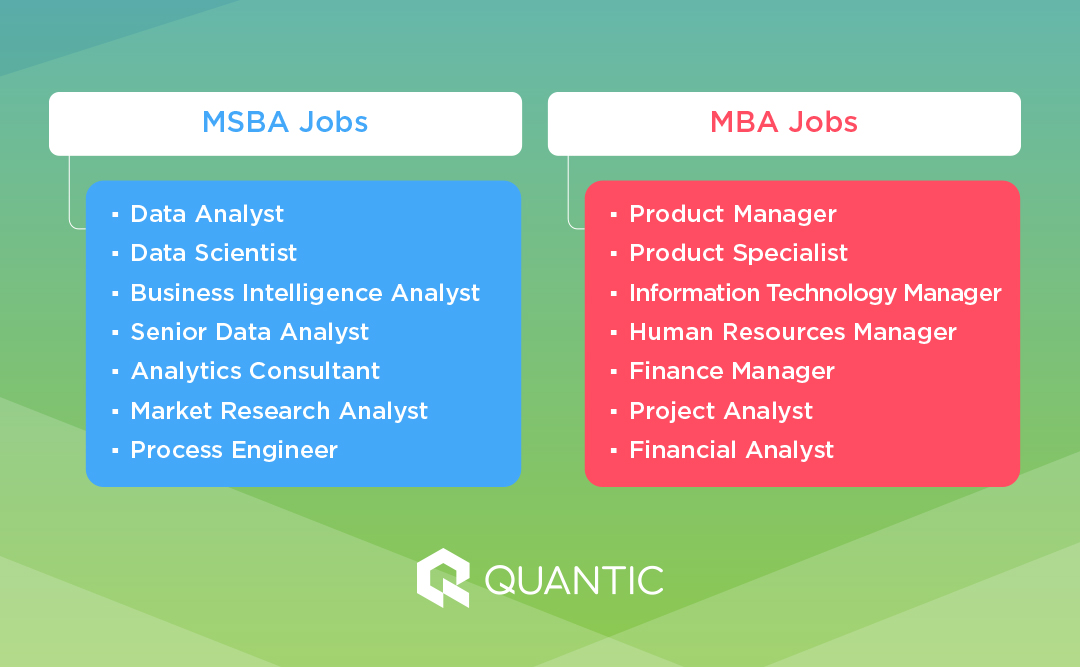
When it comes to jobs between the MSBA vs MBA, the primary difference you find is that MBA graduates are often positioned to take up managerial positions in a company. MSBA vs MBA jobs on the other hand primarily focus on distinct responsibilities: MBA roles lean toward management, while MSBA roles focus on analyzing data to advise leadership. However, MSBA graduates, with the right experience, can expect to advance to senior positions within a company.
MSBA Jobs
MBA Jobs
Data AnalystData ScientistBusiness Intelligence AnalystSenior Data AnalystAnalytics Consultant Market Research Analyst Process Engineer
It is difficult to say which is better between MSBA and an MBA. In fact, you will find the answer depends on your unique career goals. MSBAs are focused and value data analytics over leadership. For example, Quantic’s MSBA program emphasizes cutting-edge analytics tools and AI-enhanced strategies, making it ideal for those aiming to become data specialists. An MBA, on the other hand, is more flexible by providing students with a high-level business understanding with the additional potential to specialize in areas such as operations, marketing, or finance. Programs like Quantic’s MBA also allow students to build leadership skills while maintaining career flexibility.
Who the MSBA is Better for
An MSBA is best for those who wish to focus on data and analytics. If you have a passion for data science over management, you’ll most likely prefer taking an MSBA to become a data specialist. This program is best suited for those looking to keep their head down while excelling at what they do best – data science.
Who the MBA is better for
On the other hand, if you wish to rise to be a leader in a company, you’ll want to pursue an MBA. Although MBAs offer concentrations to allow you to specialize in the management of a specific field, such as data science, they offer a more general understanding rather than strict technical skills. As such, this is the program for you if you’re looking for a flexible degree that will serve you across industries as the best degree for professional growth.
Is a Master in Business Analytics Worth It?
In short, yes. A master business analytics degree is absolutely worth it for those wishing to become data specialists. These programs provide students with an effective understanding of data utilization within a business.
If you’re looking to move beyond data science and lead teams to achieve large-scale business goals, an MBA is the way to go. Quantic offers a unique and accelerated MBA program that can help position you as a leader in any industry you choose. In fact, 94% of Quantic alumni report that they achieved their career goals after graduation, thanks to the education they received through our program. What’s even more impressive is that they did so over five times faster than other MBA students from the top 10 business schools.
With Quantic, you will develop core business skills to maximize your career success, regardless of your chosen industry. All the while, you do so in an accelerated 15-month program of study specifically designed for the early-career professional with leadership aspirations. Plus, you experience this award-winning curriculum through interactive technology and collaborative group study in a structured, yet flexible format.
To read more about Quantic’s impact on its students and alumni, check out Quantic Reviews on Trustpilot, EduOpinions and Niche, where learners share how the programs have helped them achieve their professional and personal goals.
The digital age has ushered in an era of knowledge abundance, fundamentally reshaping how businesses operate and create value. A Master’s in Business Analytics equips professionals with the tools to navigate this transformation, leveraging artificial intelligence (AI) to access and analyze vast amounts of data effectively. This shift challenges traditional notions of productivity and competitive advantage by making information and computational power more accessible than ever before.
Sam Altman, CEO of OpenAI, highlights that humanity is undergoing a transformative shift where AI significantly amplifies access to knowledge and innovation (Altman, “The Future of AI and Humanity”). Similarly, Satya Nadella, CEO of Microsoft, emphasizes the importance of integrating AI into all aspects of work to thrive in today’s economy. Both leaders underscore that the competitive edge for businesses lies in their ability to adapt intelligently, innovate, and align their goals with societal and ethical imperatives.
AI represents more than just a technological advancement—it signals a fundamental shift in decision-making processes and value creation.
The Future of Decision-Making: Five Transformative Trends in 2025
1. Agentic AI and Autonomous Systems
Agentic AI represents a monumental leap in decision-making, enabling systems to operate with autonomy and tackle complex challenges. These systems independently analyze data, predict outcomes, and make strategic choices. For example, augmented reality (AR) tools integrated with AI are transforming industries like real estate, where stakeholders use immersive visualizations to interpret market trends more effectively. A Master’s in Business Analytics equips professionals with the skills to navigate these advancements while addressing critical questions about accountability and ethics. Organizations must establish robust oversight frameworks to maintain transparency, ensure fairness, and preserve trust.
2. Democratizing Analytics
The democratization of analytics empowers individuals at all organizational levels to leverage data for impactful decision-making. Tools like no-code and low-code platforms break down technical barriers, enabling employees to access and act on insights without specialized expertise. For instance, a marketing manager can use these tools to evaluate campaign performance and make data-driven adjustments in real-time, reducing reliance on IT teams. However, achieving true democratization requires investments in data literacy programs and cultural shifts prioritizing data-driven thinking. Companies that successfully adopt this approach create environments where decisions are informed, agile, and inclusive.
3. Predictive and Prescriptive Analytics
Predictive and prescriptive analytics are the backbone of proactive decision-making. Predictive models analyze historical data to forecast risks, opportunities, and trends, while prescriptive analytics recommends actionable strategies to optimize outcomes. For example, logistics companies use these tools to anticipate disruptions and adjust routes, minimizing delays and improving operational efficiency. Despite their transformative potential, organizations often face challenges with fragmented data systems and the technical expertise required to integrate these models fully. Overcoming these barriers unlocks significant competitive advantages.
4. Real-Time Analytics
Real-time analytics enhances agility by providing instant insights that enable organizations to adapt to rapidly changing conditions. Retailers leverage real-time data to adjust pricing during flash sales, maximizing revenue while maintaining customer satisfaction. Similarly, hospitals use live patient data to allocate resources more effectively during emergencies. Professionals with a Master’s in Business Analytics are uniquely positioned to harness real-time data for strategic and impactful decision-making.
The integration of real-time capabilities with predictive and prescriptive models amplifies their impact, enabling businesses to respond not only quickly but strategically. However, scaling these systems requires robust infrastructure and seamless integration to ensure decisions are timely, informed, and impactful.
5. Ethical and Societal Alignment
AI-driven analytics demands more than just technical capabilities. Businesses must create systems that empower ethical decision-making, cultivate adaptability, and integrate with broader societal objectives. It’s no longer about collecting vast amounts of data but creating frameworks that ensure insights translate into meaningful action. A Master’s in Business Analytics emphasizes the ethical use of data, preparing professionals to align analytics with societal goals.
Companies must establish robust ethical guidelines to ensure fairness, accountability, and trust in their decision-making processes. This alignment not only enhances decision-making but also reshapes competitive dynamics and economic value creation.
Master the Art of Data-Driven Decision-Making with Quantic’s MSBA Program
Quantic’s Master of Science in Business Analytics (MSBA) program uniquely blends advanced data analytics with strategic business insights in our award-winning interactive curriculum. You’ll delve into courses like Strategic Leadership, Machine Learning, Cloud-based Big Data, and AI-enhanced analytics, all while participating in a Capstone Project that brings this learning to life. This program sharpens your analytical skills and ability to use modern data collection and visualization tools, preparing you to navigate the complexities of business decision-making with confidence. Here’s how Quantic stands out:
The Active Learning Edge:
Intuitive, active learning methodology paired with expert faculty guidance.
Precision-driven AI Advisor provides tailored support and opportunities for deeper exploration of topics.
Interactive, relevant, and always evolving to meet your needs.
Social Learning:
Collaborate with a global network of peers on data-driven case studies, group projects, and enriching discussions.
Experience an impactful Capstone Project that blends theory with practical application, showcasing your readiness for a data-centric world.
Optional extended weekend conferences and meetups hosted online and in cities worldwide.
Participate in corporate site visits, workshops, and networking opportunities with exceptional peers and Quantic faculty.
Lead the Data Revolution with Confidence
AI-driven business analytics is revolutionizing how organizations make decisions, create value, and align with societal goals. By embracing data-driven strategies, businesses can unlock innovation, gain a competitive edge, and drive meaningful progress. Quantic’s MSBA program equips professionals with the tools, ethical mindset, and cutting-edge expertise to harness AI’s transformative power, bridging the gap between technology and strategic leadership in an ever-evolving landscape. Explore Quantic’s MSBA program today and take the first step toward transforming your career.
Discover why our students love us and why we’re trusted by top employers around the world by reading the highly-rated Quantic reviews here.
Business analytics trends are evolving rapidly, becoming a cornerstone of modern decision-making. The global big data market is forecasted to grow to $103 billion by 2027, more than double its size in 2018, which clearly reflects the increasing reliance on analytics to drive decision-making. Meanwhile, as companies navigate a fast-paced, data-driven world, these trends are transforming the landscape. Balancing advanced technologies with practical, real-world applications, these developments are reshaping how organizations leverage data. In summary, here are the five most impactful trends shaping the future of business analytics, followed by additional developments worth noting.
1. Agentic AI and Emerging Technologies: Smarter, Autonomous Systems
New technologies like agentic AI and quantum computing are redefining analytics by enabling systems to operate more independently while also solving complex problems faster.
Agentic AI: Agentic AI: Autonomous AI agents can analyze complex data sets and drive innovation in business analytics trends through independent decision-making. For example, Google Cloud’s trials demonstrate how these systems streamline analytics workflows.
Quantum Computing: Quantum technology solves intricate optimization problems, such as portfolio management, exponentially faster than classical methods, offering unprecedented capabilities.
AR/VR in Analytics: Immersive tools transform data visualization, making insights easier to understand and act upon. Real estate firms, for instance, use AR to overlay market trends on physical spaces.
2. Data Privacy and AI Governance: Building Consumer Trust
As businesses collect more data, ethical usage, and privacy compliance are becoming non-negotiable. Therefore, organizations must prioritize robust governance practices to foster trust and transparency.
Enhanced Data Governance: Robust policies ensure adherence to regulations like GDPR and CCPA.
Bias-Free AI Models: Ethical AI reduces discrimination in hiring and lending practices.
Blockchain Security: Decentralized ledgers safeguard data integrity and transparency.
Example: Financial institutions use blockchain to securely record transactions while protecting customer privacy. However, balancing compliance with innovation remains a challenge, making it essential to integrate these practices seamlessly.
3. Democratization of Analytics: Making Data Accessible
Today’s business analytics trends ensure analysis is no longer reserved for data scientists. Instead, tools empower employees across all departments to explore and act on data insights independently.
No-Code/Low-Code Platforms: Simplified tools allow users to create dashboards without programming expertise.
Self-Service Analytics: Platforms like Tableau enable teams to access and interpret data autonomously.
Collaborative Dashboards: Enhanced sharing features promote teamwork and unified decision-making.
While accessibility improves decision-making, businesses must address potential risks, such as data misinterpretation by non-experts, through training and oversight.
4. Predictive and Prescriptive Analytics: Anticipating What’s Next
Businesses are shifting from reactive to proactive strategies because they are leveraging predictive and prescriptive analytics.
Predictive Models: Business analytics trends like predictive models help forecast risks, opportunities, and consumer behaviors using historical data, enabling proactive strategies.
Prescriptive Analytics: Suggest actionable strategies to optimize operations.
Scenario Simulations: Explore potential outcomes of strategic decisions to mitigate risks.
Example: Logistics companies predict weather-related delays and reroute shipments proactively, reducing disruptions and costs.
5. Real-Time Analytics: Acting on Insights Instantly
In a world where delays can mean lost opportunities, real-time analytics has become essential. Consequently, organizations are increasingly adopting tools like streaming data processing and edge computing to remain competitive.
Streaming Data Processing: Platforms like Apache Kafka analyze and react to live data streams.
Edge Computing: Processes data closer to its source, reducing delays.
Automated Decision-Making: Real-time systems adjust inventory levels or reroute shipments immediately.
Example: Retailers dynamically adjust prices during peak demand, while hospitals optimize resource allocation during emergencies using live data.
Additional Trends to Watch
Hyper-Personalization: Tailored experiences, already prevalent in retail and entertainment, are becoming the norm across industries.
Streaming Analytics: Real-time analysis is crucial for monitoring social media and financial markets.
Cloud Cost Optimization: Businesses are reducing cloud expenses by scaling usage based on actual demand.
Sustainability Analytics: Companies are analyzing operations to reduce environmental impact, driven by consumer expectations and regulations.
Explainable AI (XAI): Transparent AI models build trust, especially in regulated sectors like healthcare and finance.
Decision Intelligence: Combines data analytics with human expertise to refine decision-making processes.
Data Fabric Architecture: Simplifies access to data spread across multiple systems, ensuring consistent insights across large organizations.
Looking Ahead
The future of business analytics lies in blending advanced technologies with user-friendly startup tools, making data actionable for all. To thrive, organizations must strategically adopt these trends, invest in upskilling employees, and ensure their analytics frameworks align with business goals. By staying agile and building trust, businesses can turn data into a powerful competitive advantage.
Empowering the Future of Data Leaders: Your Next Step with Quantic MSBA
To thrive in this rapidly evolving landscape, future business leaders must master the tools and techniques powering these trends. The Quantic’s Master of Science in Business Analytics program (Quantic MSBA) provides the perfect foundation, equipping students with technical, analytical, and leadership skills to excel in business analytics, data science, and AI/ML.
Designed for professionals, even those with minimal technical backgrounds, the program teaches essential skills like SQL, Python, R, and Tableau, enabling students to analyze data and deliver actionable insights. Through a curriculum that blends quantitative methods with strategic business applications, students gain expertise in data management, predictive modeling, and ethical AI practices—directly addressing the demands of emerging trends like real-time analytics and AI governance.
The program culminates in collaborative capstone projects, where students solve real-world problems, translating data into impactful business strategies. Beyond technical expertise, the MSBA offers learning in key domains such as finance, marketing, and innovation, ensuring graduates can navigate the cross-functional challenges highlighted by democratized and predictive analytics.
By integrating Quantic’s conferences and a global alumni network, the program keeps students ahead of the curve, connecting them with industry leaders and fostering lifelong learning.
Explore the Quantic MSBA program today and lead the future of business analytics.
Discover why our students love us and why we’re trusted by top employers around the world by reading Quantic reviews here.
In today’s rapidly evolving world, where technology and AI are reshaping industries, choosing the right MBA or Executive MBA program is more critical than ever. Innovative teaching methods, relevant curricula, true flexibility, and affordability have become essential factors in modern education. Quantic School of Business and Technology, a trailblazer in online business education, is redefining how professionals learn with its mobile-first, AI-powered platform. Combining unmatched flexibility with a practical, real-world curriculum, Quantic equips learners to achieve their career aspirations. But don’t just take our word for it—here are the highly-rated Quantic reviews from students and alumni about their transformative journeys with Quantic’s programs.
Quantic Reviews by Onyeka Okonkwo: A Revolutionary Approach to Learning That Sticks
An Interactive Learning Experience Like No Other
When I first discovered Quantic, I was intrigued by its mobile-first and interactive learning approach, which stood out from traditional programs. From the very beginning, the program exceeded my expectations with its bite-sized case studies and engaging, fill-in-the-answer formats that made learning enjoyable and impactful. Unlike the passive experience of video lectures, Quantic kept me actively involved, and the humor woven into the content ensured I stayed engaged throughout.
This was education like I had never experienced before—delivered in bite-sized case studies that gradually eased me into various business concepts. Learning that truly sticks! The ability to immediately apply the concepts to real-world challenges made the experience both practical and transformative.
Expanding Connections and Collaborative Growth
Quantic’s global learning community was another highlight of the program. My cohort included professionals from top universities and companies, which added immense value to group projects and discussions. The collaborative projects were particularly impactful, as they allowed me to work with diverse perspectives and apply my learning to complex business problems. Beyond academics, Quantic’s networking platform and tools, like Slack and the monthly book club, provided opportunities to connect with peers worldwide and foster valuable relationships. Overall, I had an exciting time learning at the Quantic School of Business and Technology; I totally recommend the program and look forward to putting everything I learned into practice.
Quantic Reviews by Kamila Tocicka: Rediscovering Confidence and Leadership Through Lifelong Learning
Balancing Motherhood and Education to Reclaim Myself
During one of the most challenging periods of my life—balancing the joys and struggles of motherhood with a sense of personal loss—I realized how important it was to rediscover myself. While I adored my daughter, I missed the ambitious, creative woman I used to be. Pursuing an Executive MBA at Quantic School of Business and Technology became a way to regain control and reignite my passion for learning. The program taught me invaluable skills like time management and prioritization that helped me balance the demands of motherhood and my studies. For the first time in a long time, I felt as though I was in control of my life. This transformative journey not only helped me grow as a professional but also gave me the confidence to embrace my full potential.
Personal and Professional Growth Beyond Expectations
Quantic’s program gave me more than just business acumen—it reshaped how I value myself and my accomplishments. Armed with newfound confidence and skills, I successfully transitioned back to work, excelled in my role, and even negotiated a promotion shortly after graduation. The impact extended beyond my career, enriching my relationships and allowing me to reconnect with the creative, driven person I once was.
The impact of my MBA studies went far beyond just my career. I found myself feeling more fulfilled and empowered than ever before. Quantic’s approach to lifelong learning was a catalyst for change, empowering me to overcome challenges and embrace leadership both at work and in life.
Quantic Reviews by Emily Stone: Empowering Working Professionals Through Flexible Learning
Finding the Perfect MBA for a Busy Working Parent
I enrolled in the Quantic Executive MBA program in early 2020, seeking a flexible, affordable program to help me grow beyond my expertise in HR and Learning & Development. With over 15 years of experience designing online courses, I was drawn to Quantic’s mobile-friendly platform, which offered a highly interactive and engaging learning experience through continuous assessments and practical case studies. As a full-time working mom of three young children, the program’s flexibility was essential—I could complete coursework from my phone anytime, even while sitting on the couch or waiting in line at the grocery store! The opportunity to test-drive the platform before enrolling gave me confidence that Quantic’s approach matched my learning style and goals.
How Quantic Transformed My Career and Busines
Quantic’s program exceeded my expectations, equipping me with practical business knowledge and leadership skills that I could apply immediately. The thoughtfully designed case studies and collaborative group projects challenged me to think critically and fostered valuable connections with a global community of professionals. Despite my initial hesitation, I found the group work to be a highlight of the program, as I gained insights from diverse perspectives that enriched our final projects. Since graduating in 2021, my career has flourished—I’ve doubled my consulting rate, secured high-profile clients, and expanded my expertise to become a strategic business partner. Additionally, Quantic’s comprehensive business education enabled me to grow my business, Empowered Bumps & Boobs, earning recognition in my community and beyond. Reflecting on my journey, I can confidently say,
If you’re on the fence about investing in yourself with an Executive MBA program, please use my story as one data point. For me, Quantic was the catalyst I needed to get unstuck and move toward my full potential.
Quantic Reviews by Miguel Mayorga: Transformative Learning & Meaningful Connections
Interactive Learning That Inspires Continuous Growth
Pursuing the Quantic Executive MBA has been nothing short of transformative. The program’s well-structured curriculum, featuring 60 courses and a Capstone project, is both rigorous and engaging. The interactive, mobile-first learning model kept me actively involved, with engagement every 8-10 seconds and offline access that fit seamlessly with my busy schedule. Quantic’s AI-powered advisor further enhanced my experience, providing personalized guidance throughout the program. Looking back on the interactive learning experience, this journey reignited my passion for continuous learning. A good friend once told me, “Don’t stop learning because life never stops teaching,” and this experience has truly brought that advice to life.
Building Networks and Embracing Diversity
Quantic is not just about academics; it’s also about building meaningful connections. From delivering a presentation on “How to Find the Right Contacts” to collaborating with my diverse project partners, the program offered invaluable networking opportunities. Engaging with professionals from various backgrounds broadened my perspective and improved my teamwork skills. One of the most impactful lessons was learning the importance of setting clear expectations and embracing diversity in a team setting, which I now apply in my professional role. I am grateful for the collaborative spirit of Quantic’s community, which reinforced my belief in the power of shared knowledge and innovation.
For those seeking flexible, interactive learning, Quantic is an excellent choice for professional and personal growth. The program’s affordability, continuous improvements like the AI advisor, and comprehensive curriculum make it a strong contender in today’s dynamic business environment.
Miguel Mayorga Talent Sourcing & Intelligence ZEISS Group
Quantic Reviews by Garry Sands: From Functional Expert to Strategic Leader
A Curriculum that Bridges Theory and Practice
Joining the Quantic Executive MBA program was a pivotal step in my professional journey. The curriculum, with its focus on strategic thinking, leadership, and emerging technologies like blockchain, wasn’t just theoretical—it was immediately applicable to my work. The program’s faculty, comparable to those of top institutions like Wharton and Stanford, provided actionable insights that reshaped how I approach business challenges. Reflecting on the impact, I can confidently say, “The program is designed not just to educate but to transform how you think about business and leadership.” This transformation has allowed me to step into more strategic roles and navigate complex challenges with greater confidence.
Harnessing the Power of a Global Network
One of the most rewarding aspects of my Quantic experience was the global network I became a part of. The diversity of my cohort, representing various industries and backgrounds, allowed me to gain fresh perspectives and build meaningful connections. Whether through collaborative projects, live discussions, or shared experiences, the relationships I formed have had a lasting impact on my career. The program also challenged me to grow as a leader, helping me shift from a functional expert to a strategic thinker. As I applied these lessons to real-world scenarios, I saw tangible results in my ability to lead teams, spearhead initiatives, and drive business growth.
The Quantic Executive MBA has been an eye-opening experience in my professional journey. It has equipped me with the skills, knowledge, and confidence to take on new challenges and seize new opportunities. If you’re ready to grow, to lead, and to make a difference in your career, then I encourage you to take the leap. Quantic can take you where you want to go and beyond.
Quantic Reviews by Rishabh Bitola: A Global Perspective to Drive Business Success
Learning from a Truly Global Community
As I reflect on my journey through the Executive MBA program at Quantic, I am struck by the truly global nature of this experience. Being part of a cohort spanning over 50 countries has not only broadened my perspective but has also deepened my understanding of global business dynamics. Collaborating with professionals from diverse industries and cultural backgrounds has enriched my learning and challenged me to think beyond my assumptions.
Education knows no borders; it is the global passport to success. Grateful for the global MBA experience at Quantic School of Business and Technology, where I’ve learned to embrace diversity, expand my horizons, and thrive in the interconnected world of business. Quantic’s emphasis on diversity and collaboration has truly set this program apart for me.
Exceptional Mentorship and Unwavering Support
Quantic’s innovative and interactive platform has equipped me with leadership skills and business acumen that I can directly apply in real-world scenarios. The program’s focus on experiential learning, strategic planning, and market analysis has sharpened my critical thinking and problem-solving abilities. The exceptional faculty, with their wealth of industry expertise and academic rigor, has been instrumental in shaping my professional development. The guidance, mentorship, and unwavering support of Quantic’s faculty have played a crucial role in my journey. The global perspective they bring to each lesson has been invaluable in understanding the nuances and challenges of doing business in diverse cultural contexts. This transformative learning experience has empowered me to drive innovation, foster growth, and navigate the complexities of the global business landscape with confidence.
Rishabh Bitola Founder & Director, Infotyke Director, Regitree Green Foundation
There are many more student stories—feel free to connect with our students and alumni on LinkedIn to learn more about their experiences and insights!
Beyond personal stories, Quantic students and alumni have shared glowing reviews on Trustpilot, highlighting the program’s innovative curriculum, flexibility, and real-world impact. These highly-rated reviews provide valuable insights into what makes Quantic a leading choice for professionals worldwide. Visit Trustpilot, EduOpinions and Niche to read firsthand accounts of how Quantic has helped learners achieve their personal and professional goals: Quantic Reviews.
For an in-depth exploration of Quantic’s offerings, check trusted third-party reviews and stories that evaluate the program’s curriculum, admissions process, and outcomes:
These resources provide detailed insights into how Quantic is shaping the future of business education.
Quantic Reviews FAQ
Is Quantic a legitimate school?
Yes, Quantic School of Business and Technology is licensed by the District of Columbia Higher Education Licensure Commission in Washington, DC, and accredited by the Distance Education Accrediting Commission (DEAC). The DEAC is listed by the United States Department of Education as a recognized accrediting agency and is also recognized by the Council for Higher Education Accreditation (CHEA). This ensures Quantic meets rigorous academic and professional standards.
Is Quantic’s MBA legit?
Yes, the Quantic MBA is a legitimate program. Quantic School of Business and Technology is accredited by the Distance Education Accrediting Commission (DEAC). It is designed for high-potential, early-career learners eager to make a difference.
Is the Quantic Executive MBA accredited?
Yes, Quantic’s Executive MBA is an accredited program. Quantic School of Business and Technology is accredited by the Distance Education Accrediting Commission (DEAC). It is designed for mid-career professionals and focuses on developing leadership, global strategy, and advanced business skills.
Is the Quantic MBA recognized by employers?
Absolutely. Quantic students and alumni work at top global companies, such as Google, Amazon, Microsoft, Salesforce, Deloitte, Apple, and JPMorgan Chase & Co. Over 2,100 Quantic students and alumni are employed at companies in Quantic’s Employer Network, and many employers offer tuition reimbursement for Quantic programs, demonstrating trust in its value.
Is the Quantic MBA legit in 2025?
Yes, the Quantic MBA remains a legitimate, accredited program in 2025. It is distinguished by its mobile-first, AI-powered platform, career outcomes, and affordable tuition model, making it a popular choice among professionals seeking flexible, high-quality business education. Learn more about the Quantic Method.
What’s the deal with Quantic?
Quantic School of Business and Technology is a mobile-first, AI-powered business school. Founded on the notion that higher education lacks quality, effective, flexible, and cost-efficient solutions, it provides accredited online degree programs that rival top traditional elite business education. Quantic attracts thousands of high achievers from the world’s best companies, teaching today’s leaders future-forward skills in business and technology. Visit Quantic’s website to learn more.
Who owns Quantic School of Business and Technology?
Quantic is owned by Pedago, Inc., an education technology company committed to making elite education accessible and affordable for high-potential professionals worldwide.
Is a Quantic MBA real?
Yes, the Quantic MBA is a real, accredited degree program. Selective in admissions, we assemble global cohorts of high-potential, early-career learners, delivering an online MBA curriculum with a comprehensive student experience that includes exclusive online and in-person events, while delivering exceptional career outcomes.
Is the Quantic (formerly Smartly) MBA worth it?
Yes, Quantic’s MBA is worth it for professionals seeking a flexible, affordable, and innovative business education. Graduates report career advancement, salary increases, and expanded networks. Check out how Quantic helps leaders level up and why People love Quantic.
It has been predicted that AI will contribute $19.9 trillion to the global economy through 2030. However, if this potential is to be realized, there will be an acute need for technically skilled leaders and software engineering professionals able to bridge the gap between the remarkable emerging capabilities of foundation AI models such as ChatGPT, Claude, and Gemini, and the specific needs of individual companies, industries, and individuals. Currently, there is an acute shortage of professionals and leaders with the necessary skills for this work, which will be required in every business, large and small.
While many powerful foundation models have already become available, the wave of AI adoption that will occur within all businesses throughout the economy over the coming few years to a decade is still in its infancy. Those with the key skills to enable this rollout at this time stand to ride an incredible wave of opportunity and innovation.
Located squarely in the center of this space is Quantic’s MS Software Engineering program, which is uniquely well-placed to provide the Masters-level training needed to prepare candidates, within the timeframe of one year, with the skills needed to help lead in and contribute to this economic revolution.
What Software Engineering Professionals Will Play a Key Role in Realizing the AI Economy?
The Growing Demand for Skilled Software Engineers in the AI Economy
While foundation models have incredible and rapidly increasing capabilities, they do not provide fully customized and reliable solutions for each business use case throughout the economy. This can be because the foundation models do not (and cannot) have access to the businesses’ internal proprietary data resources, do not understand the subtleties or the norms of the interactions required in the given organization or industry or cannot reliably carry out extended activities involved in typical workflows in the organization, amongst a range of other subtle and complex real-world challenges.
Here it becomes essential that skilled software engineering professionals are available who are able to lead the development of initiatives and the building of software systems that harness these powerful large language models (LLMs) to reliably implement the specific needs of individual businesses and industries. What is needed is a sophisticated range of skills from AI strategy, aspects of full-stack engineering, LLM calling, prompt engineering, orchestration and fine-tuning, the use of cloud services, cloud hosting for model inference, and a strong knowledge of modern software architectures and containerization. These are many of the key skills required for an AI Engineering role, all of which are covered in Quantic’s MS Software Engineering degree.
Entrepreneurial Opportunities for Software Engineers in AI
While foundation models have incredible and rapidly increasing capabilities, they do not provide fully customized and reliable solutions for each business use case throughout the economy. This can be because the foundation models do not (and cannot) have access to the businesses’ internal proprietary data resources, do not understand the subtleties or the norms of the interactions required in the given organization or industry, or cannot reliably carry out extended activities involved in typical workflows in the organization, amongst a range of other subtle and complex real-world challenges.
Here, it becomes essential that skilled software engineering professionals are available to lead the development of initiatives and the building of software systems that harness these powerful large language models (LLMs) to reliably implement the specific needs of individual businesses and industries. What is needed is a sophisticated range of skills from AI strategy, aspects of full-stack engineering, LLM calling, prompt engineering, orchestration and fine-tuning, the use of cloud services, cloud hosting for model inference, and a strong knowledge of modern software architectures and containerization. These are many of the key skills required for an AI Engineering role, all of which are covered in Quantic’s MS Software Engineering degree.
10 Must-Have Software Engineering Skills to Lead in the AI Economy
A Deep Understanding of Current AI Capabilities
Understanding what can and cannot be implemented with current AI model capabilities, as well as how feasible or alternatively hard a given use case is to implement, depends on a deep understanding of current AI capabilities. For example, recent developments in voice-based AI model application programming interfaces (APIs) make a whole range of innovative voice-based AI applications now possible that, just a few months ago, were not possible.
AI Strategy and Project Management
Being able to plan and architect the approach needed to manage the implementation of a given AI initiative will be key. This will include an understanding of what technologies to utilize, how to do this cost-effectively, and how to manage the project work in an agile manner. For example, some AI initiatives can be achieved through prompt engineering alone, while others may require complex application development.
AI-Driven Software Engineering Skills
Current developments in AI-based code generation enable the individual software engineer to be increasingly productive. Being an AI-first developer who utilizes these tools to dramatically increase productivity in many aspects of system development will be key to being maximally effective and productive going forward. For example, the use of AI-powered integrated development environments (IDEs) such as Cursor, Windsurf, Replit or various VSCode extensions are rapidly becoming the norm in software development.
Leadership and Organizational Strategy for AI Projects
In leading software engineering and AI initiatives, expertise in leadership and organizational strategy is required. This involves understanding the fundamentals of management, how to manage talent, how to work in teams and groups, and how to provide positive leadership. This is also combined with agile project management practices. For example, to build, maintain, and motivate a high-functioning team, all of these skills are needed.
Mastery of Cloud-Native Applications and Architectures
Modern software architectures rely heavily on cloud services, so a deep understanding of cloud architectures is central to modern software engineering. Additionally, access to cloud-based GPU hardware offers tremendous advantages for the deployment of AI models in terms of capital expenditure savings and also elastic scalability based on need or load.
AI Engineering Skills for Real-World Applications
A range of novel skills and technologies are required for AI Engineering. These relate to topics such as the use and integration of vector stores, retrieval augmented generation, the management of model context, the use of AI orchestration frameworks, and prompt engineering. An understanding of these, combined with a knowledge of the rapid evolution of vendor offerings related to these capabilities, is essential in the field. For example, if your organization has internal proprietary data, skills in these areas will support the integration of these resources with the intelligence provided by AI models.
Machine Learning Skills
Historically, machine learning skills are needed for the training and development of custom predictive models. Modern AI models can significantly decrease the need for the training of custom models. However, these skills continue to have an important role in models optimized for structured data. Additionally, machine learning skills are needed to fine-tune modern AI models. For example, a foundation model may not respond according to the particular style and parlance of your business use case – in such cases, fine-tuning an AI model can provide an appropriate solution, and fine-tuning borrows many concepts from traditional machine learning.
Continuous Integration, Testing, and Deployment for AI Systems
Continuous integration/continuous deployment, or CI/CD as it is commonly referred to, is an approach that provides the ability to rapidly and iteratively deploy incrementally improving software systems. These techniques are also key to the deployment of modern LLM-based systems. For example, these techniques allow end-user feedback to be received and addressed, and an updated application addressing critical feedback, where received, can be redeployed within the day.
Understanding of Modern Software Architectures
For enterprise-scale AI applications, understanding the application of various modern software architectures is important. Skills needed in this area include domain-driven design, microservice architectures, and event-driven architectures, amongst numerous other patterns. By utilizing the correct architecture for the given problem, scalability, cost, and reliability can all be improved.
Communication Skills
Being able to bridge the technical and business terminology gap is key to working and communicating in this field. This involves understanding the business domain and business terminology, in addition to having comprehensive knowledge of AI and software concepts and terminology.
All of these skills, and others, are covered and developed within Quantic’s MS Software Engineering program.
Top Career Opportunities in Software Engineering for the AI Economy
AI Engineer
AI Engineers design, develop, and deploy AI-powered systems using large language models, machine learning, and advanced algorithms. They play a critical role in creating scalable solutions tailored to business-specific needs in the AI economy.
Director of AI
Directors of AI lead strategic AI initiatives, overseeing the integration of machine learning models and AI tools to meet organizational goals. They manage teams and ensure AI technologies drive innovation and business growth across industries.
Vice President of AI
The Vice President of AI shapes company-wide AI strategies, aligning AI innovations with long-term business visions. They lead cross-functional teams, manage budgets, and ensure cutting-edge AI solutions deliver measurable economic and operational value.
AI-enabled Software Engineer
AI-enabled software engineers combine traditional coding with AI technologies to create intelligent applications. They utilize tools like AI-driven IDEs and prompt engineering to build smarter, more efficient software systems for modern organizations.
DevOps Engineer with an AI Focus
DevOps Engineers with an AI focus streamline AI model deployment through CI/CD pipelines, cloud-native architectures, and containerization. They ensure seamless integration of AI systems into production environments while maintaining scalability and performance.
Quantic’s MSSE program offers career support, networking opportunities, and an alumni network to help graduates secure these roles.
Why Choose Quantic’s MSSE for Aspiring AI Leaders
Flexible, Mobile-First Learning: Quantic’s award-winning, interactive platform allows students to learn anytime, anywhere, with the flexibility to balance their studies alongside professional and personal commitments. Integrated Curriculum
AI-Integrated Curriculum: Gain cutting-edge knowledge in AI-augmented software engineering, the engineering of AI systems, and AI strategy and project leadership.
Career-Boosting Connections: Students connect and collaborate with a global cohort of peers, industry mentors, and faculty. The program includes virtual academic events, optional in-person meetups in cities around the world, and access to student-led organizations, providing unparalleled opportunities for professional growth and networking.
Affordable and Accessible Education: At $21,450 for the 13-month program, Quantic’s MSSE offers exceptional value. Students often take advantage of employer reimbursements, tuition benefits, and scholarships to reduce costs further, making the program accessible to a wide range of professionals.
Embrace the Opportunities of the Emerging AI Economy
While AI promises to transform the global economy, the rollout of AI into each existing business is still in its infancy, as is the formation of the numerous new AI-first businesses that will emerge. Having advanced AI technical skills is essential for contributing to realizing economic growth nationally, but it also provides great career opportunities for each graduate individually to participate in and help lead in this AI revolution.
Ready to take the next step?Explore Quantic’s MSSE program to gain the skills and knowledge required to lead in the AI Economy. You are encouraged to reach out to Quantic with any questions you may have.
Discover why our students love us and why we’re trusted by top employers around the world by reading Quantic reviews here.