Online Master’s in AI Engineering: Curriculum, Careers, and Admissions

Are you looking for an online graduate degree that prepares you to do more than understand AI — and actually lead its adoption inside an organization? Quantic’s online Master’s in AI Engineering is designed for professionals who want to combine AI technical fluency, business judgment, and implementation leadership to help organizations identify, build, and deploy high-value AI solutions.

Dr. Robert Steele explains why Quantic’s online Master’s in AI Engineering is designed around AI adoption leadership.

“Almost every company has made AI a top strategic priority, but many organizations are still figuring out how to do this successfully. They are looking to identify their AI adoption leaders with the needed advanced skills — those with the technical depth and the business and management perspective to lead enterprise AI adoption. Quantic’s online Master’s in AI Engineering is designed from the ground up to graduate exactly such professionals — those who can be the future leaders of AI adoption in the broader economy.”

Dr. Robert Steele
Academic Program Director for Artificial Intelligence and Software Engineering
Quantic School of Business and Technology

This Q&A guide explains who Quantic’s Master of Science in AI Engineering is for, how technical the program is, what students learn, and how it compares with AI certificates, bootcamps, and traditional graduate programs. If you are evaluating an online Master’s in AI Engineering to move into an AI leadership role, this guide will help you assess fit.


Quick Answer: What Is Quantic’s Online Master’s in AI Engineering?

Quantic’s online Master’s in AI Engineering is an accredited, 13-month graduate degree for professionals who want to lead AI adoption in business, technology, and industry settings. The program blends applied AI agent and application development, AI adoption leadership, AI product thinking, AI architecture/design, and organizational transformation, to prepare students for an AI leadership role for this time of rapid change in the economy.

Key takeaways:

  • Designed for professionals who want to become AI adoption leaders, not just AI tool users.
  • Delivered online in a cohort-based format for working professionals.
  • Focuses on applied AI systems, adoption, agents, applications, and enterprise implementation.
  • Includes curriculum across AI engineering, business strategy, organizational change, and software delivery,
  • Does not require prior professional software development experience.
  • Includes a capstone where students identify and solve a real-world, high-value AI use case and build and deploy its corresponding AI solution.
  • Differentiates from AI certificates and bootcamps by offering a full accredited Master’s graduate degree.
  • Prepares graduates for roles such as AI adoption leader, AI engineer, AI product leader, AI transformation manager, enterprise AI strategy professional, and future AI senior leadership roles.
Program FeatureDetails
DegreeMaster of Science in AI Engineering
FormatOnline, cohort-based
Length13 months
Best ForProfessionals seeking AI adoption and implementation leadership
Capstone3.5-month agile AI adoption and implementation project
Technical BackgroundSoftware development experience not required
Career DirectionAI adoption leader, AI engineering, AI product, AI strategy, AI transformation, AI senior leadership roles


What Is the Core Focus of Quantic’s Online Master’s in AI Engineering?

Quantic’s online Master’s in AI Engineering is designed with a clear purpose: to prepare the economy’s future AI adoption leaders. That role is in high demand and offers significant career potential.

Similar to the industrial revolution, after the emergence of key new technologies such as the steam engine, there was a period of 80 years where that new capability diffused throughout the economy, fundamentally changing it and society. In the case of the current AI revolution, some leading experts (Dr. Demis Hassabis, Nobel Laureate and CEO of Google DeepMind, Jack Clark, Co-Founder, Anthropic) estimate that this impact will be ten times larger and ten times faster — and paradoxically, what is currently in short supply, are the skilled, sufficiently technically proficient human AI adoption leaders.

To be an effective AI adoption leader, you must combine technical know-how in relation to the latest AI developments with business, adoption, and organizational understanding. The AI adoption leader is the person who can understand their organization’s domain, determine where AI creates high value, identify, build, and deploy the systems that transform how the business works, and manage the rollout of AI initiatives.


Who Should Consider Quantic’s Online Master’s in AI Engineering?

The program is designed for professionals who aspire to become AI adoption leaders in their sector. You can enter Quantic’s online Master’s in AI Engineering without a heavily technical background; much AI system development is increasingly supported by natural-language interaction and advanced AI tooling. You will develop the technical understanding needed to use such tooling effectively. Your existing domain knowledge from your current and past professional role will be a key component for you in the program and for your future career opportunities.

Almost every company has made AI a top strategic priority, but many organizations are still figuring out what that actually means — they are looking to identify their AI adoption leaders with the needed advanced skills. There’s excitement and investment, but not always clarity around implementation, governance, or how to successfully adopt AI. This program gives you both sides of that equation: the technical depth and the business and management perspective to lead enterprise AI adoption and prepare for an AI leadership role.

The most prevalent employers of students who have currently entered the MSAIE include Microsoft, Google, Wells Fargo, Blue Cross Blue Shield, the U.S. military, Airbnb, Amazon, and many other leading organizations. Industries represented among current students include healthcare, banking, finance, consulting, pharmaceuticals, marketing, agriculture, military, cybersecurity, and many others. The goal is to help them become AI adoption leaders in their industries.


What Kinds of Professionals Enroll in Quantic’s MS in AI Engineering?

Quantic’s online Master’s in AI Engineering attracts a wide variety of entrants in terms of both seniority and industry background. Groups significantly represented include:

  • Product managers and technical product managers
  • Founders and CEOs
  • Designers
  • Data scientists and other data professionals
  • Software engineers, software architects, software engineering managers, and directors
  • Senior management professionals, such as VPs, SVPs, and CIOs
  • Consultants
  • Cybersecurity professionals
  • Developers transitioning into AI-focused roles
  • Professionals from sectors including healthcare, finance, marketing, business development, IT support, customer service, and science

Do I Need Software Development Experience to Apply?

You do not need past experience as a software developer to apply to Quantic’s online Master’s in AI Engineering. If you have software development experience, it provides a beneficial starting point, but the program provides a carefully designed on-ramp to help those without a developer background come up to speed. Additionally, much of the AI systems development work in the program is supported by natural-language interaction and leading AI software development tools.

You should demonstrate analytical ability and particularly strong motivation for staying abreast of AI and technology developments, especially if your goal is to move into an AI leadership role.


What Is Quantic’s Master of Science in AI Engineering?

The MSAIE is an accredited online graduate degree focused on AI adoption and implementation leadership. It is a 13-month, online cohort format with a class size of typically around 150 students. It is designed for professionals with domain knowledge in a particular organization or industry sector who want to complement that experience with the AI engineering skillsets needed to prepare for an AI leadership role as an AI adoption leader.

The program provides the skillset and relevant knowledge needed at the intersection of AI technology, business, and software.


What Career Pathways Can Quantic’s Online Master’s in AI Engineering Support?

Quantic’s online Master’s in AI Engineering prepares graduates for roles across AI engineering, AI adoption, product leadership, transformation, and strategy. Depending on prior experience, the MSAIE can support pathways such as:

  • AI adoption leader
  • AI engineer
  • AI product leader
  • AI startup founder
  • AI transformation manager
  • Senior manager responsible for AI leadership
  • Enterprise AI strategy professional
  • VP of AI transformation
  • Chief AI Officer, depending on prior experience

What Will Students Learn in Quantic’s Online Master’s in AI Engineering Curriculum?

In Quantic’s online Master’s in AI Engineering, students take 8 required concentrations, 2 specializations, and 1 capstone. Coursework includes areas such as:

  • Managing AI Engineering
  • AI Senior Leadership
  • AI Engineering Techniques and Architectures
  • Web Application and Interface Design
  • Software Testing and CI/CD
  • Machine Learning to AI Model Fine-Tuning
  • AI and Organizational Transformation

By the end of the program, students should be able to develop an AI strategy for an organization, identify high-value AI use cases, select the appropriate AI technologies, design, develop, test, and deploy high-value AI solutions such as agents and applications, and lead AI adoption rollouts.


Is Quantic’s Online Master’s in AI Engineering Math Heavy?

No. Quantic’s online Master’s in AI Engineering includes applied machine learning concepts but does not focus on advanced mathematical proofs. The emphasis is on leading AI initiatives and implementing AI applications and agents to meet real-world, high-value AI use cases.


Will I Learn to Code in Quantic’s Online MS in AI Engineering?

You will understand code and its concepts and vocabulary — and at this point in time, a significant proportion of software development is increasingly supported by natural-language interaction and AI-assisted tooling. Students learn to understand the design and architecture of systems, along with technical constraints and ecosystems, while doing a significant proportion of their building using English-language prompts. Students create and maintain their own GitHub repos throughout the program. The curriculum includes structured guidance and an accessible on-ramp for those without a technical background. Modern AI tools make system-building more accessible than ever before. 


How Technical Is Quantic’s Online Master’s in AI Engineering?

The program is very up to date in relation to the AI technology, architecture, and design understanding needed by AI adoption leaders at this time, along with the deep use of recently available, powerful AI software development tooling. Students conceptualize, manage, design, implement, test, and deploy AI-driven applications and agents to deliver AI initiatives. While the latest and most powerful AI-assisted tools are used throughout the program to enhance productivity, students are responsible for core architectural decisions, code implementation, debugging, testing, and deployment workflows.


What Is the Capstone Project in Quantic’s Online MS in AI Engineering?

The capstone is a 3.5-month agile AI adoption project. Students work in Scrum teams, or individually if they prefer, select an AI use case representing an innovative, high-value AI business need, complete multiple sprints, deploy a working AI application or agent, publish code to GitHub, which can be private or public, and deliver a professional demonstration — all assisted by the latest, powerful AI software development capabilities. The AI adoption deliverable is portfolio-ready and can be shared with employers. Students also provide a demonstration that they have the end-to-end skills to manage and carry out a real-world AI adoption initiative.


How Does Quantic’s Online Master’s in AI Engineering Compare With AI Certificates?

Quantic’s online Master’s in AI Engineering has a number of key advantages for professionals seeking applied AI engineering depth, AI adoption capability, and preparation for an AI leadership role:

  • A master’s credential in this area may often be important when seeking promotion opportunities into AI adoption leadership in medium to large organizations; certificates generally do not carry the same depth, breadth, or career impact.
  • Certificates are generally narrow training in a specific technology or aspect of AI, but the MSAIE covers the full range of skills needed, technical, business and leadership.
  • Certificates often involve less comprehensive assessment to verify the acquisition of knowledge or skills. Obtaining a master’s degree can demonstrate to potential employers, and to yourself, that you have developed a high level of skill and knowledge required to deliver real AI initiatives end to end.

How Does Quantic’s Online MS in AI Engineering Compare With AI Certificates, Bootcamps, and Traditional Graduate Programs?

Quantic’s online Master’s in AI Engineering is designed for professionals seeking a graduate-level path into AI adoption leadership and applied AI engineering . Unlike shorter AI courses, certificates, or bootcamps, the program combines technical fluency, software delivery, organizational transformation, business judgment, and leadership preparation for professionals pursuing an AI leadership role.

PathwayBest ForKey Difference From Quantic’s MSAIE
Generic AI coursesIntroductory exposure to AI concepts or toolsUsually narrower in scope and may not include graduate-level assessment, implementation, or leadership development
AI certificatesTargeted skill-building in a specific AI tool, vendor platform, or topicCan be useful, but typically less comprehensive than an accredited master’s degree focused on end-to-end AI adoption. Not as recognized as a Master’s degree for career progression
AI bootcampsShort-term, intensive technical practiceMay emphasize rapid technical upskilling but often lacks the broader business, management, and organizational transformation context. Not as recognized as a Master’s degree for career progression
Traditional engineering master’s programsDeeper technical specialization,mathematics,  theory, or researchMay be less focused on enterprise AI adoption, business implementation, and cross-functional leadership. Curriculum can less updated to the post-ChatGPT era.
General computer science degreesBroad computing foundations and theoretical depthMay not focus specifically on applied AI systems, agents, AI product strategy, and organizational rollout
Quantic MSAIEProfessionals who want applied AI engineering, business fluency, and leadership preparationDesigned to prepare students to identify, build, deploy, and lead high-value AI initiatives in real organizations and become AI adoption leaders within their sector and the broader economy.

Final Thoughts: Preparing for the Future of AI Engineering

Quantic’s online Master’s in AI Engineering is built for professionals who want to move from AI interest to AI adoption and implementation leadership. As organizations search for people who can translate AI potential into real business value, the program offers a graduate pathway into AI adoption, applied AI engineering,  and future-facing career growth.

Key takeaways:

  • The program is designed for working professionals preparing for AI-driven change.
  • Students build applied technical fluency while developing business and leadership judgment.
  • The curriculum supports careers in AI adoption leadership, AI engineering, AI product, AI transformation, and AI strategy.
  • The capstone helps students demonstrate practical, portfolio-ready AI initiative leadership and implementation experience.
  • Quantic’s MSAIE is broader than a certificate and more up-to-date with the current state of AI diffusion and application  than many traditional graduate programs.

Are you ready for your next career move?  Apply now for Quantic’s Master of Science in AI Engineering and join a selective cohort of professionals preparing to lead the future. You can also schedule a 1:1 video chat with an Admissions Advisor to learn more.


More on the Quantic Blog:

Is An Online Software Engineering Master’s Degree Worth It In 2025?

Is an online Software Engineering Master’s degree worth it in 2025? To answer this, let’s ponder: Should we still pursue a degree in Software Engineering in the Age of AI? Why does human creativity still shine in a world of AI-generated code? The answer is YES to all! Much like artists feared obsolescence when cameras emerged in the 19th century, only to pivot to creative expression through Impressionism, software engineers today can harness AI as a tool, not a threat. 

AI can be a powerful tool for programmers, assisting them in writing better code and accelerating development cycles. Is AI replacing programmers? No, because it still lacks creativity and problem-solving skills. – Jeff Dean, Senior Fellow at Google AI

As AI reshapes tech, earning a master’s degree in Software Engineering equips you with cutting-edge skills to innovate beyond automation, blending creativity with AI power. This is a strategic step to future-proof your career growth. Are you ready to pioneer tech’s evolution?


Growing Worries: AI’s Role in Software Development

As AI advances, concerns mount over the future of software engineering. By 2025, AI could automate significant coding tasks, with tools already generating code snippets at lightning speed. 

Programming trends suggest that software development will undergo a radical change in the future: the combination of machine learning, artificial intelligence, natural language processing, and code generation technologies will improve in such a way that machines, instead of humans, will write most of their own code by 2040, state the researchers.

For many, this sparks fear of obsolescence. So, is an online Software Engineering Master’s worth it amidst such uncertainty? While AI reshapes the industry, it also amplifies the need for skilled engineers to guide it. Let’s dive into how AI is already transforming software development today, setting the stage for tomorrow’s skills. How do these shifts affect your career path?

Current Picture: AI’s Impact on Software Development

Today, AI is revolutionizing software development by automating repetitive tasks, enhancing bug detection, and streamlining DevOps. Tools powered by machine learning analyze code, predict issues, and optimize workflows, enabling faster product creation. While AI boosts efficiency, it doesn’t replace human oversight—context and creativity remain irreplaceable. 

AI won’t replace programmers, but it will become an essential tool in their arsenal. It’s about empowering humans to do more, not do less. – Satya Nadella, CEO of Microsoft

Is an online Software Engineering Master’s worth it amid this change? Yes, for understanding and mastering these dynamics, an M.S. of Science in Software Engineering can be extremely helpful. Below are key tools supporting developers, proving AI is a partner, not a replacement. To fully harness these tools, bridging the skill gap is crucial for tomorrow’s challenges, ensuring you stay ahead in 2025’s tech landscape. What tool intrigues you most?

  • Machine Learning Frameworks: Libraries for building AI models, aiding developers with AI-powered solutions across platforms, and enhancing productivity.
  • Deep Learning Tools: Simplify AI research with dynamic approaches, supporting modern professionals in rapid prototyping with ease.
  • AI Code Assistants: Offer real-time coding suggestions to speed up development while requiring human review for accuracy.
  • Code Generation Aids: Assist with generation and refactoring, acting as collaborative support for complex projects, not standalone solutions.
  • Context-Aware Helpers: Provide coding support, boosting efficiency for developers tackling intricate tasks with AI.

Which could amplify your skills?

Bridging the Skill Gap: Thriving in the AI Era

While AI has the potential to automate many programming tasks, up to 80% of programming jobs will remain human-centric. McKinsey & Company

To stay relevant, software engineers must bridge the skill gap with AI-focused expertise. Beyond basic coding, 2025 demands mastery in machine learning, neural networks, and natural language processing, alongside soft skills like critical thinking and adaptability. Domain knowledge in sectors like healthcare or fintech, plus AI-driven tool literacy, is crucial. An online Software Engineering Master’s equips you for this shift, ensuring career development. Is an online Software Engineering Master’s worth it for upskilling? Which skill will you prioritize?

Will Software Engineers Still Be Needed in the Future?

Yes, software engineers will remain essential, but adaptability is key. AI will automate routine coding, yet human creativity, ethical oversight, and system design are irreplaceable. By 2025, roles will evolve toward strategic innovation, with Gartner predicting that 75% of enterprise software engineers will use AI code assistants by 2028. Upskilling via an online Software Engineering Master’s ensures relevance through programs like Quantic’s MSSE. Is an online Software Engineering Master’s worth it for longevity? Absolutely. How will you adapt to AI’s rise in tech?

Navigating Software Engineering in 2025 with Quantic’s MSSE

Artificial intelligence (AI) will radically reshape software development, requiring engineers to develop new skills to stay relevant. Those who adapt successfully will thrive in this new era, enjoying abundant opportunities. An Online Software Engineering Master’s offers the edge to master AI integration and lead innovation. Is an online Software Engineering Master’s worth it in 2025? Yes, for sustained success! Ready to shape tech’s future with confidence?

For those seeking to excel in this AI era, Quantic’s Master of Science in Software Engineering (MSSE) is designed to transition you from a technology generalist or early-stage specialist into an AI-focused software engineering expert in just a year. This fully online program combines asynchronous learning with real-world projects, preparing you for the AI and machine learning revolution in software development. Is an online Software Engineering Master’s worth it with such a forward-thinking approach?

Active, Project-based Learning

Quantic’s MSSE emphasizes hands-on learning through projects and real-world applications in AI software development. This practical approach enhances technical skills, problem-solving, and project management abilities, preparing students for the industry. The program also provides extensive networking opportunities, enabling connections with peers, industry experts, and potential mentors.

View Quantic’s MSSE Curriculum

Quantic’s Active Learning Edge

Quantic’s learning approach goes beyond traditional lecture-based education by integrating intuitive active learning with guidance from expert faculty and utilizing cutting-edge artificial intelligence. Our proven interactive methodology is enhanced by AI tools such as the AI Advisor, the AI Tutor (Explain This Screen), and the innovative Voice Mode—all designed to offer personalized support and facilitate in-depth exploration of any topic. This approach guarantees that learning is not only interactive and highly relevant but also continuously adapts to meet your needs.

Experience the Best Online MSSE Program

Ready to redefine your software engineering career in 2025’s AI landscape? Explore the Quantic MSSE program for cutting-edge skills and a global edge, delivered through a mobile-first, AI-powered, radically affordable approach. Apply now or start with Quantic’s Free Courses today. 

Quantic’s Master of Science in Software Engineering (MSSE) | Class of August 2026

Still wondering if an online MSSE program is right for you? Check out what our graduates are saying on LinkedIn! 

Beyond personal stories, Quantic has excellent ratings and reviews on Trustpilot, EduOpinions, and Niche. Explore more Quantic School Reviews for further insight, and connect with Quantic alumni on LinkedIn and learn about their success stories.

Quantic School of Business and Technology | Ratings on Trustpilot, EduOpinions and Niche

Frequently Asked Questions: Software Engineering and AI in 2025

1. Is an online Software Engineering Master’s worth it in 2025?


Yes, an online master’s degree in software engineering is worth it for many professionals, especially those seeking to:

✅ Advance their careers to leadership or specialized roles (e.g., software architect, project manager).

✅ Transition into cutting-edge fields like artificial intelligence, cloud computing, or cybersecurity.

✅ Gain a competitive edge in the job market, as some senior positions prefer or require advanced degrees.

✅ Deepen their understanding of software engineering principles, methodologies, and emerging technologies.

However, the return on investment (ROI) depends on factors like career goals, the reputation of the program, and the industry demand in your region.

*****

2. What Are the Admission Requirements for a Master’s in Software Engineering?


Admission requirements for a Master of Science in Software Engineering can vary, but they typically include a bachelor’s degree in a related field and a strong quantitative aptitude. Candidates may be experienced technical professionals or have demonstrated technical ability and interest. They should be motivated to lead innovation in areas such as AI, machine learning, or cloud computing and possess the following minimum requirements.

Is an online Software Engineering Master’s worth it with these criteria? Yes, for career advancement.

*****

3. What Can I Expect to Learn in a Software Engineering Master’s Program?


A master’s program like Quantic’s MSSE offers cutting-edge skills for the AI era. The curriculum consists of 8 required concentrations, 2 specializations, and 1 Capstone Project during the course of study.

✅Core Curriculum: Dive into AI-focused software development with courses like u0022Introduction to Machine Learningu0022 for building predictive models and exploring decision trees, u0022Cloud Applications and Architecturesu0022 for designing scalable cloud-based solutions, and u0022Artificial Intelligence Engineeringu0022 for adopting AI technologies, building LLM-based apps, and fine-tuning machine learning models.

✅Specializations: Students can choose two out of four advanced specializations, including Blockchain to master decentralized technologies, Communicating with Data for data visualization and impactful storytelling, Leading Organizations for leadership and organizational management skills, and Statistics for Software Engineering to gain expertise in statistical analysis and probability for engineering applications.

✅Capstone Project: Quantic’s Master of Science in Software Engineering Capstone Project results in you delivering a comprehensive software project. Over three months, you’ll work within an agile team of exceptional peers to design, develop, test, and deploy a functional software artifact. This intensive project culminates in a public GitHub repository demonstration, preparing you to manage and execute complex software engineering projects in any professional setting.

View Quantic’s MSSE Curriculum

Is an online Software Engineering Master’s worth it? Yes! What sparks your interest?

*****

4. How Long Does It Take to Complete a Master’s in Software Engineering?


Duration varies: full-time programs take 1.5-2 years, part-time 2-4 years, and online options 1-3 years. Accelerated programs can be shorter. Is an online Software Engineering Master’s worth it for quick upskilling? Yes, especially with flexible pacing for busy professionals. 

*****

5. What Are the Career Opportunities After Earning a Master’s in Software Engineering?


A master’s degree can open doors to advanced and specialized roles, such as:

✅ Software Architect: Designing high-level system structures and frameworks.

✅ AI/ML Engineer: Developing artificial intelligence or machine learning models.

✅ Cybersecurity Engineer: Protecting systems from cyber threats.

✅ Cloud Engineer: Building and maintaining cloud-based infrastructure.

✅ Project Manager: Leading software development projects and teams.

✅ Researcher or Academic: Pursuing a Ph.D. or contributing to research in software engineering.

The degree also often leads to higher salaries. According to industry reports, professionals with a master’s in software engineering earn significantly more than those with a bachelor’s degree alone.

*****

6. How Much Does a Master’s in Software Engineering Cost, and Are There Funding Options?


The cost of a Master of Science in Software Engineering varies widely depending on the institution, format (online vs. in-person), and location. Here’s an overview:

✅ Tuition Costs: Tuition can range from $10,000 to $50,000 or more per year, with some prestigious programs costing even more.

✅ Additional Fees: Students should also budget for expenses like textbooks, technology fees, and living costs if attending on-campus programs.

Funding Options – Taking Quantic School of Business and Technology as a reference:

✅ Radically Affordable Model: The Quantic MSSE features an innovative tuition model of just $21,450 for its accredited 13-month degree program. This cost is significantly lower than traditional master’s programs, making elite business education accessible without the burden of crippling debt.

✅ Employer Funding: Many of the world’s top companies, including Google, Microsoft, and Salesforce, offer tuition reimbursement programs for employees pursuing Quantic’s degree programs.

✅ Scholarship Opportunities: Quantic provides both merit-based and need-based scholarships, further reducing costs for deserving candidates.

✅ High ROI Potential: The affordable structure of Quantic ensures a quicker return on investment through career advancement opportunities.

Researching funding opportunities early in the application process can significantly reduce the financial burden.

*****


Quantic School of Business and Technology is licensed by the District of Columbia Higher Education Licensure Commission in Washington, DC and accredited by the Distance Education Accrediting Commission (DEAC). The DEAC is listed by the United States Department of Education as a recognized accrediting agency and is also recognized by the Council for Higher Education Accreditation (CHEA).


More on the Quantic Blog:

AI-Focused Software Engineering: Real-World Impact

Artificial Intelligence (AI) is revolutionizing the software engineering landscape, driving innovation and transforming industries worldwide. According to Gartner by 2028, 75% of enterprise software engineers will use AI code assistants, up from less than 10% in early 2023, yet there is an expected AI talent gap of 50%, according to new research from Reuters. This gap highlights a critical shift: AI-focused software engineering is now the linchpin of innovation. From automating code deployment to enabling real-time fraud detection in FinTech, AI isn’t just optimizing workflows—it’s redefining what software can achieve. 

However, mastering AI’s real-world applications remains daunting. Engineers grapple with ethical dilemmas, scalability bottlenecks, and the breakneck pace of tools like generative AI. Programs like Quantic’s Master of Science in Software Engineering (MSSE) are bridging this gap, equipping professionals with practical expertise—from building compliance-ready AI tools to deploying scalable systems—to excel in AI-driven roles. How do we turn cutting-edge theory into measurable impact? This article breaks down the principles, tools, and strategies powering AI-focused software engineering, offering actionable insights for professionals ready to lead the next wave of tech innovation.

The AI Revolution in Software Engineering

The rapid integration of Artificial Intelligence (AI) into software engineering is transforming how code is written, tested, and maintained. From automating tedious tasks to enhancing decision-making, AI-driven software development is redefining the future of software engineering. At the heart of this transformation lies AI-Focused Software Engineering, which enables developers to unlock new efficiencies and capabilities. Below, we explore how AI is reshaping the coding landscape and driving innovation across industries.

How AI is Redefining the Future of Code

AI-driven tools are revolutionizing coding by automating processes and introducing predictive capabilities that streamline workflows:

  • AI-Generated Code and Debugging: Tools like GitHub Copilot use advanced algorithms to suggest and generate code snippets, reducing development time and boosting accuracy. These tools exemplify the role of machine learning in engineering by applying predictive models to streamline code generation and debugging. For example, Salesforce uses AI-powered tools to automate code generation and debugging processes, enabling faster development of its CRM software.
  • Automated Testing: AI enables automated test case generation, identifying software vulnerabilities early and ensuring higher-quality outputs. Netflix, for instance, uses AI to automate testing of its streaming platform, ensuring seamless performance across millions of devices globally.
  • Predictive Maintenance: AI analyzes historical data to predict potential system failures, allowing developers to address issues proactively before they escalate. Google exemplifies this with its use of AI to optimize data center cooling, cutting energy costs by 40% while maintaining peak performance.

Industries at the Forefront of AI Integration

AI’s transformative potential is being harnessed across diverse industries to solve complex, real-world problems:

  • Healthcare: AI-powered diagnostic systems improve accuracy and speed in detecting diseases, revolutionizing patient care. For example, PathAI uses AI to assist pathologists in diagnosing cancer with greater precision, reducing diagnostic errors.
  • Finance: Fraud detection tools leverage AI to analyze transaction patterns and identify anomalies in real-time, ensuring security and trust. PayPal employs AI models to detect and prevent fraudulent transactions, saving billions annually while safeguarding users.
  • Supply Chain Optimization: AI enhances logistics by predicting demand, optimizing routes, and reducing operational inefficiencies. For instance, Amazon uses AI to optimize warehouse operations and manage inventory, ensuring faster delivery times and reduced costs.

Building Intelligent Systems: Core Principles for Real-World Impact

As AI continues to revolutionize software engineering, building intelligent systems capable of solving real-world challenges is critical. Success in AI-Focused Software Engineering hinges on designing scalable architectures and ensuring ethical AI development. These principles not only drive innovation but also ensure the systems are efficient, fair, and adaptable to evolving industry needs.

Designing Scalable AI Architectures

Scalability is a cornerstone of intelligent systems, ensuring they can handle increasing demands without compromising performance. By building scalable AI solutions, organizations can adapt to growing data loads and user demands seamlessly. Key principles include:

  • Dynamic Recommendation Engines: Platforms like Spotify rely on scalable AI architectures to deliver personalized music recommendations to millions of users daily, adapting in real-time to individual preferences.
  • Effective Deployment Tools: Industry-standard frameworks such as Kubernetes and TensorFlow Extended (TFX) facilitate seamless orchestration and deployment of AI models, ensuring systems can scale effortlessly.
  • Cloud Integration: Leveraging cloud-based solutions like AWS and Google Cloud enhances scalability by providing the infrastructure to support large-scale AI deployments.

Ethical AI Development in Practice

Building intelligent systems requires a strong focus on ethical AI practices to ensure fairness, transparency, and compliance with regulations. These practices safeguard user trust and align with evolving industry standards. Key considerations include:

  • Bias Mitigation: Companies like IBM Watson Health are addressing bias in AI diagnostics to ensure equitable healthcare outcomes, particularly in underserved populations.
  • Compliance with Data Privacy Laws: Adhering to frameworks like GDPR and CCPA is essential for AI systems handling sensitive user data. For example, Apple incorporates privacy-preserving machine learning to protect user data while delivering personalized experiences.
  • Explainable AI (XAI): Ensuring that AI systems provide clear and understandable outputs builds trust with users and stakeholders. Tools like LIME (Local Interpretable Model-Agnostic Explanations) are increasingly used to achieve this.

Tools and Technologies for Deploying AI at Scale

As businesses adopt AI-driven solutions, the ability to deploy and manage these systems at scale has become critical for success. From frameworks enabling real-time applications to AI-augmented workflows, these tools empower engineers to build robust systems that deliver measurable impact. In AI-Focused Software Engineering, mastering these technologies is key to staying competitive. Below, we explore the frameworks and methodologies driving scalable AI deployments.

Frameworks Powering Real-World AI Solutions

AI frameworks play a pivotal role in simplifying the development and deployment of intelligent systems. Key tools and their applications include:

  • Generative AI Applications: Frameworks like OpenAI’s GPT-4 and Hugging Face libraries enable the creation of AI-driven chatbots, personalized customer support tools, and content generation systems. For instance, Duolingo uses AI-powered chatbots to deliver personalized language-learning experiences, improving engagement and retention.
  • End-to-End MLOps Pipelines: Tools like TensorFlow Extended (TFX) and MLflow streamline the entire AI lifecycle—from model training to deployment. These solutions ensure real-time model updates, reducing downtime and maintaining system performance. For example, Uber uses MLOps strategies to optimize its dynamic pricing models, ensuring accuracy and responsiveness in real-time.

AI-Augmented DevOps

DevOps practices augmented by AI are transforming how software systems are developed, tested, and deployed. Integrating AI into DevOps workflows enhances productivity and reduces errors:

  • Reducing Deployment Errors: AI-driven code analysis tools like DeepCode and SonarQube identify vulnerabilities and provide actionable insights to resolve issues before deployment. For instance, Netflix employs AI-powered error detection to ensure seamless updates to its streaming platform.
  • Enhanced Collaboration with Agile Tools: AI integrates into agile methodologies, streamlining SCRUM workflows and improving collaboration among teams. Quantic’s MSSE program emphasizes these practices, preparing students to lead AI-powered DevOps initiatives effectively.

Solving Industry Challenges with Real-World AI Engineering

The adoption of Artificial Intelligence (AI) across industries is solving some of the most pressing challenges by improving accuracy, efficiency, and security. From healthcare diagnostics to financial fraud detection, AI-Focused Software Engineering provides the tools and systems needed to create meaningful change. Below, we explore how AI is tackling critical problems in diagnostics, security, and high-stakes financial systems.

AI-Driven Diagnostics and Security

AI-powered systems are transforming diagnostics and security by providing faster, more accurate insights and robust protection for sensitive data:

  • Enhanced Diagnostics: AI models are reducing diagnostic errors and improving patient outcomes. For instance, Siemens Healthineers uses AI to analyze medical imaging, enabling earlier detection of diseases such as cancer and heart conditions. These advancements have significantly reduced misdiagnosis rates, saving lives.
  • Data Encryption and Security: AI is securing sensitive information by implementing advanced encryption techniques and intrusion detection systems. Companies like Darktrace leverage AI to monitor and respond to cyber threats in real time, ensuring that sensitive data remains protected.

High-Stakes Financial Systems

AI is transforming financial operations by improving fraud detection and optimizing critical processes at scale:

  • Real-Time Fraud Detection: Financial institutions like Visa use AI to analyze billions of transactions daily, identifying fraudulent activities with exceptional speed and accuracy. These systems continuously learn from new patterns, staying ahead of increasingly sophisticated cyberattacks.
  • Optimizing Latency and Accuracy: High-frequency trading platforms are leveraging AI to balance low-latency decision-making with precise predictions. For example, JP Morgan Chase uses AI to optimize trade executions, ensuring both speed and accuracy in the competitive financial markets.

Leading the Next Wave of AI Innovation

The rapid advancement of AI technologies demands professionals who can bridge the gap between theoretical concepts and practical applications. As industries increasingly adopt AI-powered solutions, the role of AI-Focused Software Engineering becomes central to driving innovation. Quantic’s Master of Science in Software Engineering (MSSE) is designed to equip professionals with the skills and experience needed to excel in this transformative field.

Bridging Learning and Real-World Impact

Quantic’s MSSE program is designed to transition you from a technology generalist or early-stage specialist into an AI-focused software engineering expert in just a year. This fully online program combines asynchronous learning with real-world projects, preparing you for the AI and machine learning revolution in software development.

  • Aspiring Technical Innovators: Tailored for recent graduates or career shifters, regardless of technical background, eager to master software engineering and AI-enabled infrastructure. 
  • From Learning to Leading: Elevate your expertise with targeted training in machine learning integration, AI software engineering, cloud architecture, and microservices. These skills, combined with our world-class networking opportunities and career services will prime you for taking on leadership roles in any technology-driven organization.
  • Capstone: Innovation in Practice: Over five months, you’ll work within an agile team of exceptional peers to design, develop, test, and deploy a functional software artifact. This intensive project culminates in a public GitHub repository demonstration, preparing you to manage and execute complex software engineering projects in any professional setting.

Voices from the Field

The potential of Quantic’s MSSE program is already evident in the enthusiasm and experiences of its first cohort of students:

Why Choosing Quantic’s MSSE: An AI-Focused Software Engineering Master’s Program - Shared by Jess Ingrassellino
Why Choosing Quantic’s MSSE: An AI-Focused Software Engineering Master’s Program - Shared by Rajesh Krishnaswamy
Why Choosing Quantic’s MSSE: An AI-Focused Software Engineering Master’s Program - Shared by Taylor Weibley

Quantic has built a strong reputation for empowering professionals through innovative education. Alumni from other Quantic programs, such as the Executive MBA, often share how the experience has significantly shaped their careers and expanded their horizons. For example, Rishabh Bitola highlights how Quantic’s programs helped him develop a global perspective, while alumni like Emily Stone, Miguel Mayorga, and Garry Sands describe their transformative learning journeys. Additionally, professionals such as  Onyeka Okonkwo and Kamila Tocicka emphasize how Quantic’s curriculum has accelerated their career progression and fostered personal growth.

To read more about Quantic’s impact on its students and alumni, visit Trustpilot Quantic Reviews, where learners share how the programs have helped them achieve their professional and personal goals.

Quantic’s MSSE program is not just about learning AI—it’s about applying it. As industries continue to embrace AI, professionals equipped with the knowledge and experience to implement AI-Focused Software Engineering will lead the charge in shaping the future.


Are you ready to lead the future of AI-driven software development? Explore Quantic’s MSSE program and take the first step toward becoming a leader in AI innovation.


More on the Quantic Blog:

The Winning Tech Resume

Tech jobs across the world are rapidly increasing and can be found in most industries. The rise of such jobs is due to organizations increasingly relying on computer systems and technologies. 

Examples are the adoption of cloud computing and cybersecurity. As a result, employment in IT occupations is predicted to grow by 15% between 2021 and 2031. 

Some specialized tech jobs that are expected to increase in demand include:

  • Software developers
  • Web developers
  • Information security analysts
  • Mobile application developers
  • Computer system analysts

These jobs will require you to have specific skills that you will have learned and practiced. Some of the most important IT skills you may already possess are:

  • Coding
  • Application development
  • Cloud services
  • Cybersecurity
  • Database administration

Combined with the below ‘soft’ skills, you will be able to fit into a tech role of your choice. 

  • Communication skills
  • Time and project management skills
  • Analytical skills
  • Problem-solving skills

These are the basics that will enable you to work within an IT department, as well as interact with high-level management. 

Note: Though the terms are interchangeable, do not confuse tech skills and technical skills. Tech skills relate to IT skills associated with digital technology. Technical skills are a broader range of abilities, such as accounting which is not a tech skill.

Each type of tech resume needs to be tailored to the role and this is the tricky part for job seekers in the industry. 

You will need to be able to showcase your specific skills. At the same time, you need to differentiate yourself from people with similar skills and highlight relevant experience. 

How do you make your resume stand out among the thousands that employers receive? 

This guide will give you an overview of what to consider when creating a tech resume that will get you hired: For additional advice for women who are seeking tech roles check out this article.

Once you have an impressive resume, the next step is to find jobs to apply for.

By targeting employers who are looking for someone just like you, there is a better chance to be called in for an interview.

Using the Quantic platform is an ideal solution to finding new opportunities. The platform is specifically designed to connect students with top employers and every job seeker has a chance at success.

This is why we have developed sample resumes for the most popular tech jobs. Just like we did for data analysts. 

The format of your resume is also an important factor as employers only take a few minutes to skim each CV. 

Let us help you create a winning resume and take the first step towards landing your dream job.

What Makes a Good Tech Resume?

Several features that make for a good tech resume. Let’s look at 4 of the top tips.

Use the Correct Format

Structure Your Resume in Reverse Chronological Order

You need to start with your most recent job – the pinnacle of your career. After this, list all the relevant previous jobs in reverse order. 

This will draw attention to your growth path and act as a way of putting your best foot forward. 

Use Professional Fonts and Spacing

The top three fonts to use are Calibri, Cambria, and Helvetica; being the neatest and most legible. The size can be either 12 or 10 in order to be legible and headings can be either size 12 or 14.

With regards to spacing, stick with single-line spacing.

Set the Correct Margins

You don’t want to cram your resume with text as it will look unprofessional. Large margins on the other hand make it look empty. Your best option is to use one-inch margins on all sides.

Use the Correct Format – Word vs PDF?

Firstly, read the job description and follow the employer’s instructions. Send whichever format they specify and send their preferred format.

If there are no specifications, usually a PDF document is a safe choice. It will preserve your formatting and open as a professional-looking document.

One disadvantage is if the recruiter is using an applicant tracking system, (ATS). The software may have trouble scanning your CV and skip crucial information.

If unsure, you can show some initiative and reach out to the hiring manager and enquire about their preferred format. Alternatively, simply send CVs in both formats. 

Proofread Your Resume

Take the time to ensure 100% correct spelling, grammar, and formatting. Sloppy mistakes on your CV are a sure-fire way to demonstrate to your potential employers that you don’t have attention to detail.

Highlight Your Strong Points

To avoid sending a generic resume, you will need to address the needs of the company. 

To do this showcase your skills at the top of your resume. Pay close attention to the necessary skills listed on the job posting and match your strong points to the advertised position.

This is one of the tricks to creating a successful tech resume that will get you into the interview room.

Write an Engaging Experience Section

The work experience section is probably the most important part of a tech resume. Employers know what you did by looking at the job title. They are more interested in how you well did it. 

This section will be proof that you can perform the technical skills you have described. 

To make your experience section engaging, follow these tips:

  • Make use of bullet points
  • Use short, descriptive sentences 
  • Prove your experience with links to your previous work or portfolio 
  • Include the duties and responsibilities of the jobs you provide

Write According to Your Experience Level

Those with extensive experience have very different CVs compared to recent graduates.

For an expert, their education level is not going to be a deciding factor. They can simply write:

2011 – 2015

Stanford University

B.Sc., Software Engineering

This section should be placed directly under your career statement. 

For those without an extensive work history, place your degree and learning institution below your education level. This means your education section will be more detailed, like so:

2011 – 2015

Stanford University

B.Sc., Software Engineering

  • Chairperson of IT-Hub, the campus machine learning club, 2014 – 2015.
  • Completed eight advanced Java programming classes to cement my knowledge.
  • Broadcasted an online webinar on best practices for security in cloud services.
  • Wrote for the S.U. Mag, specializing in IT-related topics on a monthly basis.

Use Sentences That Get Straight to the Point

Do not use overly-long sentences when writing your resume. You want to keep the sentences short, and preferably in bullet point form. Here are some tips when writing the bullet points; 

  • Start with an action verb: Oversaw 
  • Describe a specific task: Software upgrading campaign 
  • Complete with a quantifiable point: Cost reduction of 10% 

The final sentence will read:

Oversaw a software upgrading campaign that resulted in a cost reduction of 10%. 

Your resume should also get straight to the point. 

“I want to be able to quickly glance at a resume and make sure they meet the criteria for the level of position I’m looking for and then if they do, I’ll read their resume more closely,” Melissa Wallace, Talent Acquisition Partner 

Because most tech jobs are results-oriented, provide context on how you have used the skill to achieve results. 

Use metrics to quantify your success. Using percentages is a great way to quantify your abilities. 

Some bullet points to quantify your results could be: 

  • Achieved X results in Y amount of time. 
  • Reduced costs by X amount using XYZ software. 
  • Ensured X customer queries were resolved using XYZ methods. 

You should also include details of your skill level. Are you a beginner or an expert? Mention this along with each skill. 

If you don’t, the recruiter may find your CV to be lacking and assume you do not have the correct qualifications. 

You also don’t want a resume that is too long, and tiresome to read. However, do not leave out important information; striking a balance is key. 

Talk About Your Projects

Highlighting your relevant projects in this section demonstrates your practical application of skills and problem-solving abilities. Include a concise description of each project, the technologies utilized, your role, and the achieved outcomes. Here are a few project examples:

  • Project 1 example: Market Analysis and Strategy Development for a Tech Startup Description: Conducted comprehensive market research, analyzed industry trends, and devised a strategic plan for entering new markets. Led a team of three members and implemented digital marketing campaigns resulting in a 20% increase in customer acquisition within six months.
  • Project 2 example: Financial Modeling and Investment Analysis Description: Developed a financial model to evaluate investment opportunities in the technology sector. Utilized discounted cash flow (DCF) and sensitivity analysis techniques to assess risk and return profiles. Presented findings to an industry expert panel, securing $1 million in seed funding for a startup.

Outline Any Open Source Contributions

If you have contributed to open-source projects or participated in hackathons, highlighting these experiences showcases your collaborative and innovative nature.

Here’s an example…

Open Source Contribution: Contributed to the development of a machine learning library focused on natural language processing. Implemented new features, conducted code reviews, and collaborated with a global team of developers to enhance the library’s functionality.

Expand On Your Leadership and Teamwork Abilities

Demonstrate your leadership skills and ability to work effectively in team-oriented environments.

Here’s are a couple of examples:

  1. Technical Team Lead, XYZ Software Company Description:
    • Oversaw a team of eight software engineers, providing guidance and support in the development of a complex web application. Led daily stand-up meetings, delegated tasks, and ensured adherence to project timelines. Implemented agile methodologies, resulting in a 20% improvement in team productivity and successful delivery of the project ahead of schedule.
  2. Project Manager, ABC Tech Solutions Description:
    • Managed a cross-functional team of designers, developers, and quality assurance specialists for a mobile app development project. Defined project scope, created timelines, and allocated resources effectively. Facilitated regular communication and coordination among team members, resulting in a seamless development process and the timely delivery of a high-quality app that received a 4.8-star rating on app stores.

Remember to adapt these sections to reflect your actual experiences, skills, and achievements.

How Is a Tech Resume Different From Other Industries

All tech jobs require very specific skill sets and in addition, many companies are looking for a well-rounded individual. 

You need to have a section assigned where you can list your skills. Make a table and include it just after the experience section of your resume. 

Some of the major skills for the most popular tech jobs include: 

IT Technician

  • Front and back end development 
  • Cloud computing 
  • Network structure and security 

Software Engineer

  • Programming languages 
  • Databases 
  • Encryption and cryptography 

Web Developer

  • Website design 
  • Digital advertising 
  • Mobile and social marketing 

Data Analyst

  • Data analysis and exploration 
  • Creating dashboards and reports 
  • Statistical knowledge 

Data Scientist

  • Probability and statistics 
  • Multivariate calculus and linear algebra 
  • Programming packages and software 

Product Manager

  • User experience (UX) design 
  • Data understanding and analytics 
  • Product engineering 

A Winning Tech Resume Template

There are some major things that you must include in your tech resume. 

Some of these include;

  • Contact Information: Include your name, professional title, phone number, email, LinkedIn handle, and personal portfolio, blog, or website.
  • Career Summary: A short introduction that highlights your career progress and specific skill set. It should only be a few lines and encourage the employer to read the rest of your resume.
  • Experience Section: Up to six bullet points describing the roles and responsibilities of your previous jobs.
  • Education: List your schools and degrees achieved, as well as the corresponding years. Include honors and awards, and if you are fresh from school, you can add your GPA grade. Under this section, you can include certifications and professional memberships as well as achievements and awards.
  • Skills: Use our tips to create a skills section to grab the reader’s attention. Even if creating a tech resume, some skills are desirable across the board. Here are a few:

– Leadership

– Teamwork

– Research

– Analytical thinking

  • Optional Sections: If you have space, create a hobbies and interests section. It should reflect your personality and fit in with the company culture.

To stand out, show that you have enough business acumen to perform high-level jobs. You need to be able to manage teams of technicians and communicate with high-level management.

Studying a solid, certified MBA program is a great addition to your job-specific skills and will help you go up a level – especially in the eyes of the employer.

A free Quantic MBA has been developed by leading professors to create a comprehensive 9-course curriculum.

Once completed, the areas covered will earn you a DEAC accredited degree. Some of these include:

  • Accounting and finance
  • Data and decisions
  • Markets and economics
  • Marketing
  • Strategy development and entrepreneurship

Want to Get Hired in Tech?

Quantic’s students only have good things to say, but as a tech worker, you may have some doubts about delving into the business world.

You can rest easy and be sure you are making the right decision, just like Front-end Engineer, Robin Lu.

And that dream job, won’t just land on your lap. You will need to spend time and possible money getting your resume to the right recruiter.

As a Quantic student, you will be able to apply to exclusive positions in your chosen field. 

The Quantic Talent platform gives you access to recruiters who are looking for Software Engineers, Data Scientists, Product Managers, UX/UI Designers, and more at top tech companies.

MBA for Software Engineers – Do You Need One to Climb the Career Ladder?

You’ve been a software engineer for years, and you feel it’s now time to take a step forward. But you’re wondering: What comes next? Where do I go from here? 

What catches your attention is that other software engineers are going for an MBA. As a result, they’re getting promotions and enjoying fatter paychecks. But is this the road you want to take? How will earning an MBA increase your chances of climbing the software engineer career ladder?

If this is you, we understand. We know it can be difficult to decide on the next step in your career. That’s why we’ve put together this guide specifically for you. In it we cover:

  • The career ladder of a software engineer (from bottom to top)
  • How an MBA can help you climb that ladder 
  • The different types of MBAs, and how to choose one to match your needs

When you finish reading this, you’ll know exactly where you want to go next in your career and whether or not an MBA will help you get there. Let’s dive in! 

Understanding the Software Engineer Career Path

To know where you want to go on the software engineer career path, you first need to decide what your biggest priority is. Is it to gain a bigger salary? Or is it to keep doing what you love, but on a larger scale?

Think of it like this. The higher you move up on the career ladder, the less you’ll be getting your hands dirty doing the work of actual programming. Some are happy with a lifetime of writing code and fixing bugs. Others want to go into managing complex software systems, and others want to manage teams. 

To make a good decision on where you want to go, it’s important to go into detail on the typical software engineer’s career path.

The Software Engineer Career Ladder

You start as a software engineer, but it’s not uncommon for you to move to the top with a C-suite job. 

Here’s what the career ladder of a software engineer looks like. We’ll start with the first rung on the ladder, junior software engineer, and go all the way to the highest rung, CTO. In between, you’ll see the different steps in the ladder and how each one requires its own set of more complex skills and responsibilities. 

Junior Software Engineer

Junior software engineers are mainly responsible for building quality software. This includes writing code, fixing small bugs, and working closely with senior developers on pair programming. 

The junior software engineer role is an entry-level position. The skills required are what you already have: knowledge of programming languages, operating systems, and databases. As you gain experience, you’ll start handling larger projects and working more independently. 

Senior Software Engineer 

Senior software engineers still write code, but this time with an eye on the bigger picture of a project. They’re in charge of designing and developing software solutions, plus coaching other developers. This is an excellent position for those who love programming but don’t like the idea of leading a team. 

The skills needed for this position are basic software architecture, advanced code design, and coaching. 

Lead Developer 

Lead developers still write code while coordinating work and implementing decisions. Other programmers usually look to them for direction. This position is seen as a transition into a mid-level management role. 

Technical Architect 

Technical architects rarely write code. Their main responsibilities lie in designing complex systems that other developers create. Going for the technical architect position is the biggest leap you can make as a software engineer without going into leadership and management roles. 

Development Team Lead or Software Development Manager 

Mid-level managers are in charge of overseeing either projects or teams. Depending on their leadership skills, their job can include:

  • Managing complex projects
  • Coordinating between higher management and development teams
  • Hiring and firing developers 

Besides the technical skills required for this position, mid-level managers need excellent people skills. 

Chief Technology Officer (CTO) 

Chief Technology Officer (or CTO) is the highest-ranking position in the IT business. The role of a CTO is to oversee all of the company’s technological needs. CTOs have executive powers they can use to make decisions and investments for the advancement of the company. 

The Career Path for a Software Engineer After Earning an MBA

How far up you want to go on the software engineer career ladder is up to you. Some professionals stay at the senior engineer level their whole lives (and love it!) while others progress to CTO. It all depends on what you love doing most, whether that’s writing code, managing projects, or handling relationships between people. 

If your dream is to get into leadership and management roles, getting an MBA makes sense. Here’s why. 

MBA for IT Professionals: Why It Makes Sense 

Of course, strong technical skills are a must if you want to climb the software engineer career ladder. However, they aren’t enough to get you to the position of CTO. This is because companies today are looking to hire executive officers who have both excellent technical skills plus strong business acumen.

Think of yourself in the position of hiring a new CTO for your company. The first applicant has strong technical IT skills and years of experience as a software engineer. The second one has all these, plus the ability to see the bigger picture and understand how technical decisions will impact the company’s finances and business outlook. Who do you think you will hire? 

If you already have years of experience developing software and the next logical step for you is to go into C-level management, an MBA can help you acquire the skills to fit into this position. 

Is an MBA for Information Technology Worth It?

Earning an MBA can cost upwards of $200,000. If you stop working while pursuing your studies, this amount can rise up to $400,000. 

To determine if an MBA is worth the cost, you first need to ask yourself some important questions.

  • What do you plan to do with your MBA?
  • Where do you see yourself five years after completing your MBA?
  • How long will it take you to achieve significant ROI from your MBA?

Why Do Software Engineers Pursue an MBA?

Here are six reasons software engineers pursue an MBA despite the heavy cost. 

  • Respect from business-side teams
  • Promotion to management roles 
  • Salary increase (up to $44,000 per year) 
  • Better chances of being hired as CTO in a new company
  • Greater confidence working in managerial positions 
  • Career satisfaction from being able to climb the corporate ladder

Quantic alumnus Patrick Glauner choose to persue an MBA because he recognized that although being a specialist had its benefits, he wanted to expand his career options beyond a narrow career trajectory. Glauner felt that obtaining an MBA would help him gain knowledge and skills that would position him to move into management roles where he would oversee cross-functional teams. After completing his MBA, he secured a management job with a major mechanical engineering company, Krones, and later started his own artificial intelligence consulting company, skyrocket.ai

Renée Fishel, an Engineering Manager at IBM, also found a Quantic MBA degree to be a crucial tool in her career progression. The MBA helped Fishel legitimize and formalize her leadership instincts, and differentiated her from her colleagues. Read about her experience here.

MBA Software Engineer Salary Statistics

In general, professionals with an MBA earn more than those without one. In the U.S., MBA holders earn an average of $102,100. That’s higher than the national average of $74,378. 

But it gets even better for IT professionals with an MBA. According to U.S. News, technology is one of the top three fields that pay the highest salaries for MBA holders. 

According to PayScale, a software engineer with an MBA earns an average of $119,438. That’s $44,906 larger than the average salary of software engineers, which is $74,532.

An MBA for Software Engineers

Understanding the different types of MBAs is essential for mapping out your career direction. Here are three to consider. 

  • Campus-Based MBA. Requires you to stop working and focus on earning your MBA on campus. Best for new graduates who have the time and financial stability to support themselves in school.
  • Online MBA. Allows students to continue working while they earn their MBA.
  • EMBA. Designed for professionals with many years of experience, the executive MBA is for people who want to advance their careers and move into senior leadership positions in their companies.

The Best MBA for Software Engineers

Use this as a guide to select the MBA that’s right for you. 

Executive MBA for IT Professionals 

If you are an IT professional looking to climb the career ladder into senior leadership, the best program for you would be an executive MBA. 

An EMBA is different from an MBA mainly because of its focus. While MBAs are designed for new graduates, EMBAs are for professionals with years’ worth of experience looking to showcase their business credibility and advance their careers. 

The qualifications for EMBA are also different from those of a regular MBA. While qualifying for a regular MBA requires top-notch academic scores, getting into an EMBA program requires a look into professional working experience and skills. 

MBA Career Network for Tech Professionals

Since 80% of positions are filled through networking, it’s an excellent idea to look into programs that offer exposure to other top-notch professionals. Knowing great people will not only widen your chances of professional growth, but also challenge you to grow and sharpen your skills. 

What’s great about joining a career network is that you can connect with thousands of the brightest minds around the world. You get access to current students, alumni, plus the chance to get discovered and hired by excellent tech companies.  

MBA Course Curriculum for Software Engineers

Before selecting an MBA program, it’s essential to look into the curriculum to see if it includes these four aspects.

  • Business. To lead in a C-suite position, it’s important to understand the core concepts of business, finance, and marketing.
  • Strategy. In a management position, you’ll be in charge of top-level strategy so it’s important to find an MBA that covers this.
  • Decision Making. IT professionals should be able to understand how to make critical business decisions based on data.
  • Leadership. Since leading a team will be one of your duties, acquiring communication and interpersonal skills is a must. 

MBA for Software Engineer Discussions on Reddit

Going through other professionals’ different experiences and opinions will help you weigh out the pros and cons of getting an MBA and make your decision. One great way to do it is to read Reddit threads on the topic. 

Believe it or not, Reddit is an open community and discussion forum that’s influential among higher education students. Here you can ask, find specific questions from other software engineers, and get answers and suggestions from those who are in the same field and have earned their MBA. 

Summary: Should You Get an MBA? 

Getting an MBA is not for everyone. To determine whether it’s right for you, you first need to consider your priorities and where you want to go on the software engineering path.

If writing code is what you want to do all your life and you have no interest in managing a team, getting an MBA might not be the best fit for your needs. However, if you have your sights set on mid-level management or even CTO, earning one will give you the knowledge and credentials to get there. 

Fixturies: The speed of fixtures and the maintainability of factories

We had a rails app. We used factories in our tests, and it took ten minutes to run them all.  That was too slow. (spoiler alert: by the end of this blog post, they will run in one minute.)

We suspected that we could speed up the test run time by using fixtures instead, but worried that fixtures would be much more difficult to maintain than our factories.

As it happens, we are not the first developers to deal with the issue that factories are slow and fixtures are hard to maintain.  I cannot explain the issue any better than the following folks do, so I’ll just give you some quotes:

“In a large system, calling one factory may silently create many associated records, which accumulates to make the whole test suite slow …”

“Maintaining fixtures of more complex records can be tedious. I recall working on an app where there was a record with dozens of attributes. Whenever a column would be added or changed in the schema, all fixtures needed to be changed by hand. Of course I only recalled this after a few test failures.”

“Factories can be used to create database records anywhere in your test suite. This makes them pretty flexible and allows you to keep your test data local to your tests. The drawback is that it makes them almost impossible to speed up in any significant way.”

In our case, 99% of our tests were using identical records.  For example, we were calling FactoryGirl.create(:user) hundreds of times, and every time, it was creating the exact same user.  That seemed silly.  It was great to use the factory, because it ensured that the user would always be up-to-date with the current state of our code and our database, but there was no reason for us to use it over and over in one test run.

So we wrote the gem fixturies to solve the problem this way:  Each time we run tests, just once at the beginning, we execute a bunch of factories to create many records in the database.  The fixturies gem then dumps the state of the database to fixtures files, and our tests run blazingly fast using those fixtures.

We saw a 10x improvement in run times, from ten minutes down to one.  We still use factories here and there in our tests when we need a record with specific attributes or when we want to clear out a whole table and see how something behaves with a certain set of records in the database.  But in the vast majority of cases, the general records set up in that single run at the beginning are good enough.

If you are using factories in your tests to re-create the same records over and over again, and your tests are running too slowly, give fixturies a try and let us know how it goes.  It only took us about half a day to refactor 700 tests to use fixturies instead of traditional factories, so there is a good chance it will be worth your time.

text-transform: An Unlikely Source of Jank

Here at Quantic, we take a hard look at the performance of our applications so that our users don’t have to experience any troublesome hiccups (or “jank”) that might otherwise sour a sweet learning experience.

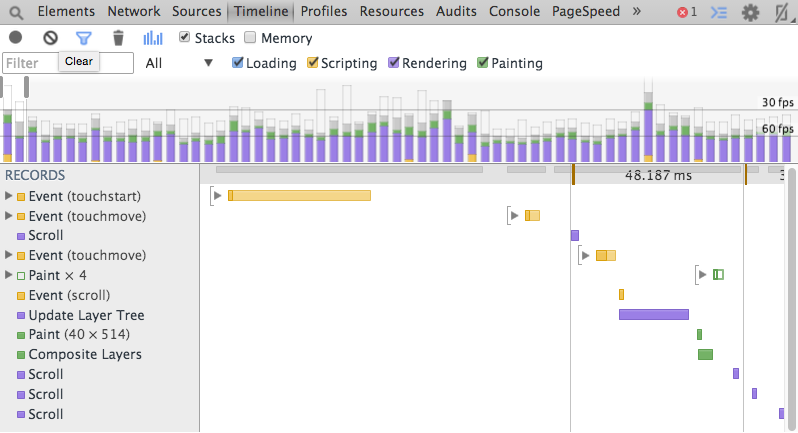
While “performance” can cover a wide array of metrics, we tend to be extremely critical of browser overhead (script execution, rendering layout, and painting). While others have covered optimization of these metrics in great detail, we came across an unlikely jank-vector that we thought was worth mentioning.

When analyzing CSS performance in relation to browser lifecycle, there are a few notorious styles (eg: border-radius, box-shadow, transform, backface-visibility, etc) that tend to slow down frame rate. Some of these are obvious as they dramatically influence the rendering process or add additional calculations for stylistic ooomph. One might be extremely likely to overlook the rather mundane text-transform while focusing on that list, though.

We had several elements each containing a finite number of additional elements that all were performing CSS-dictated uppercasing on their text content. Now, this might not be a significantly intensive operation in itself, but combined with some excessively spastic scrolling, it degraded the user experience somewhat significantly. After we updated the content to be rendered in uppercase without the need for CSS text transformation, the improvement was obvious.

Here’s how things looked on a common mobile platform, prior to the change (FPS is the key metric, with 60FPS as an ideal target):

with CSS text transform

As you can see, we were barely hitting the 30FPS threshold and often even missing that window. Here’s what we observed after we removed the relevant text-transform styles:

no CSS text transform

As you can see, we’re now closer to consistently hitting that golden 60FPS benchmark! Granted, we were probably abusing a CSS style that was intended for narrower application, and the DOM of this particular page meant that there were a lot of them, so your mileage may certainly vary. However, this might help serve others in the war against jank!

How do I read the AngularJS message: [$rootScope:infdig] 10 $digest() iterations reached. Aborting! Watchers fired in the last 5 iterations

I’ve been using Angular every day for over a year, but have always been too intimidated by this error message—and the crazy list of information that comes along with it—to really dig into it and find out how to use it to my advantage.

Building a new product at Pedago, I see this error happen from time to time in production (possibly related to a user using an old browser), but never when developing locally. So I have the error message from our error logs, but I can’t reproduce it or debug it by making changes in the code.

After researching the issue, here’s what I found out on my own.

After the colon there are two brackets. (…’atchers fired in the last 5 iterations: [[{“msg’) The first bracket is the beginning of a json block. Copy from the first bracket to the end of the error and find a way to pretty-print that json. (Use your favorite code editor or an online json formatter.)

Now you have a pretty-printed array with 5 entries in it. Each entry represents an iteration in the digest cycle, i.e. one pass through all of the active watchers in your app, looking for changes. Angular will repeat iterations until it does one in which no watcher has a changed value, or until it hits 10 iterations, at which point it will error. That’s what happened in this case.

There were 10 iterations before the error, and 5 are included in the error message. Presumably that means there are 5 more iterations that happened earlier than what is included in the error message. The first entry in the error message is the 6th iteration, and the last entry in the message is the 10th iteration.

The entry for each iteration is also an array. In this case it is an array of objects, and each object represents a watcher whose value changed during this iteration. Each object will give you the text or the function that defines the watcher, the old value for the watcher before this iteration and the new value after this iteration.

Read it from top to bottom like a story, adding commentary based on what you know about your app. In my case, I was able to see how the changes in each iteration caused new watchers to be created, requiring yet another iteration. “In the 6th iteration, this watcher changed, causing this new stuff to be rendered on the page, creating new watchers which were assigned values in the 7th iteration, and then …” There was no infinite loop or anything. In fact, if Angular had been willing to do just 1 or 2 more iterations, it would have finished.

I hope this is helpful to anyone else experiencing this issue.

Five key principles that make geographically split software teams work

Geographically distributed teams can work. How? In my experience, there are five key principles that make all the difference.

The other day, I realized that I have worked on geographically split software teams for the last decade. I didn’t set out intending to do so. When I got my first job out of college as a software engineer, I thought being in the office was non-negotiable. If you ask company recruiters, most say in no uncertain terms they are not looking for remote employees.

But the reality on the ground is that many software companies end up letting most full-time engineers work flexible hours, from anywhere. Yet few companies acknowledge or advertise this explicitly. You can’t get this opportunity by asking for it in your interview, but after you are in the door, the opportunity arises. There are a few ways this happens.

Software companies with heavy on-call burdens, like Amazon for example, end up with an unspoken but widespread assumption that people can work from anywhere because they are working all the time. Since most engineers are contractually obligated to be on-call, and emergency issues arise at all hours of the day and night, these engineers start working remotely out of necessity. Soon, whole teams realize there is no barrier to working where and when they are most productive. On any given day during my tenure at Amazon, maybe half of my teammates weren’t in the office when I was.

 I’ve worked for several startups with surprisingly similar team environments. At one, people preferred to work at nearby coffeehouses with outdoor porches that made it easier to work while smoking. At another, unreliable wireless bandwidth in the office drove people to work from home out of necessity. At another, almost every person employed there lived in a different time zone, because this startup needed a very specific set of skills that happened to be scarce at the time.

Later I went to work for Rosetta Stone, which had three offices when I started, and grew to six offices when I left . Most of the teams I worked on ended up having people in at least three office locations, and as many time zones. Only one of the four bosses I had during those years worked in the same office as me. Not only were the teams geographically split, but once a team is split across two or more time zones, for all practical purposes, this team is also working flex time hours.

 These teams all worked well together. No matter where and when we worked, everyone still was accountable for meetings and deadlines. I never felt particularly disconnected from my team, and I had rapport with and support from my bosses.

Today I work for Pedago.com, a startup company that is geographically split and has been from the very beginning. It is the most productive team I have ever worked with.

Geographically distributed teams can work. How? In my experience, there are five key principles that make all the difference.

1. Shared chat room where all team communication, questions, updates, and banter happen

I’ve used Skype, IRC, and HipChat for this — there are many viable options. In a geographically split team, showing up to the chat room is the same as showing up to work. Conversely, not showing up to chat is like not showing up to the office, with the same professional and social side effects. Knowing everyone will be in one place means you always know where you can ask questions if you have them. And if you are ever away and need to catch up on team discussion, there’s a nice transcript of all the debates, conversations, and decisions the team made while you were away that you can easily read to catch up.

2. Shared “online” hours

These are the hours everyone is guaranteed to be available in the shared chat room. No matter how scattered the team is, there will always be some set of hours that work for everyone. Everyone is assumed to be available during these hours, and if any person can’t make it or needs to leave to run errands, they are expected to notify everyone.

3. Short daily video check-in meetings

If your team uses Scrum as its project management strategy, these are just your daily standup meetings. It makes a huge difference to see peoples’ faces once a day, if only to remember that they are human beings in addition to being demanding product owners or cantankerous engineers. The visual feedback you get from face to face conversations helps facilitate complex discussions, amplifies positive feedback, and the subconscious pressure to announce a socially acceptable level of progress helps hold everyone accountable.

4. Teammates need to be aggressive about helping and asking for help.

However tempting, no one should ever spin their wheels when stuck. Teams should declare that ad hoc pair programming, calls, and hangouts are a part of their team’s working style, and developers should be aggressive about picking up the phone or screen-sharing whenever they get stuck or need to ask a question.

5. Everyone on the team needs to buy into these rules.

No exceptions. If even one person refuses to get in the shared team chat-room or doesn’t feel like showing up to the video check-in meetings every day, these strategies won’t work for the rest of the team. Everyone on the team has to buy in, and in particular, managers and team leads need to lead by example, being disciplined about leading discussions and disseminating information only in the team’s shared forums.

But how do you know people are working if you can’t see them?

Simple answer. The same way you know they’re working when you can see them: you talk to them about requirements, check in on progress, look at what they deliver. If you are a technical manager, you monitor deployments or skim the latest check-ins. Software management really isn’t very different with distributed versus in-house teams. The secret to success is still the same: clear direction, well-defined, prioritized requirements, and carefully managed execution.