Her research aims to provide a theory-based means for firms to improve customers’ likelihood to provide reviews and elicit reviews that are more accurate accounts of customers’ consumption experience. The research also examined the moderating impact of type of review (whether the reviews are anonymous or identified) on the effect of moral identity on the likelihood to provide reviews and accuracy of the reviews. Two experiment studies were used to collect measurements for variables. Data were analyzed with structural equation models.
The research shows that moral identity positively impacts the likelihood that customers will agree to provide reviews and the accuracy of the reviews. Also, the type of review moderates the effect of moral identity for those whose moral identity was not activated (i.e. uninfluenced). However, the type of review did not moderate the effect of moral identity when participants’ moral identity was activated or primed. Strategies currently used to elicit online reviews yield low conversion rates or elicit reviews that potential customers do not trust. This research provides an empirically tested, theory-driven means for managers of digital platforms to improve customer engagement behaviors such as “liking”, tweeting, sharing and product reviews.
Dr. Nan Zhang is a marketing Subject Matter Expert at Quantic.
Dr. Zhang is a leading marketing Subject Matter Expert at Quantic School of Business and Technology. She has worked in multiple roles as researcher, consultant, and professor. Her research focus is the impact of consumer’s identify on social media communication. She received her PhD in marketing from Southern Illinois University.
Dr. Zhang’s publications can be seen in leading marketing journals such as Journal of Research in Interactive Marketing. She presented as keynote speaker at American Marketing Association and Society of Marketing Advances, and has been working on the editorial board of Journal of Consumer Research. Dr. Zhang has worked extensively with business practitioners and serves as marketing strategic consultant and mentor to help startups and small and medium enterprises.
She is certified in project-based teaching by the Association of College and University Educators. She is also a certified analyst in marketing stack tools such as Google Analytics and Tableu.
Out of work, she is an enthusiastic VR gamer. Her favorite game is Room VR. She also enjoys water sports, especially kayaking and diving.
Hear more about Dr. Zhang’s work and research in her recent Quantic Conversations interview:
Lisa discussed everything from Quantic’s career services resources, common misconceptions about networking, and how to enhance your presence on LinkedIn.
Lisa is a career coach and connector, specializing in helping people discover and realize their potential, regardless of industry, life stage, or background. Before launching career services at Quantic, she worked in admissions and career services at Duke University’s Fuqua School of Business, spending the last 5 years leading career services for the master of management studies and the weekend executive MBA programs. She holds a Doctorate in Education from North Carolina State University and is a Designing Your Life certified coach.
Do you want to learn more about the Quantic student experience? Enjoy our conversation with Quantic Marketing SME, Dr. Nan Zhang!
Dr. Zhang has worked in multiple roles as researcher, consultant, and professor. Her research focus is the impact of consumer’s identity on social media communication. She received her PhD in marketing from Southern Illinois University.
Her publication can be seen in leading marketing journals such as Journal of Research in Interactive Marketing. She presented as keynote speaker at American Marketing Association and Society of Marketing Advances, and has been working on the editorial board of Journal of Consumer Research.
Dr. Zhang has worked extensively with business practitioners and serves as marketing strategic consultant and mentor to help startups and small and medium enterprises.
She is certified in project-based teaching by the Association of College and University Educators. She is also a certified analyst in marketing stack tools such as Google Analytics and Tableau.
Out of work, she is an enthusiastic VR gamer. Her favorite game is Room VR. She also enjoys water sports, especially kayaking and diving.
Chief Academic Officer and Quantic Co-Founder, Alexie Harper, is a trailblazer in the digital education space. Before Quantic, she was previously the director of R&D and a senior researcher at Rosetta Stone. She was also a travel writer and editor for Let’s Go Inc. after earning an M.A. in Irish and Irish-American Studies from NYU and an A.B. in English Literature and Language from Harvard University.
Finding creative solutions to difficult problems has always inspired Alexie to become the industry leader that she is today. “I’ve always enjoyed creating something new,” says Alexie. “From my school days in Odyssey of the Mind, through my time creating educational software at Rosetta Stone, to now, I’m at my happiest when I can tackle a difficult problem by brainstorming creative solutions, and then do the hard work of testing and implementing those solutions. I don’t mind when those experiments don’t work out; I find it invigorating to keep trying to improve whatever it is I’m working on, and there’s ample opportunity to do that!”
Creating solutions to unsolved problems, like making the digital learning experience even better than traditional classroom learning, is at the heart of Quantic’s strategy. “Rather than virtualize the typical classroom experience, I’m more interested in what is required to reinvent the core mechanisms that drive student learning, particularly for the adult student, and to do so in a way that’s more effective and more engaging than what you would encounter in person,” explains Alexie. “I feel like Quantic has made great strides in this arena, and there is so much more that we would like to try to create a flexible learning environment that accommodates learners around the globe.”
But in order to find great solutions and success, one must go through some hiccups and growing pains. Even failure itself is a constant motivation for the Co-Founder. Throughout her career, Alexie realized the power of resilience and courage. “I haven’t always succeeded,” notes Alexie. “Along the way, I’ve had a lot of failures and setbacks, as most entrepreneurs have, and it can be crushing in the moment. I’ve tried to respond with resilience and have refused to give up, and I think that’s why I’m still doing this!”
Courage and resilience are often qualities that are associated with a trailblazer or maverick in an entrepreneurial field. However, a big key to success that Alexie stands by is support. “It’s extremely difficult to succeed without the help and support of others,” says Alexie. “I’m very grateful for the mentors and colleagues of all genders who have provided advice and support throughout my career, particularly when I was first starting out. I believe it’s important to cultivate connections with others, share advice, and support one another in whatever field or endeavor you choose.”
Alexie’s advice for the next generation of trailblazers? Have conviction in your own ideas and don’t be afraid to take a few risks along the way. “Try lots of things and find what you love,” says Alexie. “You’ll always be more motivated to work at something that you find interesting, meaningful, and important. Don’t be overly influenced by career advice that others might give you, as only you can decide what field, industry, or discipline is right for you. And take risks; life is more interesting when you jump in feet first.”
Countless aspiring tech entrepreneurs launch and fail within their first year.
They fail after overlooking one key step they need to take before spending a single dime or contacting a potential investor.
Before starting a tech company, every entrepreneur needs to establish a mission that solves a business problem. Put another way, a “brilliant” technical idea is worthless if potential customers don’t already need it.
We’re about to dive into the basics of how to start a tech company and explain what you need to maximize your potential for success.
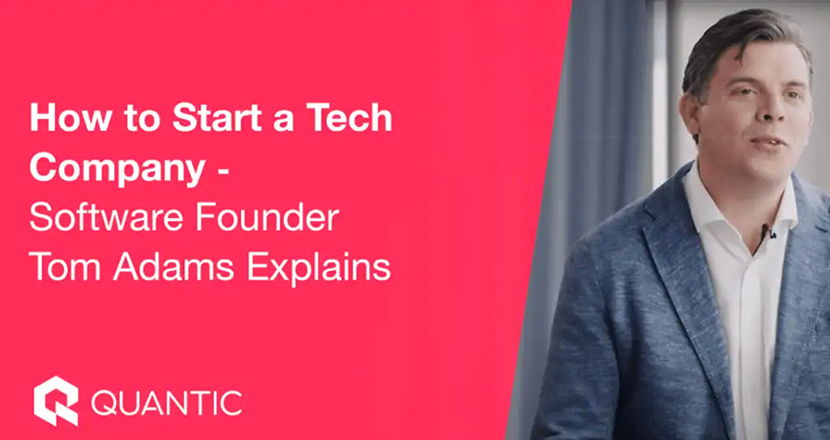
In an exclusive interview with Quantic’s founder, Tom Adams, you’ll learn how Tom built Quantic into a multi-million dollar tech startup. Now, he teaches other tech entrepreneurs to leverage the same recipe for success.
What Is a Tech Startup?
Put simply, a tech startup is a fledgling company that brings technology-based products and services to market.
In the current technology landscape, a tech startup can be launched very quickly — sometimes in just a matter of a few weeks — if the collaborators and resources are in alignment.
With the advent of the cloud and integration companies, it’s more accurate to say that a business is assembled rather than built from scratch. Multiple service providers supply resources, including online computing power, programming teams, project management, and security services.
In the technology industry, an entrepreneur with the right mission and the ability to seek out the right providers can start a business within days — depending on the complexity of the service or product.
Starting a Technology Business
Starting a tech company is no different than starting any other business. Right?
In short, wrong.
There are some major differences between starting a tech business and a traditional brick & mortar business.
The traditional business is dependent on location to function, with factors to consider like:
Local foot traffic or commuter traffic for visibility and access
Office space leasing
Availability of qualified staff within close distance
Storage and warehouse needs
The tech business lives in a virtual landscape. Every member of the team, from the founder and CEO to the administrative assistant, can work remotely from anywhere in the world. The Internet is their office; their laptop is their factory.
Ease of access to your company and your means of production makes the logistics of starting a company very fast. But the virtual business arena comes with its own unique challenges, such as:
Reduction in collaboration if teams aren’t disciplined about staying connected
Constant security obstacles from hackers, spammers, and other online threats
Business shutdowns when service providers (e.g. AWS, PayPal) have an outage
While tech companies and physical businesses have fundamental differences, they will always share the same business principles of success. You can see those principles at work in the most recent list of Bloomberg 2020 billionaires, the types of businesses they run, and the education they pursued to become successful.
For example, former US presidential candidate and founder of Bloomberg LP, Michael Bloomberg, earned his MBA from Harvard Business School. Phil Knight, the co-founder of Nike, earned an MBA from Stanford University. And Lee Kun-Hee, the chairman of the Samsung Group, earned an MBA from George Washington University.
All billionaires. All leaders of very different types of companies, including tech companies. All basing their business success on consistent principles learned through an MBA.
Quantic’s Founder Tom Adams Explains How to Create a Tech Startup
Tom Adams, Chairman/CEO and Co-founder of Quantic, is an E&Y Entrepreneur of the Year National Winner and former Chairman/CEO of Rosetta Stone. Tom holds an MBA from INSEAD, one of the world’s largest graduate business schools, and a B.A. in history from Bristol University.
Tom Adams, Chairman/CEO and Co-founder of Quantic
It’s fair to say that Tom has spent years acquiring the education, experience, and success to build winning businesses. He’s shared his invaluable insight into what it takes to start a winning technology business in the current landscape.
How to Build a Tech Company From the Ground Up
According to Tom Adams, there are three fundamental elements an entrepreneur needs to incorporate into their strategy right from the very start.
Define the mission, and make sure it’s “crystal clear.”
Define the constraints such as “things you will always do” and “things you will never do.”
Iterate quickly to ensure the “design meets reality” and the product is adjusted to fit the customers’ needs.
How to Start a Tech Company Without a Tech Background
Much of what goes into a company’s success is “product/market fit”, which involves matching the product or service to the customers who want to buy it.
Once the mission and constraints are crystallized as the company’s mantra, the goal is to assemble a team with all the collective strengths necessary to execute that mission.
Starting a Software Company With No Programming Experience
But, doesn’t a software company need every member of the team to be fluent in programming languages?
On the contrary!
In other words, an entrepreneur need not be a programming expert to make the world’s greatest technology solution a reality. But, an entrepreneur does need to know how to assemble a team that brings all the ingredients together, including programming, to make the mission possible.
How to Start a Tech Startup With No Money
There are two primary methods for funding your startup without already having the funds or bootstrapping. Both involve seeking funds from investors who believe in you or obtain “working capital” by accepting advance payment on products/services.
First, you can seek investment from individuals or groups, such as angel investors. The key is to “find people who believe in you.”
This is where having a crystal clear mission comes into play. When an entrepreneur has a mission they believe in, investors will believe in the entrepreneur.
Belief begets belief.
The second avenue is obtaining “working capital”:
Early access, early bird pricing, and limited-time benefits are all methods that could be used to entice customers to buy early and help pay for the launch.
How to Find Tech Startup Ideas That are Viable for Growth
Viable growth begins by “mapping out the existing landscape” for the problem your solution is meant to solve.
When you’re developing a solution in a market already filled with competitive solutions, think about; “what are you going to eliminate, and what are you going to create and elevate in terms of features and benefits for the customer.”
If your solution is similar to others on the market, success will depend on developing a cost advantage. Either through streamlining development to make production cheaper than the competition or by selling at reduced margins to capture significant market share.
Small startups begin at a “scale disadvantage.” To compensate, success comes from innovating “new combinations of features” and benefits “that delight” customers enough to outweigh the loss of features customers would normally get from competitors.
Tips on How to Create Technology
Although the crystal clear mission of a startup describes creating a very specific solution to a very specific problem, technology rarely exists in isolation. A connected world means every new solution created must “co-exist with other applications.”
That means a new solution will need to “interoperate” to fit with what people are already doing today.
For example, if you create a new mobile application that helps customers to stay more organized while at work, you’ll need to design the application to work across mobile devices. Also, organization tools will typically need to integrate with calendars, mail applications, or cloud file storage services.
It all has to work together. As a result, thorough and ubiquitous compatibility is crucial.
The Most Important Key to Growing Your Tech Business
Your solution can’t be the very best and most perfect answer to every aspect of the problem your customer faces.
Focus on being the very best in the world at a “few things” to ensure your team remains concentrated on being the market leader where it counts.
Does an MBA Education Benefit Future Tech Startup Founders?
Everyone starts somewhere. The challenges a tech startup faces are unique when compared to traditional brick & mortar businesses, but the fundamentals of business are still the same.
Entrepreneurs learn entrepreneurship by doing. Programmers learn programming by doing. Nearly every member of the team assembled to execute the mission brings the particular strengths they’ve honed through time and experience. All by doing.
An MBA can’t teach those strengths to a well-assembled team, but an MBAcan teach “strategic leadership so they can scale and direct the organization much more effectively.”
An MBA empowers a fledgling CEO to:
Think in “terms of value creation for a long-term strategy.”
“Position competitively in terms of branding or product placement.”
Quantic, Tom Adams’s company, understands the value of an MBA for new CEOs. Quantic’s MBA program teaches the “fundamentals such as accounting or strategy.” And students get to “build out business plans” and develop a “network of peers” to “accelerate their proficiency in the key terms and the key ways of building business success.”
Quantic has demonstrated a track record of success for their students. Not just in providing a world-class MBA program to give CEOs the tools they need, but also in helping students start their own successful businesses.
Read the case study about a Quantic student whose startup connects with their hearing-impaired audience.
Who says statistics isn’t exciting? Through fun scenarios and images, like the above from Quantic’s Advanced Statistics Inference course, Linda Richard is helping to re-brand statistics for thousands of learners! Linda, one of Quantic’s content creators in the field of probability and statistics, has a background in business and education and currently resides in the Netherlands. She believes that statistics is an important subject to understand because it touches so many disciplines including business, medicine, and foreign policy.
In this post, we catch up with Linda to learn what she’s working on and why she decided to join Quantic.
1. What’s your name, and where are you based?
Linda Richard.
Currently I live in the Netherlands due to my husband’s work. Before that, I lived in Seattle, and before that, New York, North Carolina, and Minnesota!
2. How long have you been writing for Quantic?
About 2 years.
3. What’s your professional and educational background?
I have a Bachelor’s in Math, a Master’s in Operations Research (a field of applied math), and a Master’s in Teaching. I worked in business for almost 10 years before changing careers to teaching. Then I taught high school math in Seattle for 6 years before moving abroad. I keep my fingers in the public education sphere through projects with Washington State and other high school curriculum organizations.
4. How and why did you start writing for Quantic?
When we moved to Europe, I wanted to find work that would allow flexible hours for traveling and other fun living-abroad-activities, but still be part of the education world. Pedago was looking for math content developers, which was right in my wheelhouse.
5. What are some of the courses and subjects that you’ve written about in Quantic?
I’ve written lots of statistics and probability lessons, as well as Excel lessons. Recently I’ve started writing lessons on coding with Python, which is a whole ‘nother challenge!
6. Why do you think it’s important for students to understand statistics?
Statistics is probably the most important field of math that most people will interact with after they finish their schooling. Statistics are used to make decisions on health, education, foreign policy, and of course in business. Stats can so easily be mis-used, intentionally or not, so having a solid knowledge base to question and understand this topic is really critical for workers and citizens.
7. What’s the hardest concept you’ve had to communicate (so far), and what was it like to try and distill it for the Quantic platform?
The probability concepts of Bayes’ Rule and the Law of Total Probability were challenging to communicate. Visual illustrations, concrete real-world examples, and spending prep time building up learners’ intuition on these concepts were the strategies. We focused on conceptual understanding rather than on formula memorization – a formula can always be looked up, but if the foundational understanding isn’t there, no formula can help you! The Law of Total Probability, for example, looks like a fairly incomprehensible, complicated formula at first glance, but it’s really just a weighted average.
8. What do you admire about Quantic learners?
With people’s busy lives, it can be hard to find the motivation and the time to take on education projects. People taking Quantic classes are doing so on their own initiative, to advance their learning and their careers.
9. What do you do to keep your learners in mind?
With my background in teaching, I’ve learned how to monitor my own thinking. When you’re teaching content that you know well, you have to be alert for concepts that seem “obvious,” but only feel that way because you’ve been working with them for a long time. Especially in math–there are a lot of embedded concepts that need to be carefully unpacked for people unfamiliar with the topics.
I also try to incorporate visuals and concrete examples wherever possible, knowing that people have different learning styles. The interactive nature of the Quantic platform of course helps with this too!
10. What’s one of your favorite storylines (or characters) used in one of your courses in Quantic?
For the Advanced Statistical Inference courses, we created a fictional winter sports equipment company. It allowed a lot of room for examples with testing equipment, sampling customer preferences, and analyzing market schemes. Plus, my editor, Ellie, found great images with gorgeous snow-covered mountains, and we were able to have some fun putting our characters in situations involving competitive snowball tournaments!
11. What’s your favorite whimsical or snarky answer message you’ve written in Quantic?
Definitely it’s the Monty Python references in the Python lessons. Some are obvious but some are hidden a bit more deeply! Spam and eggs; hovercrafts full of eels; dead parrots; the possibilities are endless.
12. What’s one of your favorite images used in one of your courses in Quantic?
Two come to mind from the Advanced Statistical Inference course. In this capstone lesson, the scenario is that all the experts on statistics at a company, except for the learner, are out of the office with the flu. All the junior analysts are panicked and looking for help. My editor, Ellie, found/created images which put a smile on my face and hopefully the learner’s too!