10 Software Engineering Skills Needed to Lead in the AI Economy

It has been predicted that AI will contribute $19.9 trillion to the global economy through 2030. However, if this potential is to be realized, there will be an acute need for technically skilled leaders and software engineering professionals able to bridge the gap between the remarkable emerging capabilities of foundation AI models such as ChatGPT, Claude, and Gemini, and the specific needs of individual companies, industries, and individuals. Currently, there is an acute shortage of professionals and leaders with the necessary skills for this work, which will be required in every business, large and small.

While many powerful foundation models have already become available, the wave of AI adoption that will occur within all businesses throughout the economy over the coming few years to a decade is still in its infancy. Those with the key skills to enable this rollout at this time stand to ride an incredible wave of opportunity and innovation.

Located squarely in the center of this space is Quantic’s MS Software Engineering program, which is uniquely well-placed to provide the Masters-level training needed to prepare candidates, within the timeframe of one year, with the skills needed to help lead in and contribute to this economic revolution.

What Software Engineering Professionals Will Play a Key Role in Realizing the AI Economy?

The Growing Demand for Skilled Software Engineers in the AI Economy

While foundation models have incredible and rapidly increasing capabilities, they do not provide fully customized and reliable solutions for each business use case throughout the economy. This can be because the foundation models do not (and cannot) have access to the businesses’ internal proprietary data resources, do not understand the subtleties or the norms of the interactions required in the given organization or industry or cannot reliably carry out extended activities involved in typical workflows in the organization, amongst a range of other subtle and complex real-world challenges.

Here it becomes essential that skilled software engineering professionals are available who are able to lead the development of initiatives and the building of software systems that harness these powerful large language models (LLMs) to reliably implement the specific needs of individual businesses and industries. What is needed is a sophisticated range of skills from AI strategy, aspects of full-stack engineering, LLM calling, prompt engineering, orchestration and fine-tuning, the use of cloud services, cloud hosting for model inference, and a strong knowledge of modern software architectures and containerization. These are many of the key skills required for an AI Engineering role, all of which are covered in Quantic’s MS Software Engineering degree.

Entrepreneurial Opportunities for Software Engineers in AI

While foundation models have incredible and rapidly increasing capabilities, they do not provide fully customized and reliable solutions for each business use case throughout the economy. This can be because the foundation models do not (and cannot) have access to the businesses’ internal proprietary data resources, do not understand the subtleties or the norms of the interactions required in the given organization or industry, or cannot reliably carry out extended activities involved in typical workflows in the organization, amongst a range of other subtle and complex real-world challenges.

Here, it becomes essential that skilled software engineering professionals are available to lead the development of initiatives and the building of software systems that harness these powerful large language models (LLMs) to reliably implement the specific needs of individual businesses and industries. What is needed is a sophisticated range of skills from AI strategy, aspects of full-stack engineering, LLM calling, prompt engineering, orchestration and fine-tuning, the use of cloud services, cloud hosting for model inference, and a strong knowledge of modern software architectures and containerization. These are many of the key skills required for an AI Engineering role, all of which are covered in Quantic’s MS Software Engineering degree.

10 Must-Have Software Engineering Skills to Lead in the AI Economy

10 Must-Have Software Engineering Skills to Lead in the AI Economy | The Quantic Blog

A Deep Understanding of Current AI Capabilities

Understanding what can and cannot be implemented with current AI model capabilities, as well as how feasible or alternatively hard a given use case is to implement, depends on a deep understanding of current AI capabilities. For example, recent developments in voice-based AI model application programming interfaces (APIs) make a whole range of innovative voice-based AI applications now possible that, just a few months ago, were not possible.

AI Strategy and Project Management

Being able to plan and architect the approach needed to manage the implementation of a given AI initiative will be key. This will include an understanding of what technologies to utilize, how to do this cost-effectively, and how to manage the project work in an agile manner. For example, some AI initiatives can be achieved through prompt engineering alone, while others may require complex application development.

AI-Driven Software Engineering Skills

Current developments in AI-based code generation enable the individual software engineer to be increasingly productive. Being an AI-first developer who utilizes these tools to dramatically increase productivity in many aspects of system development will be key to being maximally effective and productive going forward. For example, the use of AI-powered integrated development environments (IDEs) such as Cursor, Windsurf, Replit or various VSCode extensions are rapidly becoming the norm in software development.

Leadership and Organizational Strategy for AI Projects

In leading software engineering and AI initiatives, expertise in leadership and organizational strategy is required. This involves understanding the fundamentals of management, how to manage talent, how to work in teams and groups, and how to provide positive leadership. This is also combined with agile project management practices. For example, to build, maintain, and motivate a high-functioning team, all of these skills are needed.

Mastery of Cloud-Native Applications and Architectures

Modern software architectures rely heavily on cloud services, so a deep understanding of cloud architectures is central to modern software engineering. Additionally, access to cloud-based GPU hardware offers tremendous advantages for the deployment of AI models in terms of capital expenditure savings and also elastic scalability based on need or load.

AI Engineering Skills for Real-World Applications

A range of novel skills and technologies are required for AI Engineering. These relate to topics such as the use and integration of vector stores, retrieval augmented generation, the management of model context, the use of AI orchestration frameworks, and prompt engineering. An understanding of these, combined with a knowledge of the rapid evolution of vendor offerings related to these capabilities, is essential in the field. For example, if your organization has internal proprietary data, skills in these areas will support the integration of these resources with the intelligence provided by AI models. 

Machine Learning Skills

Historically, machine learning skills are needed for the training and development of custom predictive models. Modern AI models can significantly decrease the need for the training of custom models. However, these skills continue to have an important role in models optimized for structured data. Additionally, machine learning skills are needed to fine-tune modern AI models. For example, a foundation model may not respond according to the particular style and parlance of your business use case – in such cases, fine-tuning an AI model can provide an appropriate solution, and fine-tuning borrows many concepts from traditional machine learning.

Continuous Integration, Testing, and Deployment for AI Systems

Continuous integration/continuous deployment, or CI/CD as it is commonly referred to, is an approach that provides the ability to rapidly and iteratively deploy incrementally improving software systems. These techniques are also key to the deployment of modern LLM-based systems. For example, these techniques allow end-user feedback to be received and addressed, and an updated application addressing critical feedback, where received, can be redeployed within the day.

Understanding of Modern Software Architectures

For enterprise-scale AI applications, understanding the application of various modern software architectures is important. Skills needed in this area include domain-driven design, microservice architectures, and event-driven architectures, amongst numerous other patterns. By utilizing the correct architecture for the given problem, scalability, cost, and reliability can all be improved. 

Communication Skills

Being able to bridge the technical and business terminology gap is key to working and communicating in this field. This involves understanding the business domain and business terminology, in addition to having comprehensive knowledge of AI and software concepts and terminology.

All of these skills, and others, are covered and developed within Quantic’s MS Software Engineering program.

Top Career Opportunities in Software Engineering for the AI Economy

AI Engineer

AI Engineers design, develop, and deploy AI-powered systems using large language models, machine learning, and advanced algorithms. They play a critical role in creating scalable solutions tailored to business-specific needs in the AI economy.

Director of AI

Directors of AI lead strategic AI initiatives, overseeing the integration of machine learning models and AI tools to meet organizational goals. They manage teams and ensure AI technologies drive innovation and business growth across industries.

Vice President of AI

The Vice President of AI shapes company-wide AI strategies, aligning AI innovations with long-term business visions. They lead cross-functional teams, manage budgets, and ensure cutting-edge AI solutions deliver measurable economic and operational value.

AI-enabled Software Engineer

AI-enabled software engineers combine traditional coding with AI technologies to create intelligent applications. They utilize tools like AI-driven IDEs and prompt engineering to build smarter, more efficient software systems for modern organizations.

DevOps Engineer with an AI Focus

DevOps Engineers with an AI focus streamline AI model deployment through CI/CD pipelines, cloud-native architectures, and containerization. They ensure seamless integration of AI systems into production environments while maintaining scalability and performance.

Quantic’s MSSE program offers career support, networking opportunities, and an alumni network to help graduates secure these roles.

Why Choose Quantic’s MSSE for Aspiring AI Leaders

Flexible, Mobile-First Learning: Quantic’s award-winning, interactive platform allows students to learn anytime, anywhere, with the flexibility to balance their studies alongside professional and personal commitments. Integrated Curriculum

AI-Integrated Curriculum: Gain cutting-edge knowledge in AI-augmented software engineering, the engineering of AI systems, and AI strategy and project leadership.

Career-Boosting Connections: Students connect and collaborate with a global cohort of peers, industry mentors, and faculty. The program includes virtual academic events, optional in-person meetups in cities around the world, and access to student-led organizations, providing unparalleled opportunities for professional growth and networking.

Affordable and Accessible Education: At $21,450 for the 13-month program, Quantic’s MSSE offers exceptional value. Students often take advantage of employer reimbursements, tuition benefits, and scholarships to reduce costs further, making the program accessible to a wide range of professionals.

Embrace the Opportunities of the Emerging AI Economy

While AI promises to transform the global economy, the rollout of AI into each existing business is still in its infancy, as is the formation of the numerous new AI-first businesses that will emerge. Having advanced AI technical skills is essential for contributing to realizing economic growth nationally, but it also provides great career opportunities for each graduate individually to participate in and help lead in this AI revolution.

Ready to take the next step? Explore Quantic’s MSSE program to gain the skills and knowledge required to lead in the AI Economy. You are encouraged to reach out to Quantic with any questions you may have.

Discover why our students love us and why we’re trusted by top employers around the world by reading Quantic reviews here.

Related articles:

Mentorship and Coaching for Working Professionals in Online MBA Programs

MBA students are required to have at least two years of business experience, making it common for program applicants to be working professionals. Working while completing a degree requires a flexible academic program and a support system of mentors and coaches. Quantic offers one of the best accredited online MBA programs that allows students to study with and learn from other professionals with similar career goals and achievements. Here are some of the coaching and mentoring opportunities available to online graduate students:

Mentorship

Quantic’s faculty share their experiences and knowledge to help students understand complex topics and apply what they’ve learned to real-world scenarios. Research advisors provide MBA students with support and encouragement throughout their capstone projects and individual research. This can help students complete successful projects and evaluate the effectiveness of their research and planning methods. Instructors, administrators, and other institution staff have experience in various business fields and specializations. This makes them valuable resources for students looking for advice about their studies and future career paths.

Coaching

Coaches like enrollment advisors help students select the correct courses and plan for their future academics according to their career goals and interests. Financial advisors connect students to financial aid opportunities like scholarships and employer funding. Our network of employer partners provides partial or full tuition assistance to students who currently work within their organizations. At Quantic, we offer impact scholarships to students who show global leadership potential. We also focus on providing funding opportunities for students of diverse backgrounds and experience types. This helps create a dynamic peer group for students to collaborate with and learn from during their time in the program.

Our library services include coaching sessions for resume and cover letter reviews. These one-on-one sessions are 30 minutes long and allow students to meet with a Quantic professional who offers feedback to help resumes and cover letters stand out. Library staff is also available to provide guidance on individual research and how to get the most out of Quantic’s research database. Our professional librarians will give students an overview of how to use the database and how to approach their research to find the most helpful information that supports their project. Research guidance sessions give students an outline of what their searches and sources should include for an effective project outcome. These appointments are 15 minutes in length and can be scheduled online at a time that works best with each individual’s schedule.

Classmate Collaboration

Students who are working professionals can learn from each other and identify how they’re applying their knowledge to their current roles. Group projects, case studies, and discussions allow students to share insights and broaden their perspectives on business issues. The peer groups in each course range from recent graduates to mid-career adults with extensive industry experience. This gives students an opportunity to learn leadership skills and adapt to modern business practices they may not have been exposed to in their current role. At Quantic, our social learning platform is designed to help students learn from each other and build lasting personal and professional connections.

Networking Opportunities

Quantic holds in-person and online networking events for students around the globe. Some of our most recent in-person events were held in cities like Washington D.C., Dublin, Bangkok, New York City, and Singapore. Conferences and immersion weekends are optional, but students who attend get to hear from business leaders from various industries. These professionals share their specialized knowledge and business experiences to inform and inspire students. 

MBA students are automatically connected to Quantic’s extensive alumni network of over 15,000 exceptional working professionals in various business industries around the world. The Quantic app has a networking feature that allows students to search for and connect with current students and alumni. This feature allows students to filter their network search results based on industry, location, and interests. This helps students find individuals with similar career goals, fostering professional relationship development and potential collaboration opportunities.

Online Resources

Quantic students have access to various online resources to further propel their academic and professional goals. These resources support self-directed learning and can be used in conjunction with mentorship to enhance students’ understanding of complex business concepts. They include an online library with peer-reviewed research databases and other reputable sources. This allows students to view market and consumer data, industry reports, and competitor analyses that are relevant to their research and personal interests. Students are also given access to course materials within their specific program for life, after they’ve graduated. This allows them to return to complex topics and learn more as they advance in their careers. Access to this content keeps them up-to-date on topics and strategies that could help their organizations.

Enroll in One of the Best Accredited Online MBA Programs

Quantic’s online MBA and Executive MBA programs offer working professionals a flexible, affordable avenue to advance their knowledge and skills. Our high-quality programs are accredited by the Distance Education Accrediting Commission (DEAC). Completing an accredited MBA program can make business professionals more valuable in the workplace and more competitive in the job market. Explore our courses or reach out to an admissions advisor today to learn more about our program requirements.

Benefits of Getting an MBA Online

Applying for online MBA programs is the first step to earning your degree. This program particularly impacts working professionals who go to work and school simultaneously. At Quantic, we offer both an MBA and an Executive MBA program delivered entirely online for such individuals. Here are a few benefits that online MBA programs provide: 

Marketability

The 2022 Corporate Recruiters Survey issued by the Graduate Management Admission Council reports that 92% of companies hoped to fill their open positions that year with MBAs. Having the right credentials and being available to start working can improve a candidate’s marketability. The quicker you adapt to a job, the more attractive you may be to prospective employers. 

Earning your MBA online while also working helps you avoid gaps in your resume. You bring both an extensive work history and the requisite educational skills to the table. This appeals to companies searching for job candidates with MBAs prepared to adjust to the rigors of daily professional work. Employers want employees who will be proactive in learning and thriving in their respective positions. Continuously looking to build up your skill set shows this level of determination. 

Adaptability

2023 Pew Research Center data shows that 35% of workers who can work remotely do so. An additional 41% of employees work hybrid schedules (some days at home, some in the office). Those accustomed to working remotely are better prepared to fill these roles. 

Most online courses may consist of both on-demand content and lectures streamed live. Students might also have to collaborate with others virtually when completing class projects. This learning environment simulates many of the components of online work, better preparing students to function successfully in that setting. 

Completing your MBA online also familiarizes you with the technological tools facilitating remote work. Attending meetings and giving presentations via online platforms like Zoom, Microsoft Teams, or Google Meet requires knowing how to operate those programs. You can prepare for professional communication with online messaging tools like email or direct messages.

Networking

An online MBA degree at Quantic gives you the chance to network with other businessmen and potential companies who want to hire employees from this program. You will work with your fellow classmates on assignments and hear their insights, which can help you grow in your profession. There are also options for MBA workshops in several different cities where you’re able to network with other people. 

Flexibility

Online curriculum is often offered at more flexible hours for working professionals. This allows you sufficient time to work and study. Depending on the course, you may participate in lectures and study groups in the evening and complete assignments on weekends. 

Many online MBA programs are designed to streamline your studies. The online course’s continuous access to content allows virtual courses to set different term schedules than in-person classes. This may allow you to complete your MBA program faster. 

Online programs can be specifically designed for working professionals, focusing on maintaining a good work-life balance. The added flexibility of an online program typically provides enough time to complete school assignments, fulfill job responsibilities, and still enjoy some personal time. This may make it less likely for online MBA students to experience burnout.

Cost

Organizations that offer online MBA programs don’t have to meet the operating costs of maintaining physical offices or classrooms. They may also present the curriculum through web links or PDFs rather than textbooks. These cost savings can be passed on to students through reduced tuition. 

The accelerated nature of many online courses also allows those offering them to focus on core fundamentals, eliminating potentially redundant or extraneous coursework. This means you’re in school for less time. Even in cases where online tuition is comparable to the per-semester cost of in-person classes, the program’s overall cost is less. 

Online courses are attractive to companies looking to bolster their staff’s skills. These businesses may partner with such programs and offer employee tuition assistance. Other organizations may offer to cover the cost of a current employee’s online MBA tuition as part of a management training program. 

Outreach

Online campuses allow access to students from all over the globe, enabling you to work with people from diverse backgrounds with differing perspectives. This form of cultural education may be another benefit of getting your MBA online. Working with people from various regions also allows you to develop networking connections. A student or instructor in an online course might serve as a bridge to a job with a new organization in a different area. You also have the opportunity to identify talent that you could recruit for your company. 

The broad reach of online programs results in an extensive range of alumni. You connect with alumni from different years through shared experiences, leading to future networking opportunities.

Advance Your Career Through Online MBA Programs

Online MBA programs offer you the chance to further your career pursuits while working in your current job. The skills you gain through earning your MBA can complement your work experience, putting you in a potentially advantageous position over job candidates with educational credentials alone. At Quantic, we have created MBA programs to encourage professionals to take the next step in their careers. To get started working towards your MBA, take a moment to complete our online assessment.

What Specializations Are Available in an Online MBA Program?

Quantic offers online MBA programs that allow students to earn an MBA on their own schedules while using their mobile devices. Our curriculum was designed to help individuals develop core business skills, enabling them to achieve their career ambitions. Quantic’s MBA and Executive MBA programs offer multiple specializations, so students can customize their MBA to fit their needs.

MBA Program Specializations

Our MBA program is a 15-month program of study designed for early-career professionals. The curriculum includes eight required concentrations, one specialization, and one capstone project. The specialization options for the MBA program include:

Advanced Corporate-level Strategy

We designed our advanced corporate-level strategy specialization for professionals aiming for executive-level roles. It includes five courses: Vertical Integration, Diversification, Mergers and Acquisitions 1 and 2, and Cooperative Strategy and Strategic Alliances. These courses help students learn how to create value, adapt to changing market conditions, and sustain competitive advantages. The teachings help make it easier to anticipate industry trends and identify growth opportunities, which are valuable corporate skills.

Entrepreneurship

Quantic offers an entrepreneurship specialization for professionals interested in starting their own businesses. This specialization includes courses like the Practice of Entrepreneurship, Recognizing a Business Opportunity, Design Thinking, and Entrepreneurial Experimentation. The courses focus on learning the qualities, mindsets, and habits needed to be a successful entrepreneur. They also instruct students on how to test and refine their ideas through experimentation so they know whether their idea has the potential to be successful.

Executive MBA Specializations

The Executive MBA curriculum consists of the same eight required concentrations as the MBA and one capstone requirement, but it requires three specializations instead of one. There are also ten additional specialization options to choose from. Some of these options include:

Advanced Finance

The core curriculum for the MBA and Executive MBA program includes seven courses on finance. An advanced finance specialization expounds on many of the concepts introduced in these courses, providing students with a deeper understanding of finance in a business environment. This specialization includes two Valuation courses, as well as the courses Modern Portfolio Theory, International Finance, and Derivatives.

Blockchain

A blockchain specialization helps students understand the technical side of blockchain, equipping them to identify industry-specific applications and opportunities. This specialization teaches the basics in an Introduction to Blockchain course. Students expound on this information in courses like Decentralized Applications, Blockchains in Practice, and Decentralized Finance.

Business Communications

The business communications specialization aims to develop each student’s verbal, written, and interpersonal communication skills. The courses in this specialization include Effective Business Writing, Business Storytelling, the Art of Negotiation, the Art of Presentation, and Developing a Business Plan. Each course was designed to prepare students for the demands of the corporate world.

Managing Software Development

Specializing in software development can qualify students to manage software projects in a variety of industries. It can also be a good specialization for individuals working in a technology company. The required courses to earn this specialization include Managing Application Development, Web Application Foundations, and Cloud Foundations. These courses teach students how to compare process models, explore components of web-based applications, and determine the best system architecture and hosting to support different applications.

Strategic Leadership

The courses within this specialization focus on honing different types of leadership and include Strategic Leadership, Positive Leadership, and Change Leadership. Other courses include Power and Influence and Balanced Scorecard. Balanced Scorecard teaches students how to use the balanced scorecard method to create and implement a successful business strategy. These courses aim to develop leadership skills such as communications, change management, and decision-making. These competencies can help students become better leaders so they can inspire their teams and achieve successful business outcomes.

US Business Law

The US business law specialization focuses on common business laws that executives encounter in their careers. Each course focuses on one or more relevant laws. The specialization currently includes the courses US Business Formation Law, US Employment Law, and US Intellectual Property Law. This specialization is helpful for entrepreneurs with limited legal knowledge. Learning the fundamentals of these laws can help students choose the type of business they want to start and educate them on the legal challenges they may face.

Explore Quantic’s Online MBA Programs

An MBA specialization allows individuals to customize their MBA. Students can use specializations to prepare for a specific career, set themselves apart from other candidates, or explore an interest. At Quantic, our online MBA programs offer multiple specializations so students can choose the one that works best for them and their goals. Whether an individual wants to start their own business or advance in a particular industry, an MBA or Executive MBA from Quantic can help. Our programs use a ground-breaking instructional method to teach business concepts, and our online case studies and in-person meet-ups provide valuable networking opportunities. Explore our MBA programs to learn more, or apply to an MBA program today.

66 Business Analyst Interview Questions and Answers for 2024

As a business analyst (BA) prospect, you will face stiff competition from others who have all the same skills and qualifications. The only difference will be your ability to convince Human Resource (HR) managers why you are better.

On the opposite end of the interview desk, HR managers face their own struggles. They need to align potential employees with organizational goals and overall vision. Human capital holds the potential to make or break any business so making the right decision is crucial. 

The decision to move an interviewee along the line depends on your ability to judge their skills based on a few minutes of conversation.

We have just the solution for both interviewees and interviewers. Take a look at our comprehensive list of business analyst interview questions and answers.

Understanding Business Analysis

In simple terms it’s a way of saying that someone is looking at how a company is doing and figuring out how to make it better. Business analysts do this by taking a close look at everything – from the products and services a company offers to their customers and even their competitors. They use special techniques like gap analysis and benchmarking to find ways to improve efficiency and help the company reach its goals. Here are some ways they do that…

Analyzing data

Analyzing data is crucial in making informed decisions, and strong analytical skills are essential for business analysts. They must be able to gather relevant information from various sources, process it into meaningful insights, and validate their ideas with additional research. Strong quantitative skills to interpret complex data accurately are a must.

Problem-solving

Problem solving requires customised solutions that go beyond the conventional, and business analysts must think strategically while considering short and long-term implications. Communication is vital when working as a business analyst. They need excellent written and verbal communication skills to present their ideas and recommendations effectively, understand different perspectives, and collaborate with colleagues from various departments.

Project management

Project management is crucial to ensure projects stay on track and progress efficiently towards completion. Skilled professionals must understand how to prioritise and delegate tasks among team members, and anticipate potential issues using risk assessment methods and strategies.

Business Analyst Interview Preparation

Before even setting foot in the interview room, you will need to make the cut with an exemplary BA CV. Analysts have very specific job descriptions and these need to be reflected.

You could spend hours sending out your CV, and never receive any response. What is the solution? Joining a career network is probably your best option. This will give you the opportunity to apply to exclusive positions.

Combined with professional qualifications, you can propel your career to the next level. This will save you precious time and give you access to the ideal employer.

For HR managers, sourcing these CVs is the 1st step in finding qualified candidates. The best, (and easiest) place is through an outstanding Talent Acquisition Network.

Talent acquisition has a more strategic approach compared to recruitment. So where do you find such talent, and how do you ensure they are of the caliber you require?

An interview does not begin when you walk through the door. Rather, you need to be as prepared as you would be for a test.

Here are a few tips to become adept at passing any interview:

Do your research:

Before walking into an interview, you must know who is interviewing you. You need to know the company you are looking to work for. This will let you tailor your answers to their specific requirements.

Know your future job:

Thorough knowledge of your future job is an easy way to highlight your specific capabilities in line with the job requirements.

Re-learn your skills:

Invest some time in refreshing your memory on the key skills involved in a BA position. Make sure you can do what you say in your CV.

Study interview questions:

A job interview is similar to a test in which you do not know the questions. Lucky for you, you have the chance to study as many interview questions as possible.

Prepare your own questions:

Interviewers usually ask you if you have any questions of your own at the end of the interview. Ask a few questions regarding the opening, the job duties, and what is expected of you. Ask questions about the future plans of the company and their vision for BAs in the organization. The aim is to leave a lasting impression before you leave the room.

Junior vs. Senior Level Business Analyst Interview Questions

As a BA, your level of education, as well as experience, determines how far up the ladder you can go. Most analysts require a basic business or tech educational background. Success in an interview will then depend on additional skills.

A great way to accelerate your career is to complete an MBA or EMBA degree and give yourself an extra leg up.

Junior analysts generally have less experience and may have recently graduated. One option to accelerate your career as a junior analyst is an MBA program. The traditional MBA program usually requires 2 years of full-time study. It equips you with the business skills to grow in your career.

But how about an MBA that takes only 10 months? You may think this would be a sub-standard program and you would be wrong. The Quantic MBA is a fast-paced, personalized program, taught online, giving you the advantage of earning while you work. With an MBA in your pocket, you will be better prepared to answer these junior analyst interview questions.

Junior Level Analyst Interview Questions

1. How do you propose to compensate for your lack of experience?

This question is key for junior analysts as it is an opportunity to show that you can use your education as a basis to learn new tasks. Explain what experience you do have. The point is to show that you are capable of assimilating new information.

2. How do you think you would fit this position as a junior analyst?

Your research into the company will come in handy when answering this question. Look at the company philosophy and working methods. Be ready to explain how you would adapt to perform in the new role.

3. How do you deal with giving difficult feedback, especially in a junior role?

This is a test of your communication skills. Show that you can be tactful and thoughtful when giving negative feedback. It shows you are capable of working in a team, or in a future managerial position.

4. Can you name two diagrams used by a business analyst?

You will need to remember what you have learned when answering these types of questions. Be sure to mention and elaborate on:

  • Case diagrams
  • Collaboration diagrams

5. What steps are required before converting an idea into a product?

Explain the different types such as SWOT, gap, market, and competitor analyses.

6. Can you name the initial steps in project development?

This is another question that will test your theoretical capabilities. If possible, give examples of these steps in action.

Initial steps include:

  • Market analysis
  • SWOT analysis
  • Personas
  • Competitor analysis
  • Identifying the strategic vision

7. What are the key phases of business development?

There are four key phases, namely: forming, storming, norming, and performing.

8. What are the exceptions?

These are unexpected errors that occur when you run an application.

9. Can you give an example of a time when you had to make a tough decision?

This question tests your decision-making skills and ability to think critically under pressure. Provide an example of a difficult decision you had to make and how you arrived at your final decision.

10. What data analysis tools are you familiar with?

As a junior analyst, you should be familiar with basic data analysis tools such as Excel, SQL, and Tableau. Be sure to discuss your experience with each tool and any specific projects you worked on using them.

11. How do you prioritize tasks when working on a project?

Time management is critical for junior analysts. Discuss your process for prioritizing tasks, such as using project management tools or creating a prioritization matrix based on impact and effort.

12. What are some current industry trends in data analysis?

Research current trends in the data analysis industry, such as artificial intelligence, machine learning, and big data. Be prepared to discuss how these trends may impact the company you are interviewing with.

Senior Level Analyst Interview Questions

Senior analysts generally have more experience and a higher level of education. If you are looking to move up from junior to senior analyst, an EMBA may be the best move for your career.

You probably have an impressive resume with relevant experience. Adding an EMBA allows you to move into a more senior role.

Here are some questions to expect during your interview:

13. Can you explain the key roles and responsibilities of a business analyst?

You may not be able to list all the ‘textbook’ capabilities, so tailor these to your experience. Some may include:

  • Creating detailed analyses
  • Defining business requirements
  • Communicating with stakeholders
  • Planning and monitoring projects
  • Managing teams

14. What is a flow chart and how do you use it?

A flowchart shows the flow of systems using diagrams and signs. Mention how you have used one to make systems understandable for stakeholders.

15. What tools do you typically use as a business analyst?

Refer to common tools such as Rational tools, Microsoft Office, and ERP systems. Demonstrate working knowledge of how you have used them in the past.

16. What is project management in BA and how have you used it in your experience?

Define project management as the process used to attain desired goals as a BA. Explain how you have used it to identify glitches and the goals you have achieved. These could be solutions such as better functionality, lower costs, etc.

17. Tell me about a suggestion you have made that has benefited an organization you’ve worked for?

Take this as an opportunity to show what you are capable of. Prepare an example that was accepted and had a positive impact. Try to relate it to the position you are applying for.

18. What measures do you take to increase your team’s productivity?

As a senior analyst, you will be expected to be a proficient leader. This question gives you the chance to show that you are able to motivate a team. Answer with a ‘team-mindset’ in mind. Explain how you would use managerial skills to help team members achieve organizational goals. Include practical examples such as mentoring or having an ‘open-door’ policy.

19. How do you ensure that your team is meeting project deadlines and delivering high-quality work?

As a senior analyst, you will be responsible for managing a team and ensuring that project deadlines are met while maintaining high-quality work. Describe your approach to managing teams, including how you motivate team members, monitor progress, and provide feedback to improve performance.

20. Can you provide an example of a difficult project you have worked on, and how you overcame any challenges?

Senior analysts often work on complex projects that require creative problem-solving and critical thinking skills. Share an example of a challenging project you have worked on, including the obstacles you faced and how you overcame them.

“Tell Me About Yourself” Business Analyst Questions

These are usually open-ended questions that give you the opportunity to explain yourself and your passion for the job. Some of the personal questions include:

21. Why do you want to work as a business analyst?

You can explain the story of how you started your journey into business analytics. Give details as to why you are interested in pursuing a career in the field. Tell the interviewer what inspires you to do your day-to-day job.

22. What do you hope to achieve as an analyst?

Employers will ask this to determine if the job fits into your career aspirations. Explain your future goals in line with the position you are applying for. You can touch on ambitions such as attaining a leadership position.

23. What would you say are your strengths as a BA?

Personalize your answer to this question. Be sure to show you understand the skills necessary to succeed in the job role. Discuss both soft and hard skills. Prepare three strengths using the below formula:

  • Awards: Name prizes you have won.
  • Accolades: Mention special honors you have achieved due to your strengths.
  • Anecdotes: Tell a story that demonstrates how you used your strengths.
  • Acknowledgments: Name special recognitions you have received.

24. What would you say are your weaknesses as an analyst?

Do not try to downplay this question. Answering honestly and taking responsibility shows you are aware of the areas you should work on.

Technical Business Analyst Interview Questions

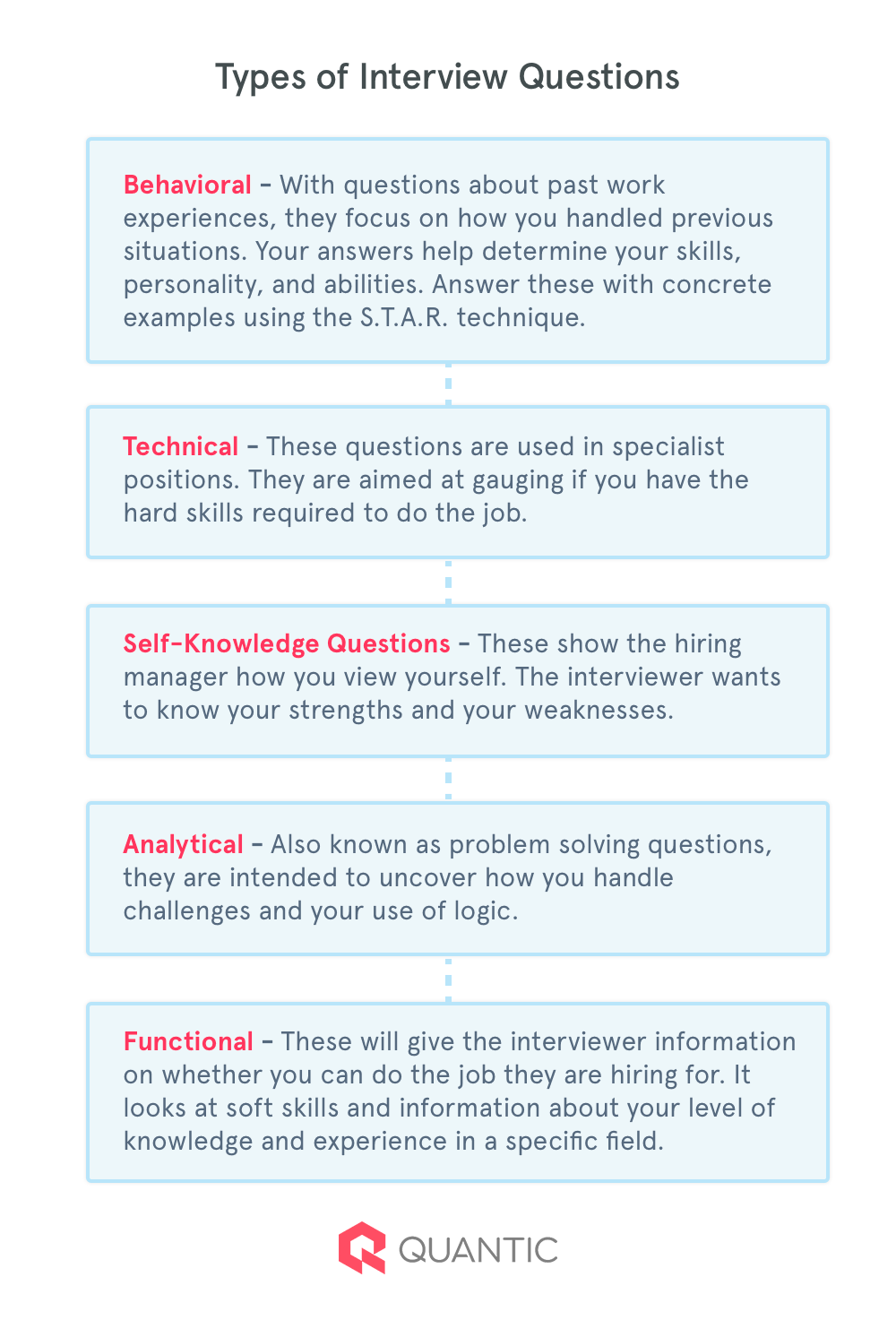
A technical business analyst focuses on using software and hardware to provide analysis that can be used to improve business systems. With that in mind, interview questions will focus both on business and technical skills. Take a look at some questions that are specific to technical BAs:

25. Can you describe your SQL skills?

As a technical business analyst, SQL is key in performing any job function. The HR team will be looking for someone with practical skills such as data manipulation, navigation, and the ability to write queries. If the interviewer is part of a technical team, you can wow them with technical lingo. This will help them understand the scope of your skills.

26. Can you describe the types of SQL statements?

This is another technical question that tests your educational background. You will probably face this in an interview with a manager in the business analytics team. Do not be afraid to explain in-depth your knowledge of SQL. Expand on the types, namely:

  • SQL definition
  • SQL manipulation
  • SQL control

27. What is your experience with technical and functional documents?

All BA’s should be able to explain what solutions various systems provide. As a technical analyst, you will be required to discuss how the system will work. Tell the interviewer you would be able to create documents such as Stakeholder Analysis and Scope Statement.

28. How do you convey complex, technical information to non-technical stakeholders?

The way you answer will showcase your communication skills. Show that you can be relatable, able to create simple mockups, and answer questions in an understandable manner.

29. What are the components of UML as you understand them?

There is no set answer to this question as concepts can be derived from many sources. Be sure to mention components for UML:

  • Structure – actor, attribute, interface, object, etc
  • Behaviour – event, message, operation, state, etc
  • Relationships – association, composition, inheritance, etc

30. Can you describe your experience with UAT?

User Acceptance Testing is the final part of any analyst’s project. Go through these 5 steps and explain how you executed each one.

31. What is PaaS?

PaaS is a cloud computing platform that allows developers to build apps over the Internet. The services are accessible by users via their web browsers.

32. What is SaaS?

Software as a Service is used a third-party to host applications and give access via the Internet.

33. What is IaaS?

This is a form of cloud computing that provides virtual computing resources through the Internet.

34. What is CaaS?

Communications as a Service is a cloud-based solution that is leased from a single vendor over the Internet.

IT Analyst Interview Questions

35. How would you describe the role of an IT analyst in an organization?

This question is aimed at gauging your understanding of the position. Mention the fact that an IT analyst is key in the daily functioning of the organization. They ensure the smooth running of infrastructure and applications.

36. What are your technical certifications?

Have a list ready of your relevant certifications. If you are looking to continue studying, be sure to include these as well.

37. How do you ensure quality in deliverables?

To answer this, refer back to the client requirements that you would have gathered prior to providing a solution. Making sure the client is satisfied is key to measuring the quality of deliverables.

38. After researching a business tool, you come across two possible solutions. One is cloud-based, the other, premises-based. Which one would you recommend and why?

Guide the interviewer through your thought process when deciding on the best option. There is no concrete answer so explore both options. Give examples of when each could apply.

39. Provide examples of how you used data analysis to support your decision-making process.

The interviewer is looking to see if you understand the role of data analysis in decision making. Explain its importance in identifying problems and estimating the impact of possible solutions.

40. Which data visualization tools do you have experience with?

Your answer will show your ability to communicate with non-technical team members and clients. Have experience with at least one visualization technique.

Behavioral Business Analyst Interview Questions and Answers

Behavioral interview questions work on the premise that past behavior is a good indicator of future behavior. 

To answer these types of questions, use the S.T.A.R. technique to structure your response.

Plan ahead for such questions with ready examples and remember to keep the tone positive.

Analysts may face the below behavioral interview questions:

41. How do you handle difficult stakeholders?

How you deal with difficult stakeholders will show how successful you are in completing projects. Show that you can be objective, control your emotions as well as reach an amicable resolution.

42. Can you tell me of a mistake you made? How did you handle it?

The key to this answer is honesty. No one can do their job perfectly so do not try to cover up your errors. The interviewer wants to see that you took responsibility and corrected the error.

43. Have you ever had to pitch an idea to a senior employee? How did you handle it?

The interviewer is looking at your communication skills as well as independent thinking. Outline the steps you took to prepare and the results of your pitch. If you have never had such an opportunity, explain how you would handle a pitch if given the chance.

44. Have you experienced conflict with a peer at work? How did you deal with it?

Using the S.T.A.R method, explain how the conflict arose and how you resolved it. Emphasize on communication skills and your conflict resolution strategy. Demonstrate the ability to understand other people and reach an agreeable solution.

45. Tell me of a time when you had to deal with a lot of stress or work under pressure.

This will reflect your ability to deal with pressure in the future. Provide tactics you use, such as adequate preparation, relaxation techniques, and your change of mindset when under pressure.

46. What is the biggest goal you have achieved as an analyst? How did you achieve it?

Prepare by having your proudest goal in mind. The key is to focus on the steps you took to achieve that goal.

47. Tell me of when you had to learn a new skill. How did you master it and how has it helped you in your career?

Using the S.T.A.R method, describe the type of training you underwent in relation to BA and the quantitative results. You want to show that you are open to learning and are capable of putting theory into action.

48. Tell me of a time when you did not achieve a goal.

Respond by showing that you are capable of handling failure. The interviewer wants to see that you learned from the experience, and can do things differently if faced with a similar situation.

Functional Analyst Interview Questions

Functional questions will focus on what an individual can do. They allow the hiring manager to evaluate your skills, education, and have a glimpse at your desired career path.

Some questions include:

49. What is your experience as a business analyst?

There is almost a 100% chance you will have to answer this question. Be prepared to break down your experience, and summarise it all concisely.

50. Why should we hire you?

By understanding the job description, you can link your specific skills and experience with what the company wants. If your skills are not up to par, emphasize passion and commitment.

51. What are your current job responsibilities?

This is to see if your duties match the job requirements and those on your CV. Expand on the points in your resume and give a clear picture of what you currently do.

52. What is your educational background?

This is one of the simpler questions. Give relevant information on your education and how it could be applied to your career as a BA.

53. What does your typical day look like?

There is no ‘typical day’. This is aimed to see how you plan and how efficiently you organize your time.

54. What is most satisfying about your job?

Your answer will reveal what you believe in as an employee. Speak of an element of the job that applies to the job you are interviewing for.

55. What is the most challenging part of your job?

Breakdown your job and decide which challenges you face, but focus on the ones that can be solved. Choose a skill area that won’t affect your core tasks but can be improved.

56. Where do you see yourself in 2-5 years time?

HR will want to know if you plan on being with them in the long-run. Even if you do not have a concrete plan, show a sense of ambition and a desire to grow.

Analytical Interview Questions

Analytical questions are aimed at assessing your critical thinking. It is a chance to showcase your problem-solving skills and use of data to analyze processes in the organization.

57. How does analytical reporting provide value? Does it have any shortcomings?

Prove you understand the importance of analytical reporting. Do not, however, make it the ‘end -all’ of all decisions. Be sure to include the fact that other factors may not be well represented in data, yet they will influence the decision.

58. In your professional opinion, what does requirement analysis entail?

Requirement analysis needs you to analyze, document, validate, and manage software. Use this definition and the ‘SMART’ technique to show how you have used it in your previous experience.

59. Can you describe the requirements analysis process?

The process involves 4 steps, namely:

  • Eliciting requirements
  • Analyzing requirements
  • Modeling requirements
  • Reviewing requirements

60. What is the most important aspect of analysis reporting?

Explain the impact that analytical reporting has had in your previous roles. Show how you have used tools to provide value. This is a chance to show analytical and critical thinking skills.

61. Have you ever encountered conflicting data during analysis? How did you deal with it?

Show your problem-solving skills. Describe your process (e.g.: how you found the source of the problem and escalated the issue).

62. Can you describe the difference between design models and analysis models?

This theoretical question will test your working knowledge. Design involves raw data collection, planning, and creation. The analysis is the execution, fixing, and reporting of the model.

Marketing Performance Analyst Interview Questions

A marketing performance analyst provides solutions based on insights around marketing performance. They investigate marketing trends that can influence organizational tactics and strategies.

Some questions you may encounter during a marketing analyst interview include:

63. How would you build a predictive model? Can you describe it and the process you would go through?

You will need to demonstrate your ability to forecast future trends and probabilities from historical data. Use your past experiences to give an example of where you used a logical thought process to create a model.

64. What is the most surprising finding you have come across? How did it affect your work?

As a marketing analyst, you should be able to put preconceived notions aside when interpreting data. Showing your ability to be unbiased and open to new ideas could be the difference between you and the next candidate.

65. What type of CRM and analysis software have you worked with?

Be ready with an explanation of the different software programs you have used and how they have helped you as a BA.

66. What recommendations have you used that have increased sales?

Use work experience to show your ability to use data to add value. If you have no prior experience, give a scenario that you would implement in your future job.

Taking the Next Step

Start preparing to ace your next interview and land your perfect job with these questions. By ensuring you have the credentials required and a healthy amount of confidence, you will be well-equipped to level-up your career.

Why not follow Patrick’s example…

MBA in the Pharmaceutical Industry – Do You Need One? 

It’s no secret that the pharmaceutical industry is a lucrative one. With the right skills, you can go far. However, it’s also easy to become trapped in your current position with no chance of advancement in sight. This is a struggle many young professionals face today. Thankfully, there are options.

Pursuing the right MBA program can help you advance your career and get you into that leadership position in the pharmaceutical industry that you’ve always wanted. However, what is the right program? What about an MBA in pharmaceutical management or maybe healthcare management? Is it really necessary? Are there alternatives?

Well, that’s exactly what we’re going to look at today. We’re going to explore whether you need an MBA with a specialization in pharmaceuticals to advance your career in this industry. 

But first, let’s look at your specialization options for your MBA and what they can do for you. 

Pharmaceutical MBA Types 

There are a variety of pharmaceutical MBAs you can choose from to further your career, and we’re going to cover a few of them so you don’t walk away from this article confused.

Here are a few pharmaceutical MBA types you can consider: 

  • Pharmaceutical Management – A popular pharmaceutical MBA, pharmaceutical management students focus on developing the skills to manage and administer businesses in the pharmaceutical industry. It combines the study of basic and pharmaceutical sciences as well as marketing and management courses. 
  • Pharma Marketing – Whereas pharmaceutical management courses include marketing, pharma marketing focuses on it. Students in these programs learn the necessary skills to market drugs and medical devices to great effect. As such, it’s typically pursued by those seeking to become marketing specialists in the pharma industry.
  • Healthcare Management – Healthcare and pharmaceuticals are close to one another in the industry. This MBA specialization focuses on how to manage and administer healthcare systems in both the private and public sectors.

And these are only three of the specializations you can pursue with your MBA. You no longer have to wonder what is an MBA in pharmaceutical management or how it differs from pharma marketing.

Mind you, a typical pharma MBA, regardless of specialization will require at least 2 years to complete, and require them to adhere to a strict schedule of in-person courses. 

Contrast this with Quantic’s MBA program which can be completed in as little as 15 months. What’s more, a Quantic MBA can be completed remotely and flexibly so as to not interrupt your professional life. As such, it offers a strong alternative to other MBA programs. 

Is an MBA in Pharma a Good Option? 

As with any choice in life, you’ll need to weigh the pros and cons of an MBA in pharma.

Let’s start with the positives. Of course, an MBA in pharma will provide you with the necessary business and financial knowledge to understand the inner workings of a pharmaceutical business. This includes the necessary soft skills such as communication and leadership to perform well in the cross-company collaboration required for a healthy business. That’s not to mention that MBA holders often earn higher salaries than their peers. 

However, this all comes at a cost. Your typical MBA requires a serious time commitment of 2 years of in-person classes and time is taken off to attend said classes. As such, pursuing a traditional MBA can be similar to hitting pause on your professional life – something the young professional often avoids. And there is the cost. According to Investopedia, the average program can easily cost $40,000 per year. That’s $80,000 to complete the entire degree.

With this all in mind, whether we can call an MBA in pharma good highly depends on the needs of the person seeking it out. It offers quality education to become a leader in your company. However, a pharma MBA also typically comes at a prohibitive cost and time commitment.  

MBA Jobs in the Pharmaceutical Industry

So, with that in mind. What can you do with a pharmaceutical MBA? That’s to say, what is the scope of an MBA in pharmaceutical management? After all, the primary reason to pursue this degree is to advance in your career. Where can you advance to? What kind of MBA marketing jobs are there in pharmaceutical companies?

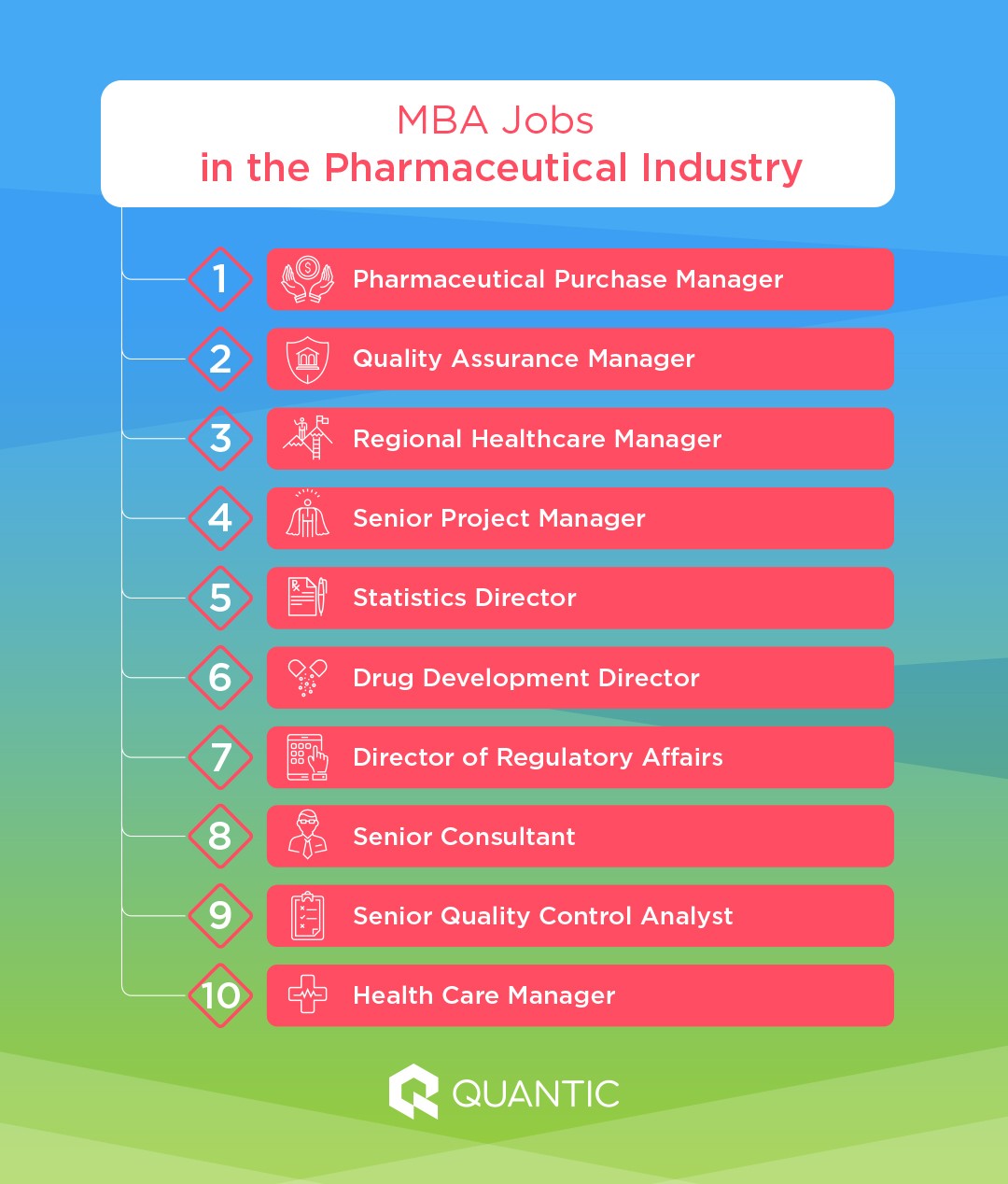
To answer that, take a look at these pharmaceutical management jobs available to MBA pharmaceutical graduates. 

  1. Pharmaceutical Purchase Manager 
  2. Quality Assurance Manager 
  3. Regional Healthcare Manager
  4. Senior Project Manager
  5. Statistics Director
  6. Drug Development Director
  7. Director of Regulatory Affairs
  8. Senior Consultant
  9. Senior Quality Control Analyst 
  10. Health Care Manager

MBA in Pharmaceutical Management Salaries in the US 

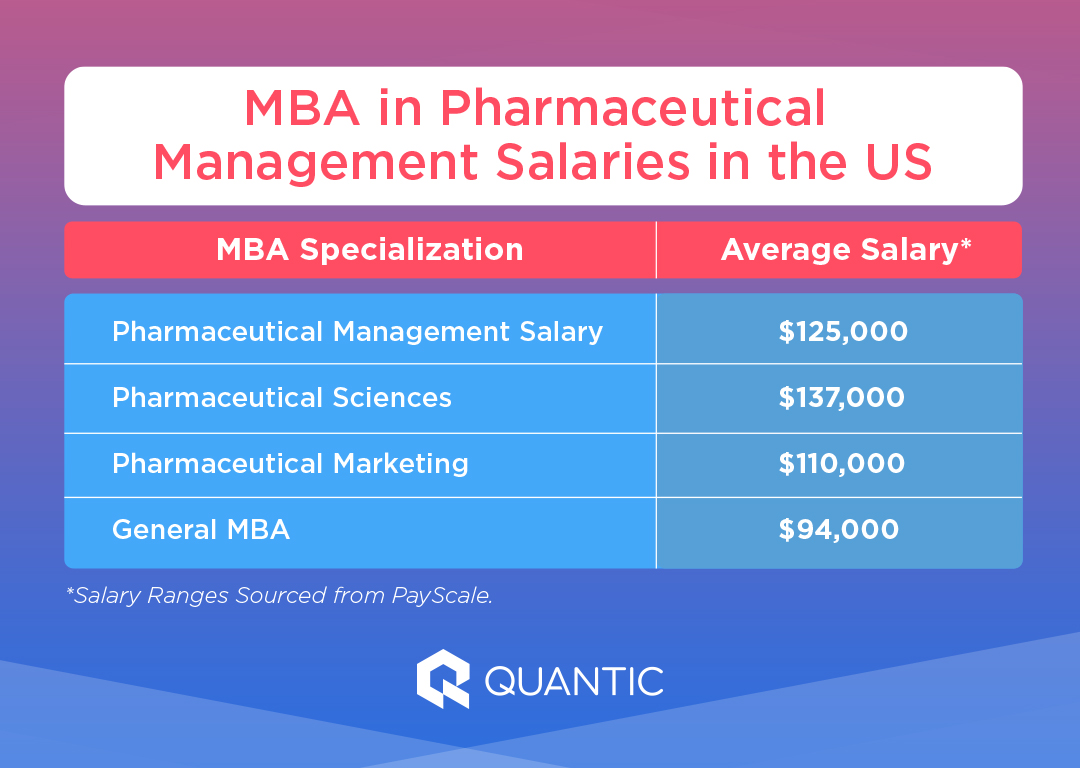
We briefly mentioned the high salary that an MBA in pharmaceutical management can bring before. So, let’s explore that further and how that salary compares to other MBA specializations. 

mba pharma slaries
MBA SpecializationAverage Salary*
Pharmaceutical Management Salary$125,000
Pharmaceutical Sciences$137,000
Pharmaceutical Marketing $110,000
General MBA$94,000

*Salary Ranges Sourced from PayScale. 

Pharmaceutical Recruiters 

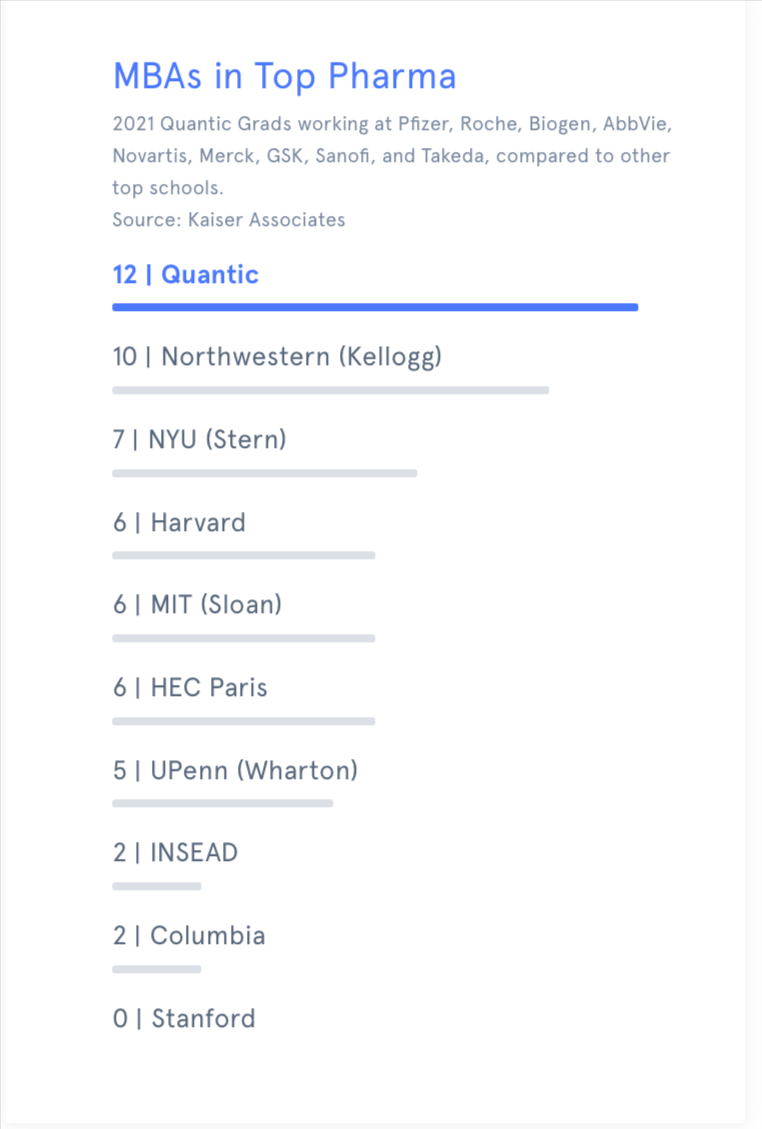
Now, when you’re looking for a high-paying position in pharmaceuticals, you’re likely looking to work for the biggest companies in the pharma industry. To that end, consider pursuing your MBA with Quantic. Quantic graduates work with many of the top pharma companies today. 


Quantic MBA graduates have been hired by:

  • Pfizer
  • Roche
  • Biogen
  • AbbieVie
  • Novartis
  • Merck
  • DSK
  • Sanofi
  • Takeda
MBAs in Top Pharma

But your choices are certainly not limited to these companies. There are many more pharmaceutical companies looking for talented MBA graduates.

These include: 

  • Reaction Search International 
  • Advanced Clinical 
  • Allen-Jeffers Associates
  • The Bandish Group
  • Beckford Search Partners
  • Bio-Partners and Lennon Search Associates

Best Online MBA for the Pharmaceutical Industry 

When you’re looking for the best MBA for your career in the pharmaceutical industry, you should take into careful consideration the potential downsides of specialized MBAs such as those in pharmaceutical management. As we discussed, these programs are costly and time-consuming – requiring you as a student to make a significant investment. Even then, it will take time to see return on your investment pursuing a traditional MBA.

The same can be said of EMBA in pharmaceutical management, perhaps even more so. 

An MBA in pharmaceutical industry management does offer the specialized knowledge to work within the industry and take on leadership roles. However, it has the same problem as pharmaceutical management – cost, time, and overall risk on ROI.


So, in light of this, consider Quantic’s MBA program to help you find your dream job in the pharmaceutical industry. With Quantic’s flexible and innovative approach to advanced education, you’ll enjoy an accelerated 15-month education that’s both cheaper and more effective than other MBA programs.

66% of Quantic graduates report receiving a promotion during their first year out of the program. This is because Quantic’s MBA is designed for early career professionals looking to get ahead. Quantic provides exactly that with an award-winning curriculum that combines interactive technology and collaborative group study.

Plus, you don’t have to put your career on pause with Quantic. You enjoy a quality education alongside a cohort of fellow talented professionals via our remote learning model so you can approach your education on your terms.  

So, apply today to get a Quantic leap on your career.

Do You Need an MBA for Consulting? A Comprehensive Guide

An MBA is one of the most and lucrative popular post-graduate degrees for consultants. However, do you really need one? What are the benefits? Why would you pursue an MBA if you’re already a consultant? 


These questions are exactly what we’re going to answer today. We’re going to looking what an MBA does for a consultant, how it affects their pay, and how they can go about obtaining their MBA. For additional information from real people, join the conversation on the best MBA for consulting. Reddit often discusses the subject.

But first, let’s look into exactly what consulting is. 

What is Consulting? 

Consulting is a very loose term. So, it’s little wonder the exact definition depends on the context. However, consulting is essentially providing business advice and guidance on various business topics that range from marketing and IT to overall corporate strategy.

Consultants define problems and opportunities for a business and help plan implementation strategies and more across the company. 

How Does an MBA Help Consultants? 

An MBA is a post-graduate degree that gives you holistic management knowledge that stretches across an entire business. MBA graduates also learn and develop vital soft skills and leadership principles to prepare them for a top-down approach to business. Plus, MBA holders leave the program with a professional network and a diversified perspective on business as a whole. 

All of these are beneficial when you’re considering a career in consulting. 


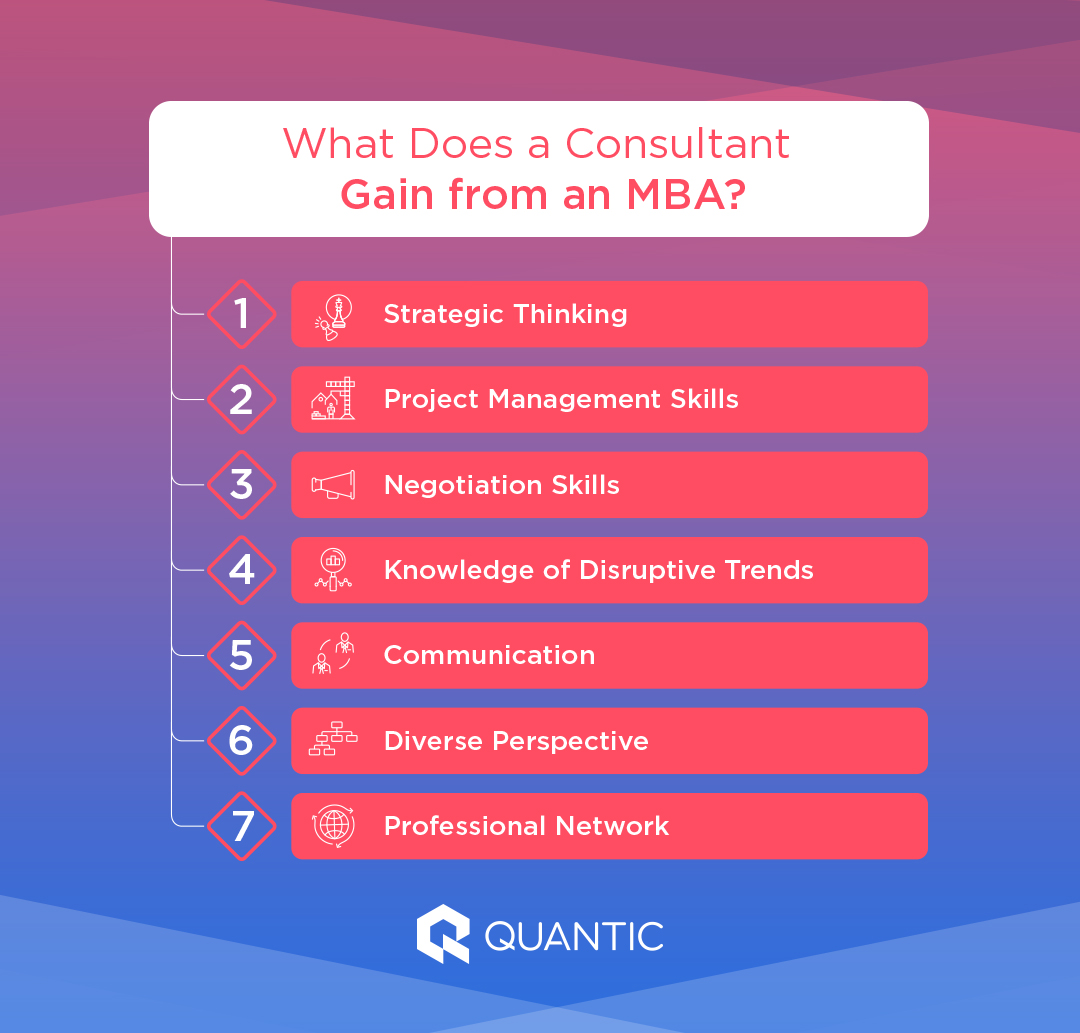
Here’s a quick list of the things you’ll learn and gain from an MBA program, and how they directly help consultants: 

  • Strategic Thinking – If you’re going to help solve a business’s problems, you’ll need to be able to think strategically. MBA programs teach their students how to develop this skill to solve complex problems for themselves and the businesses that employ them.
  • Project Management – It’s one thing to tell a business they have a problem, but it’s another thing entirely to help them solve it. Project management skills empower consultants to advise their clients on the projects they undertake to improve their businesses.
  • Negotiation – Sometimes a consultant will face a conflicting situation that will require them to mediate a communication breakdown or another such complication. MBA programs provide students with entire courses dedicated to the art of negotiation.
  • Knowledge of Disruptive Trends – MBA programs will help you develop your knowledge of current trends and what to watch for in the future.
  • Communication – An MBA will strengthen your ability to work with and lead diverse teams by developing your communication and presentation skills.
  • Diverse Perspective – MBA graduates learn how to develop and draw from diverse perspectives to solve complex problems. This is an essential skill for any successful consultant.
  • Professional Network –   The key to consulting is building trust with your clients, and that means building a meaningful reputation and network. 

Why MBA for a Consulting Career?

And that list is only a few of the ways an MBA will benefit a consulting career.  As such, MBAs are remarkably useful to consultants as it builds on all of the necessary skills they will need. What’s more, an MBA will allow you to specialize further in your field with options to pursue concentrations, which we will cover in detail later on. 

Overall, an MBA provides a wide base of business knowledge that consultants can leverage throughout their career. You will also learn how to lead teams and consult with confidence, using strong communication and presentation skills.  

Quantic’s MBA program provides all of this and more. Consider joining our 17,057 students and Alumni that enjoy a 66% rate of 1st-year job promotion rate and an average 21% 1st-year salary increase. 

MBA Consulting Salary 

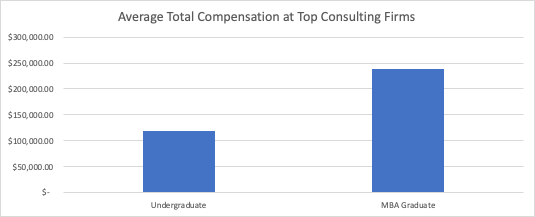
Speaking of salaries. There is a significant difference in pay for consultants with and without MBAs.

Here are the salary ranges of undergraduate and master’s hires compared to MBA hires at the top consulting firms:

  • Undergraduate Consultants: $77,000 – $100,000
  • MBA Consultants: $145,000 – $175,000
average consulting salary

Do You Need an MBA for Consulting? 

From what we have discussed thus far, you know that an MBA is not strictly necessary for a career in consulting. However, you also know of the benefits. An MBA provides a marked salary increase and the tools you need to be a better consultant.

However, as we just said, it’s not strictly necessary.

The people who would benefit the most from an MBA are those looking to work for the best consulting firms in the business. Even if you don’t land the job out of the gate, an MBA will build you up and get you started on the path. The increase in pay and marketable skills don’t hurt either. 

If you want to hear firsthand how Quantic’s MBA provides students with the tools to make a bigger impact with their existing skill set, check out this video. 

[Embed Video]

How an MBA Helps You Prepare for Consulting 

As we discussed before, when you pursue an MBA, you gain more than just a broader understanding of how a business functions. It prepares consultants with the skills to improve their trust and credibility among their clients. What’s more, you gain a network of similarly minded and ambitious fellow alumni to reach out to throughout your professional career. 

MBA vs JD for Consulting 

For some who enter consulting, they’re torn between pursuing an MBA or JD for their career. Not everyone can pursue both. That’s why we’re going to take a quick look at who should pursue one over the other.

An MBA prepares you for consulting in business. This includes management, entrepreneurship, and business consulting. It is broad reaching and flexible. 

A JD, on the other hand, should be pursued only by those who wish to focus on legal consultation. Management consultants with JDs use legal knowledge to help their clients. Contrast this with the MBA’s holistic business approach which does not include this legal component. 

Is an MBA Worth it for People Already in Consulting? 

Even if you’re already a consultant with multiple years of experience, an MBA will still be worth it for you. Only those with more than 10 years of experience would need to stop to consider the returns.

As an established consultant, there are many benefits an MBA can provide. 

One is the networking opportunities. Pursuing an MBA will allow you to revitalize or expand your network. This will expand your reach and reputation in the professional world. 


Another is your opportunity to update your knowledge. Business is constantly changing. A consultant absolutely needs to stay up to date with the latest developments. Pursuing an MBA will allow you to do exactly that, and prepare you with the skills to stay on the edge of new developments in business.

And last, and certainly not least, an MBA can lead to a meaningful boost in your salary. 

What MBA Concentration is Best for Consulting 

The beauty of an MBA program is the diversity of concentrations. Each allows a student to focus on the niche part of the industry they wish to pursue. This specialization is appealing to employers and useful to students. 


Here are some of the best MBA concentrations for consultants.

  • Corporate Strategy – A concentration in corporate strategy helps you discover how companies create value, develop portfolios and work with other organizations. This provides consultants with an excellent background in inter-business dealings.
  • Entrepreneurship – The entrepreneurship concentration teaches you how to build a company from the ground up. As a consultant, this gives you valuable insight to help start-ups and venture capital
  • General Management – This middle-of-the-road concentration gives you a broad overview of business functions, focusing on finance, leadership, and data analysis. 
  • International Management – Enterprises today are more global than they’ve ever been, and the international business community is becoming more connected every day. An MBA in International management equips you with the knowledge to consult for worldwide enterprises.
  • Project Management – As we mentioned before, consultants should know how to implement the advice they give their clients. As such, a concentration in project management allows you to aid in organizational efficiency for industries such as information technology, construction, and manufacturing.

What Consulting Firms Look for Post-MBA

Unless you already worked as a consultant before you got your degree, post-MBA is the time to start looking for a position. Consulting firms are looking for candidates with certain qualities, and these can vary between companies. These include leadership, initiative, and communication. You will have developed these skills during your MBA program. 

Do Consulting Firms Pay for MBA?

Many of the top consulting firms pay for their employee’s MBAs. In fact, this is one of the best ways to earn an MBA without any cost to yourself. MBA holders are considered valuable and worthy investments in many firms.

Here are a few firms that offer sponsorship options:

  • Deloitte
  • PwC
  • KPMG
  • McKinsey

It is important to note that most firms, such as EY-Parthenon, do not sponsor MBAs. However, if your company is among them, you still have options.


If your company doesn’t offer MBA sponsorship, you’ll have to build a case. Consider the revenue of your company, the education of leadership, and what an MBA holder would bring to the team. Compile this information, find a program that provides the skills that meet your company’s needs, and prepare a training request letter.

With a convincing pitch, you may well find your employer amicable to paying for your MBA. 


Even then, Quantic’s MBA program offers tuition assistance and even tuition reimbursement for the right candidates. 

Quantic – The Best MBA Program for Consulting!

Consider Quantic when pursuing an MBA for consulting. We offer a unique and innovative MBA program that provides the student with a mobile-first active learning experience. What’s more, Quantic sparks a connection with fellow professionals with a network-first approach to build a meaningful network.

Quantic provides everything in an MBA that a consultant could ever need.

So, sign up with Quantic today to begin your MBA and become a better consultant. 

How to Get Your First Software Engineer Job in 7 Steps

Software engineers are the professionals who make most of the online world possible. They undertake the daunting, but rewarding, tasks of designing and building applications that we enjoy online. As such, it’s both a lucrative and attractive job. 

However, breaking into this industry can be a challenge. Many organizations have high standards for their software engineers, and there’s plenty of competition out there in the labor pool.

That’s why today we’re going to take a look at the steps you can take to get your first software engineering job, the hardest part of the journey.

But first, let’s take a look at what software engineering entails. 

What is Software Engineering?

Software Engineering can be considered any technical field which helps design, develop, build, and test computer software. It requires a strong understanding of computer science, various engineering skills, and in-depth technical knowledge. Software engineers often work as part of a team of developers to produce new and innovative software. 

There is a common misconception that software engineers inherently equate to programmers. However, the position is much more complex than that. Whereas a software engineer does require an understanding of programming languages, their main daily tasks involving code are focused on writing code and creating the framework for software that a developer will in turn build upon.

Software engineering is more than coding. It’s about collaborating as a member of a team, helping guide the final product of a given software. That means software engineers require a mix of additional skills including teamwork, pair programming, and general problem-solving.

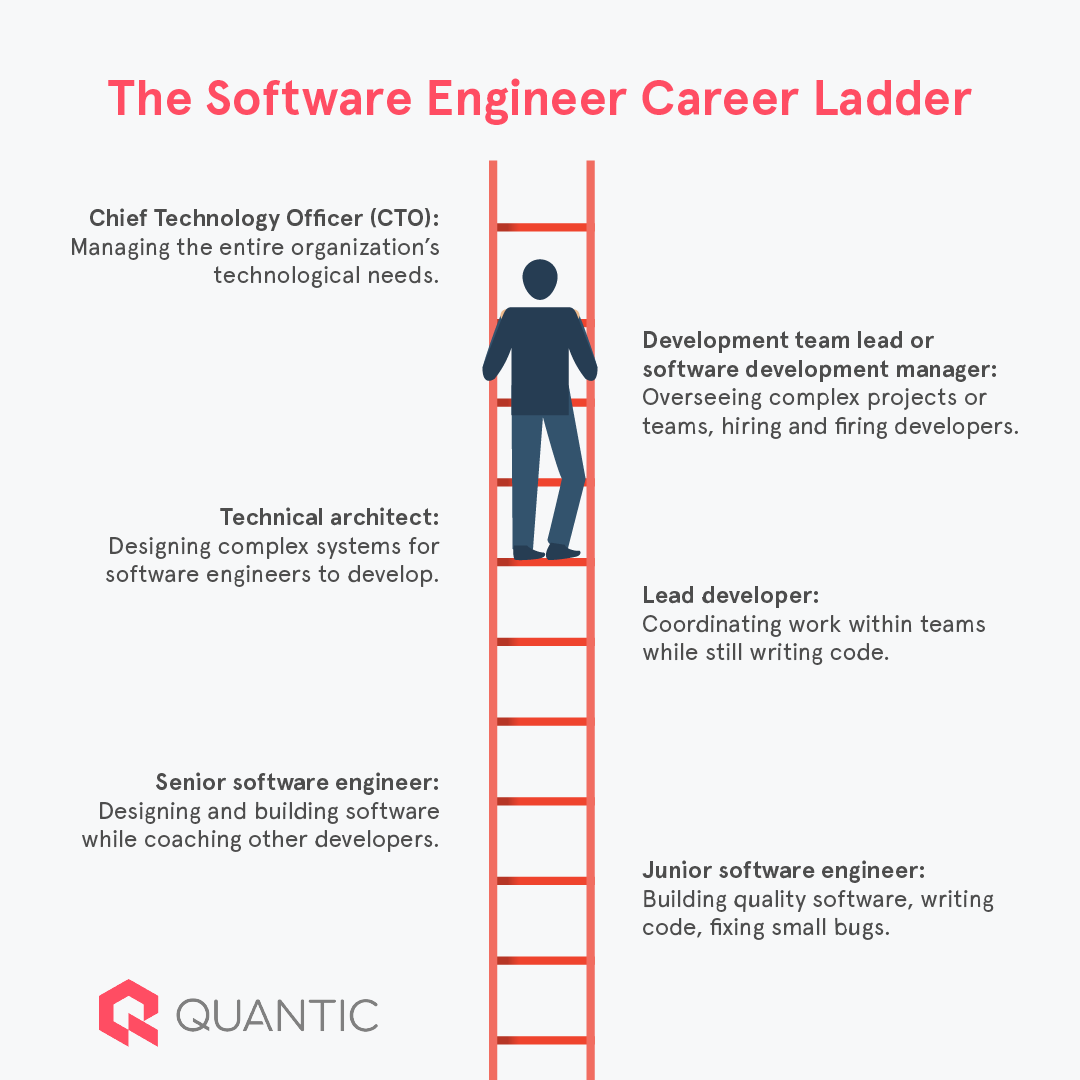
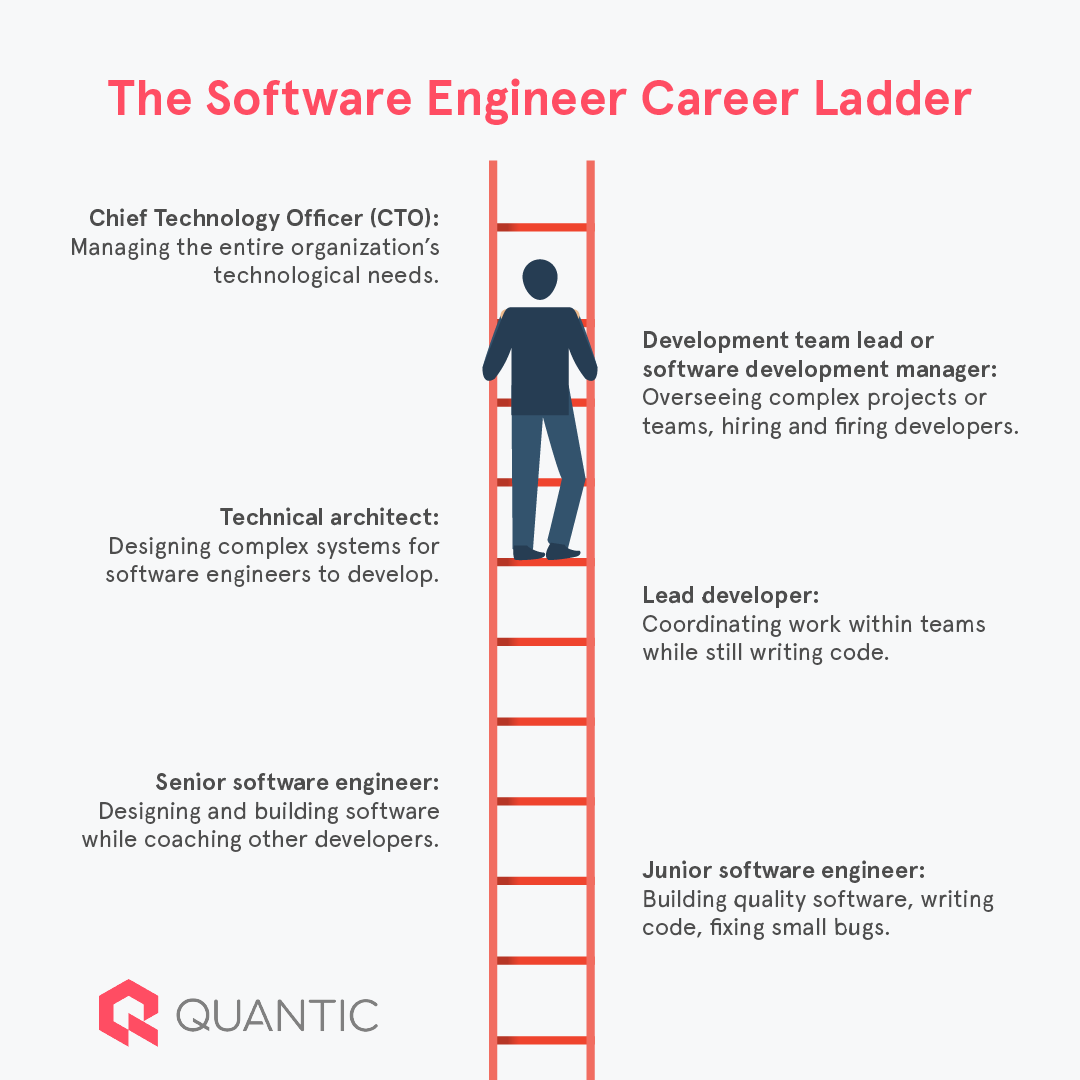
Starting on the software engineer career typically begins as a junior software engineer, the entry-level position in this field. Here you will work to build software, hammer out code, and fix bugs in said code. From here, you will likely progress to a senior software engineer, performing many of the same tasks while coaching entry-level developers.

Senior software engineers eventually become lead developers who coordinate entire teams while still writing code. This will continue onward, providing you continue to develop your skills, to the top of the career ladder to chief technology officer, managing an entire organization’s technical needs. 


But first, you need to get that entry-level job. It can seem daunting, but developing the right skills will get your foot in the door. And once you get that foot in the door, it’s only a matter of time before you’re climbing that ladder yourself. 

software engineer careers

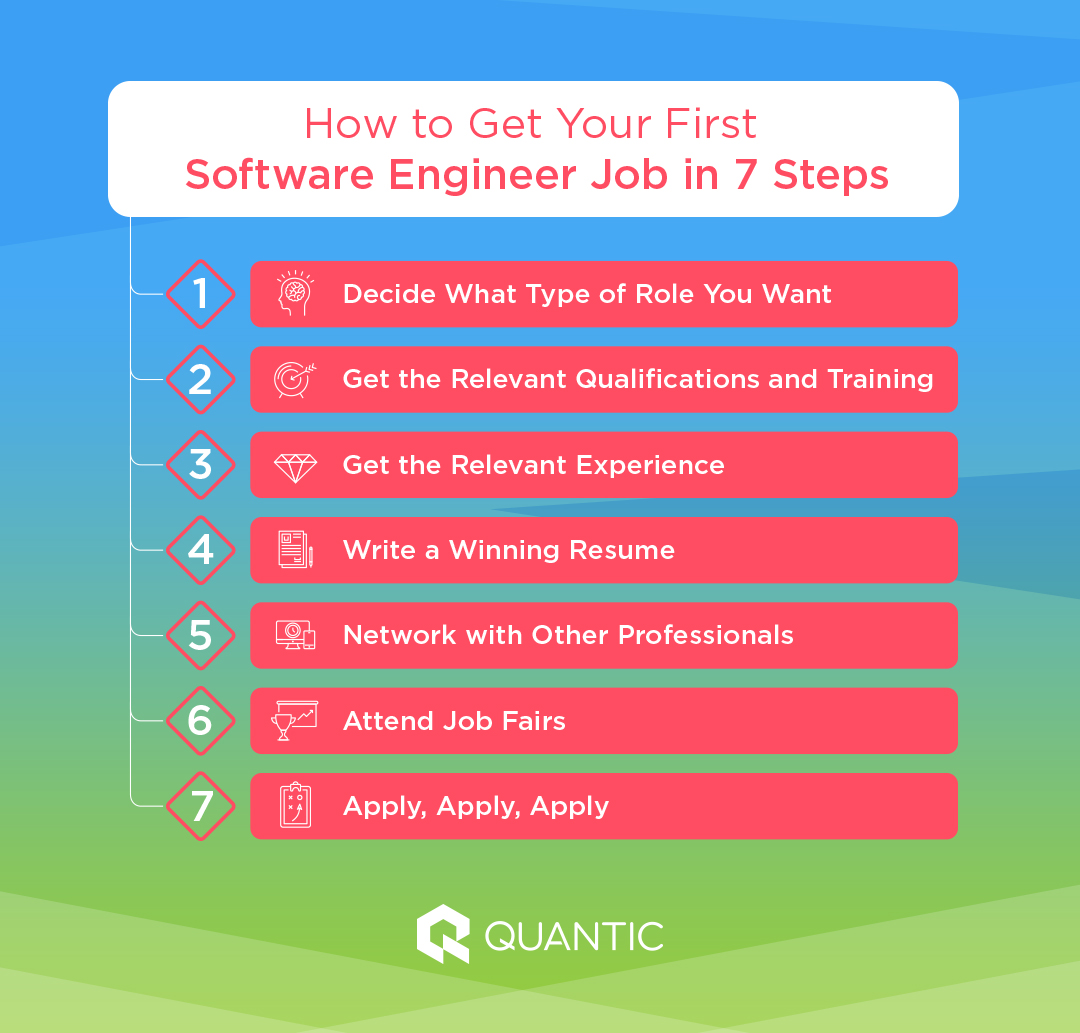
How to Get Your First Software Engineer Job in 7 Steps 

Getting your first software engineer job won’t be easy, but with the right steps, you’ll get there. In this guide, we’re going to look at every step you need to take from choosing your choice of engineering role to applying for the position. Along the way, you’ll learn how to get an entry-level software engineering job.

For additional reading, you can join the conversation on how to get a software engineering job on Reddit. 

how to get your first software engineering job

Step 1 – Decide What Type of Role You Want 

There are many types of software engineers. Before you can begin on your journey, you should consider which role you want. To help you do just that, we’ve compiled a list of some of the different types of software engineer roles.

  • Front-End Engineer – Front-end software engineers specialize in the development of user interfaces – the UI. These are the visual elements including layout and aesthetic that the end user will interact with. As a Front-End Engineer, you can expect to work with code that runs across different user devices, browsers, and operating systems while creating responsive applications.
  • Back-End Engineer – As the name implies, back-end engineers work on the parts of applications that the end user doesn’t see. This includes the underlying logic and overall performance of a piece of software. In this role, you will find yourself designing and implementing the core logic that runs entire applications while working with Application Programming Interfaces or APIs.
  • DevOps Engineer – Unlike Front-end or Back-end engineers, the DevOps engineer’s role revolves around the technologies necessary to develop, integrate and administer back-end software. That’s to say, they focus on application infrastructure such as databases and servers.
  • Security Engineer- Security engineers specialize in creating systems and procedures to test the security of software systems. As such, they look to exploit and fix any security flaws in a given software to protect it from malicious intent. These engineers are more commonly known as “white hats” or “ethical hackers.”
  • Full-Stack Engineer – You can think of this role as a combination of both front-end and back-end software development. Full-stack engineers provide the skills to create a fully functional piece of software.

Each of these roles is unique in its tasks. As such, take this step into serious consideration. An entry-level position in any of these roles will be the first rung of the ladder in your software engineering career. 


However, if you’re looking for the easiest role to start with, consider becoming a front-end engineer. These professionals often work in coding languages such as Java to create appealing user interfaces, a well-known coding language that’s friendly to newcomers. Plus, learning front-end coding will give you the opportunity to see direct, visual results of your code. 


On the other hand, if you’re looking for a challenge. Start with cybersecurity. This role may be the hardest role to break into when you’re just starting out. Cybersecurity software engineers depend on an in-depth and advanced understanding of software and coding languages.

Step 2 – Get the Relevant Qualifications and Training

Once you’ve decided on a direction, you need to develop your qualifications. That means pursuing training and other resources to help you get that entry-level engineering position. So, what should you learn to get a software job? 

Well, the answer to that question is not simple. Software engineers need a diverse set of skills, and that requires a fair amount of education, training, or a combination of the two. Regardless, you will need to develop your understanding of coding languages, database knowledge, debugging knowledge, and similar technical skills starting out as a software engineer.

This is best done by attending various coding boot camps or even pursuing a bachelor’s in computer science. However, the cost of an advanced education can be a major roadblock to many. As such, this brings is us to a very common question: how to get a job as a software engineer without a degree?

It is possible without a degree, but it’s certainly not easy. You’ll need to be a self-starter, ready to learn everything you need on your own. There are many resources available online to do this.

Here’s a list of some of those resources:

  1. Free Code Camp
  2. LearnPyhton.org
  3. Try.GitHub.io
  4. Learn Git Branching
  5. CodingBat 

Beyond these, consider pursuing an MBA for Information Technology. An MBA will not only help you understand your role in a business but put you in a position to climb the corporate ladder much faster than your peers. That’s not even to mention that, according to U.S. News, technology is one of the top three fields that pay the highest salaries for MBA holders. 


It’s only a matter of the right MBA program for you. Quantic’s MBA program, for example, has a higher level of student satisfaction than both Harvard and INSEAD, and provides an innovative curriculum tailored specifically for early-career learners like yourself. Check it out if you’re interested in pursuing an education with an active learning method and strong networking opportunities. 

Step 3 – Get the Relevant Experience 

The next step on your journey is acquiring experience. To this end, let’s explore how to get a software engineering job with no experience. This will be of the biggest hurdles in your software engineering journey.

To this end, you’ll need to continue working on your coding skills. Along the way, pick up personal projects or coding gigs to add to your portfolio. In the process, you should also be looking to build your network and online presence to show potential employers that you have the right skills. Certifications and applying to internships will also help.

During this process, continue applying to entry-level positions that will help you build professional experience in the end, and ultimately help you climb the ladder to your dream job. 

Now, how long it will take to get a software engineer job with no experience will highly depend on where you are right now. It could be a matter of years if you’re starting from absolute ground zero – no skills, no network, and no experience. However, with perseverance and the right programs, you could cut this down to a matter of months. Quantic’s MBA program has helped thousands of students to get jobs in major tech companies including Microsoft, Google, and Deloitte. 

Step 4 – Write a Winning Resume 

As with any other job, you’ll need a good resume to even catch the attention of recruiters. 

Start with the structure of your resume. You’ll want to lead with your most recent job followed by your most relevant previous positions. In terms of format, use professional fonts, spacing, and ensure your resume is in the format specified by your potential employer. Should no format be listed, PDF is your safest choice. 

A stellar resume will highlight your strong points. Showcase your most relevant skills at the top of your resume according to the position you’re applying to. To this end, take the job posting into careful consideration and identify the keywords and skills the company is looking for. This will allow you to tailor your resume to the position. 

With a good resume and a little luck, you’ll be invited to the interview stage. 

Some strong software engineer interview tips include: 

  • Familiarize yourself with the company – Many tech companies have preferred coding languages in which they work. Ensure you are familiar with the ones your chosen company prefers. Your interviewer will likely ask you questions relevant to the language.
  • Study potential coding questions – On the subject of coding, consider the common challenges you may face in this position. Recruiters often use these as screening questions to test your knowledge.
  • Prepare for other assessments – Every software engineering job is going to be more than coding. Be prepared to answer questions regarding your communication skills and other soft skills.

Step 5 – Network with Other Professionals 

We’ve all heard it before, “It’s not what you know, it’s who you know.”

This old adage survives for good reason – it’s often true. Many new software engineers find themselves in their position as someone has vouched for them with their employer. As such, network with software engineers and other aspiring software engineers whenever possible.

This is another benefit of pursuing an MBA. Quantic, for example, puts you in a host of high-ambition, highly-skilled individuals looking to advance in their careers that you can rely on for the rest of your professional career.

Step 6 – Attend Job Fairs 

Job fairs offer excellent opportunities for meeting potential employers in person and yet another opportunity to network with others in your field. It also gives you a chance to share your portfolio and resume directly with employers and directly communicate your interest in any open positions they may have.

Overall, a job fair is a great opportunity for career development, even if you’re just getting started. 

Step 7 – Apply, Apply, Apply

So, you’ve developed your experience. You’ve earned qualifications. You’ve networked. You’ve done everything we’ve discussed here today. It’s time to apply, and don’t stop applying while continuing to work on yourself. With perseverance, you will find yourself in an entry-level software engineer position. 

Kickstart Your Career With Quantic

As we’ve discussed, getting your first software engineer job is no easy task, but it’s certainly not impossible. With the right tools and determination, it’s not a matter of if you get the job. It’s when you get the job.

Looking for an edge over the other applicants?

An online MBA from Quantic will show employers that you’re more than a software guru, you’re a business professional. Apply today. 

How to Get a Job at Microsoft 

Microsoft is renowned as one of the biggest tech companies in the world. As such, it is something of a matter of prestige to be hired. Getting a position with Microsoft means you beat out potential thousands of other candidates for a single position. The process can be extensive, with several rounds of interviews between applying and receiving an offer.

You’ll need to be able to prove to the recruiters at every stage that you have the skills that set you apart in this massive candidate pool.

That’s why today we’re going to take a look at what it takes to get a job at this tech Giant. We’re going to explore what you can expect from the recruitment process and the different positions available at Microsoft. Along the way, we’re going to look at what you can do to develop your skills and experience to make you the right candidate for those positions.

How Many Employees Does Microsoft Have? 

As of September 2022, Microsoft employs approximately 221,000 people in full-time positions around the world. Every one of them went through the daunting Microsoft hiring process that you will, and they came out the other side a full-fledged Microsoft employee. With effort, you can too.

Don’t worry if you don’t get the offer your first time. Many employees for the tech giants such as Microsoft try and try again before they finally land their dream job. It’s this persistence that Microsoft recruiters look for in their candidates alongside a desire to learn, grow and adapt with a real passion for technology.

Microsoft recruiters are also looking for technical and analytical skills that allow a person to learn through hands-on experience. If these traits describe you, Microsoft would love to have you. 

How Hard is it to Get a Job at Microsoft in 2022? 

Forbes listed Microsoft as one of the top five tech companies people wanted to work for in 2020. Now it’s 2 years later, and it remains true today. As such, they receive millions of applications every year to fill their open positions.

This makes it a difficult task to get a job at Microsoft, especially if you’re light on education and experience.

Due to this high competition, the Microsoft hiring process involves 4 to 5 rounds of interviews before you’ll land an offer. According to Zippia, this process takes a median of 22 days for non-technical positions and 32 days for technical positions.

However, despite competition and inherent difficulty, getting a job at Microsoft is still very much an attainable goal. To join the discussion on how to get a job at Microsoft, Reddit’s community of techies discuss the subject somewhat regularly.

Microsoft Jobs Salary 

One of the major benefits of working for Microsoft, beyond the prestige, is the more than fair salaries offered to full-time employees. 

Role Salary*
Entry level$73,000 – $103,000**
Research $93,000 – $281,000
Mechanical engineer$155,000 – $193,000
Technical sales $126,000 – $122,000
Data science$138,000 – $236,000
Software engineering $153,000 – $239,000

*Range estimates created using Glassdoor. 

**Entry level estimate ranges across roles.

How to Get a Job at Microsoft Step-By-Step Guide

  1. Look at Microsoft’s Company Job Qualifications 

To start your journey from candidate to new hire with Microsoft, you’ll begin like any other job hunt. Begin by comparing how you measure up to Microsoft’s desired qualifications.

Microsoft primarily divides its job postings into preferred qualifications and required qualifications. Let’s take a look at some of them. 

  • Digital Sales Representative – Cloud Acquisition 
    • Required: Extensive sales and negotiation experience
      • Or a Bachelor’s Degree in Business Management or a related field with 1+ years of sales experience.
    • Preferred: A Bachelor’s in Business Management or a related field with 3+ years of sales experience. 
  • Data Analyst 
    • Required: Either 1-year experience and a Bachelor’s degree in business, marketing, or related fields
      • Or  2+ years of experience in research, marketing, data science, or finance 

    • Preferred: 4+ years of experience and a Bachelor’s degree in business, marketing, or related fields
      • Or 5+ years in research, marketing, data science, or finance.
      • Or 3+ years in research, marketing, data science, or finance with a Master’s degree in business, marketing, or related fields. 
      • An MBA or equivalent with a strong academic background.
  • Principal Researcher 
    • Required: Ph.D. in applied mathematics, computer science, or a related field.
      • Relevant post-PhD experience in the field. 
      • Working knowledge of python. 
  • Preferred: People management experience.  

If you find that your experience and qualifications already match the criteria of the position you’re looking for, go ahead and skip to step 4. 

If you find yourself on the other side of the coin, you still have options to pursue a career with Microsoft. In these next steps, we’ll look at how to get a job at Microsoft without a degree or experience. 

  1. How to Get a Job at Microsoft Without a Degree 

Take a second look at the qualifications of the first two positions we discussed. You will notice that Microsoft is willing to accept equivalent experience in some cases instead of a degree. This is because Microsoft is looking for skilled candidates, not good grades.

Begin by developing your skills either through entry-level positions. These jobs are not ideal, but allow you to earn the necessary experience to get you considered in the Microsoft hiring process. 

Alternatively, you could expand your skills through other approaches. For example, Microsoft is the third largest employer of Quantic graduates, and only 43% of those students possess Master’s degrees.

  1. How to Get a Job at Microsoft with No Experience

Perhaps you already have the degree, and you’re just struggling to find a position that works for you. Similar to getting a job with no education, no experience means you’ll need to pursue internships and entry-level positions.

Applying for an internship also gives you a good opportunity to make an impression. It gets your foot in the door, and you’ll be able to learn what the company is looking for firsthand. However, these positions are not easily won either. You’ll have to prove you have what it takes, i.e. the passion and knowledge of technology, to beat out your internship competition.

If you’re looking for another way to ahead of the competition, consider expanding your skillset with an MBA through Quantic. This provides you with an education to see the big picture and a network-first approach to making meaningful connections with other skilled and ambitious individuals like yourself.

As such, you’re more likely to meet someone while pursuing your MBA with Quantic that can help open doors for you at businesses such as Microsoft in the future. 

  1. Decide What Type of Role You Want 

So you have the qualifications. It’s time to decide which role best suits you. Thankfully, Microsoft has hundreds of open positions for you to consider.

These include

  • Researcher
  • Scale Customer Success Associate
  • Data Center Technician
  • Strategic Account Strategist
  • Presales Specialist
  • Product Manager
  • Electrical Engineer
  • Mechanical Engineer 
  • HR Consulting Manager
  • Data Scientist 

Each of these roles has unique requirements and qualifications. To help you help land your dream Microsoft job, here’s some advice for four of the roles you can pursue at Microsoft. 

How to Get a Software Engineer Job at Microsoft 

First up, to get any software engineer job, you’ll need to learn how to code either through formal education or free resources. The safest languages to start with are either JavaScript or Python due to their high demand, but the choice depends on your interests. However, if you’re looking for bonus points with Microsoft, it wouldn’t hurt to learn that language they created: C#. 

Afterward, you’ll be able to land your first programming job or an internship to further your experience toward being ready to apply for a position with Microsoft.

However, getting a job at Microsoft is more than technical skills alone. Microsoft is looking for team members that understand their roles and the effects their work has on the whole organization. Quantic’s software engineer MBA graduates not only learn this valuable skill but see their promotion prospects grow. 

Here’s what the typical Software Engineer Career ladder looks like…

How to Get a Mechanical engineering Job at Microsoft

To become a mechanical engineer for Microsoft, you’ll need to meet some basic qualifications. These include a Bachelor’s degree in mechanical engineering and a college-level understanding of a niche within the engineering field. This could include knowledge of  HVAC systems and the operation of facility environments’ heating and cooling systems for example.

To achieve this, seek out other work on projects involving building and supporting the infrastructure of tech-oriented environments, and build your experience in supporting tech and development. 

How to Get a Technical Sales Job at Microsoft 

To get a technical sales job with Microsoft, you’ll need to be able to understand and explain the systems you’re pitching in great detail. As such, Microsoft is looking for individuals who possess computer science or related degrees to fill these positions.

However, if you can prove technical aptitude with a marketing degree, you also stand a chance of being hired for this position. 

How to Get a Job at Microsoft Research 

For those interested in pursuing a career in research with Microsoft, it’s best to start while pursuing an undergraduate degree in computer science or a related field. During this time, you can apply for an undergraduate research internship in computing or similar fields. Whether this is from Microsoft or not is up to you and your qualifications.

However, a research internship is an excellent way to get your foot in the door and build experience at the same time. 

  1. Explore Microsoft Careers 

If you’re not sure what role might suit you, or how your qualifications stand up to Microsoft’s expectations, check out Microsoft’s career page. There you’ll be able to see all of the positions available around the world and their requirements. 

  1. Work on Your Resume 

The key to crafting a good resume for a Microsoft position is to craft it according to the job description provided. Using the same keywords between the minimum and preferred qualification categories, your resume is more likely to stand out to recruiters and resume screening algorithms.

Additionally, Microsoft recruiters look for certain key aspects in a resume. These include clean formatting, an elevator pitch introduction of the candidate, a reduced skill section, and simplicity.

For more advice on how to craft a professional resume, check out our 6 steps to a professional resume. 

To get a jumpstart on your resume, grab a professional resume template here. 

  1. Apply Online

Here’s what you need to do to apply for a Microsoft position online. 

  1. Open the Microsoft Career Page and select “explore career opportunities.” 
  1. From here, you’ll be able to select to either explore professions or locations 
  1. Selecting professions will present you with a page of all the disciplines Microsoft hires 
  1. Choose a discipline you’re interested in and then select the position. 
  1. Sign in to the portal and create a profile
  2. Upload your resume and complete the necessary forms including contact information and professional experience.
  3. Interview – Microsoft Interview Process 2022 

Including assessments, Microsoft’s interview process involves approximately 6 rounds. 

  1. Recruiter Contact – This step may be skipped in favor of an online assessment. However, should a recruiter reach out to you directly, you can expect a short conversation regarding yourself and your interests. This acts as a brief preliminary screening.
  2. Online Assessment – The first round of interviews will be remote, either through an online Codility test or a phone screening, sometimes both. 

The Microsoft Codility test is specifically for positions such as software engineers and consists of 2-4 coding questions to solve in 60 to 90 minutes.

The screening interview will likely be held over Microsoft teams or Skype. It will last for about 30 minutes and cover behavioral assessments, coding problems (for relevant candidates), and conceptual questions. Common questions include “explain recursion to a 5-year-old” and “what is a linked list?”

  1. On-Site Interviews – The remaining 4-5 interviews will be conducted onsite, each lasting approximately 1 hour. These interviews will feature more coding questions for software engineers and behavioral interview questions.

The best way to prepare for this process is to read extensively about the position for which you applied and review potential material. 

  1. Offer 

If you’ve made it this far, congratulations. The hiring team has made you an offer. Assuming the terms of your employment are everything you’d hope them to be, you just need to accept. Look forward to onboarding and your new dream job at Microsoft. 

Conclusion 

At the end of the day, getting a job at Microsoft is a daunting task no matter how prepared you are. But it’s not impossible. With the right education, experience, and sticktoitiveness, you can work for one of the biggest and most successful companies in the tech industry.

If you find yourself looking for a way to make yourself stick out from the crowd that applies every year, take a look at what an MBA with Quantic can do for your career. 94% of our alumni report meeting their career goals post-graduation. 

How to Get a Job at Google

So, you want to get a job at Google. That ambition is admirable on its own. Now it’s only a matter of making your ambition a reality. Getting hired at Google means you’re going to have to show the recruiters how you stand out against the other 2 million candidates that apply every year. 

That’s right, 2 million applicants, and Google only hires 2,000 to 4,000 of them a year. 

And what is it that sets these hires apart from the others? It’s more than education and experience. It’s how the candidates approach their work. Successful Google applicants are versatile and innovative thinkers in their given fields.

If a software manager, or any other professional, wants to get their dream job at this tech giant, they’ll need more than experience. They’ll need an education that provides them the skills to take on senior roles, and the opportunity to network with other talented professionals. 

To help you along your path to becoming the new Google hire, we’re going to take a look at exactly how to get a job at Google. 

How Hard is it to Get a Job at Google in 2022? 

As we said, over 2 million candidates apply to Google every year. That’s a lot of competition. Plus, with such a large candidate pool to choose from, Google can safely keep its expectations incredibly high when looking for the right person to fill a position.

As a result, it is undoubtedly difficult to get a job at Google. You have to convince recruiters that you’re the best of the best who could possibly fill the position. It takes skill and no small amount of work to even meet the minimum qualifications for many of the available positions that open every year.

That’s why many successful applicants report taking multiple attempts at the hiring process before they were accepted.

If you want to join the conversation with other applicants and employees on how to get a job at Google, Reddit’s r/Google users often explore this question, and share barriers they’ve faced themselves. 

How to get a job at Google Step-by-step guide

1. Look at Google’s Company Job Qualifications 

Like any other job hunt, it’s best to check your qualifications. There are hundreds of positions at Google, too many to list in a single article. So, let’s take a look at just a few to give you an idea of what to expect.

Google has a set of minimum and preferred qualifications for each of its roles:

  • Failure Analysis Technician, Augmented Reality 
    • Minimum: Associate’s degree or equivalent experience, Experience with SEM (Scanning Electron Microbe) imaging, FIB (Focused Ion Beam) sample preparation, and Semiconductor wafer processing. 
    • Preferred: Bachelor’s degree in Electrical Engineering or related field, or equivalent experience, experience in the creation of failure analysis reports and operation of metrology tools. 
  • Program Manager, Sustaining Operations. 
    • Minimum: Bachelor’s in Supply Chain Management with 12 years of experience. 
    • Preferred: MBA or Master’s degree in the same field.
  • Senior Software Engineer, Cloud Data Management. 
    • Minimum: Bachelor’s degree in Computer Science or equivalent experience, 5 years of experience with software development, 3 years of experience testing, maintaining, and launching products, and 3 more years of experience developing large-scale infrastructure. 
    • Preferred: Master’s degree or Ph.D. in Computer Science or related, 1 year in a technical leadership role, and experience developing accessible technologies. 


If your experience and qualifications already match the position you’re looking for, skip to step 4.

However, if you don’t meet the listed criteria, you still have options. In the next steps, we’ll look at how to get a job at Google without a degree or experience.

2. How to Get a Job at Google Without a Degree

Something you’ll notice on many Google job listings is the phrase “or equivalent experience.” This is because Google isn’t focused on degrees or education alone. They want experienced team members with a passion for what they do.

Furthermore, there are still options for those who don’t have a degree and aren’t pursuing one. As we said, Google is looking for what you can do, not the grades you had in school. Develop your skills through entry-level positions, and put in the work to exceed expectations. Impressive work history will go a long way in getting hired at Google. 


Regardless of your education, networking is a serious asset to getting a job at Google. Having someone on the inside to go to bat for you will get your resume considered early in the process, improving your chances of an interview and an eventual offer.

Quantic’s network-first approach to learning allows MBA students to make meaningful connections with other skilled and ambitious individuals like themselves through peer-to-peer learning and networking events. As a result, our network includes exceptional alumni and corporate employers including Google.

3. How to Get a Job at Google With No Experience

Maybe you have a degree, but no experience. In this case, you’re going to need to build your skills and experience through entry-level jobs or other work such as internships.


Applying for an internship is also a good opportunity to get your foot in the door. However, remember Google internships are just as competitive as their regular positions. Bring your current software experience to the forefront, and, if you have what it takes, you’ll be able to gain the exact experience Google is looking for through them directly.

If you want to get ahead of your competition, consider expanding your skillset with an MBA through Quantic. Google is looking for candidates with the skill to see the big picture, and our program provides you with the knowledge to do just that. That’s why Google is the second top employer of our students. 222 Quantic alumni have been placed in positions at Google, to date!

Here’s what some of our Google Alumni had to say…

4. Decide What Type of Role You Want

When looking for a job with Google, you have hundreds of roles to choose from. Simply find one that suits you before applying.

These include: 

  • Data Analytics Specialist 
  • Integration Engineer 
  • Software Engineer 
  • Physical Design Engineer 
  • Sales Specialist 
  • Digital Marketer 
  • Operations Technician 
  • Product Manager 
  • Financial Analyst 
  • Field Sales 

All of these roles have unique requirements and qualifications. To help you along, here’s some advice for software engineers and sales. 

How to Get a Software Engineer Job at Google 

First up, to get any software engineer job, you’ll need to learn how to code either through formal education or free resources. The safest languages to start with are either JavaScript or Python due to their high demand, but the choice depends on your interests. 

Afterward, you’ll be able to land your first programming job or an internship to further your experience.

However, getting a job at Google is more than technical skills alone. Google is looking for team members that understand their role and the effects their work has on the whole organization. Quantic’s software engineer MBA graduates not only learn this valuable skill but see their promotion prospects grow. 

How to Get a Job at Google Sales 

Similar to software engineers, you’ll need to start with your skills through formal education or practical experience. Regardless, you’ll want to take your sales career to the technology industry including SaaS and similar products. 

  1. Explore Google Careers 

If you’re not sure what role might suit you, or how your qualifications stand up to Google’s expectations, check out Google Careers. There you’ll be able to see all of the positions available around the world and their requirements. 

6. Work on Your Resume

The key to crafting a good resume for a Google position is to craft it according to the job description provided. Using the same keywords between the minimum and preferred qualification categories, your resume is more likely to stand out to recruiters and resume screening algorithms.

For more advice on how to craft a professional resume, check out our 6 steps to a professional resume. 

Grab a professional resume template here. 

Apply Online

Here are the steps to follow to apply for a Google Position online.

  1. Go to Google Careers and use the search box to find a relevant position

  1. Once you find a position you like hit “Apply”
  1. Create a profile with your email, name, country, and phone number. This will allow you to save your info and potentially apply to other positions faster.
  2. Upload your resume and provide contact information, education background and employment history, and a cover letter. 

6. Interview 

Once you’ve made it to the interview stage of the hiring process, you can expect several rounds of interviews from short virtual chats about your key skills to in-depth interviews 3-4 times a single day.

For these interviews you will need to: 

  • Make connections between your resume and the job description – Review the resume you submitted, and be prepared to answer questions on how the information you provided relates to the job description. 
  • Prepare data – Being able to quantify the effect your work has had in the past gives recruiters a better understanding of your abilities. 
  • Review work experience – Recruiters will ask you how you have performed or achieved in your past roles. Reviewing will prepare you to answer those questions. 
  • Prepare questions – Google wants employees that care and are engaged in what they do. 

No Luck? Think Outside the Box! 

Don’t be discouraged if you don’t get the job with your first application. Many candidates apply multiple times before receiving an offer. However, don’t be afraid to get creative with your approach.

Here’s how Omari Itani landed a job as an Account Manager for Google at 26: 

When he passed the initial screening process, the recruiter presented him with a brief business case to discuss during the second interview. However, Omari prepared a complete presentation to illustrate his understanding and approach to the issue and impressed the interviewer by taking control of the interview.

Offer 

If you’ve made it this far, congratulations. The hiring team has made you an offer. Assuming the terms of your employment are everything you’d hope them to be, you just need to accept. Look forward to onboarding and your new dream job at Google. 

Conclusion 

At the end of the day, getting a job at Google is a difficult task, but it’s not impossible. With the right education, experience, and sticktoitiveness, you can work for one of the biggest and most successful companies in the tech industry.

If you find yourself looking for a way to make yourself stick out from the crowd that applies every year, take a look at what an MBA with Quantic can do for your career. 94% of our alumni report meeting their career goals post-graduation.