Quantic Executive MBA Review: Benefits, Features & Outcomes

Quantic School of Business and Technology is a DEAC-accredited*, mobile-first, AI-powered business school. Currently, Quantic offers four accredited master’s degree programs, including an MBA, an Executive MBA, a Master of Science in Business Analytics (MSBA), and a Master of Science in Software Engineering (MSSE). This Quantic Executive MBA review will explore how Quantic’s innovative approach empowers experienced professionals to reach new heights in their careers.

What Makes the Quantic Executive MBA Unique?

Firstly, the Quantic Executive MBA is designed for mid-career professionals looking to enhance their leadership and strategic management skills. It integrates advanced technology with a flexible, mobile-first delivery method for a top-tier education. Here’s what sets the Quantic Executive MBA apart:

Innovative Active Learning Method

Specifically, the Quantic Executive MBA redefines business education with its  Active Learning method, an innovative approach designed to boost engagement and retention. Unlike traditional lecture-based models, the platform offers interactive, bite-sized lessons that require active participation, ensuring students master key concepts before progressing.

Key features of the Active Learning method include:

  • AI-driven personalization: Tailored feedback and recommendations based on individual performance and progress.
  • Five to ten-minute lessons: Structured to fit seamlessly into the schedules of busy professionals.
  • Immediate feedback: Students receive guidance at every step to reinforce learning.

In fact, a 2017 study compared learning Probability and Statistics across Quantic, edX, and Khan Academy. Quantic learners spent only one-third of the time required by others, reported greater engagement, and achieved higher average exam scores. In contrast, learners in rival programs were five times more likely to score below 50%. Quantic’s Active Learning approach makes its degree programs ideal for professionals seeking flexibility without compromising quality.

Global and Selective Cohort

Quantic’s MBA attracts a highly diverse, selective cohort of students from around the globe. Moreover, with 17,000+ students and alumni representing over 150 countries and hailing from top global companies, the program provides a rich, collaborative learning environment that fosters global connections and insights.

Highlights of the Quantic Executive MBA cohort:

  • Diverse backgrounds: Students include senior managers, directors, and executives from leading Fortune 500 companies and innovative startups.
  • Selective admissions: A rigorous application process ensures a network of high-caliber, driven professionals.
  • Collaborative projects: Group case studies, virtual discussions, and team projects create opportunities for meaningful professional connections.

Additionally, the program offers optional in-person events in cities such as Dubai, Bangkok, and Washington, DC. These events enable students to strengthen relationships and expand professional networks beyond the online platform.

Quantic Executive MBA Curriculum Overview

The Quantic Executive MBA curriculum is meticulously designed to help mid-career professionals develop advanced leadership and strategic management skills. With a focus on flexibility, the program allows students to tailor their learning experience through specialized tracks and a hands-on Capstone Project. Delivered in an accelerated, 15-month mobile-first format, the curriculum blends cutting-edge theory with real-world application to prepare experienced professionals for executive roles and global challenges.

Core Concentrations and Specializations

The Quantic Executive MBA curriculum covers a comprehensive range of advanced business topics, providing students with the tools and knowledge needed to lead effectively in competitive environments. The curriculum consists of 8 required concentrations, 3 specializations, and 1 Capstone Project during the course of study.

Core Curriculum:

  • Markets and Economies
  • Accounting
  • Finance
  • Leading Organizations
  • Strategy
  • Data and Decisions
  • Marketing and Pricing
  • Supply Chain and Operations

Specializations:

  • Advanced Corporate-Level Strategy Specialization
  • Advanced Finance Specialization
  • Advanced Statistical Inference Specialization
  • Blockchain Specialization
  • Business Communications Specialization
  • English Business Law Specialization
  • Entrepreneurial Finance Specialization
  • Entrepreneurship Specialization
  • Managing Software Development Specialization
  • Statistical Analysis Specialization
  • Strategic Leadership Specialization
  • US Business Law Specialization

This flexible curriculum ensures that students gain a deep understanding of key business functions while tailoring their education to meet their career aspirations.

Capstone Project for Practical Learning

The Capstone Project is central to the Executive MBA experience, allowing students to apply their learning to real-world business challenges. This project bridges theory and practice, enhancing critical thinking, problem-solving, and leadership skills.

Working individually or as a group, students have the opportunity to select one of the following options for their Capstone Project.

  • Business Plan Capstone: In this project, students will conduct original industry and market research to create a cohesive plan that compellingly describes their business opportunity, key people, its business context, and potential risks and rewards. Students selecting this option will also have the opportunity to submit their business plan into Quantic Moonshot — our annual pitch competition!
  • Strategy Report Capstone: This Capstone prompts students to solve critical strategic challenges and develop actionable recommendations, such as organization turnaround strategies, expansion plans, organizational reinvigoration, or new ventures entirely. Using a range of frameworks and concepts acquired over the course of their program, students scope the issue, diagnose, and evaluate problems, conduct extensive research and analysis, and prepare an executive report outlining high-value, practicable recommendations.

The Quantic Executive MBA curriculum combines academic depth with practical application, empowering mid-career professionals to confidently lead in complex, high-stakes environments. Its rigorous structure, combined with a focus on flexibility and real-world learning, ensures that graduates are well-equipped to achieve their leadership and career goals.

Who Is the Quantic Executive MBA For?

Mid-Career Professionals with Leadership Potential

The Quantic Executive MBA is tailored for accomplished mid-career professionals and entrepreneurs from a diverse set of industry backgrounds who are ready to accelerate their leadership journey and thrive in competitive industries. Moreover, this program focuses on enhancing strategic, analytical, and management skills, preparing students for executive roles, and equipping them with the advanced tools and global perspectives necessary for success.

Designed for ambitious talents making an impact in their organizations or entrepreneurial ventures, the program features a flexible, mobile-first platform. This allows busy professionals to balance their studies with demanding careers and personal commitments, making it ideal for those seeking career advancement without disrupting their current responsibilities.

Admissions Requirements and Selectivity

The Quantic Executive MBA maintains a selective admissions process to ensure a cohort of exceptional talent. Applicants are evaluated holistically, with a focus on their academic achievements, leadership qualities, and professional accomplishments. It values, but does not assume, prior management and executive experience, and has the following minimum requirements:

  • Educational Background: An undergraduate / bachelor’s degree is mandatory.
  • Relevant Professional Experience: Minimum 7 years of industry experience.
  • English Language Proficiency: GRE and GMAT scores are accepted but not required.

Qualified applicants may be invited for a brief interview with the Admissions team. This is an opportunity for both parties to evaluate the candidate’s fit with the program.

Quantic Executive MBA Review

The Quantic Executive MBA is more than just a degree—it’s a transformative program designed to accelerate the careers of mid-career professionals. By combining an advanced curriculum with a powerful global network, the program equips graduates with the leadership skills, strategic expertise, and connections needed to achieve success at an executive level.

With a 52% six-month job promotion rate and an average 22% salary increase within six months of graduation, Quantic delivers tangible career advancements for its alumni. Moreover, 94% of graduates report achieving their career goals, while an impressive 97% would recommend Quantic to a friend, demonstrating the program’s widespread satisfaction and impact.

Quantic also boasts a Net Promoter Score (NPS) of 61, outperforming many traditional business schools. Additionally, 99% of learners approve of the lessons, highlighting the quality and effectiveness of the program’s innovative curriculum. Learn more about the program’s success by exploring Quantic Quick Facts.

Is Quantic mba worth it: Students and education leaders appreciate our value and disruptive approach.

Career Impact of the Quantic Executive MBA

Alumni success stories underscore the transformative potential of the Quantic Executive MBA. Graduates like Emily Stone, Miguel Mayorga, and Garry Sands have shared how the program empowered them to achieve their professional aspirations. Alumni such as Rishabh Bitola highlight how the Quantic Executive MBA broadens global perspectives, while others, like Kamila Tocicka and Onyeka Okonkwo, emphasize its profound impact on personal growth and career progression.

Career Impact of the Quantic Executive MBA - Kamila Tocicka
Career Impact of the Quantic Executive MBA - Onyeka Okonkwo

Beyond these inspiring testimonials, Quantic has earned outstanding reviews on Trustpilot, where students frequently praise the program’s cutting-edge curriculum, unparalleled flexibility, and ability to deliver real-world results. These glowing reviews reflect why the Quantic Executive MBA is a top choice for mid-career professionals aiming to elevate their leadership potential.

Read on Quantic Executive MBA review on Trustpilot, EduOpinions and Niche for more insights from our students and alumni on how Quantic empowers them to transformative growth.

Networking and Professional Growth Opportunities

The Quantic Executive MBA fosters professional growth through its robust global network and exclusive events. Students and alumni connect through:

  • Global Conferences: In-person events in cities like Bangkok, Chicago, and Singapore offer workshops, case studies, and keynote speakers.
  • Virtual Meetups: With over 365 virtual meetups annually, students engage in meaningful discussions, workshops, and networking sessions.
  • Student-Led Clubs: Groups like the Quantic Entrepreneur’s Club and the Sustainability Group enable members to collaborate on shared interests and initiatives.
  • Alumni Network: Representing 155 countries and industries such as technology, consulting, and finance, Quantic alumni provide mentorship, job leads, and partnership opportunities.

These avenues help students build lasting relationships, find mentors, and access career opportunities worldwide.

The Quantic Executive MBA not only equips students with cutting-edge business knowledge but also connects them with a thriving community of like-minded professionals who drive career success.

Tuition, Scholarships, and Financial Benefits

This Quantic Executive MBA review underscores how the program is designed to deliver exceptional value for its students, offering a top-tier education at a fraction of the cost of traditional business schools. With its innovative tuition structure and multiple financial support options, Quantic ensures that affordability goes hand-in-hand with quality. Here’s how the program makes it financially accessible for high-achieving professionals.

Employer-Funded Tuition Model

Quantic stands out with its employer-funded tuition model, making it possible for many students to pursue their MBA with little to no out-of-pocket costs. Companies recognize the value of Quantic’s program in developing leadership and strategic skills, and many offer tuition reimbursement to support employee growth.

  • Corporate Support: 38% of U.S.-based students report being eligible for tuition reimbursement through their employers.
  • Work-Study Balance: The mobile-first format allows students to continue working full-time while completing the program, ensuring immediate application of learning on the job.
  • Partnership Opportunities: Quantic collaborates with top companies worldwide to help students access tuition benefits and professional development resources.

This employer-centric approach not only reduces the financial burden but also aligns the MBA experience with career advancement goals.

Scholarship Opportunities

Quantic also offers partial scholarships to support students in achieving their educational goals. These scholarships are awarded based on both merit and financial need, further enhancing the program’s accessibility.

  • Partial Coverage: Approximately 40% of students receive some form of scholarship to offset tuition costs.
  • Selective Criteria: Scholarships are awarded to exceptional candidates who demonstrate leadership potential, academic achievements, and a commitment to professional growth.
  • Application Fee: Unlike many MBA programs, Quantic has a $0 application fee, making it easier for prospective students to apply for both admission and scholarships.

Combined with the already affordable tuition of $24,750 for the 15-month program, these financial benefits make the Quantic ExecutiveMBA an outstanding value for aspiring business leaders.

Quantic’s unique tuition model and scholarship opportunities ensure that cost is not a barrier to accessing a world-class education. This commitment to affordability empowers students to focus on achieving their academic and professional goals without unnecessary financial stress.

Are you ready to jump start your career? Start learning with Quantic. Apply to the Quantic Executive MBA today!


Quantic School of Business and Technology is licensed by the District of Columbia Higher Education Licensure Commission in Washington, DC and accredited by the Distance Education Accrediting Commission (DEAC). The DEAC is listed by the United States Department of Education as a recognized accrediting agency and is also recognized by the Council for Higher Education Accreditation (CHEA).


More on the Quantic Blog:

MSBA vs MBA – The Difference Explained. Which One is Better? 

Many young professionals find themselves at a loss for how to best advance their careers. After all, there are so many master’s programs out there that it’s easy to be trapped in analysis paralysis. This is especially true when you find yourself torn between a Master of Science in Business Analytics (MSBA) vs MBA, two programs that offer distinct paths to professional growth.

How do you decide which is right for you? Both have similar merits but ultimately have different outcomes. But what are those outcomes and which should you choose?

Well, that’s exactly what we’re going to explore today. We’ll discuss the difference between the two programs, the jobs you can expect post-graduation, and how you can decide which is right for you.

But first, let’s clearly define what MBAs and MSBAs are. 

What is an MBA? 

An MBA gives students an overall understanding of how business works. It provides a top-down understanding of business operations while developing the skills to take on leadership roles and navigate the problems that often face businesses. Many modern MBA programs, such as Quantic’s accelerated, mobile-first MBA, are designed to equip early-career professionals with leadership skills in as little as 15 months, offering a flexible yet structured approach to learning.

What is an MSBA? 

Your average MSBA program is much shorter than an MBA at around one year to complete. It is similar to the MBA in that it focuses on business operations. However, MSBA students specifically learn analytics and data management skills to use data to drive business decisions. Programs like Quantic’s AI-powered MSBA blend advanced technical skills in areas such as Machine Learning and Data Visualization with strategic business insights, preparing graduates to lead data-driven decision-making processes in their organizations.

As such, this is an excellent program if you wish to strictly pursue data analytics. 

What is the Difference Between MSBA and MBA? 

Although these two programs are similar, let’s take a look at the core differences between MSBA and MBA programs: 

msba vs mba
  • Focus – An MBA focuses on overall business management – the ins and outs of everything the student needs to know how a business operates. The MSBA, on the other hand, focuses on how to collect and utilize data to make business decisions.
  • Time – As we’ve discussed, your typical MBA takes two years to complete whereas the MSBA takes one year. However, there are alternative programs such as Quantic’s MBA program that can bring an MBA down to roughly 15 months.
  • Soft Skills – In addition to the hard skills it takes to run a business, MBAs include soft skill development that we don’t see in MSBA programs such as problem-solving, teamwork, and general communication.
  • Options –   You have more options with MBA programs as they come in many types. You’re not limited to a single concentration or general overview. If you are more technically minded but still want a high-level understanding of business, check out an MBA program with a STEM concentration. 
  • Experience Requirements – Whereas almost anyone with the right education can pursue an MSBA, MBA programs often require applicants to possess at least 2 years of industry experience. 

Still confused? Don’t worry. You’re not alone. The MSBA vs MBA is a common debate on Reddit, and it’s worth checking out what people are saying about it before you make a decision that’s right for you. 

Job Comparison 

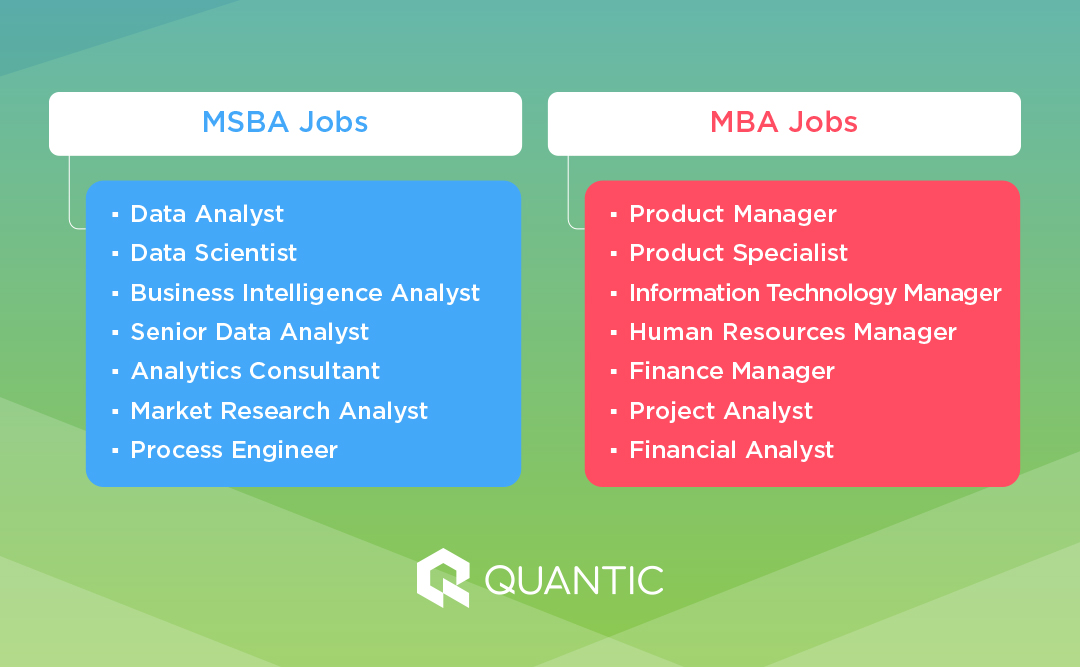
When it comes to jobs between the MSBA vs MBA, the primary difference you find is that MBA graduates are often positioned to take up managerial positions in a company. MSBA vs MBA jobs on the other hand primarily focus on distinct responsibilities: MBA roles lean toward management, while MSBA roles focus on analyzing data to advise leadership. However, MSBA graduates, with the right experience, can expect to advance to senior positions within a company.

msba vs mba job comparison
MSBA JobsMBA Jobs

Data AnalystData ScientistBusiness Intelligence AnalystSenior Data AnalystAnalytics Consultant Market Research Analyst Process Engineer 

Product ManagerProduct SpecialistInformation Technology ManagerHuman Resources ManagerFinance ManagerProject AnalystFinancial Analyst 

Salary Comparison 

According to Payscale, MBA and MSBA graduate salaries vary by an average of a little over $10,000. 

msba vs mba salary comparison
Average MSBA SalaryAverage MBA SalaryMedian Quantic MBA Salary
$73,197$88,783 $105,500

By contrast, Quantic’s 2022 MBA Alumni saw an average salary of over $105,500

quantic mba salary results

Is an MSBA Better Than an MBA? 

It is difficult to say which is better between MSBA and an MBA. In fact, you will find the answer depends on your unique career goals. MSBAs are focused and value data analytics over leadership. For example, Quantic’s MSBA program emphasizes cutting-edge analytics tools and AI-enhanced strategies, making it ideal for those aiming to become data specialists. An MBA, on the other hand, is more flexible by providing students with a high-level business understanding with the additional potential to specialize in areas such as operations, marketing, or finance. Programs like Quantic’s MBA also allow students to build leadership skills while maintaining career flexibility.

Who the MSBA is Better for

An MSBA is best for those who wish to focus on data and analytics. If you have a passion for data science over management, you’ll most likely prefer taking an MSBA to become a data specialist. This program is best suited for those looking to keep their head down while excelling at what they do best – data science. 

Who the MBA is better for 

On the other hand, if you wish to rise to be a leader in a company, you’ll want to pursue an MBA. Although MBAs offer concentrations to allow you to specialize in the management of a specific field, such as data science, they offer a more general understanding rather than strict technical skills. As such, this is the program for you if you’re looking for a flexible degree that will serve you across industries as the best degree for professional growth. 

Is a Master in Business Analytics Worth It? 

In short, yes. A master business analytics degree is absolutely worth it for those wishing to become data specialists. These programs provide students with an effective understanding of data utilization within a business.

If you’re looking to move beyond data science and lead teams to achieve large-scale business goals, an MBA is the way to go. Quantic offers a unique and accelerated MBA program that can help position you as a leader in any industry you choose. In fact, 94% of Quantic alumni report that they achieved their career goals after graduation, thanks to the education they received through our program. What’s even more impressive is that they did so over five times faster than other MBA students from the top 10 business schools.

With Quantic, you will develop core business skills to maximize your career success, regardless of your chosen industry. All the while, you do so in an accelerated 15-month program of study specifically designed for the early-career professional with leadership aspirations. Plus, you experience this award-winning curriculum through interactive technology and collaborative group study in a structured, yet flexible format. 

So, if you’re ready to advance your career with a Quantic leap forward, check out our admissions page today. 

To read more about Quantic’s impact on its students and alumni, check out Quantic Reviews on Trustpilot, EduOpinions and Niche, where learners share how the programs have helped them achieve their professional and personal goals.


More on the Quantic Blog:

How a Master’s in Business Analytics Transforms Decision-Making

The digital age has ushered in an era of knowledge abundance, fundamentally reshaping how businesses operate and create value. A Master’s in Business Analytics equips professionals with the tools to navigate this transformation, leveraging artificial intelligence (AI) to access and analyze vast amounts of data effectively. This shift challenges traditional notions of productivity and competitive advantage by making information and computational power more accessible than ever before.

Sam Altman, CEO of OpenAI, highlights that humanity is undergoing a transformative shift where AI significantly amplifies access to knowledge and innovation (Altman, “The Future of AI and Humanity”). Similarly, Satya Nadella, CEO of Microsoft, emphasizes the importance of integrating AI into all aspects of work to thrive in today’s economy. Both leaders underscore that the competitive edge for businesses lies in their ability to adapt intelligently, innovate, and align their goals with societal and ethical imperatives.

AI represents more than just a technological advancement—it signals a fundamental shift in decision-making processes and value creation.

The Future of Decision-Making: Five Transformative Trends in 2025

1. Agentic AI and Autonomous Systems

Agentic AI represents a monumental leap in decision-making, enabling systems to operate with autonomy and tackle complex challenges. These systems independently analyze data, predict outcomes, and make strategic choices. For example, augmented reality (AR) tools integrated with AI are transforming industries like real estate, where stakeholders use immersive visualizations to interpret market trends more effectively. A Master’s in Business Analytics equips professionals with the skills to navigate these advancements while addressing critical questions about accountability and ethics. Organizations must establish robust oversight frameworks to maintain transparency, ensure fairness, and preserve trust.

2. Democratizing Analytics

The democratization of analytics empowers individuals at all organizational levels to leverage data for impactful decision-making. Tools like no-code and low-code platforms break down technical barriers, enabling employees to access and act on insights without specialized expertise. For instance, a marketing manager can use these tools to evaluate campaign performance and make data-driven adjustments in real-time, reducing reliance on IT teams. However, achieving true democratization requires investments in data literacy programs and cultural shifts prioritizing data-driven thinking. Companies that successfully adopt this approach create environments where decisions are informed, agile, and inclusive.

3. Predictive and Prescriptive Analytics

Predictive and prescriptive analytics are the backbone of proactive decision-making. Predictive models analyze historical data to forecast risks, opportunities, and trends, while prescriptive analytics recommends actionable strategies to optimize outcomes. For example, logistics companies use these tools to anticipate disruptions and adjust routes, minimizing delays and improving operational efficiency. Despite their transformative potential, organizations often face challenges with fragmented data systems and the technical expertise required to integrate these models fully. Overcoming these barriers unlocks significant competitive advantages.

4. Real-Time Analytics

Real-time analytics enhances agility by providing instant insights that enable organizations to adapt to rapidly changing conditions. Retailers leverage real-time data to adjust pricing during flash sales, maximizing revenue while maintaining customer satisfaction. Similarly, hospitals use live patient data to allocate resources more effectively during emergencies. Professionals with a Master’s in Business Analytics are uniquely positioned to harness real-time data for strategic and impactful decision-making.

The integration of real-time capabilities with predictive and prescriptive models amplifies their impact, enabling businesses to respond not only quickly but strategically. However, scaling these systems requires robust infrastructure and seamless integration to ensure decisions are timely, informed, and impactful.

5. Ethical and Societal Alignment

AI-driven analytics demands more than just technical capabilities. Businesses must create systems that empower ethical decision-making, cultivate adaptability, and integrate with broader societal objectives. It’s no longer about collecting vast amounts of data but creating frameworks that ensure insights translate into meaningful action. A Master’s in Business Analytics emphasizes the ethical use of data, preparing professionals to align analytics with societal goals.

Companies must establish robust ethical guidelines to ensure fairness, accountability, and trust in their decision-making processes. This alignment not only enhances decision-making but also reshapes competitive dynamics and economic value creation.

Master the Art of Data-Driven Decision-Making with Quantic’s MSBA Program

Quantic’s Master of Science in Business Analytics (MSBA) program uniquely blends advanced data analytics with strategic business insights in our award-winning interactive curriculum. You’ll delve into courses like Strategic Leadership, Machine Learning, Cloud-based Big Data, and AI-enhanced analytics, all while participating in a Capstone Project that brings this learning to life. This program sharpens your analytical skills and ability to use modern data collection and visualization tools, preparing you to navigate the complexities of business decision-making with confidence. Here’s how Quantic stands out:

  • The Active Learning Edge:
    • Intuitive, active learning methodology paired with expert faculty guidance.
    • Precision-driven AI Advisor provides tailored support and opportunities for deeper exploration of topics.
    • Interactive, relevant, and always evolving to meet your needs.
  • Social Learning:
    • Collaborate with a global network of peers on data-driven case studies, group projects, and enriching discussions.
    • Experience an impactful Capstone Project that blends theory with practical application, showcasing your readiness for a data-centric world.
  • Global Events:
    • Optional extended weekend conferences and meetups hosted online and in cities worldwide.
    • Participate in corporate site visits, workshops, and networking opportunities with exceptional peers and Quantic faculty.

Lead the Data Revolution with Confidence

AI-driven business analytics is revolutionizing how organizations make decisions, create value, and align with societal goals. By embracing data-driven strategies, businesses can unlock innovation, gain a competitive edge, and drive meaningful progress. Quantic’s MSBA program equips professionals with the tools, ethical mindset, and cutting-edge expertise to harness AI’s transformative power, bridging the gap between technology and strategic leadership in an ever-evolving landscape. Explore Quantic’s MSBA program today and take the first step toward transforming your career.

Discover why our students love us and why we’re trusted by top employers around the world by reading the highly-rated Quantic reviews here.

Sources:

Altman, Sam. “Sam Altman: The Future of AI and Humanity.” TED. Accessed January 24, 2025. https://www.ted.com/pages/sam-altman-on-the-future-of-ai-and-humanity-transcript.

Warren, Tom. “Microsoft Thinks AI Is Transforming the Future of Work.” The Verge. Last modified January 17, 2025. https://www.theverge.com/2025/1/17/24345865/microsoft-ai-announcements-2025-notepad.


Related articles:

AI-Focused Software Engineering: Real-World Impact

Artificial Intelligence (AI) is revolutionizing the software engineering landscape, driving innovation and transforming industries worldwide. According to Gartner by 2028, 75% of enterprise software engineers will use AI code assistants, up from less than 10% in early 2023, yet there is an expected AI talent gap of 50%, according to new research from Reuters. This gap highlights a critical shift: AI-focused software engineering is now the linchpin of innovation. From automating code deployment to enabling real-time fraud detection in FinTech, AI isn’t just optimizing workflows—it’s redefining what software can achieve. 

However, mastering AI’s real-world applications remains daunting. Engineers grapple with ethical dilemmas, scalability bottlenecks, and the breakneck pace of tools like generative AI. Programs like Quantic’s Master of Science in Software Engineering (MSSE) are bridging this gap, equipping professionals with practical expertise—from building compliance-ready AI tools to deploying scalable systems—to excel in AI-driven roles. How do we turn cutting-edge theory into measurable impact? This article breaks down the principles, tools, and strategies powering AI-focused software engineering, offering actionable insights for professionals ready to lead the next wave of tech innovation.

The AI Revolution in Software Engineering

The rapid integration of Artificial Intelligence (AI) into software engineering is transforming how code is written, tested, and maintained. From automating tedious tasks to enhancing decision-making, AI-driven software development is redefining the future of software engineering. At the heart of this transformation lies AI-Focused Software Engineering, which enables developers to unlock new efficiencies and capabilities. Below, we explore how AI is reshaping the coding landscape and driving innovation across industries.

How AI is Redefining the Future of Code

AI-driven tools are revolutionizing coding by automating processes and introducing predictive capabilities that streamline workflows:

  • AI-Generated Code and Debugging: Tools like GitHub Copilot use advanced algorithms to suggest and generate code snippets, reducing development time and boosting accuracy. These tools exemplify the role of machine learning in engineering by applying predictive models to streamline code generation and debugging. For example, Salesforce uses AI-powered tools to automate code generation and debugging processes, enabling faster development of its CRM software.
  • Automated Testing: AI enables automated test case generation, identifying software vulnerabilities early and ensuring higher-quality outputs. Netflix, for instance, uses AI to automate testing of its streaming platform, ensuring seamless performance across millions of devices globally.
  • Predictive Maintenance: AI analyzes historical data to predict potential system failures, allowing developers to address issues proactively before they escalate. Google exemplifies this with its use of AI to optimize data center cooling, cutting energy costs by 40% while maintaining peak performance.

Industries at the Forefront of AI Integration

AI’s transformative potential is being harnessed across diverse industries to solve complex, real-world problems:

  • Healthcare: AI-powered diagnostic systems improve accuracy and speed in detecting diseases, revolutionizing patient care. For example, PathAI uses AI to assist pathologists in diagnosing cancer with greater precision, reducing diagnostic errors.
  • Finance: Fraud detection tools leverage AI to analyze transaction patterns and identify anomalies in real-time, ensuring security and trust. PayPal employs AI models to detect and prevent fraudulent transactions, saving billions annually while safeguarding users.
  • Supply Chain Optimization: AI enhances logistics by predicting demand, optimizing routes, and reducing operational inefficiencies. For instance, Amazon uses AI to optimize warehouse operations and manage inventory, ensuring faster delivery times and reduced costs.

Building Intelligent Systems: Core Principles for Real-World Impact

As AI continues to revolutionize software engineering, building intelligent systems capable of solving real-world challenges is critical. Success in AI-Focused Software Engineering hinges on designing scalable architectures and ensuring ethical AI development. These principles not only drive innovation but also ensure the systems are efficient, fair, and adaptable to evolving industry needs.

Designing Scalable AI Architectures

Scalability is a cornerstone of intelligent systems, ensuring they can handle increasing demands without compromising performance. By building scalable AI solutions, organizations can adapt to growing data loads and user demands seamlessly. Key principles include:

  • Dynamic Recommendation Engines: Platforms like Spotify rely on scalable AI architectures to deliver personalized music recommendations to millions of users daily, adapting in real-time to individual preferences.
  • Effective Deployment Tools: Industry-standard frameworks such as Kubernetes and TensorFlow Extended (TFX) facilitate seamless orchestration and deployment of AI models, ensuring systems can scale effortlessly.
  • Cloud Integration: Leveraging cloud-based solutions like AWS and Google Cloud enhances scalability by providing the infrastructure to support large-scale AI deployments.

Ethical AI Development in Practice

Building intelligent systems requires a strong focus on ethical AI practices to ensure fairness, transparency, and compliance with regulations. These practices safeguard user trust and align with evolving industry standards. Key considerations include:

  • Bias Mitigation: Companies like IBM Watson Health are addressing bias in AI diagnostics to ensure equitable healthcare outcomes, particularly in underserved populations.
  • Compliance with Data Privacy Laws: Adhering to frameworks like GDPR and CCPA is essential for AI systems handling sensitive user data. For example, Apple incorporates privacy-preserving machine learning to protect user data while delivering personalized experiences.
  • Explainable AI (XAI): Ensuring that AI systems provide clear and understandable outputs builds trust with users and stakeholders. Tools like LIME (Local Interpretable Model-Agnostic Explanations) are increasingly used to achieve this.

Tools and Technologies for Deploying AI at Scale

As businesses adopt AI-driven solutions, the ability to deploy and manage these systems at scale has become critical for success. From frameworks enabling real-time applications to AI-augmented workflows, these tools empower engineers to build robust systems that deliver measurable impact. In AI-Focused Software Engineering, mastering these technologies is key to staying competitive. Below, we explore the frameworks and methodologies driving scalable AI deployments.

Frameworks Powering Real-World AI Solutions

AI frameworks play a pivotal role in simplifying the development and deployment of intelligent systems. Key tools and their applications include:

  • Generative AI Applications: Frameworks like OpenAI’s GPT-4 and Hugging Face libraries enable the creation of AI-driven chatbots, personalized customer support tools, and content generation systems. For instance, Duolingo uses AI-powered chatbots to deliver personalized language-learning experiences, improving engagement and retention.
  • End-to-End MLOps Pipelines: Tools like TensorFlow Extended (TFX) and MLflow streamline the entire AI lifecycle—from model training to deployment. These solutions ensure real-time model updates, reducing downtime and maintaining system performance. For example, Uber uses MLOps strategies to optimize its dynamic pricing models, ensuring accuracy and responsiveness in real-time.

AI-Augmented DevOps

DevOps practices augmented by AI are transforming how software systems are developed, tested, and deployed. Integrating AI into DevOps workflows enhances productivity and reduces errors:

  • Reducing Deployment Errors: AI-driven code analysis tools like DeepCode and SonarQube identify vulnerabilities and provide actionable insights to resolve issues before deployment. For instance, Netflix employs AI-powered error detection to ensure seamless updates to its streaming platform.
  • Enhanced Collaboration with Agile Tools: AI integrates into agile methodologies, streamlining SCRUM workflows and improving collaboration among teams. Quantic’s MSSE program emphasizes these practices, preparing students to lead AI-powered DevOps initiatives effectively.

Solving Industry Challenges with Real-World AI Engineering

The adoption of Artificial Intelligence (AI) across industries is solving some of the most pressing challenges by improving accuracy, efficiency, and security. From healthcare diagnostics to financial fraud detection, AI-Focused Software Engineering provides the tools and systems needed to create meaningful change. Below, we explore how AI is tackling critical problems in diagnostics, security, and high-stakes financial systems.

AI-Driven Diagnostics and Security

AI-powered systems are transforming diagnostics and security by providing faster, more accurate insights and robust protection for sensitive data:

  • Enhanced Diagnostics: AI models are reducing diagnostic errors and improving patient outcomes. For instance, Siemens Healthineers uses AI to analyze medical imaging, enabling earlier detection of diseases such as cancer and heart conditions. These advancements have significantly reduced misdiagnosis rates, saving lives.
  • Data Encryption and Security: AI is securing sensitive information by implementing advanced encryption techniques and intrusion detection systems. Companies like Darktrace leverage AI to monitor and respond to cyber threats in real time, ensuring that sensitive data remains protected.

High-Stakes Financial Systems

AI is transforming financial operations by improving fraud detection and optimizing critical processes at scale:

  • Real-Time Fraud Detection: Financial institutions like Visa use AI to analyze billions of transactions daily, identifying fraudulent activities with exceptional speed and accuracy. These systems continuously learn from new patterns, staying ahead of increasingly sophisticated cyberattacks.
  • Optimizing Latency and Accuracy: High-frequency trading platforms are leveraging AI to balance low-latency decision-making with precise predictions. For example, JP Morgan Chase uses AI to optimize trade executions, ensuring both speed and accuracy in the competitive financial markets.

Leading the Next Wave of AI Innovation

The rapid advancement of AI technologies demands professionals who can bridge the gap between theoretical concepts and practical applications. As industries increasingly adopt AI-powered solutions, the role of AI-Focused Software Engineering becomes central to driving innovation. Quantic’s Master of Science in Software Engineering (MSSE) is designed to equip professionals with the skills and experience needed to excel in this transformative field.

Bridging Learning and Real-World Impact

Quantic’s MSSE program is designed to transition you from a technology generalist or early-stage specialist into an AI-focused software engineering expert in just a year. This fully online program combines asynchronous learning with real-world projects, preparing you for the AI and machine learning revolution in software development.

  • Aspiring Technical Innovators: Tailored for recent graduates or career shifters, regardless of technical background, eager to master software engineering and AI-enabled infrastructure. 
  • From Learning to Leading: Elevate your expertise with targeted training in machine learning integration, AI software engineering, cloud architecture, and microservices. These skills, combined with our world-class networking opportunities and career services will prime you for taking on leadership roles in any technology-driven organization.
  • Capstone: Innovation in Practice: Over five months, you’ll work within an agile team of exceptional peers to design, develop, test, and deploy a functional software artifact. This intensive project culminates in a public GitHub repository demonstration, preparing you to manage and execute complex software engineering projects in any professional setting.

Voices from the Field

The potential of Quantic’s MSSE program is already evident in the enthusiasm and experiences of its first cohort of students:

Why Choosing Quantic’s MSSE: An AI-Focused Software Engineering Master’s Program - Shared by Jess Ingrassellino
Why Choosing Quantic’s MSSE: An AI-Focused Software Engineering Master’s Program - Shared by Rajesh Krishnaswamy
Why Choosing Quantic’s MSSE: An AI-Focused Software Engineering Master’s Program - Shared by Taylor Weibley

Quantic has built a strong reputation for empowering professionals through innovative education. Alumni from other Quantic programs, such as the Executive MBA, often share how the experience has significantly shaped their careers and expanded their horizons. For example, Rishabh Bitola highlights how Quantic’s programs helped him develop a global perspective, while alumni like Emily Stone, Miguel Mayorga, and Garry Sands describe their transformative learning journeys. Additionally, professionals such as  Onyeka Okonkwo and Kamila Tocicka emphasize how Quantic’s curriculum has accelerated their career progression and fostered personal growth.

To read more about Quantic’s impact on its students and alumni, visit Trustpilot Quantic Reviews, where learners share how the programs have helped them achieve their professional and personal goals.

Quantic’s MSSE program is not just about learning AI—it’s about applying it. As industries continue to embrace AI, professionals equipped with the knowledge and experience to implement AI-Focused Software Engineering will lead the charge in shaping the future.


Are you ready to lead the future of AI-driven software development? Explore Quantic’s MSSE program and take the first step toward becoming a leader in AI innovation.


More on the Quantic Blog:

5 Business Analytics Trends to Watch for in 2025 and Beyond

Business analytics trends are evolving rapidly, becoming a cornerstone of modern decision-making. The global big data market is forecasted to grow to $103 billion by 2027, more than double its size in 2018, which clearly reflects the increasing reliance on analytics to drive decision-making. Meanwhile, as companies navigate a fast-paced, data-driven world, these trends are transforming the landscape. Balancing advanced technologies with practical, real-world applications, these developments are reshaping how organizations leverage data. In summary, here are the five most impactful trends shaping the future of business analytics, followed by additional developments worth noting.

1. Agentic AI and Emerging Technologies: Smarter, Autonomous Systems

New technologies like agentic AI and quantum computing are redefining analytics by enabling systems to operate more independently while also solving complex problems faster.

  • Agentic AI: Agentic AI: Autonomous AI agents can analyze complex data sets and drive innovation in business analytics trends through independent decision-making. For example, Google Cloud’s trials demonstrate how these systems streamline analytics workflows.
  • Quantum Computing: Quantum technology solves intricate optimization problems, such as portfolio management, exponentially faster than classical methods, offering unprecedented capabilities.
  • AR/VR in Analytics: Immersive tools transform data visualization, making insights easier to understand and act upon. Real estate firms, for instance, use AR to overlay market trends on physical spaces.

2. Data Privacy and AI Governance: Building Consumer Trust

As businesses collect more data, ethical usage, and privacy compliance are becoming non-negotiable. Therefore, organizations must prioritize robust governance practices to foster trust and transparency.

  • Enhanced Data Governance: Robust policies ensure adherence to regulations like GDPR and CCPA.
  • Bias-Free AI Models: Ethical AI reduces discrimination in hiring and lending practices.
  • Blockchain Security: Decentralized ledgers safeguard data integrity and transparency.

Example: Financial institutions use blockchain to securely record transactions while protecting customer privacy. However, balancing compliance with innovation remains a challenge, making it essential to integrate these practices seamlessly.

3. Democratization of Analytics: Making Data Accessible

Today’s business analytics trends ensure analysis is no longer reserved for data scientists. Instead, tools empower employees across all departments to explore and act on data insights independently.

  • No-Code/Low-Code Platforms: Simplified tools allow users to create dashboards without programming expertise.
  • Self-Service Analytics: Platforms like Tableau enable teams to access and interpret data autonomously.
  • Collaborative Dashboards: Enhanced sharing features promote teamwork and unified decision-making.

While accessibility improves decision-making, businesses must address potential risks, such as data misinterpretation by non-experts, through training and oversight.

4. Predictive and Prescriptive Analytics: Anticipating What’s Next

Businesses are shifting from reactive to proactive strategies because they are leveraging predictive and prescriptive analytics.

  • Predictive Models: Business analytics trends like predictive models help forecast risks, opportunities, and consumer behaviors using historical data, enabling proactive strategies.
  • Prescriptive Analytics: Suggest actionable strategies to optimize operations.
  • Scenario Simulations: Explore potential outcomes of strategic decisions to mitigate risks.

Example: Logistics companies predict weather-related delays and reroute shipments proactively, reducing disruptions and costs.

5. Real-Time Analytics: Acting on Insights Instantly

In a world where delays can mean lost opportunities, real-time analytics has become essential. Consequently, organizations are increasingly adopting tools like streaming data processing and edge computing to remain competitive.

  • Streaming Data Processing: Platforms like Apache Kafka analyze and react to live data streams.
  • Edge Computing: Processes data closer to its source, reducing delays.
  • Automated Decision-Making: Real-time systems adjust inventory levels or reroute shipments immediately.

Example: Retailers dynamically adjust prices during peak demand, while hospitals optimize resource allocation during emergencies using live data.

  • Hyper-Personalization: Tailored experiences, already prevalent in retail and entertainment, are becoming the norm across industries.
  • Streaming Analytics: Real-time analysis is crucial for monitoring social media and financial markets.
  • Cloud Cost Optimization: Businesses are reducing cloud expenses by scaling usage based on actual demand.
  • Sustainability Analytics: Companies are analyzing operations to reduce environmental impact, driven by consumer expectations and regulations.
  • Explainable AI (XAI): Transparent AI models build trust, especially in regulated sectors like healthcare and finance.
  • Decision Intelligence: Combines data analytics with human expertise to refine decision-making processes.
  • Data Fabric Architecture: Simplifies access to data spread across multiple systems, ensuring consistent insights across large organizations.

Looking Ahead

The future of business analytics lies in blending advanced technologies with user-friendly startup tools, making data actionable for all. To thrive, organizations must strategically adopt these trends, invest in upskilling employees, and ensure their analytics frameworks align with business goals. By staying agile and building trust, businesses can turn data into a powerful competitive advantage.

Empowering the Future of Data Leaders: Your Next Step with Quantic MSBA

To thrive in this rapidly evolving landscape, future business leaders must master the tools and techniques powering these trends. The Quantic’s Master of Science in Business Analytics program (Quantic MSBA) provides the perfect foundation, equipping students with technical, analytical, and leadership skills to excel in business analytics, data science, and AI/ML.

Designed for professionals, even those with minimal technical backgrounds, the program teaches essential skills like SQL, Python, R, and Tableau, enabling students to analyze data and deliver actionable insights. Through a curriculum that blends quantitative methods with strategic business applications, students gain expertise in data management, predictive modeling, and ethical AI practices—directly addressing the demands of emerging trends like real-time analytics and AI governance.

The program culminates in collaborative capstone projects, where students solve real-world problems, translating data into impactful business strategies. Beyond technical expertise, the MSBA offers learning in key domains such as finance, marketing, and innovation, ensuring graduates can navigate the cross-functional challenges highlighted by democratized and predictive analytics.

By integrating Quantic’s conferences and a global alumni network, the program keeps students ahead of the curve, connecting them with industry leaders and fostering lifelong learning.

Explore the Quantic MSBA program today and lead the future of business analytics.

Discover why our students love us and why we’re trusted by top employers around the world by reading Quantic reviews here. 


Related articles:

Is Quantic’s MBA worth it: Real Student Reviews and Outcomes

Is the Quantic MBA worth it? This question is on the minds of many prospective students seeking a flexible, affordable, and accredited MBA program. Quantic School of Business and Technology has redefined online education with its mobile-first, AI-powered learning platform and significantly lower tuition costs compared to traditional MBAs. Quantic offers a unique approach to business education. But does the program live up to the hype? Here are the 25 FAQs commonly discussed by prospective students about Quantic, along with real student reviews, career outcomes, and an evaluation of whether Quantic delivers on its promise of an innovative, flexible MBA experience.

Legitimacy and Accreditation

Is Quantic a legitimate school?

Yes, Quantic School of Business and Technology is licensed by the District of Columbia Higher Education Licensure Commission in Washington, DC, and accredited by the Distance Education Accrediting Commission (DEAC). The DEAC is listed by the United States Department of Education as a recognized accrediting agency and is also recognized by the Council for Higher Education Accreditation (CHEA). This ensures Quantic meets rigorous academic and professional standards.

Is Quantic’s MBA legit?

Yes, the Quantic MBA is a legitimate program. Quantic School of Business and Technology is accredited by the Distance Education Accrediting Commission (DEAC). It is designed for high-potential, early-career learners eager to make a difference.

Is the Quantic Executive MBA accredited?

Yes, Quantic’s Executive MBA is an accredited program. Quantic School of Business and Technology is accredited by the Distance Education Accrediting Commission (DEAC). It is designed for mid-career professionals and focuses on developing leadership, global strategy, and advanced business skills.

Is the Quantic MBA recognized by employers?

Absolutely. Quantic students and alumni work at top global companies, such as Google, Amazon, Microsoft, Salesforce, Deloitte, Apple, and JPMorgan Chase & Co. Over 2,100 Quantic students and alumni are employed at companies in Quantic’s Employer Network, and many employers offer tuition reimbursement for Quantic programs, demonstrating trust in its value.

Is Quantic’s MBA regionally accredited?

No. Quantic is nationally accredited by the Distance Education Accrediting Commission (DEAC). The DEAC is listed by the United States Department of Education as a recognized accrediting agency and is also recognized by the Council for Higher Education Accreditation (CHEA). It accredits distance education institutions that offer online programs, such as those pioneered by the Quantic School of Business and Technology.

Is the Quantic MBA legit in 2025?

Yes, the Quantic MBA remains a legitimate, accredited program in 2025. It is distinguished by its mobile-first, AI-powered platform, career outcomes, and affordable tuition model, making it a popular choice among professionals seeking flexible, high-quality business education. Learn more about the Quantic Method.

What’s the deal with Quantic?

Quantic School of Business and Technology is a mobile-first, AI-powered business school. Founded on the notion that higher education lacks quality, effective, flexible, and cost-efficient solutions, it provides accredited online degree programs that rival top traditional elite business education. Quantic attracts thousands of high achievers from the world’s best companies, teaching today’s leaders future-forward skills in business and technology. Visit Quantic’s website to learn more.

Who owns Quantic School of Business and Technology?

Quantic is owned by Pedago, Inc., an education technology company committed to making elite education accessible and affordable for high-potential professionals worldwide.

Is a Quantic MBA real?

Yes, the Quantic MBA is a real, accredited degree program. Selective in admissions, we assemble global cohorts of high-potential, early-career learners, delivering an online MBA curriculum with a comprehensive student experience that includes exclusive online and in-person events, while delivering exceptional career outcomes.

Is the Quantic (formerly Smartly) MBA worth it?

Yes, Quantic’s MBA is worth it for professionals seeking a flexible, affordable, and innovative business education. Graduates report career advancement, salary increases, and expanded networks. Check out how Quantic helps leaders level up and why People love Quantic.

Program Details

What programs does Quantic School of Business and Technology offer?

Quantic offers a range of programs designed for professionals at different career stages:

MBA: As an accelerated 15-month program of study, the MBA is designed for the early-career professional with leadership potential. The award-winning curriculum combines interactive technology and collaborative group study with exceptional classmates around the world, delivered in a structured, yet flexible format.

Executive MBA: Our premier 15-month degree program is designed for the mid-career professional, integrating collaborative group projects with our rigorous MBA curriculum, enhanced with specializations in management, leadership, entrepreneurship, and advanced strategy.

MS in Business Analytics (MSBA): Our accredited MSBA degree uniquely blends advanced data analytics with strategic business insights in our award-winning interactive curriculum.

MS in Software Engineering (MSSE): Quantic’s MSSE prioritizes hands-on learning with a focus on projects and real-world applications, especially in AI software development.

Quantic Executive Education Programs: A suite of certificates designed to help you stay sharp and level up. It’s lifelong learning at any career stage.

How long does it take to complete a Quantic MBA?

Quantic MBA and Executive MBA programs each take 15 months to complete, offering a streamlined yet rigorous curriculum tailored for ambitious professionals. Designed with flexibility at their core, these programs leverage Quantic’s innovative mobile-first platform, allowing students to seamlessly balance their studies with demanding careers. With AI-powered, Active Learning, Quantic empowers working professionals to learn dramatically easier and faster.

How hard is the Quantic MBA program?

The Quantic MBA program is rigorous, yet intentionally designed to support the success of busy professionals. While the program challenges students with its mastery-based progression and engaging, interactive coursework, its innovative structure ensures flexibility and accessibility:

Mobile-First Platform: The program is entirely mobile-friendly, allowing students to learn anytime, anywhere. 

Bite-Sized Lessons: Lessons are designed to be concise, typically 5–10 minutes long, enabling learners to make consistent progress in short, focused bursts.

AI-Powered and Personalized Learning: Quantic’s platform uses artificial intelligence and machine learning to adapt to each student’s pace and needs. This ensures personalized guidance, immediate feedback, and tailored support to help you master challenging concepts.

Mastery-Based Progression: Quantic’s program requires active engagement and frequent interactions to advance. This approach reinforces understanding while building on prior lessons, ensuring students are well-prepared for the next challenge.

The program’s structure makes it demanding yet manageable, offering a balance of rigor and flexibility that empowers professionals to advance their careers without sacrificing their current responsibilities. This learner-focused design is what makes Quantic both challenging and uniquely effective.

What’s the deal with the Quantic Executive MBA?

Quantic’s Executive MBA combines our award-winning MBA curriculum with added advanced courses designed for mid-career professionals and entrepreneurs. This curriculum is enhanced with a comprehensive student experience that includes online and in-person events while delivering exceptional career outcomes. Learn more about the Quantic Executive MBA.

Admissions and Selectivity

How competitive is the Quantic MBA admission?

Through a rigorous admissions process, Quantic attracts a large pool of talented applicants from diverse industries. Quantic students come from prestigious universities such as Oxford, UC Berkeley, and Harvard and work at top-tier companies, including Google, Amazon, and Microsoft. Applicants are evaluated on their academic background, professional experience, and career aspirations to ensure a strong and collaborative cohort.

How selective is Quantic’s MBA?

Quantic has a selective admissions process that evaluates applicants based on their professional accomplishments, academic background, and career goals. The program attracts a diverse group of students, including professionals from leading companies and graduates of respected universities. Quantic looks for individuals who are motivated to develop leadership skills and thrive in a collaborative learning environment.

Is it hard to get into the Quantic MBA?

Admission to the Quantic MBA is competitive, as the program seeks applicants with strong academic backgrounds, relevant professional experience, and clear career goals. Applicants who effectively highlight their qualifications and motivation for growth are more likely to succeed in the admissions process.

What happens after I’m accepted to Quantic School of Business and Technology?

After being accepted to Quantic School of Business and Technology, here’s what you need to do next:

(1) Register for the Program:
You must confirm your spot in the program by registering online, typically within three weeks of receiving your admission decision.
During registration, you’ll need to select a tuition plan and make your initial payment.

(2) Complete Enrollment Documents:
Within two weeks of the registration deadline, you’ll need to submit all required enrollment documents. These include:

– Verifying your identity.
– Providing unofficial university transcripts (official transcripts will be required later).
– Submitting proof of English language proficiency, if applicable.

Your enrollment will be finalized, and you’ll be fully admitted once these documents are reviewed and your academic eligibility is confirmed.

(3) Prepare for Program Start:
Quantic conducts occasional virtual orientations to help you get familiar with the program. Look out for emails announcing these dates.
You’ll gain access to an online class forum where you can connect with your classmates and prepare for collaborative projects.

(4) Access the Curriculum:
Approximately one week before classes officially begin, you’ll receive access to the full program curriculum. This early access allows you to start working on foundational courses ahead of the formal schedule.

To learn more, email admissions@quantic.edu or schedule a 1:1 video chat with an Admissions Advisor.

Outcomes and Values

What makes Quantic School of Business and Technology stand out in terms of learning outcomes and career impact?

Quantic stands out due to its innovative Active Learning method, measurable career outcomes, and proven efficacy compared to traditional MBA programs:

(1) Active Learning for Better Retention: Unlike traditional lecture-based education, Quantic uses an interactive, mastery-based approach. This method requires students to actively engage with the material, make decisions, and receive immediate feedback, ensuring deeper understanding and retention.

(2) Career Advancement: Quantic’s program has demonstrated measurable career impact:
– 52% of students report a job promotion within six months of graduation.
– A median graduate salary increase of 22% was reported during the same timeframe.

(3) Global Recognition and High Satisfaction:
– Quantic boasts a Net Promoter Score (NPS) of 61, surpassing traditional top business schools like Harvard (41) and Wharton (51).
– 97% of students recommend the program, and its app holds a 4.9-star rating on both Apple and Google Play.

(4) Proven Efficacy and Unique Teaching Approach:
– In a 2017 study, learners on the Quantic platform mastered Probability and Statistics in one-third of the time compared to edX and Khan Academy students. Quantic learners also reported higher engagement and achieved higher exam scores, with competitors being five times more likely to score below 50%.
– Additionally, a Stanford study showed Quantic MBA students performed as well or better than students from the top 10 global business schools in Accounting and Finance, completing the material faster and with higher retention.

Quantic is ideal for professionals seeking an efficient, impactful, and affordable education that rivals the outcomes of elite traditional programs. Learn more about Quantic’s method.

What is the graduation rate for Quantic?

Quantic’s graduation rates highlight the program’s success in preparing students for career advancement on a global scale. In 2020, the MBA program achieved an 86% graduation rate, while the EMBA program boasted an even higher 91% graduation rate.

These outcomes are part of Quantic’s broader impact:

Global Reach: With 17,000+ students and alumni across 155 countries, Quantic fosters a diverse and worldwide professional network.

Career Advancement: 52% of graduates receive a job promotion within six months of completing the program, and graduates report a median 22% salary increase during the same period.

Student Satisfaction: Quantic’s exceptional Net Promoter Score (NPS) of 61 surpasses top schools like Harvard (41) and Wharton (51), and 97% of students recommend the program to others.

Quantic’s impressive graduation rates, combined with its measurable career outcomes and global reach, underscore its effectiveness in helping professionals achieve their academic and professional goals. See more stats.

What jobs can you get with a Quantic MBA?

Quantic MBA graduates excel in diverse industries such as technology, consulting, finance, healthcare, and entrepreneurship, with top roles including senior management, operations, product management, IT, and marketing. Alumni work at leading companies like Google, Amazon, Microsoft, Deloitte, and Salesforce, leveraging their degrees to secure senior positions, launch startups, and drive innovation across industries. Meet our students to learn more about alumni success stories.

Is Quantic MBA worth the money?

Quantic’s mobile-first, AI-powered MBA offers exceptional value by combining a practical and engaging curriculum with measurable career impact. Students consistently praise the program’s flexibility, affordability, and ability to fit into busy professional schedules. Alumni report accelerated career growth, with many securing promotions, higher-paying roles, or launching successful ventures.

The program’s global network is another standout feature, connecting learners across 150+ countries and fostering meaningful collaborations with peers and industry leaders at top companies like Google, Amazon, and Microsoft. Quantic’s cutting-edge education has been recognized by leading publications like Poets & Quants and the BusinessBecause for its disruptive approach to business education.

Explore more reviews and detailed testimonials from students and alumni to see why Quantic is a smart investment: Quantic Reviews.

Thoughts on Quantic MBA: What are students and alumni saying about Quantic?

Quantic consistently receives outstanding feedback from its students and alumni. Many, like Emily Stone, Miguel Mayorga, and Garry Sands, have shared transformative experiences completing the Quantic Executive MBA. Alumni such as Rishabh Bitola highlight how the program expands global horizons, while others, like Onyeka Okonkwo and Kamila Tocicka, emphasize its profound impact on personal growth and career advancement.

In addition to these personal stories, Quantic has received glowing reviews on Trustpilot, where students praise the program’s innovative curriculum, flexibility, and real-world impact. These highly-rated reviews offer valuable insights into why Quantic is a top choice for professionals seeking to elevate their careers. Here are just a few of them: 

“There’s never an easy time to go to business or grad school, especially if you’re busy with work, family, and the billion other things one grapples with as an adult. I believe this is where Quantic shines — an MBA program you can do without completely upending your life and routine. The curriculum is robust, and the learning process is engaging, flexible, and thoughtful. It’s rigorous, but it’s doable if you’re keen, and can commit the time and effort required.” – ⭐⭐⭐⭐⭐Solomon Osadolo

“Absolutely worth it! Great program, fantastic peers, very well orchestrated. I can compare to studies on a high profile university in the UK and in Central Europe and Quantic definitely sets the quality bar really high.” – ⭐⭐⭐⭐⭐ Kamila Tocicka

“Completing my MBA with the Quantic School of Business & Technology was one of the best decisions I’ve made. The modern curriculum, delivery format (making it flexible), the community of students and alumni (from exemplary backgrounds and diverse), and affordability make this option highly invaluable. In addition, I was able to secure significantly professional advancement (with role and pay) after completing my program. I’ve also enrolled in their MS in Software Engineering program, and can’t share enough how valuable this school is – I highly recommend it.” –⭐⭐⭐⭐⭐ U A

“My experience with Quantic was awesome. I enjoyed my interactions with the school right from the interviews, billing and onboarding which was very smooth. The lessons were short and fun yet really loaded and insightful. The entire program was very well paced and I was able to easily fit it in my busy schedule. The case studies and projects were challenging and helped reinforce the learnings… I interacted with students from diverse backgrounds through the regular student events. Even after graduation I have access to all the lessons, alumni events, career services and more! It can’t get better than this! I truly had a delightful experience and would recommend it” – ⭐⭐⭐⭐⭐ Betty Gatwiri

Check out Quantic Reviews on Trustpilot, EduOpinions and Niche to read more testimonials of how Quantic has enabled learners to achieve their personal and professional goals.

Last update on 5 February 2025

Students and education leaders appreciate
our value and disruptive approach.

Is Quantic mba worth it: Students and education leaders appreciate our value and disruptive approach.

Learn more: 

More questions? Please visit Quantic FAQ.


More on the Quantic Blog:

Quantic Reviews: Hearing Directly From Students and Alumni

In today’s rapidly evolving world, where technology and AI are reshaping industries, choosing the right MBA or Executive MBA program is more critical than ever. Innovative teaching methods, relevant curricula, true flexibility, and affordability have become essential factors in modern education. Quantic School of Business and Technology, a trailblazer in online business education, is redefining how professionals learn with its mobile-first, AI-powered platform. Combining unmatched flexibility with a practical, real-world curriculum, Quantic equips learners to achieve their career aspirations. But don’t just take our word for it—here are the highly-rated Quantic reviews from students and alumni about their transformative journeys with Quantic’s programs.

Quantic Reviews by Onyeka Okonkwo: A Revolutionary Approach to Learning That Sticks 

An Interactive Learning Experience Like No Other

When I first discovered Quantic, I was intrigued by its mobile-first and interactive learning approach, which stood out from traditional programs. From the very beginning, the program exceeded my expectations with its bite-sized case studies and engaging, fill-in-the-answer formats that made learning enjoyable and impactful. Unlike the passive experience of video lectures, Quantic kept me actively involved, and the humor woven into the content ensured I stayed engaged throughout. 

This was education like I had never experienced before—delivered in bite-sized case studies that gradually eased me into various business concepts. Learning that truly sticks! The ability to immediately apply the concepts to real-world challenges made the experience both practical and transformative.

Expanding Connections and Collaborative Growth

Quantic’s global learning community was another highlight of the program. My cohort included professionals from top universities and companies, which added immense value to group projects and discussions. The collaborative projects were particularly impactful, as they allowed me to work with diverse perspectives and apply my learning to complex business problems. Beyond academics, Quantic’s networking platform and tools, like Slack and the monthly book club, provided opportunities to connect with peers worldwide and foster valuable relationships. Overall, I had an exciting time learning at the Quantic School of Business and Technology; I totally recommend the program and look forward to putting everything I learned into practice.

Onyeka Okonkwo
Risk Manager
KPMG UK

Read the Full Review on LinkedIn | Comprehensive Review of the Quantic MBA

Quantic Reviews by Kamila Tocicka: Rediscovering Confidence and Leadership Through Lifelong Learning 

Balancing Motherhood and Education to Reclaim Myself

During one of the most challenging periods of my life—balancing the joys and struggles of motherhood with a sense of personal loss—I realized how important it was to rediscover myself. While I adored my daughter, I missed the ambitious, creative woman I used to be. Pursuing an Executive MBA at Quantic School of Business and Technology became a way to regain control and reignite my passion for learning. The program taught me invaluable skills like time management and prioritization that helped me balance the demands of motherhood and my studies. For the first time in a long time, I felt as though I was in control of my life. This transformative journey not only helped me grow as a professional but also gave me the confidence to embrace my full potential.

Personal and Professional Growth Beyond Expectations

Quantic’s program gave me more than just business acumen—it reshaped how I value myself and my accomplishments. Armed with newfound confidence and skills, I successfully transitioned back to work, excelled in my role, and even negotiated a promotion shortly after graduation. The impact extended beyond my career, enriching my relationships and allowing me to reconnect with the creative, driven person I once was.

The impact of my MBA studies went far beyond just my career. I found myself feeling more fulfilled and empowered than ever before. Quantic’s approach to lifelong learning was a catalyst for change, empowering me to overcome challenges and embrace leadership both at work and in life.

Kamila Tocicka
Assistant Director
EY

Read the Full Review on LinkedIn | From Baby Blues to Leadership: How Pursuing Lifelong Learning Transformed My Life

Quantic Reviews by Emily Stone: Empowering Working Professionals Through Flexible Learning

Finding the Perfect MBA for a Busy Working Parent

I enrolled in the Quantic Executive MBA program in early 2020, seeking a flexible, affordable program to help me grow beyond my expertise in HR and Learning & Development. With over 15 years of experience designing online courses, I was drawn to Quantic’s mobile-friendly platform, which offered a highly interactive and engaging learning experience through continuous assessments and practical case studies. As a full-time working mom of three young children, the program’s flexibility was essential—I could complete coursework from my phone anytime, even while sitting on the couch or waiting in line at the grocery store! The opportunity to test-drive the platform before enrolling gave me confidence that Quantic’s approach matched my learning style and goals.

How Quantic Transformed My Career and Busines

Quantic’s program exceeded my expectations, equipping me with practical business knowledge and leadership skills that I could apply immediately. The thoughtfully designed case studies and collaborative group projects challenged me to think critically and fostered valuable connections with a global community of professionals. Despite my initial hesitation, I found the group work to be a highlight of the program, as I gained insights from diverse perspectives that enriched our final projects. Since graduating in 2021, my career has flourished—I’ve doubled my consulting rate, secured high-profile clients, and expanded my expertise to become a strategic business partner. Additionally, Quantic’s comprehensive business education enabled me to grow my business, Empowered Bumps & Boobs, earning recognition in my community and beyond. Reflecting on my journey, I can confidently say,

If you’re on the fence about investing in yourself with an Executive MBA program, please use my story as one data point. For me, Quantic was the catalyst I needed to get unstuck and move toward my full potential.

Emily Stone
Founder & CEO
Empowered Bumps & Boobs

Read the Full Review on LinkedIn | My Quantic Review: Completing the Quantic School of Business and Technology Executive MBA Program as a Learning Designer

Watch the Full Review on YouTube | Quantic Executive MBA Review

Quantic Reviews by Miguel Mayorga: Transformative Learning & Meaningful Connections

Interactive Learning That Inspires Continuous Growth

Pursuing the Quantic Executive MBA has been nothing short of transformative. The program’s well-structured curriculum, featuring 60 courses and a Capstone project, is both rigorous and engaging. The interactive, mobile-first learning model kept me actively involved, with engagement every 8-10 seconds and offline access that fit seamlessly with my busy schedule. Quantic’s AI-powered advisor further enhanced my experience, providing personalized guidance throughout the program. Looking back on the interactive learning experience, this journey reignited my passion for continuous learning. A good friend once told me, “Don’t stop learning because life never stops teaching,” and this experience has truly brought that advice to life.

Building Networks and Embracing Diversity

Quantic is not just about academics; it’s also about building meaningful connections. From delivering a presentation on “How to Find the Right Contacts” to collaborating with my diverse project partners, the program offered invaluable networking opportunities. Engaging with professionals from various backgrounds broadened my perspective and improved my teamwork skills. One of the most impactful lessons was learning the importance of setting clear expectations and embracing diversity in a team setting, which I now apply in my professional role. I am grateful for the collaborative spirit of Quantic’s community, which reinforced my belief in the power of shared knowledge and innovation.

For those seeking flexible, interactive learning, Quantic is an excellent choice for professional and personal growth. The program’s affordability, continuous improvements like the AI advisor, and comprehensive curriculum make it a strong contender in today’s dynamic business environment.

Miguel Mayorga
Talent Sourcing & Intelligence
ZEISS Group

Read the Full Review on LinkedIn | My Full Take on Quantic’s EMBA: Flexible, Affordable, Transformative

Quantic Reviews by Garry Sands: From Functional Expert to Strategic Leader

A Curriculum that Bridges Theory and Practice

Joining the Quantic Executive MBA program was a pivotal step in my professional journey. The curriculum, with its focus on strategic thinking, leadership, and emerging technologies like blockchain, wasn’t just theoretical—it was immediately applicable to my work. The program’s faculty, comparable to those of top institutions like Wharton and Stanford, provided actionable insights that reshaped how I approach business challenges. Reflecting on the impact, I can confidently say, “The program is designed not just to educate but to transform how you think about business and leadership.” This transformation has allowed me to step into more strategic roles and navigate complex challenges with greater confidence.

Harnessing the Power of a Global Network

One of the most rewarding aspects of my Quantic experience was the global network I became a part of. The diversity of my cohort, representing various industries and backgrounds, allowed me to gain fresh perspectives and build meaningful connections. Whether through collaborative projects, live discussions, or shared experiences, the relationships I formed have had a lasting impact on my career. The program also challenged me to grow as a leader, helping me shift from a functional expert to a strategic thinker. As I applied these lessons to real-world scenarios, I saw tangible results in my ability to lead teams, spearhead initiatives, and drive business growth.

The Quantic Executive MBA has been an eye-opening experience in my professional journey. It has equipped me with the skills, knowledge, and confidence to take on new challenges and seize new opportunities. If you’re ready to grow, to lead, and to make a difference in your career, then I encourage you to take the leap. Quantic can take you where you want to go and beyond.

Garry Sands
Co-founder & CEO
World Of Turnips

Read the Full Review on LinkedIn | A Strategic Investment in Leadership: The Quantic Executive MBA | Quantic MBA Review

Quantic Global Students and Alumni Network

Quantic Reviews by Rishabh Bitola: A Global Perspective to Drive Business Success 

Learning from a Truly Global Community

As I reflect on my journey through the Executive MBA program at Quantic, I am struck by the truly global nature of this experience. Being part of a cohort spanning over 50 countries has not only broadened my perspective but has also deepened my understanding of global business dynamics. Collaborating with professionals from diverse industries and cultural backgrounds has enriched my learning and challenged me to think beyond my assumptions.

Education knows no borders; it is the global passport to success. Grateful for the global MBA experience at Quantic School of Business and Technology, where I’ve learned to embrace diversity, expand my horizons, and thrive in the interconnected world of business. Quantic’s emphasis on diversity and collaboration has truly set this program apart for me.

Exceptional Mentorship and Unwavering Support

Quantic’s innovative and interactive platform has equipped me with leadership skills and business acumen that I can directly apply in real-world scenarios. The program’s focus on experiential learning, strategic planning, and market analysis has sharpened my critical thinking and problem-solving abilities. The exceptional faculty, with their wealth of industry expertise and academic rigor, has been instrumental in shaping my professional development. The guidance, mentorship, and unwavering support of Quantic’s faculty have played a crucial role in my journey. The global perspective they bring to each lesson has been invaluable in understanding the nuances and challenges of doing business in diverse cultural contexts. This transformative learning experience has empowered me to drive innovation, foster growth, and navigate the complexities of the global business landscape with confidence.

Rishabh Bitola
Founder & Director, Infotyke

Director, Regitree Green Foundation

Read the Full Review on LinkedIn | Expanding Horizons: Grateful for the Global MBA Experience at Quantic School of Business and Technology

Discover More Inspiring Quantic Reviews

There are many more student stories—feel free to connect with our students and alumni on LinkedIn to learn more about their experiences and insights!

Beyond personal stories, Quantic students and alumni have shared glowing reviews on Trustpilot, highlighting the program’s innovative curriculum, flexibility, and real-world impact. These highly-rated reviews provide valuable insights into what makes Quantic a leading choice for professionals worldwide. Visit Trustpilot, EduOpinions and Niche to read firsthand accounts of how Quantic has helped learners achieve their personal and professional goals: Quantic Reviews.

For an in-depth exploration of Quantic’s offerings, check trusted third-party reviews and stories that evaluate the program’s curriculum, admissions process, and outcomes:

These resources provide detailed insights into how Quantic is shaping the future of business education.

Quantic Reviews FAQ

Is Quantic a legitimate school?

Yes, Quantic School of Business and Technology is licensed by the District of Columbia Higher Education Licensure Commission in Washington, DC, and accredited by the Distance Education Accrediting Commission (DEAC). The DEAC is listed by the United States Department of Education as a recognized accrediting agency and is also recognized by the Council for Higher Education Accreditation (CHEA). This ensures Quantic meets rigorous academic and professional standards.

Is Quantic’s MBA legit?

Yes, the Quantic MBA is a legitimate program. Quantic School of Business and Technology is accredited by the Distance Education Accrediting Commission (DEAC). It is designed for high-potential, early-career learners eager to make a difference.

Is the Quantic Executive MBA accredited?

Yes, Quantic’s Executive MBA is an accredited program. Quantic School of Business and Technology is accredited by the Distance Education Accrediting Commission (DEAC). It is designed for mid-career professionals and focuses on developing leadership, global strategy, and advanced business skills.

Is the Quantic MBA recognized by employers?

Absolutely. Quantic students and alumni work at top global companies, such as Google, Amazon, Microsoft, Salesforce, Deloitte, Apple, and JPMorgan Chase & Co. Over 2,100 Quantic students and alumni are employed at companies in Quantic’s Employer Network, and many employers offer tuition reimbursement for Quantic programs, demonstrating trust in its value.

Is the Quantic MBA legit in 2025?

Yes, the Quantic MBA remains a legitimate, accredited program in 2025. It is distinguished by its mobile-first, AI-powered platform, career outcomes, and affordable tuition model, making it a popular choice among professionals seeking flexible, high-quality business education. Learn more about the Quantic Method.

What’s the deal with Quantic?

Quantic School of Business and Technology is a mobile-first, AI-powered business school. Founded on the notion that higher education lacks quality, effective, flexible, and cost-efficient solutions, it provides accredited online degree programs that rival top traditional elite business education. Quantic attracts thousands of high achievers from the world’s best companies, teaching today’s leaders future-forward skills in business and technology. Visit Quantic’s website to learn more.

Who owns Quantic School of Business and Technology?

Quantic is owned by Pedago, Inc., an education technology company committed to making elite education accessible and affordable for high-potential professionals worldwide.

Is a Quantic MBA real?

Yes, the Quantic MBA is a real, accredited degree program. Selective in admissions, we assemble global cohorts of high-potential, early-career learners, delivering an online MBA curriculum with a comprehensive student experience that includes exclusive online and in-person events, while delivering exceptional career outcomes.

Is the Quantic (formerly Smartly) MBA worth it?

Yes, Quantic’s MBA is worth it for professionals seeking a flexible, affordable, and innovative business education. Graduates report career advancement, salary increases, and expanded networks. Check out how Quantic helps leaders level up and why People love Quantic.


More on the Quantic Blog:

10 Software Engineering Skills Needed to Lead in the AI Economy

It has been predicted that AI will contribute $19.9 trillion to the global economy through 2030. However, if this potential is to be realized, there will be an acute need for technically skilled leaders and software engineering professionals able to bridge the gap between the remarkable emerging capabilities of foundation AI models such as ChatGPT, Claude, and Gemini, and the specific needs of individual companies, industries, and individuals. Currently, there is an acute shortage of professionals and leaders with the necessary skills for this work, which will be required in every business, large and small.

While many powerful foundation models have already become available, the wave of AI adoption that will occur within all businesses throughout the economy over the coming few years to a decade is still in its infancy. Those with the key skills to enable this rollout at this time stand to ride an incredible wave of opportunity and innovation.

Located squarely in the center of this space is Quantic’s MS Software Engineering program, which is uniquely well-placed to provide the Masters-level training needed to prepare candidates, within the timeframe of one year, with the skills needed to help lead in and contribute to this economic revolution.

What Software Engineering Professionals Will Play a Key Role in Realizing the AI Economy?

The Growing Demand for Skilled Software Engineers in the AI Economy

While foundation models have incredible and rapidly increasing capabilities, they do not provide fully customized and reliable solutions for each business use case throughout the economy. This can be because the foundation models do not (and cannot) have access to the businesses’ internal proprietary data resources, do not understand the subtleties or the norms of the interactions required in the given organization or industry or cannot reliably carry out extended activities involved in typical workflows in the organization, amongst a range of other subtle and complex real-world challenges.

Here it becomes essential that skilled software engineering professionals are available who are able to lead the development of initiatives and the building of software systems that harness these powerful large language models (LLMs) to reliably implement the specific needs of individual businesses and industries. What is needed is a sophisticated range of skills from AI strategy, aspects of full-stack engineering, LLM calling, prompt engineering, orchestration and fine-tuning, the use of cloud services, cloud hosting for model inference, and a strong knowledge of modern software architectures and containerization. These are many of the key skills required for an AI Engineering role, all of which are covered in Quantic’s MS Software Engineering degree.

Entrepreneurial Opportunities for Software Engineers in AI

While foundation models have incredible and rapidly increasing capabilities, they do not provide fully customized and reliable solutions for each business use case throughout the economy. This can be because the foundation models do not (and cannot) have access to the businesses’ internal proprietary data resources, do not understand the subtleties or the norms of the interactions required in the given organization or industry, or cannot reliably carry out extended activities involved in typical workflows in the organization, amongst a range of other subtle and complex real-world challenges.

Here, it becomes essential that skilled software engineering professionals are available to lead the development of initiatives and the building of software systems that harness these powerful large language models (LLMs) to reliably implement the specific needs of individual businesses and industries. What is needed is a sophisticated range of skills from AI strategy, aspects of full-stack engineering, LLM calling, prompt engineering, orchestration and fine-tuning, the use of cloud services, cloud hosting for model inference, and a strong knowledge of modern software architectures and containerization. These are many of the key skills required for an AI Engineering role, all of which are covered in Quantic’s MS Software Engineering degree.

10 Must-Have Software Engineering Skills to Lead in the AI Economy

10 Must-Have Software Engineering Skills to Lead in the AI Economy | The Quantic Blog

A Deep Understanding of Current AI Capabilities

Understanding what can and cannot be implemented with current AI model capabilities, as well as how feasible or alternatively hard a given use case is to implement, depends on a deep understanding of current AI capabilities. For example, recent developments in voice-based AI model application programming interfaces (APIs) make a whole range of innovative voice-based AI applications now possible that, just a few months ago, were not possible.

AI Strategy and Project Management

Being able to plan and architect the approach needed to manage the implementation of a given AI initiative will be key. This will include an understanding of what technologies to utilize, how to do this cost-effectively, and how to manage the project work in an agile manner. For example, some AI initiatives can be achieved through prompt engineering alone, while others may require complex application development.

AI-Driven Software Engineering Skills

Current developments in AI-based code generation enable the individual software engineer to be increasingly productive. Being an AI-first developer who utilizes these tools to dramatically increase productivity in many aspects of system development will be key to being maximally effective and productive going forward. For example, the use of AI-powered integrated development environments (IDEs) such as Cursor, Windsurf, Replit or various VSCode extensions are rapidly becoming the norm in software development.

Leadership and Organizational Strategy for AI Projects

In leading software engineering and AI initiatives, expertise in leadership and organizational strategy is required. This involves understanding the fundamentals of management, how to manage talent, how to work in teams and groups, and how to provide positive leadership. This is also combined with agile project management practices. For example, to build, maintain, and motivate a high-functioning team, all of these skills are needed.

Mastery of Cloud-Native Applications and Architectures

Modern software architectures rely heavily on cloud services, so a deep understanding of cloud architectures is central to modern software engineering. Additionally, access to cloud-based GPU hardware offers tremendous advantages for the deployment of AI models in terms of capital expenditure savings and also elastic scalability based on need or load.

AI Engineering Skills for Real-World Applications

A range of novel skills and technologies are required for AI Engineering. These relate to topics such as the use and integration of vector stores, retrieval augmented generation, the management of model context, the use of AI orchestration frameworks, and prompt engineering. An understanding of these, combined with a knowledge of the rapid evolution of vendor offerings related to these capabilities, is essential in the field. For example, if your organization has internal proprietary data, skills in these areas will support the integration of these resources with the intelligence provided by AI models. 

Machine Learning Skills

Historically, machine learning skills are needed for the training and development of custom predictive models. Modern AI models can significantly decrease the need for the training of custom models. However, these skills continue to have an important role in models optimized for structured data. Additionally, machine learning skills are needed to fine-tune modern AI models. For example, a foundation model may not respond according to the particular style and parlance of your business use case – in such cases, fine-tuning an AI model can provide an appropriate solution, and fine-tuning borrows many concepts from traditional machine learning.

Continuous Integration, Testing, and Deployment for AI Systems

Continuous integration/continuous deployment, or CI/CD as it is commonly referred to, is an approach that provides the ability to rapidly and iteratively deploy incrementally improving software systems. These techniques are also key to the deployment of modern LLM-based systems. For example, these techniques allow end-user feedback to be received and addressed, and an updated application addressing critical feedback, where received, can be redeployed within the day.

Understanding of Modern Software Architectures

For enterprise-scale AI applications, understanding the application of various modern software architectures is important. Skills needed in this area include domain-driven design, microservice architectures, and event-driven architectures, amongst numerous other patterns. By utilizing the correct architecture for the given problem, scalability, cost, and reliability can all be improved. 

Communication Skills

Being able to bridge the technical and business terminology gap is key to working and communicating in this field. This involves understanding the business domain and business terminology, in addition to having comprehensive knowledge of AI and software concepts and terminology.

All of these skills, and others, are covered and developed within Quantic’s MS Software Engineering program.

Top Career Opportunities in Software Engineering for the AI Economy

AI Engineer

AI Engineers design, develop, and deploy AI-powered systems using large language models, machine learning, and advanced algorithms. They play a critical role in creating scalable solutions tailored to business-specific needs in the AI economy.

Director of AI

Directors of AI lead strategic AI initiatives, overseeing the integration of machine learning models and AI tools to meet organizational goals. They manage teams and ensure AI technologies drive innovation and business growth across industries.

Vice President of AI

The Vice President of AI shapes company-wide AI strategies, aligning AI innovations with long-term business visions. They lead cross-functional teams, manage budgets, and ensure cutting-edge AI solutions deliver measurable economic and operational value.

AI-enabled Software Engineer

AI-enabled software engineers combine traditional coding with AI technologies to create intelligent applications. They utilize tools like AI-driven IDEs and prompt engineering to build smarter, more efficient software systems for modern organizations.

DevOps Engineer with an AI Focus

DevOps Engineers with an AI focus streamline AI model deployment through CI/CD pipelines, cloud-native architectures, and containerization. They ensure seamless integration of AI systems into production environments while maintaining scalability and performance.

Quantic’s MSSE program offers career support, networking opportunities, and an alumni network to help graduates secure these roles.

Why Choose Quantic’s MSSE for Aspiring AI Leaders

Flexible, Mobile-First Learning: Quantic’s award-winning, interactive platform allows students to learn anytime, anywhere, with the flexibility to balance their studies alongside professional and personal commitments. Integrated Curriculum

AI-Integrated Curriculum: Gain cutting-edge knowledge in AI-augmented software engineering, the engineering of AI systems, and AI strategy and project leadership.

Career-Boosting Connections: Students connect and collaborate with a global cohort of peers, industry mentors, and faculty. The program includes virtual academic events, optional in-person meetups in cities around the world, and access to student-led organizations, providing unparalleled opportunities for professional growth and networking.

Affordable and Accessible Education: At $21,450 for the 13-month program, Quantic’s MSSE offers exceptional value. Students often take advantage of employer reimbursements, tuition benefits, and scholarships to reduce costs further, making the program accessible to a wide range of professionals.

Embrace the Opportunities of the Emerging AI Economy

While AI promises to transform the global economy, the rollout of AI into each existing business is still in its infancy, as is the formation of the numerous new AI-first businesses that will emerge. Having advanced AI technical skills is essential for contributing to realizing economic growth nationally, but it also provides great career opportunities for each graduate individually to participate in and help lead in this AI revolution.

Ready to take the next step? Explore Quantic’s MSSE program to gain the skills and knowledge required to lead in the AI Economy. You are encouraged to reach out to Quantic with any questions you may have.

Discover why our students love us and why we’re trusted by top employers around the world by reading Quantic reviews here.

Related articles:

Student Spotlight: Innovating in Biotech and Beyond

As we celebrate the achievements of 2024, we’re proud to spotlight Executive MBA Alumnus, Rudy Ham-Zhu, a biotechnology innovator who made waves this year by earning a coveted spot in the Techstars San Diego powered by SDSU Accelerator Program. With an acceptance rate of less than 2%, Techstars is one of the most competitive and prestigious startup accelerators in the world. Rudy’s groundbreaking startup, Mahmi Bio, is on a mission to transform the $114 billion food allergy market and improve the lives of millions worldwide.

The Journey to Techstars

Rudy’s acceptance into Techstars represents a monumental milestone in his entrepreneurial journey. Drawing on his expertise as a scientist and engineer with over 15 years of experience in fermentation, cell culture, and biotechnology, Rudy founded Mahmi Bio, a startup focused on tackling food allergies—an issue that affects over 500 million people globally and has personally impacted his family.

Rudy credits Techstars for helping him refine his vision and scale his company. Over the course of the accelerator’s 13-week program, he collaborated with world-class mentors, gained access to vital resources, and connected with a global network of investors and industry leaders.

“In light of the retraction in biotech/foodtech, being selected by Techstars is a monumental achievement,” Rudy reflects. “It’s proof that what we’re building has the potential to make a significant impact in the lives of millions.”

An Innovator with a Global Reach

Rudy’s professional journey spans continents and industries. As a quadrilingual expert in biotech, he has worked or consulted for some of the world’s most innovative companies, including Beyond Meat, AstraZeneca, DuPont, BASF, and Atara Biotherapeutics. His contributions have ranged from developing vaccine production processes to optimizing enzyme and protein manufacturing, showcasing his versatility and deep expertise in biotechnology.

A passionate advocate for education and innovation, Rudy has shared his insights as a TEDx speaker, judged the iGEM competition, and even helped create a Spanish-language Massive Open Online Course to make science more accessible. His commitment to knowledge-sharing and collaboration reflects his belief in biotechnology’s power to transform lives and nations.

Rudy’s journey as an entrepreneur and innovator has been fueled by his relentless pursuit of learning. With degrees in Biochemical Engineering and Biotechnology, Rudy earned his MBA from Quantic to further hone his leadership and business acumen.Beyond his work with Mahmi Bio, Rudy was also named one of this year’s Top 50 Latinos of Influence by the San Diego Business Journal, a recognition of his contributions to the biotech and startup ecosystems.

Student Spotlight: Advocate for Accessibility and Inclusion

As we reflect on 2024, few stories embody resilience and leadership as powerfully as Jordyn Zimmerman’s. A Quantic MBA Alumnus, Jordyn is a passionate educator, disability rights advocate, and trailblazer working tirelessly to redefine what is possible for individuals with disabilities. Her journey to becoming a globally recognized leader is nothing short of extraordinary.

Finding Her Voice

Diagnosed with nonspeaking autism at a young age, Jordyn was misunderstood and often segregated within the education system. For 18 years, she lacked the tools to communicate effectively—a reality that left her frustrated and excluded. But everything changed when she gained access to augmentative and alternative communication (AAC) through an iPad at age 18.

This breakthrough opened the door to self-expression, advocacy, and connection. “The iPad gave me so much confidence to really connect with people,” Jordyn recalls. With her newfound voice, Jordyn graduated high school within a year, pursued higher education, and began using her platform to champion accessibility and inclusion for all.

A Catalyst for Change

Today, Jordyn leverages her experience to drive systemic change. She serves as Board Chair of CommunicationFIRST, the only national nonprofit dedicated to protecting the rights of individuals who cannot rely on speech. Under her leadership, the organization has advanced initiatives that ensure access to robust communication tools, improve self-determination, and advocate for inclusive policies.

Her advocacy extends to her work as a two-time appointee on The United States President’s Committee for People with Intellectual Disabilities, where she collaborates on policies that promote equity and inclusion. She has also shared her insights on autism and inclusion through keynote speeches, global presentations, publications in The New York Times, The Boston Globe, and The 19th, as well as being recently interviewed by CBS News.

Jordyn’s story was also featured in the documentary This Is Not About Me, which highlights the systemic barriers nonspeaking autistic individuals face and her fight for inclusion. The film sheds light on her personal journey and the broader need for change in education and society.

Impact Through Education

Jordyn’s advocacy is deeply rooted in her educational journey. She earned a bachelor’s degree in Education Policy from Ohio University, where she was recognized with the International Council for Exceptional Children’s “Yes I Can!” Award. She went on to complete her Master’s in Education at Boston College and earn her MBA with Quantic, which has further empowered her leadership.

“Quantic provided me with the skills to lead with confidence and structure,” Jordyn shares. “The tools I gained have strengthened my ability to manage teams, develop strategic plans, and amplify my advocacy work.”

Vision for the Future

Jordyn’s mission is clear: to ensure all individuals have access to effective communication and inclusive communities. She continues to challenge the status quo by advocating for policies that prioritize early access to AAC, eliminate IQ-based assumptions, and expand community-based services for individuals with disabilities.

Her leadership is fueled by her belief in disrupting ableism and creating spaces where everyone belongs. “Every time I present and share my story, I impact one person,” she explains. “I know I can’t change the world alone, but I can create ripples to facilitate meaningful improvements.”

Jordyn’s story is a testament to the power of resilience, education, and purpose. Her journey from silence to leadership exemplifies the transformative potential of empowering individuals with the tools they need to thrive. As we celebrate the end of 2024, Jordyn’s impact reminds us that creating a more inclusive world is not only possible but necessary. Through her advocacy and determination, she is paving the way for a future where every voice is heard and valued.