How To Advance Your Career As A Biomedical Engineer

Biomedical engineering is a new field and is one of the fastest-growing engineering disciplines.

With advancements in technology and the need for better innovative healthcare, there’s a rising need for skilled biomedical engineers to bridge the gap. 

Biomedical engineering ranks #5 in the list of best engineering jobs. However, there are several different career paths for biomedical engineers, all of which require some form of specialization. Selecting the wrong field can be detrimental to your career.

The challenge, however, is there are very few companies in the field, limiting opportunities, as discussed by a practicing engineer on biomedical engineering Reddit.

With that, today we’ll discuss: 

  • Different career outlooks and prospects
  • Job opportunities in the respective fields
  • Requirements and salary estimations

These will give you a better glimpse of the biomedical engineering field and provide insight on how to climb up the ranks so that you can set yourself apart as a biomedical engineer.

Biomedical Engineering Career Outlook

The Bureau of Labor Statistics estimates a 10% growth in biomedical engineers and bioengineers’ employment between 2021 and 2031, which is faster than average.

It’s also estimated that on average, every year throughout the decade, there’ll be 1,400 openings for biomedical engineers and bioengineers stemming from the replacement of workers who transfer to different fields or exit due to retirement.

The projected growth comes from rapid growth in technology and smartphone integration, its implementation in medical equipment, and the increasing demand for hip and knee replacements due to the growing population of senior citizens.

There is a demand for biomedical engineers in all areas of biomedical engineering and biomedical research. These biomedical engineers are needed to find solutions for the new breakthroughs in medical research and development that will improve human health.

There are biomedical engineering jobs in biomedical research and development, biomedical manufacturing (pharmaceuticals), biomedical equipment sales companies, biomedical departments at universities, hospitals/clinics and medical devices manufacturers. 

The main sectors of this industry are biomedical equipment manufacturing (40%), biotechnology (25%), biomedical business management consulting services (13%) biomedical imaging (7%) and others (6%).

Biomedical engineers will be able to find employment in biomedical research facilities because they will be needed for most areas of biomedical equipment manufacturing. 

They will also be needed for biopharmaceutical laboratories where they can conduct studies on new medicines and vaccines. 

Biomedical Engineering Career Prospects

Technology is at the forefront of healthcare advancement, and biomedical engineering is the center of the two. 

Biomedical engineering stands as the major driving force behind medical innovation.

Healthcare is a concern for everyone on the planet. Therefore, a lot of investment has been put into finding solutions to improve the quality of life for all humans. 

In 2014, there were 288,500 biomedical engineers employed in the U.S. As new biomedical technologies develop that improve human health there will be more jobs created to fulfill the demand of those products or services. 

There are several reasons for increased employment growth including new technologies for cardiac imaging which allow physicians to visualize detailed anatomical location and function of heart tissue.

Also as medical technology improves clinicians can perform higher quality procedures with less chance of their patients experiencing complications from the procedures. 

Being a relatively new field compared to other engineering disciplines such as mechanical, electrical, and chemical engineering, employment opportunities in biomedical engineering have grown up to 72% between 2012 and 2018. 

Previously, job positions in biomedical engineering were dominated by mechanical engineers because they could specialize on the go. However, biomedical engineering demands more specialization. You’ll have an advantage if you major in biomedical engineering.

The biomedical engineering industry has been growing at an exponential rate. Now is the perfect time for graduates in this area of study to enter the workforce. Occupational growth rates are projected upwards of 25% by 2022 according to BLS data from 2014-2024 projections, almost twice as high as most other fields at 14%.

The projected employment growth rate up to the year 2024, 18%, is higher than the average growth rate predicted by the Bureau of Labor Statistics 10% for all occupations. Projected employment numbers of biomedical engineers from 2014-2024 are: 

  • Biomedical technicians: 12,600 with a growth rate of 15%
  • Biomedical scientists: 100,000 with a growth rate of 20%
  • Biomedical engineering technicians: 52,300 with a growth rate of 11%

With this information, it is clear that there will be high employment rates for biomedical engineers in biomedical research and development companies, healthcare facilities, biomedical manufacturing, hospitals/clinics, medical equipment sales companies and university biomedical departments.

The BLS said that engineers are going to see job growth and around 65,000 new engineer jobs will be added during the next ten years.

The employment outlook is different for different types of engineers during this time period. Here are the employment outlooks for various types of engineers during that same 10-year period:

  • Biomedical engineer: 23.1%
  • Environmental engineer: 12.4%
  • Petroleum engineer: 9.8%
  • Marine engineer: 8.9%
  • Civil engineer: 8.4%
  • Mechanical engineers: 5.3%
  • Computer hardware engineers: 3.1%

7 Biomedical Engineering Career Options

Biomedical engineering is a multidisciplinary field that integrates engineering and biology, applied engineering concepts and materials to medicine and healthcare. 

Biomedical engineers can work in: research facilities, manufacturing, and medical institutions, among others. Their work involves designing surgical tools, medical devices, implants, 3-D painted organs, and other innovations that save lives.

Career options for biomedical engineers are diverse. Depending on the area of specialty, bioengineers can work as the following:

Doctor

The main focus of biomedical engineers is developing new equipment and devices to improve human health through the integration of technology and medicine. 

With an undergraduate degree in biomedical engineering, you can choose to pursue a medical degree and become a doctor or surgeon. 

To achieve this, biomedical engineering students take courses in physiology, molecular biology, human anatomy, and pharmacology, just like MD students, making for an easier transition. 

According to the Bureau of Labor Statistics, there’s an unexpected growth of 13% in positions for doctors and surgeons between 2018 and 2028. Therefore it’s worthwhile to make the switch to medicine.

Biomaterials Developer

This job involves designing and developing biomaterials, either natural living tissues or artificial materials for use in the human body. Biomaterials can be used to detect and image disease or repair and replace lost function in the body.

As a biomaterials developer, your job is to ensure implant materials are free of carcinogens and toxins to ensure 100% safety for patients. Implants also have to be structurally sound, inert, and chemically stable to last a lifetime.

Other areas where you can work in biomaterials development are biomedical implant development, tissue engineering, nano implants, and drug delivery.

There’s no shortage of jobs in biomaterials development, and the projected employment rate is 7% according to BLS. At the entry level, all you need is your Bachelor’s degree in biomedical engineering.

Manufacturing Engineer

With a Bachelor’s degree in biomedical engineering, you can work as a manufacturing engineer for medical products. These products include hospital equipment, prosthetics, imaging devices, medical instruments, and more. 

As a manufacturing engineer, your responsibilities are developing and cost-effectively designing quality medical products to help improve the healthcare industry.

Manufacturing engineers with a background in biomedical engineering are tasked with a leadership position in designing medical products or managing the design team as a whole.

This is a competitive job, and positions are often open to other engineering disciplines.

Software Engineer

Software engineers with a background in biomedical engineering focus on designing and developing computer programs used for a wide range of medical applications. These programs allow personnel in medical facilities to display and manipulate recorded medical data.

To work as a software engineer, you need additional education and specialization in information technology. This can either be a major in IT or proceeding with a Master’s degree in IT.

Biomedical Researcher or Biomedical Scientist

Biomedical engineers work as researchers. As a biomedical scientist, your job involves using clinical trials to research and find solutions for medical problems by conducting scientific laboratory tests.

Biomedical engineering researchers spend much of their time seeking information to help in designing and developing medical products and biomedical technology. They also conduct product testing to ensure they’re safe to use on patients. 

Biomechanics is also a field where biomedical engineers can work as researchers. The job involves integrating medical problems and body systems to help create biomedical devices. 

Biomedical scientists can also teach at the university level. To become a researcher, you need an MBA or PhD in Biomedical Engineering or other related disciplines. 

The job growth rate projection for biomedical scientists is 8% by the BLS. Faster than the average occupation growth rate of 3%.

Biomedical Consultant

Becoming a biomedical consultant is a great career path for a biomedical engineer. They get to work with research institutions and medical organizations and give them recommendations and guidance individually. 

Consultants help medical organizations with decision-making, workforce organization, execution of processes, equipment selection, among other important decisions. This can take place for an extended period, sometimes years.

Independent biomedical consultants can work with multiple businesses and cultivate great relationships with various stakeholders while also enjoying the benefits of diverse experiences and being their own boss!

Rehabilitation Engineer

As a biomedical engineer, you can venture into a rehabilitation engineering career. This job involves designing and developing prosthetics to help people who have lost limbs regain normal function.

Other roles you might work on are creating custom solutions for rehabilitation technology by making research improvements based on unique needs.

Biomedical Engineers working in rehabilitation get to work on diverse projects ranging from mechanical equipment that help patients regain mobility or virtual reality systems for better limb mobility.

Biomedical Engineering Career Ladder

Careers in biomedical engineering are diverse, and since some may be closely related, advancement hierarchies are sometimes horizontal.

The career ladder in every biomedical field has 5 major steps. Progression depends on experience, area of specialization, and academic level achievement.

  1. Top-level engineer
  2. Entry-level engineer
  3. Junior level engineer
  4. Mid-level engineer
  5. Senior-level engineer

When you sign up with Quantic, you get access to a career development platform where you connect to top employers in the industry and apply for exclusive job positions. 

How to Strengthen Career in Biomedical Engineering

The first step to a great career is to get your foot in the door. Once you secure an entry-level job, the rest should be much easier. Here are a few tips to give you an edge and help strengthen your biomedical career.

Join a Professional Society

Professional societies are well known for helping people climb up the ladder through networking. They organize events where you meet leaders, specialists, and peers who can provide great insights and connect you to prospective employers.

Great professional societies in the biomedical field include: 

  • The Engineering in Medicine and Biology Society (EMBS)
  • The Institute of Electrical and Electronics Engineers (IEEE)
  • The Biomedical Engineering Society (BMES), the Materials Research Society (MRS)
  • The Tissue Engineering and Regenerative Medicine International Society (TERMIS)

Education

Advancing your education by enrolling in a master’s or PhD helps elevate your skills in the field and provides more specialization, increasing your qualification for certain job positions with higher pay.

The first step to a great career is to get your foot in the door. Once you secure an entry-level job, the rest should be much easier. Here are a few tips to give an edge and help strengthen your biomedical career.

Here are a couple of examples of people who chose to study with Quantic:

  1. Tracey Mullen, a Chemical-Biological engineer from MIT, started her career in antibody discovery and then pursued an MBA degree through Quantic to advance her career. She joined Abveris as Director of Antibody Discovery Operations and was later promoted to Chief Operating Officer and then to Chief Executive Officer. This demonstrates the importance of continuous learning and skill development to advance one’s career within the biomedical industry.
  2. Dr. Young began his career as a doctor, but he eventually transitioned into law to become a patient safety advocate, driven by personal experience with medical malpractice. Through his work at Ross Feller Casey LLP, he represents plaintiffs in medical malpractice actions, fighting for those who have been catastrophically harmed by the healthcare system. Dr. Young’s story highlights the importance of following one’s dreams and leveraging one’s skills to make a meaningful impact in the world.

Keep up With Technology

The biomedical engineering industry is dependent on technology. With the rapid advancements in technology, it’s important to stay up-to-date with the latest developments in the industry to keep you on top of your game and improve your eligibility to prospective employers.

Continual Research

Research in the medical field never stops, and neither should you. Several illnesses are yet to be cured and even more developing by the day. 

To succeed as a biomedical engineer, conduct more research so that you can come up with innovative solutions to unsolved healthcare problems. You never know. You just might be the one to cure cancer.

Biomedical Engineering Salaries 

Wondering how much you can make as a biomedical engineer? Well, let’s just say it’s an enriching career. 

So how much are we talking? Let’s find out.

What is the Starting Salary for Biomedical Engineering?

According to Payscale, entry-level jobs for biomedical engineers pay a basic salary of $50,000 to $98,000, plus a bonus between $517 to $10,000. This brings the average total to around $68,158 per year.

These jobs include biomedical engineer, quality engineer, development engineer, 

design engineer, associate engineer. They all require a bachelor’s degree.

What is the Average Salary for Biomedical Engineering?

Biomedical engineers earn based on their seniority. Salaries and wages vary by state, but on average, a biomedical engineer makes $87,932 yearly which is 44 percent above the national average, according to Career Explorer.

How Much Does a Masters in Biomedical Engineering Make?

According to the US Bureau of Labor Statistics, biomedical engineers with a master’s degree had a starting salary of $67,360 a year on average. This is significantly high compared to their bachelor’s degree counterparts.

A master’s degree also makes them eligible for higher positions that come with better pay, such as mid-level engineers who make $87,932 a year on average.

How Much Do Biomedical Engineers With an MBA Make?

Biomedical engineers with an MBA are eligible to work in either pharmaceutical management or hospital management. Those are two best compatible MBA specializations.

Their average salary for a pharmaceutical project manager is $107,015 and $86,000 for hospital operations director, and $160,000 for CEOs.

MBA Course Curriculum & Syllabus for Engineers

A great MBA course curriculum for biomedical engineers should include business concepts such as finance. 

Building a successful engineering career takes more than technical skills. You have to understand the business side of it too. This involves administration, management, marketing, finance, personnel, and planning.

Strong business and finance concepts help engineers to manage projects, teams, and budgeting effectively. Get started with a free online business and finance course.

Marketing skills help engineers understand customers’ needs and wants, making them design better products to suit their needs. Quantic offers a competitive marketing MBA course that will help you take your career to the next level. Sign up today.

An organization’s survival in today’s competitive market depends on management’s ability to envision and run operations. As an engineer, you’re responsible for the company’s strategic management. A strategy course at Quantic Is just what you need to take that next step.

Managing a team requires data analysis and critical decision-making. As an engineer, you should analyze data, interpret it and use it to make important decisions for your team. A statistics course is the right step towards achieving this goal.

Leadership skills are crucial for engineers as most get to work as team leaders for various projects. Learn how to manage your team and achieve maximum productivity by taking an online course on leadership. 

At Quantic, we offer comprehensive and radically affordable online MBAs to help you advance your career to the next level. We are an accredited US institution offering a wide variety of online courses and a career network to help connect you to the top employers.

Start your journey with us today.

How To Build A Learning Organization The Right Way In 2024

Our business world is complex. The traditional approach to doing business is at a crossroads. Employee satisfaction, corporate power, and healthy competition are often under scrutiny.

Many of the problems organizations face today are related to their learning methods. This includes their ability to change and take up competitive challenges. 

Organizational learning has proved key to survival in this demanding environment. In it, employees share decision-making powers and corporate accountability.

Organizational learning helps businesses adapt to environmental uncertainties and learn from past mistakes. This critical knowledge is useful in the days ahead.

Organizational learning brings operational efficiency.  Yet, it comes with uncertainty. Many organizations struggle to apply its principles to their daily operations.

Today, we’ll take an evidence-based approach to the practices of organizational learning. We’ll consider the associated method that organizations need to apply its principles.

What Is a Learning Organization?

Experts in learning organization theory have had a hard time finding an exact definition of a learning organization.

In his book, The Fifth Discipline: The Art & Science of The Learning Organization, Peter Senge defines learning organizations as those that:

Learning organizations should respond to present-day pressures. This is useful for competition.

Learning Organization Characteristics/Culture

A learning organization’s culture has the following 5 dimensions.

Systems Thinking

This approach encourages a collaborative learning pattern. Individuals bring in their innovation as part of the whole framework.

Quantic offers a group-learning platform. This includes classmate interaction and class exercises. They also build knowledge together weekly.

Personal Mastery

Corporate learners are challenged into a lifelong learning mindset.  They thus develop personal mastery and get the results they desire most. The Skills obtained are applied in real life.

Quantic’s lessons are interactive, emphatically testing a learner’s understanding. Coaches on the platform help learners apply lessons to real-life scenarios.

Mental Models

Corporate learners practice self-reflection, which shapes their decisions and actions. They’re allowed to take risks, learn from mistakes, and improve their assumptions and approach. 

Building a Shared Vision

Corporate learners commit to their workgroups. They thereby build shared perceptions of desirable futures and what to do to get there. 

Managers are challenged to be forward-thinking. They use regular team meetups, active social media engagement, and live webinars to set the pace for organizational growth.

Team Learning

In this fifth discipline, synergy is critical. Every member in a learning organization pores over overall objectives and outcomes.

They collaborate via a shared knowledge repository which includes:

  • An online training portal 
  • Links, which are shared by authority
  • Worker-generated content, which they share with peers

Learning Organization Examples

Exco

Exco is an Australian manufacturer that specializes in mining and construction products. In 1994, Exco began implementing a flatter organizational structure. This involved:

  • Personal Mastery: The company used the Covey 7-Habits program, which helped employees achieve mastery at work. The employees’ feedback indicated improvement.
  • Team Learning: A standardized questionnaire helped a member assess another member’s performance. The member then sent feedback to the individual and the team.

    The HR team facilitated a detailed training program. This helped team members improve their collaboration skills.  
  • Building a Shared Vision: Individual teams came up with strategies across functional areas. These were then adopted by top management. Communication improved.

The table below summarizes the elements adopted by Exco:

Exco developed a flattened organizational structure. This has helped Exco employees contribute to its development. This has also improved teamwork.

NASA

NASA adopts a learning system. It used revised rules, improved skills, and focus on knowledge to solve problems. 

The following 3 domains inform NASA’s learning system:

  • Personal Mastery: At NASA, employees are constantly rotated. This induces them to reapply past experience and NASA’s embedded wisdom into new assignments.
  • Team Learning/Systems Thinking: If an employee doesn’t know what to do, they can draw from others in NASA’s network. This augments their problem-solving ability.

    So, the researcher gets to know the solution and the person behind it. This further cements personal contact.
  • Shared Vision: NASA keeps information in its knowledge domains, including manuals and policy files. These provide managerial principles, e.g. team-building methods.

    This is regarded as common knowledge, which is effective by combining it with personal/network knowledge.

The image below summarizes NASA’s three learning domains:

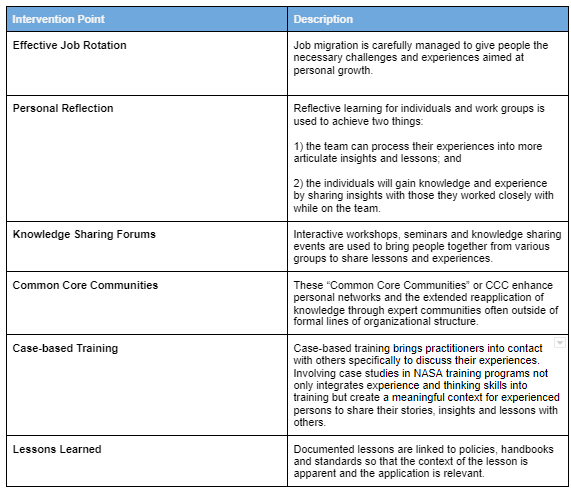
NASA learning model involves six key intervention points, which are summarized below:

NASA’s learning culture involves free information flow. It also includes open-ended decision-making and extensive discussion around decisions.

The three mental models offer room for continuous commitment to lifelong learning. Workers apply the knowledge in their demanding tasks at NASA.

Benefits of Creating a Learning Organization

Organizations can help their workers grow and develop a culture of learning, which leads to the following benefits:

Improved Innovation (Bloomfire)

Organizations can foster a suitable environment to encourage innovation. Factors like culture and talent aid these disruptive conditions. 

Google is an example of innovation. Its culture incorporates openness to new ideas. Employees learn, pitch, and explore these ideas (no matter how out-of-place they are).

Google Cafés are designed to spark employee interaction around work and play. The relaxed environment creates time for reflection and room for cross-team collaboration. 

Google workers are also allowed to mail top management at any level directly.

Innovation encourages a proactive approach to problem-solving.  It also empowers employees to work towards a common target. They also learn from one another.

Better Team Management (GetSmarter)

A knowledge culture aids employees in upskilling and knowledge sharing. Overall, this conceives a learning culture bent on productivity and cross-departmental support. 

Learning organizations have reported retention rates of up to 50%. This owes to staff satisfaction and shared ownership of projects. All these form part of an accountability framework.

Peter Senge defines learning organizations as places where “people are continually learning how to learn together.” (Senge 1990). Shared ownership of work means shared accountability of the results. 

Learning organizations are assistive places where corporate employees learn a lot collaboratively. This includes aspects of the information age, principles of sustainable workplaces, cyber-physical systems, etc.

A Collaborative Approach To Problem Solving (Bloomfire)

The adage “teamwork will win” applies especially to learning organizations. Here, teams are pooled together under a common goal. Each individual brings a unique perspective and viewpoint to the table. 

This shared brain power has many advantages.  Instead of outsourcing solutions, businesses can turn to their internal powerhouse. This yields faster turnaround times at comparatively lower costs.

Internal teams also tend to be more streamlined and agile. 

First,  they collaboratively point out a potential loophole in an intended solution. Afterward, they work together as departments to improve efficiency and service provision.

Transformational Leadership (Sapna Rijal)

Leadership is crucial in developing learning within the organization. A leader understands the company’s situation, its people, and the necessary transition steps. Transformation begins with them.

Learning organization managers need many employee management skills. This includes modeling learning behavior and crafting a collective vision. They should also prepare employees for imminent challenges.

These managers should be at the forefront in inventing learning/growth practices. They should also take part in them. Otherwise, they will give employees a feeling that their senior administrators aren’t committed.

Administrators must adapt system practices and paths that employees can imitate. Consequently, employees feel comfortable with change and provide valuable ideas.

Better Communication  (ResearchGate)

Communication is a top priority to successful changes in a learning organization.

In a traditional organization, a message is passed across several layers of the organization. Interestingly, each layer adds its own bias to the message before passing it on. This communication loop is subject to misinterpretation.

A free flow of ideas creates a competitive advantage, allowing the company to adapt its rules accordingly. Methods include teaching, developing, and training employees to better articulate objectives.

Effective communication in a learning organization involves:

  • The process of sending and receiving information.
  • Top administration, and how well their words tie to their actions.
  • Filters, which help personnel send their messages clearly to the intended audience.

Learning Organization vs. Traditional Organization

In a traditional organization, top management manages everything. This includes the shared vision and conflict resolution.

You become a learning organization when your company embraces collaborative learning. You should also accommodate diverse personal viewpoints. Also, ideas are nurtured and executed at all organizational levels. 

Also, in this model, your top management will deeply engage workers. They’re considered a part of the company’s vision. Also, harmonize their divergent viewpoints.. 

Traditional organizations and learning organizations compare as follows:

FactorTraditional OrganizationLearning Organization
Conflict ResolutionPower and hierarchical influence are used to solve problems.Conflicts are handled through collecting viewpoints and collaborative learning
Creation/Implementation of IdeasTop management formulates action, and the others follow.Formulation and execution of ideas take place across all organization levels.
Leadership and MotivationEmployee rewards and punishment control are determined by management.Charismatic leadership is used to empower personnel. It instills commitment and oversees decision-making across all employee levels.
Determining Overall DirectionTop management determines overall vision/direction.While top management oversees the vision, input emerges from many quarters.
Organizational ThinkingEach person is responsible for their performance, competence, and responsibilities.Personnel understands their roles and how acting their part affects other personnel.

As your organization evolves, you’ll need to divest in organizational leaders. These are the stewards, designers, and teachers of this new learning system. 

As designers, your leaders need to shift into a foundational framework. This drives the organization’s purpose and core values. 

They should invest in cooperating with the company’s teams. Collectively, they ensure strategies and policies support core values and business decisions. 

Leadership should also mentor personnel into developing approaches that efficiently tackle problems. This approach ensures authentic learning, development, and growth.

Lastly, leadership should ensure the organizational values are internalized and practiced. This relates to the organization’s higher purpose, good behavior, and member support. 

Management should commit to the concepts of this learning organization. They should promote learning, and open up to sharing power with employees. 

You’ll learn more of this in the areas below.

How to Become a Learning Organization

Meaning

A learning organization specializes in the process of managing knowledge. This affects behavior at all levels. 

Staff and administration foster work-related learning and collaboration.  Employees therefore improve and adapt to new ideas and knowledge. 

Overall, staff test new experiences (mistakes, risks, and expertise).  They use the lessons to improve the organization. 

Management

The following guidelines will help you manage a learning organization:

Commitment to Change

A learning organization cuts into your organizational eye view,. It helps to create varied approaches to problem-solving. You should ask yourself all the “what-if” questions along the way.

The learning organization concept involves learning and improvement. Always lookout for ways to enhance the learning experience.

The organization’s leaders should show their commitment to its vision.  They should maintain a positive attitude towards change.

You will manage difficulties in today’s information environment by meeting new challenges. Also, consider adopting new technologies, and enhancing service provision. 

Aim at a Flat, Knowledge Sharing Structure

A top-down hierarchical organization format is not favorable for a learning organization. This is because its bureaucratic nature inhibits problem-solving and promotes mindless obeisance.

Contrarily, a flat organizational structure boosts creativity and inter-departmental engagement. It also uses communication to aid in the flow of knowledge. This provides the double benefits of individual and group learning.

Creating Practical Mental Models to Support and Reward Learning

Organizations can incorporate individual learning programs/processes. This is alongside classes, workshops, and enhanced staff development courses to model learning.

A learning organization uses rewards to support and promote learning. Proper appraisals are aimed at honoring teamwork. It aids new skill acquisition and personal development towards goals.

Rewarded people are more likely to embrace and support learning activities.

Quantic has adopted Active Learning as a crucial element in its online education platform. By using technology backed with feedback, lessons are delivered more efficiently. Our pedagogical approach makes learning faster.

Measurement 

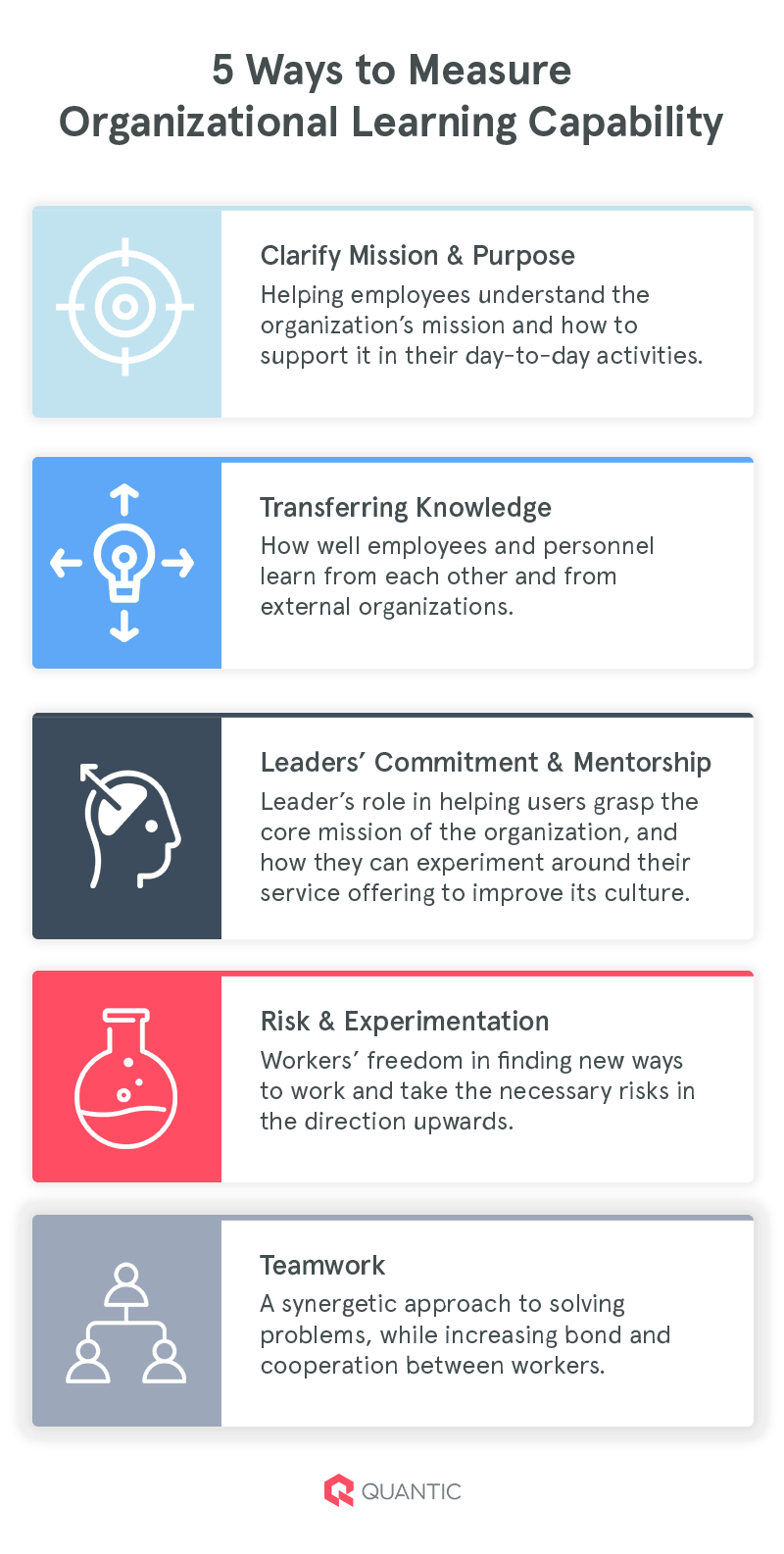
Performance measures used in organizational learning involve survey instruments that are used to understand learning capability. These measures include:

  • Clarity of Mission and Purpose.
  • Transferring Knowledge
  • Leadership Commitment
  • Risk and Experimentation
  • Teamwork

These are summarized in the diagram below:

Quantic’s Active Learning helps students participate actively in their learning. The instructor’s feedback provides an individualized experience. Every 8 seconds into a video, a student is prompted to engage instantly and only move forward upon mastering the skill.

Please play the video below for more on our pedagogical, Active Learning methodology:

Building A Learning Organization With Quantic

How, then, would you realize organizational learning? Becoming a learning organization does not happen overnight. It takes quite a bit to revise your Learning and Development culture. This includes getting the right experts and providing the necessary learning opportunities.

At Quantic, we believe in learning and knowledge as the drivers to adaptation. Moreover, we support team learning, which involves training your workforce at scale. Learners trained this way easily share lessons from a scenario.  This brings adaptation to a whole team. 

Team learning supplements Active Learning. It provides an affordable and faster alternative to training your team as a whole.

Collaborative learning is the backbone of an efficient learning organization. Quantic offers a collaborative environment that allows your team to develop courses. Employees gain and share knowledge, and boost your organization’s knowledge base.

MBA for Engineers – Worth It to Advance Your Career?

You’re at the top of your game in your engineering field: solving problems, creating products, and applying what you learned from your graduate degree. 

But now it feels like it’s time to move up in the world, get more responsibility, and earn more money—but what’s the next step? 

Some engineers take a master’s in engineering degree at this point to improve their technical skills. Yet many engineers are also turning to business schools for MBA programs to step up their management skills.

Which path has greater benefits to your career progression? There’s some uncertainty as to whether an MBA is the right graduate program for engineers. 

So, to help you make an informed decision, we’ll take a deep dive into:

  • The engineer’s career path
  • Pros and cons of an MBA in the engineering field
  • Which way to go to take your career to the next level

Let’s get to it.

Understanding the Engineer With an MBA Career Path

Your undergraduate degree empowers you with quantitative and problem-solving skills to get you into entry-level jobs. 

To stay competitive, you’re required to get a professional-level engineering qualification to earn your professional certification. 

You can continue to work quite comfortably with these credentials. However, when you feel a tingling desire to run after bigger things like promotions and more senior roles, you’ll need to take your learning a notch up. 

At this point, you have two options. To pursue an advanced degree in a strictly engineering field or broaden your horizons via the MBA route. 

If you follow the MBA path, you go through rigorous training in business acumen, project management, human resources, negotiation, and other soft skills. 

These skills combined with your engineering smarts catapult you into senior roles in engineering, senior administration, and managing teams. 

This is because you offer the best of both worlds to your employer—you’re a first-rate engineer with fluency in corporate and business language. 

You can land yourself roles like:

  • Project Quality Manager 
  • Product or Production manager
  • Mechanical Engineering Principal Director 

Picture it this way; your career progression is akin to scaling a high-rise building. Everyone starts on the ground floor with basic engineering qualifications. Gaining more experience and education unlocks the access cards to higher floors. 

Without an MBA, your access can be capped at senior engineering-only roles. Whereas an MBA unlocks access to higher executive roles in business administration and engineering management. 

Engineering MBA Salary

The median salary for engineers with an MBA degree stands at around $100,000 per annum. Individual statistics may differ depending on the specific MBA program. 

According to statistics from Payscale, the salary scale for an MBA engineer is an average of $111,000 per year. Here are some average salaries for different sectors. 

  • Principal Electrical Engineer  $138,860
  • Senior Mechanical Engineer  $98,221
  • Product Management Director $146,784
  • Process Development Engineer $78,083
  • Program Manager Engineering $111,087

Other salary statistics peg the salary for MBA engineers at between $130,462 and $138,960 each year.  

Statistics also show that holders of MBA engineering management degrees were reported to earn an average of $94,000 per annum.

Some job titles for MBA in engineering management holders include:

  • Manufacturing engineer $74,100
  • Business Manager $132,329
  • Software Engineering Manager $78,990
  • Senior Quality Engineer $71,927
  • Senior Electrical Engineer $98,380
  • Sales Engineering Manager $81,088

Engineer With No MBA vs. MBA Salary

Reports from The Bureau of Labor Statistics show that engineers with a Bachelor’s degree make at least 13% less than those with an MBA. For instance, mechanical engineers with a bachelor’s degree earn an average of $88,570 annually. 

In contrast, engineering managers in the civil and architectural field made about $149,530 per year on average.

The table below summarises some key salary differences for MBA vs. non-MBA engineers.

AreaMBANon-MBA
Civil $110,000$63,400
Electrical $121,400$71,200
Structural $117,700$65,900
Chemical$126,700$71,500

5 Benefits of an Engineering MBA

Apart from the salary gap, here are some of the main reasons why an MBA is a worthwhile investment.

An MBA Gives You a Deeper Understanding of Business

The business environment is complex. From dealing with forecasts about spending, warding off competitors, and managing projects, it often demands a lot from managers.

To succeed in a management role, you’ll need to be well versed in all the aspects that make the business flow. 

MBA programs can help you gain an in-depth understanding of how businesses work. The courses take a deep dive into modules like:

  • Strategic management 
  • Accounting for non-financial managers 
  • The business environment 
  • Marketing 
  • Risk management
  • Business ethics and leadership

With these skills, you’re better placed to fully deliver shareholder value, making you a valuable asset to any team. 

In addition, an MBA degree will help hone your people skills through courses like communication and human resource management. That way, you can effectively manage the personnel management element of managerial roles. 

An MBA Can Give Weight to Your Entrepreneurial Drive

As an engineer, you have a logical problem-solving mindset designed to bring solutions to complex problems. This technical point of view usually plants ideas and concepts for new products and solutions in your mind.

However, potentially great ideas can fizzle out if you don’t launch them into the business world properly. 

With an MBA from a top business school, you can gain the know-how and confidence you need to start the ball rolling on your project. Plus, learning about financial positions can help you figure out how to prepare the right documentation to entice investors into giving you funding. 

In addition, once you launch, you’re equipped to keep abreast of your financial situation, helping you transform your ideas into a profitable business. 

MBA’s Improve Your Career Options

An MBA adds weight to your resume that attracts quality employers. Big corporations often look for candidates with a mix of technical expertise and business skills to fill managerial posts. 

Having an MBA inspires confidence in your employers, making you eligible to qualify for promotions when the opportunity arises.

You’ll be regarded as an engineering management expert with a title to prove it.

An MBA Helps You Switch to Active Learning Mode 

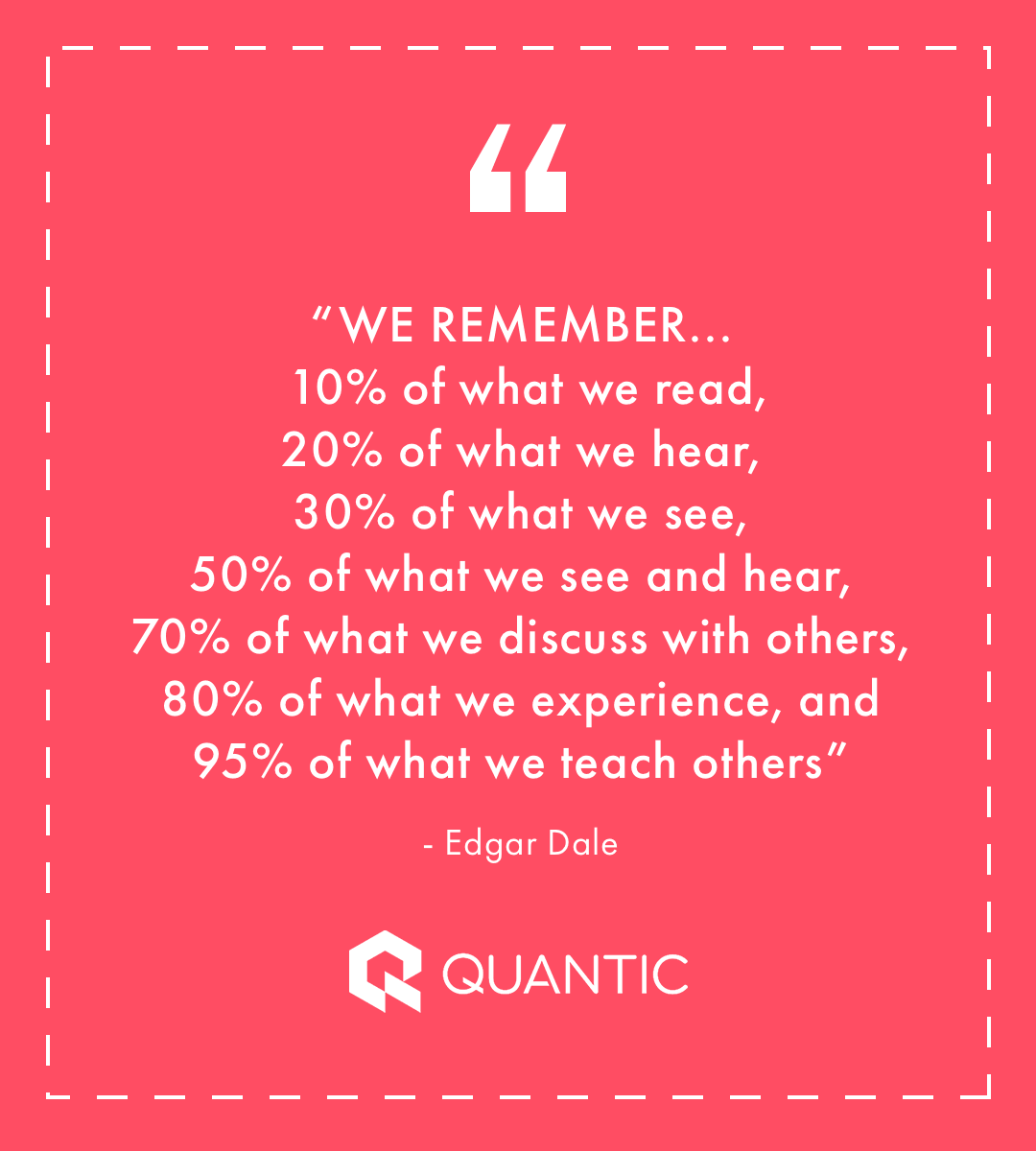
From as early as the 1900’s, educators like Edgard Dale discovered that idly listening to information isn’t the best method of teaching and learning. 

The nature of a good MBA program follows an active learning path. This simply means the mode of instructions doesn’t passively feed you information. 

Instead, it focuses on active engagement through case studies, role play, discussions, and similar methods. 

Throughout the studies, your mind remains in active learning mode. How does this help you? 

With active learning mode, your mind retains more knowledge. On top of that, you’ll find it easier to relate real-life work experiences to your learning. 

By forming those active connections between the workplace and your studies, you’ll find applying knowledge to tasks a breeze. 

An MBA, therefore, puts you in the right position to actively apply knowledge in the workplace. 

Quantic’s MBA degree is all about active learning. The online MBA platform is designed to prompt learners to engage after every 8 seconds.

Plus, it allows you to give feedback about your progress throughout. The system will only allow you to proceed to the next level when you’ve mastered the previous one. 

That way, you stay engaged, and by the end of the course, you can be sure to have grasped all that you need to. 

With an MBA, You Can Tap Into Pedagogical Advancements

Pedagogy refers to methods of teaching and learning. In its advanced form, pedagogy is student-centered. It focuses on the student mastering the concepts, not on passing a test.

Gaining an MBA qualification through an advanced pedagogy-based program like Quantic’s MBA gives you the best learning opportunity.  

It’s no secret that how you learn influences how you teach. When you employ these teaching and learning techniques in your role as a manager, you become better at imparting instructions, helping and grooming subordinates, and inspiring teamwork. 

All these factors contribute together to making you an outstanding leader in your field. 

Quantic MBAs Have Already Helped Students To Advance Their Careers

Our student spotlight articles highlight how the revolutionary Quantic MBA is helping engineers advance their careers.

  1. This article highlights the story of Patrick Glauner, an alumnus of Quantic’s mobile-friendly MBA program, who also holds a PhD in computer science. Patrick’s decision to pursue an MBA was driven by his desire to gain management skills that would enable him to oversee cross-functional teams and move into leadership positions. His technical training and MBA education helped him secure a management job at a major mechanical engineering company, Krones, and later start his own AI consulting company, skyrocket.ai.
  2. Renee Fishel’s story shows how an MBA degree can be an effective tool for engineers looking to advance their careers into leadership and managerial roles. As an Engineering Manager at IBM, Fishel credits her Quantic MBA with formalizing her leadership instincts and differentiating her from her colleagues. She also emphasizes the role of leadership in building diverse teams and fostering a more inclusive environment, which is especially important in male-dominated industries.
  3. You can read about Richard Lim’s experience here. Richard is a Technical Architect at Salesforce and the article explains why he chose to pursue an MBA with Quantic. It details his experience with the program; as someone in technical field who has found value in pursuing an MBA.

Cons of an Engineering MBA

You have to look at both sides of the coin to settle for the best decision. So let’s get into the cons of an MBA. 

MBA’s Are Expensive

The cost of getting an MBA runs into hundreds of thousands and can make a sizable dent in your pocket. 

The table below looks at the fee structure for an MBA program at selected colleges.

InstitutionFees
MIT Sloan$138,850
NYU Stern$121,541
Tuck School of Business$118,047
Harvard Business School $111,542
Duke Fuqua$97,741
Wharton School$115,464
Kelley College of Business $78,678
Howard University$72,000

For online courses, here’s what you can expect to pay.

University of Wisconsin $78,288
Harvard Business Online$73,440
Florida Institute of Technology $32,256
Webster University $27,000
Indiana University $55,560

In contrast, Quantic’s MBA program is emphatically affordable. For $950 USD per month over the 15-month duration of the program, you get access to a top-rated online MBA program. In addition, case-by-case scholarships are available to help cover the cost of tuition. 

It’s Difficult to Find the Time to Complete MBA Classes

An MBA is demanding. The sheer volume of content, especially in unfamiliar business concepts, can drown you in hours of work. If you take an in-class program, juggling work and finding time for classes is a tall order. 

When comparing a traditional MBA degree vs. an online MBA program, the latter gives you more leeway to work around your schedule. 

However, even with online studies, if the course is dense, packed with dull lectures, and lacking engagement, it’ll overburden you. As an MBA student with an engineering background, you need a course designed to allow you to thrive.

Quantic’s MBA is structured in such a way that you can consume the material in bite-sized chunks. In addition, the interactive platform and active learning component make it easier and faster to grasp. You can get your MBA or EMBA in 15 months. 

An MBA Won’t Help if Your Career Has Already Progressed High Enough

The longer you work in your field of engineering, you gain experience and valuable skills. Through this experience, you can move up the pecking order into a senior managerial post.

When you’ve reached this point in your career, you may already be too high up the ladder; there isn’t anywhere else to go.

Getting an MBA when you’ve already climbed that far would only be an unnecessary cost. MBAs are more suited for engineers who still have some way to go to get to the top. 

An MBA Isn’t Necessary if You Plan on Sticking to Technical Skills

MBA programs are explicitly designed to teach the language of business like business economics and international business. 

If you’re more concerned with staying on the technical side and not in managing the business affairs, then the MBA may not be of much use to you.  

For instance, if you’d rather stay in a traditional engineering firm or stick to the hands-on side of things, then focus on expanding your technical engineering education. 

That said, if you still have an appetite for an MBA, here’s what you’ll get. 

MBA Course Curriculum & Syllabus for Engineers

A good MBA degree should include critical core and elective courses like the following: 

  • Business. Your role in management will involve preparing forecasts for the business, like how much of the product you need to make. You’ll also handle the finances and get involved in the marketing of the product, so you need to gain the right business skills necessary to hold up the role. 
  • Strategy. Without proper strategic planning and project management, any organization will fall flat on its face. That’s why, when you transition into a leadership role, you need to be equipped with business management skills. 

With accurate planning skills and your engineering management know-how, you can steer the organization in the right direction.

  • Decision making. With the cutthroat competition in business, you have to be able to make critical decisions quickly. A good MBA program includes a statistics and data analytics component to help you with cost-benefit analysis.
  • Leadership. Managing people and resources is a critical part of a manager’s role. Resources are often scarce, and a diverse pool of different personalities takes a lot of effort to harmonize. 

An MBA includes leadership as part of the business education to empower MBA students to ace engineering management positions.

MBA vs. Masters In Engineering

The choice between an MBA or a Master’s in engineering comes down to your career goals. 

If your aim is to lead the organization in a position requiring a technical and business touch, you can lean towards an MBA degree to advance your career progression. 

On the other hand, if you see yourself strictly as a scientist responsible for leading in a technical role, a master’s in engineering would be more suited to your goals. 

MBA Programs for Engineers

You can launch your path to executive-level engineering management roles through an MBA with one of three options. 

  • A part-time or full-time in-class MBA with 20 to 25 fixed lectures per week for 12 to 21 months.
  • An online option that gives you lectures, course materials, and exams for a minimum of 18 months.
  • An online flexible MBA like Quantic’s MBA for 5 to 15 hours per week for a maximum of 15 months. 

You can opt for the traditional in-class and online options, but they’ll cost you an arm and a leg. 

A Quantic MBA offers the same recognized MBA qualification for a fraction of the cost. In addition, you get access to a fully interactive platform that’ll make learning simpler. 

Plus, you’ll get the papers to qualify for senior-level engineering management roles in no time. Apply now to get started with Quantic’s online MBA program.

What Is a Learning Management System (LMS)? Your Best Options

Human Resource (HR) teams are continuously adapting technology to meet their staff training needs.

Globally, many top Fortune 500 companies have adopted self-paced e-learning courses to aid their employees’ training. 

However, there’s still a problem:

Many industries have already established a set-up for HR and Learning and Development (L&D) departments. 

Weaning off these learning tools and legacy software routines for newer technological innovations involves great adaptability.

It gets more complex when this unlearning, learning, and adoption cuts across multiple levels. 

By now, you’ve probably settled on your L&D plan but don’t know how to get everyone going. Your system may end up being unused in such a state and your targets not being met. That’s because there’s a need to properly scope your learning goals.

To break through, you need to first prepare your employees for a shift in the digital direction. Your training programs should aim at a personalized experience that they’ll readily embrace. 

Finally, you should follow up on learner progress and improve the learning delivery to an overall advantage.

Today, you’ll learn more about what an LMS system is and how to deploy it to maximum advantage.

An obvious question would then be:

What Is a Learning Management System?

An LMS delivers content in different formats through online courses and live instruction sessions. 

Many online LMS platforms have also embraced sophisticated Artificial Intelligence (AI) to understand learner behavior and craft personalized experiences for participants.

What Is the Purpose of a Learning Management System

At its simplest level, a learning management system helps teams gather, distribute, and follow through with learning activities. It should cover the following:

Onboarding: New employees would benefit from an LMS to help them quickly find their way around their new office and associated procedures at the workplace.

Development and Retention: An LMS could ensure employees have the right skills, knowledge of product upgrades and changes, and have an understanding on company trends.

Compliance Training: An LMS would make sure employees receive training geared, for example, towards recurrent certification and mandated procedures. This helps mitigate risks and avoid any issues related to compliance. 

There is, however, a common misconception that we need to clear before going further.

LMS vs. LCMS (Learning Content Management System)

Well, here’s the difference:

An LMS is a platform used to assign, deliver and track course completion. It’s simply a locked store of published content — updates usually are managed outside the system.  

The end goal is to measure and give feedback on course completion. It doesn’t factor in content authors who constantly need to produce, maintain, and optimize content.

On the flip side, an LCMS is a platform that supports the entire training content cycle: authoring tools, publishing, delivery, and measurement. It provides a collaboration hub where content can be synced and re-used in many formats. 

This separation of content from presentation frees it and allows re-use in different formats, which can be distributed in or out of an LMS.

At the same time, it provides a central content and asset repository and supports single-source publishing. 

Just remember, it’s not simply a matter of one versus the other.

Both serve different purposes. However, a healthy blend of both platforms can give any HR organization a complete end-to-end solution.

Having said that, let’s talk about the benefits.

Learner Management Software Benefits

Business operations rely on collaboration and especially corporate training. Having a suitable learning activity management system can help motivate employees, increase productivity and improve learning outcomes. 

The following vital reasons are therefore worth considering when seeking LMS integration into your current HR operations.

Data Integrity

Data redundancies waste time and lead to training inefficiencies. An intelligent LMS system comes with data integrity tools to ensure data is entered consistently and accurately.

Personalized Online Training

You certainly would love access to advanced analytics for each employee, including past performance, job responsibilities, and online training progress.

Better visibility means you can recommend training based on an employee’s necessary skills, work tasks, and professional aspirations. You, therefore, have a comprehensive view of an employee’s work history and a holistic view of your staff.

This helps you know top performers who can then be allowed to advance more.

At the same time, you’ll identify employees who are struggling for the sake of knowing where they may be assisted.

Convert Trends Into Actionable Goals

As employees engage with your LMS, you can spot patterns and trends of data and convert them into actions that improve user performance and reduce employee challenges.

For example, department A is struggling with low employee retention. You can leverage data from department B, which does better, and boil that down to more engaging content for department A.

Leverage Big Data for Effective Online Training Analytics

Integrating LMS with your current HR system helps you analyze data quickly and more efficiently. You’ll then have more insight into your employee pool and the type of training they require.

For example, you could consider an employee’s job description and track training gaps based on their LMS training progress. You’ll therefore provide additional training resources to help them scale appropriately.

Then there’s the notable advantage of a streamlined system maintenance experience. Big Data can be migrated between your existing system and the LMS, ensuring that the information is automatically synced and up-to-date. 

Improved HR Training ROI

Time and the ability to quickly collect actionable data all lead to a profitable investment. You will only choose online training initiatives that make the most impact and discard what’s irrelevant.

You’ll have to carefully do your homework to know what works best for you while avoiding a high learning curve or a cluttered interface.

 Next, let’s consider the learning phases and how an LMS can aid in the process. 

LMS-Learning Process

David Kolb’s Learning Cycle reveals that there are four main phases of learning.

The stages can be summarized as:

  1. Review: Reveals the current training context and helps learners bridge the knowledge they have with the new knowledge they seek.
  2. Learning: Defines course content, including attitude, skills, and knowledge.
  3. Application: The learner applies the knowledge and skills obtained.  
  4. Adaptation: Helps the learner make a change to their work environment based on their learning.

But then, how can the phases above be applied in the context of an LMS?

Let’s review the phases, one by one.

The Review Phase

At this stage, you assess what the user already knows using the pre-assessment procedure. For example, you could include a set of 10-20 questions. If an employee passes this test, they can proceed to the actual training. Otherwise, consider pre-requisite training before introducing new concepts.

An example application would be an induction training program. New employees are given a virtual video tour of the company.

The Learning Phase

Here, the user is introduced to core learning procedures and processes geared towards reinforcing learning objectives. A blended learning strategy can be adopted, which combines classroom sessions with e-learning courses to accelerate proficiency.

For those with little time, microlearning courses can be adopted, short, and focused on a single objective. These could take the form of animated videos and short, strategic or interactive games.

Moreover, this has been known to align with short concentration spans and gives users the exact information they need to fulfill one actionable objective.

The Application Phase

This phase helps employees practice to cement their knowledge based on their newly acquired knowledge and skills.

Simulations are most appropriate for this phase, since they are a replica of the real world. Consequently, employees can experience real-life job circumstances without the risk of failure.

For example, consider employee training on computer networking to connect and troubleshoot internet disruption. Instead of tampering with existing equipment, they could be introduced to Packet Tracer, a “Watch, Try, Do” simulator that mimics the real world without the risks.

They will watch, try following prompts, then finally perform the actions themselves. In this way, performance-based assessments are conducted, which demonstrates knowledge in action.  

The Adaptation Phase

At this final stage, employees transfer what they’ve learned to the actual working environment. LMS can help refresh knowledge as well as support job performance.

One thing, though: repetition is key.

The Curve of Forgetting reveals that during day 1 of learning, retention stands at 100%. It goes down to 50-80% on the second day, and so on. By day 30, retention is at a mere 2-3%.

Figure 2: The Forgetting Curve

Therefore, it’s important to consider regular refresher training to reinforce learning, revise knowledge, and mitigate the Forgetting Curve.

Micro-learning and mobile learning are preferred methods at this stage since they deliver material in small bits and fit into your employee’s busy schedule.

At the same time, consider formats such as infographics, how-to videos, interactive PDFs, and checklists. These come in handy and should be easily accessed by the learner at the time of need.

Consider a sales employee. At this stage, a PDF of the latest prices and offers is a powerful reference when dealing with a client and helps them act more confidently. 

LMS Management

There are best practices to be considered to run an LMS effectively.

Role Assignment

This is the first and most crucial step in managing LMSs. You’ll assign people to critical departments such as HR, Operations, and IT. Accountability is paramount to ensuring everyone does their duty well.

A good LMS will make it easy to perform administrative duties such as registering users, giving them access according to level, and performing instruction tasks such as creating and managing courses.

User On-Boarding

Getting users to start with an LMS poses multiple challenges. Consider leaders who aren’t tech-savvy and learners who seemingly fear the complexity of the system.

Therefore, it’s crucial to market the LMS internally so that the benefits are well highlighted. Incentives can also be introduced to encourage the learners in the process.

On the administrative side, familiarity with the system is crucial to simplify adding users to the system.

Creating and Publishing Content

Compelling content has been known to boost employee engagement by up to 18%. However, the expertise required to reach these standards can be extensive.

Beyond PowerPoint, creators could think of interactive animation, gamification, videos, audio, and images to spruce up the content delivered.

Course creation can take considerable time, especially when the content is custom-made to fit a specific organization’s needs.

You may develop a schedule with reasonable delivery dates. Then, make a follow-up to ensure effective delivery in time.

The next step involves publishing content, which requires a knowledge of the LMS tools. A friendly UI is crucial, which should also come with accessibility features where possible. 

Beyond this, consider third-party integration with related systems.

Reporting Progress

A crucial element of an LMS is the data that it captures, including course progress and performance in tests. A step further is the analysis of the data.

Through appropriate graphs and charts, reports can be obtained that give an accurate representation of LMS activities while empowering an organization to make data-driven decisions and adjustments.

Handling IT Resources

When an LMS is ready to be deployed, tasks such as integration with a HR System, server maintenance, technical support, and security should be considered. These will be handled by IT.

An honest audit of IT resources is appropriate at this point, as related to the LMS, and in such a way that the LMS’s effectiveness will not be compromised. Alternatively, the organization could consider outsourcing to the IT team from the LMS provider.

End-User Support

LMS users will have questions on how the system works. There should be a way to let users know how to use various LMS features, from simple to complex ones. For example, if there is a payment extension, the organization needs to know how to handle the payment flow.

What Is LMS Training?

Do You Need an LMS Training System?

Are you hesitant about whether an LMS training system will work for your organization? If so, you need to ask yourself a few questions:

How much do you spend in training each year? Traditional training means that you cover transport expenses for facilitators (or, in some instances, the employees themselves), booking physical venues, paying tutors, and covering other hidden expenses.

An LMS will provide a more effective way to track student progress and reduce training costs.

How streamlined is your course delivery? An LMS provides material, content, and instructions in one central portal.

How do you track performance? Physical training is OK, and paper questionnaires are also an option used with most businesses. But how do you manage this data over time, say five years down the road? An LMS software will have performance indicators for progress tracking, knowledge acquisition, and ROI.

Do you require regulatory compliance? Many companies require training assessments to cover compliance. Examples lie in the energy sector, including oil and gas. Compared to the traditional approach, the data and progress reports greatly enhance this task. 

What Are Examples of Learning Management Systems?

A cloud-based LMS is hosted by a vendor on their servers. The end-user accesses it via a browser portal. It does not require specialized software or digital investment to operate.

Adobe Captive Prime is a good example. Users pay based on their use.

Software-as-a-Service(SaaS) LMSs are centrally hosted by a software provider. Users buy licenses by subscribing periodically. The pricing model often considers the user base and functionalities accessed.

D2L Brightspace is an example of SaaS that supports learning for K-12 and higher education institutions.

Open-source LMS. The creator has made the source code available for developers to modify accordingly. As a result, there is no licensing fee. However, in some cases, you may incur downloading costs.

Moodle is the most popular open-source platform. The software can be downloaded and modified free of charge. 

Enterprise LMSs help corporations embrace online learning. SAP Litmos is an example of an ELMS. 

Example LMS Courses

The higher education market has been empowered by a plethora of courses that meet various needs. The closest example is the NKI distance education network, which is aimed at helping develop employee competence. 

Online executive MBA programs are also an area where an LMS is heavily utilized. This provides flexibility and self-paced learning for busy professionals. Quantic’s online EMBA is proof of this. 

The lingering question in your mind now might be:

What Are the Best Learning Management Systems in 2021?

Not only should you properly consider aspects such as the user interface, but you should also have a set of metrics that help you track performance and tweak accordingly.

This will help you make the most of your training expenditure.

A solid LMS will provide high rewards and build loyalty while remaining affordable. Similarly, employee tuition assistance reduces turnover and helps attract qualified candidates.

5 Ways An MBA Will Advance Your IT Career – And 5 Ways It Won’t

Technology is the future. A software degree is the modern day equivalent to a medicine and law degree. 

However, there’s almost 30,000 computer science graduates each year. Not to mention other equally qualified graduates from advanced collegiate schools and business schools with a major in IT. Competition for job positions is at an all-time high.

While getting an entry-level job is not so difficult, there are several factors that can impact the advancement of your IT career. Getting an MBA is one of them. 

Today, we will address:

  • The information technology career path
  • Job outlook and prospects
  • Salary expectations
  • The pros and cons to getting an MBA

All to help you decide whether investing in an online MBA is worth it to advance your career as an IT manager.

Let’s get to the facts.

Understand the IT Manager Career Path

The IT manager career path is unconventional. There are different directions you can take which will lead you to different positions which require different skill sets. 

The most sought-after positions in IT management are Chief Technological Officer (CTO), Chief Information Officer (CIO) or IT Director.

As a typical IT manager, you will be responsible for the management of tech systems, managing teams and providing solutions to hardware and software glitches. 

You need exceptional problem-solving skills and leadership skills to help with technical issues.

Communication skills are also vital for your IT manager career since your task involves explaining complex issues to members of your team in different levels of the company.

To help you make a better decision on which direction to take on your IT career path, you should understand the typical progression of an IT manager.

IT Manager Career Ladder

There’s a continuous 15% growth in demand for IT managers every year. However, one of the best parts about a career in IT is job security and flexibility to work on innovative projects.

However, the IT Manager career path is difficult. Being an IT manager comes with the responsibility of overseeing teams and project management. You must have an analytical mindset as well as strong business intelligence. 

Here is what a typical IT manager career ladder looks like.

The IT Manager Career Ladder

#1. Chief Information Officer 

The highest-ranking executive responsible for managing and implementing information and computer technology systems of a company.

#2. VP Information Technology

Responsible for the design, development and implementation of organizational information systems, software development, and IT support and infrastructure systems.

#3. Director of Information Technology Services

Responsible for strategic planning and management of information technology resources.

#4. Senior Project Manager, Information Technology

Account management, employee and external consultants supervision, planning and administering budgets, tracking program expenditures and controlling income and revenue.

#5. Program Manager, Information Technology

Coordinates organization’s projects. Supervise software engineers.

#6. Software Engineer

Designing and implementing systems, improving system quality and enhancing applications

Software Engineer

As a software engineer, your job and responsibilities include research and analysis for programming solutions and providing technical documentation. You’ll also be responsible for designing software and code implementation for the overall product infrastructure. 

Once products are released to the market, they require continuous iteration and therefore, support. It’s your job as the software engineer to fix bugs when they arise.

Program Manager, Information Technology

This is a people-oriented role. You’ll need excellent organizational, planning, and communication skills to excel in this role.

Here is a breakdown of the roles and responsibilities of an IT program manager.

  • Organizing programs and activities to achieve the mission and goals of the company.
  • Developing new programs and managing long-term goals to support the strategic direction of the organization.
  • Budgeting and operations management for the program.
  • Developing an evaluation method to assess program strengths and identify areas for improvement.
  • Managing teams with a diverse array of talents and responsibilities usually made up of software engineers and ensuring projects are completed on time.

Senior Project Manager Information Technology

Senior IT project managers are responsible for developing project plans and overseeing budgetary needs. They are the go-to person for project managers and serve a supervisory role which includes conducting meetings with other team members on a regular basis.

They are responsible for account management and track program expenditures in order to control the company’s income and revenue.

Director of Information Technology Services

The director of IT services is responsible for the management, strategy and execution of IT infrastructure for the company.

The roles and responsibilities in this job include:

  • Overseeing technical projects to ensure they are in line with organizational goals
  • Managing business activities and supervising teams while working closely with managers.
  • Creating financial budgets and presenting capital project proposals to senior executives for approval.
  • Sourcing for new market opportunities and spearheading efforts to improve IT processes.

Vice President, Information Technology

The vice president of information technology’s main responsibility is planning the information technology future for the organization and implementing and maintaining the current systems. 

They have to ensure maximum reliability and stability in the company’s computer systems and networks. In a nutshell, the role is about technology leadership, and the VP of IT must be able to organize teams around the technology plan and path for the company.

Chief Information Officer

This is the highest-ranking executive position with responsibilities that match the title. 

With big titles comes great responsibility.

The roles include:

  • Managing all employees in the IT department by monitoring progress to ensure maximum productivity.
  • Overseeing implementation of new systems and networks such as new CMS systems or intranets.
  • Staying up to date with industry changes in trends and new IT technologies by reading reports and studying new technologies that could be implemented in the company to be at par with competitors.
  • Working in liaison with company officials to form company best practices.
  • Forming and maintaining business relationships with IT vendors for smooth supply-chain and approving IT devices purchases.

MBA Information Technology Management Jobs

Getting a job in this era is not easy with the growing population and number of graduates entering the market each year.

The good news?

The IT industry is an ever-growing industry. You might not get the exact job you want on the get-go, but getting your foot in the door is significantly easier than other fields.

According to the US Bureau of Labor Statistics, employment of information technology managers was projected to grow 16% from 2021 to 2031. That is much faster than the average for all occupations.

Businesses are expanding their digital platforms and scaling up every day. As a result, the demand for computer and information systems managers has grown and will continue to grow.

Taking an online MBA course with Quantic might be the best decision you ever make for your career. Not only will you get a comprehensive curriculum but learn valuable business administration skills and connect with top employers in the industry. Sign up today.

Trisha Hautéa

Trisha Hautéa

TUFTS UNIVERSITY

MIT, Program Facilitator

“I quickly learned how legitimate and challenging the Quantic MBA program is. It’s comprehensive and I learned way more than anticipated.”

How Long Does it Take to Get MBA Management?

An MBA full course curriculum usually takes two years to complete if you’re studying full-time. Part-time can take up to 3 years depending on the credit units you complete in an academic year.

If you have more time on your plate, an accelerated online MBA program is a good option since it can take between 12 to 18 months to complete. 

MBA IT Management Salary

Professionals with an MBA in information technology, in general, earn more than those who don’t. In the US, MBA holders earn an average of $102,100 which is higher than the national average of $74,378. 

The deal gets even better for IT professionals with an MBA. Job positions in information technology are the top three highest paying salaries for MBA holders according to US News, ranging between $100,000 to $150,000 a year.

IT Manager With No MBA vs MBA Salary

Here is the salary breakdown according to US News.

JobMedian Salary
IT manager with MBA$156,390
Software Developers$111,620
Computer Systems Analysts$96,160
Database Administrators$93,750

5 Ways An MBA Will Advance Your IT Career

A bachelor’s degree in information systems can help you secure a great job with great benefits. Professionals dedicated to growing their careers seek MBA programs for that extra edge.

Yet, balancing work and study is one of the most difficult tasks. Is it really worth it?

To help you make that decision, here are 5 ways earning an MBA will help advance your IT career and 4 ways it won’t.

An MBA Will Teach You Business and Analytical Skills

Chief Information Officers (CIOs) and Chief Technology officers (CTOs) are responsible for the overall business administration. They require a business education and skills to propel their companies forward and give them a competitive edge in the market.

MBA course curriculums are comprehensive. Quantic’s online MBA program includes courses in accounting, finance, leadership, marketing, supply chain and operations, data analysis and decision-making, economics, strategy and innovation, and entrepreneurship. 

As an information technology manager, the higher up the career ladder you go, the more you’ll be called upon to step into a leadership role. An MBA teaches you analytical skills that will help you step into that role and execute it with maximum efficiency. 

An MBA Will Earn You a Title Bump

Doesn’t it sound nice to have that MBA title in your name? Well, getting an online MBA earns you that by default. 

Is it just a title? No.

With an MBA title to your name, you earn more respect as an expert in your field. In IT, you’ll be thought of as a tech guru and business professional even without proving it first.

How does this help your career?

When you’re regarded as an expert in your field, you have more access to opportunities. It’s easier to get a promotion to a senior role since it’s apparent you can handle more responsibility.

An MBA Will Increase your Income

Information technology managers with MBA’s earn more those without. An MBA increases your likelihood of getting a promotion to a senior role (such as business administration) which comes with a higher salary and benefits. Likewise, there are firms that offer their staff a pay increase if they obtain an MBA. 

An MBA Program Provides you Active Learning

Active learning is an instructional approach that actively engages students with the course material through discussions, problem-solving, case studies, role plays and other methods. 

Getting an online MBA enables you to gain and retain vast knowledge through active learning. It puts you in a unique position to be able to actively practice your skills, making it easier to apply them at work. 

An MBA Allows For Pedagogical Advancements

Learning and teaching methods are gradually improving with the incorporation of technology. 

Acquiring an MBA will help you gain more knowledge not only from educators but from peers as well. 

Employing the same techniques on the job can help you improve communication and collaboration skills that may improve outcomes in the work environment.

Moreover, access to information and learning tools is far easier today than before, with online classes and programs.

4 Ways An MBA Won’t Advance Your IT Career

While getting an MBA has a great advantage, it’s not the be-all and end-all for your career.

MBA’s Are Expensive

The average cost of an on-campus MBA is $100,000- $200,000. This is a huge expense and might strain your budget and put you in debt for the next couple of years. Although online MBAs are cheaper to an extent, it’s still a hefty expense.

Quantic’s online MBA is $950 USD per month over the 13-month duration of the program. We also have scholarship initiatives that provide partial and full funding for students who need financial aid. 

We also have a built-in career network where companies pay to recruit our graduates, helping offset tuition fees to students.

Our dedication is to reduce and often eliminate student cost through an innovative and generous employer-funded tuition model.

Tough to Find Time for Classes

An on-campus MBA is time-consuming and intellectually demanding. Finding time for classes after work can be a challenge. An MBA is best suited for those who don’t have a full-time job. With that in mind, however, as a working professional, an online MBA is a great choice.

While traditional MBA programs take up to 2 years for completion, Quantic’s online MBA takes 10 months to complete and 12 months for an Executive MBA. In addition, it offers more flexibility with online courses, allowing you to work on your own time.

To learn more about the pros and cons of traditional versus online MBA programs, click here.

You May Be Too Far Along in Your Career 

IT is the newest and fastest-growing industry. Many who have been in the industry from the beginning have seen tremendous growth and learn many skills on the job. The longer you work in a field, the higher you go on the career ladder.

If you’re already high up in your department, there may be no need for you to get an MBA. Your work ethic and your position are sufficient to scale you up if need be. Online MBA programs may be more necessary for lower-level positions looking to grow.

Certificates Don’t Guarantee Success

Ever heard the saying that education is not a measure of intelligence? This is what we mean by certificates don’t guarantee success. 

Getting an MBA might get you a foot in the door but whether you stay in is dependent on your ability to get the job done. Understand that learning a skill is not equivalent to having the skill.

You have to be self motivated and driven to prove yourself and earn your way to success. No shortcuts.

Bearing all of that in mind. If you still want to take an MBA here’s what is on offer.

MBA Course Curriculum & Syllabus for IT Managers

Before selecting an MBA program, it’s important to look into the curriculum. A good MBA curriculum should cover business administration essentials that includes these core aspects:

  • Business. Leading in an executive position, you’ll be responsible for the company’s finance and budgeting. Since you’ll be directing and managing engineers responsible for the design and development of new products, marketing skills are important to help you understand customers’ needs and wants.
  • Strategy. Managing and directing teams requires an understanding of strategic planning in order to align teams’ operations with the company’s goals and mission.
  • Decision making. Data analytics is an integral part of information technology management. Professionals need to understand how to analyze data and make critical decisions for the good of the company. This requires knowledge of statistics. 
  • Leadership. CIOs and CTOs and their prospects are responsible for managing teams to ensure the overall success of the company. They require leadership skills in order to understand different behaviors and personalities and form effective and productive teams.

MBA vs MS IT management

MS is Master of Science while MBA is Master of Business Administration. Pursuing an MS allows you to attain in-depth knowledge in a specific subject or discipline while an MBA is more general and gets you acquainted with the business and management side of things. 

The table below shortlists the key differences.

CriteriaMBAMS
Required time 10 months – 2 years2 years
FocusAcquiring business and management skillsAcquiring technical skills in a specific field
Work experience2 – 5 yearsGenerally not required
Employment opportunitiesFinance, consulting, operations, investment banking, private equity.Engineering, Math and sciences, computer science.
Average basic salary $100,000 – $150,000 $75,000 – $82,000

Which one is better, MBA or MS? 

Well, that in large depends on what your interests are. If you’re more of a scientist, MS is a definite go-to, but if you’re more of a manager and your end goal is to run the company at CIO level, then definitely take the route. 

Quantic is an accredited institution for business and technology with trusted partner programs, providing you the best online education. Ready to get started on your online MBA? Apply here for free. 

Student’s Who Have Advanced Their IT Careers With Quantic

Richard Lim

Richard is a technical Architect at Salesforce, who is also an alum of Quantic’s Executive MBA program.

His interview offers insights into why he pursued an MBA, why he chose Quantic, and how the program has impacted his career. He highlights the importance of inclusivity and networking in the business world.

Avik Bhowmick

Avik is a great example of how a Quantic MBA can help you enhance your leadership skills, gain a well-rounded view of business, and network with a diverse group of professionals, among other benefits. His experience offers insights into the potential advantages and limitations of pursuing an MBA for those in the IT industry.

Patrick Glauner

Patrick was able to leverage his MBA degree to advance his career in IT. This article provides insights into how Patrick’s technical training in computer science combined with his MBA education helped him secure management positions in a major mechanical engineering company and start his own AI consulting firm, skyrocket.ai. Patrick also emphasizes the importance of having prior work experience and building trust with other businesses to build credibility and a positive reputation as an entrepreneur.

The 10 Best Employee Retention Strategies for 2021

Your workers are leaving. That’s bad business.

Employee turnover costs are pricey. Your competitors can swipe at them the next moment. You’ve got to do everything possible to retain your top talent.

From actionable tips to a walkthrough on developing an employee retention plan, this guide covers all there is to creating and implementing effective employee retention strategies.

Employees won’t just stay for extended periods anyway. So first, you need to understand the reason for the focus on employee retention.

Employee Retention Strategy: What’s the Big Deal?

A feasible employee retention strategy is a distinctive marker of a company set up for long-term success. It looks good to investors and is a solid bragging right to other business leaders. 

When you create a plan to keep your coveted talent, you save time and resources expended in the hiring and onboarding process for new staff. 

In a press release, the Society for Human Resource Management discovered that it takes an average of 42 days to fill a regular job position. 

In a nine-to-five situation, that’s 378 work hours lost due to a vacancy that could have been avoided.  

The Work Institute reports that employers have lost upwards of $600 billion due to a lack of a working plan to keep hold of their best team members. 

An effective employee retention strategy empowers forward-thinking enterprises with increased revenue, greater productivity, and improved company culture.  

HR departments are the key drivers of employee retention in an establishment. 

On the whole, they create, test, and implement these strategies. They also modify every so often based on evolving data.  

The Role of HR in Combating Employee Turnover

The function of HR departments in workforce retention strategy comes down to 4 essential responsibilities: 

  • the recruitment and onboarding processes
  • managing the employee experience 
  • and conducting exit interviews.

Recruitment Process

The onus here is to identify candidates who are most likely to stay long-term. An actionable tip is to note how long they have stayed in previous employment via their LinkedIn profile or resume.

In the talent market, hiring managers should keep an eye out for candidates who have stuck through extended periods in recreational activities and volunteer work. This will help you make near-accurate speculations on their tenure at your company. 

Next, go on to assess the candidate’s values and how they align with the values your company holds dearly. You wouldn’t want to hire someone big on cutting corners when your company is rooted in honesty and following the rules. 

Onboarding Program

After every hiring process should come an onboarding program. 

Glassdoor found that organizations with an intentional onboarding program improved their employee retention rate by 82% and their productivity by 70%. 

The internet has made it easier than ever before for job hunters to seek out job openings and apply to them. This is where an effective onboarding program makes all the difference.

The onboarding process should include employee retention best practices like:

  • Corporate training for all new hires
  • Goals that keep employees eager to hit them
  • Promoting teamwork 
  • Keeping new employees abreast with company culture

Employee Experience

Creating a positively distinct working experience for your staff is one of the most successful employee retention strategies out there. 

What adjectives do your employees use to describe working at your company? Would they recommend someone to work there with enthusiasm? 

Encourage positive employee relations as this is an important aspect of your workers’ experience at your company. 

The feel members of your staff get would be determined by all the other factors talked about in this article.

Exit Interviews

In an ideal world, you create the perfect plan and all your employees stay. But in the real world, employee turnover is bound to happen regardless of the strategies you put in place. 

Before you let a worker go, make sure to conduct an extensive interview to know exactly why they’re leaving. This lets you keep a tab on destructive patterns your company might have and improves your employee retention rate in the long haul.  

Ask revealing questions to find out the motive behind your employees’ exit. In some cases, you can work out a solution and compel them to stay. In others, no amount of negotiation would suffice.

Developing an Employee Retention Plan

Follow this sequence to create a workable plan:

  1. Evaluate to know where you’re at, and what work needs to be done. Document what you currently do and what you don’t. Review relevant metrics and note how the results of your documentation affect them.
  2. Ask your employees for feedback on what they’d like best. Don’t make assumptions for your workers. Meet them individually and get a consensus. Use this consensus in the next stage.
  3. Decide which strategies you’re going to use. This depends on results from your evaluation, your business type, and the kind of employees you have.
  4. Start implementing. Don’t try to do it all at once. For example, bring in remote work options. Note how your stats change over a year. Keep adding and testing to see what works.

10 Talent Retention Strategies You Should Implement Today

#1 — Invest in Your Employees Growth

Employees will overlook a relatively lower pay in a job that gives them room to grow. 

This is not to promote lower pay, but to express the importance of making professional training opportunities for your staff. 

To show your employees that you have their professional interests in mind, create an in-house training program or take advantage of external learning opportunities. 

A step in the right direction is  QUANTIC’s tuition reimbursement program. Our MBA or Executive MBA program is affordable yet gives a disproportionate return on investment in terms of employee retention. 

People love to receive and your employees are no different. Championing the career growth of your staff by providing them with corporate training makes them see you as more of a partner that can be trusted than a demanding boss who they can’t wait to leave. 

#2 — Offer a Competitive Base Salary and Benefits

Asides from boosting their social standing, getting skills, and interacting with co-workers, people work to make money. It’s simple. 

Workers work to improve their financial situation and thus lead a more robust life. Offer a salary with benefits that’s hard to match and you’ve done more than half of the work needed in wooing your top talent to stay.  

Fundamental benefits employees consider before taking on a new job or looking elsewhere include:

  • Health benefits 
  • Insurance
  • Money-back on education costs
  • And a Retirement plan

Research to know the benefits your employees would appreciate the most. 

#3 — Provide Flexible Work Arrangements

Post covid-19, there has been a tremendous upward shift in the worth employees are placing on job flexibility, especially as regards working from home. 

FlexJobs’ 2019 annual survey reported that 80% out of 7300 workers would be more loyal to their employers if they had flexible work options. 

The same study found that working remotely full-time was the best-case scenario for respondents, occupying 76 percent of the poll. 

Flexible scheduling, part-time scheduling, and working remotely part-time follow behind with 72, 46, and 43 percent in order.

Flexible work schedules increase workforce productivity by reducing burnout.

When members of staff are better in control of their time,

  • they allocate their best time to work. 
  • They feel less stressed and more empowered. 
  • They bring greater joy to their work. 

These ultimately manifest in higher quality work which is the essence of business.

#4 — Construct Ladders for Your Team Members to Climb

Employees would generally opt out of a job that pegs their income and professional status at a spot. 

As an HR professional or business owner, you have to be deliberate about constructing ladders for your employees to ascend. Progression boosts employee morale a great deal.

#5 — Study Relevant Data to Note Patterns

Protecting your workforce demands that you be well-informed about key HR statistics. Tracking important figures like your voluntary turnover rate will give you better insight into important trends. Both beneficial, and destructive.

Other measurables to track are:

  • Employee turnover rate
  • Voluntary turnover rate
  • Employee turnover cost
  • Employee tenure
MetricEmployee Retention RateEmployee Turnover RateVoluntary Turnover RateEmployee Turnover CostEmployee Tenure
DefinitionThe number of employees who have stayed within a given periodThe number of workers that have to be replaced within a given periodThis is the employee turnover rate for staff who choose to leaveThe amount it takes to bring in a replacement employeeThis is the average amount of time employees stay at your company
Formula[Employees who remained / No of employees] * 100[No of separations / No of employees] * 100[No of voluntary separations / No of employees] * 100Varies.[No of months worked by 

#6 — Make Employees Feel Valued

Do not undermine your employees’ contributions.

Make promotions from time to time.

Praise rather than belittle them.

As apparent as these gestures might seem, only a small percentage of HR professionals implement them in their workplace. 

A case in point is data from Gallup’s 2017 State of the American Workforce report. 

Gallup recounts that a mere 3 out of 10 employees “strongly agree that in the last seven days they have received recognition or praise for doing good work.” 

Interestingly, so many statistics have proved the correlation between making staff feel appreciated and increased retention. 

For example, 90% of workers said they are more likely to stay at a company that takes and acts on feedback. 

So how do you make your employees feel valued? 

It’s important to note that everybody is different and what makes one employee feel valued might not make the other feel valued. 

That aside, some general tips that have worked for a lot of business owners are:

  • Be transparent. Keep no secrets. Let your team in on vital information that affects everybody.
  • Recognize hardworking team members publicly. 
  • Be appreciative. Say thank you when your employees do things that move the needle forward. Regardless of if you pay them for it or not.
  • Ask for their opinion. Ask for feedback and take it seriously. They can sometimes observe little things that you can not as the HR manager or business owner. 

While you’re at it, make sure every team member feels valued. From the cleaners to group leaders to senior management—The whole team is needed for the smooth sailing of the company.

#7 — Promote a Healthy Work-Life Balance

Healthy employees are better contributors to a company’s success. This is even more true when you think in light of their performance long-term. 

A few things to keep in mind:

  • Don’t call or email staff outside work hours. 
  • Make provisions for remote work options.  
  • Notice employees who are burnout and give them time off.
  • Offer paid vacations

#8 — Create a Conducive Company Culture

Company culture encompasses many things. From the color of your office walls to the tone workers use to interact with each other. These factors play a substantial part in determining whether your employees stay long or not. 

In light of employee retention, conducive company culture favors employee engagement. A step in the right direction is giving your employees some form of autonomy.

This makes them feel valued and less under pressure to do things a certain way. Focus on results rather than a routine.  

Organize team outings once in a while. Just chat and get to know members of your team. 

This releases tension in the air and puts your employees in a better position to be creative and come out with original ideas.  

An important aspect of company culture is teamwork. QUANTIC has this great professional course where we go deep into the dynamics of organizational behavior.

#9 — Create a Mentorship Program for New Hires

Team up an older employee with a new one. 

This saves everyone’s time and increases the efficiency of your staff.  

#10 — Transparency in Leadership

Transparency is a key driver of employee engagement. 

Coming out with vital changes in the workplace out of the blue can lead to a disconnect between employer and employee. 

Thus, the employee feels no remorse leaving at any new opportunity. Avoid favoritism. 

Be honest about income, policies and share news across all levels of the organizational ladder. 

You can’t claim to value every worker and reserve important news for high-level employees only. 

Remember: you’re a team. 

You need the entire team’s input to achieve success.  

An Employee Retention Program That Works

American Express is a classic example of a diligent company in ensuring that members of its team stay on board. Several online media outlets extol AmEx’s low turnover rates. One of such is its listing on CNBC’s list of companies workers don’t want to leave in 2020. 

A company that takes full advantage of QUANTIC’s tuition reimbursement program, Fortune says American Express has a: 

  • 7% voluntary turnover rate for full-timers
  • 9% for part-timers
  • 16% of its workforce based in the US have been there for 20 years

5 Strategies American Express Uses to Retain Talent

Employee reviews are a great way to know what a company is truly about. Great Place to Work quotes AmEx’s workers as having said these:

  • “When you join the company, you are made to feel welcome.”
  • “Management is competent at running the business.”
  • “I feel good about the ways we contribute to the community.”
  • “I’m proud to tell others I work here.”
  • “Our customers would rate the service we deliver as ‘excellent.’”

Going by these reviews, we can deduce that, American Express has its onboarding program down to the T. We see that there is good leadership, employees feel valued and there’s a lot of company culture present.

Make it a difficult decision for your employees to leave by taking advantage of QUANTIC’s tuition reimbursement program for MBA and EMBA degrees.

A QUANTIC stamp on a certificate signifies prestige, innovativeness, and business competence.

Take one action by signing up for QUANTIC’s tuition reimbursement program today. 

Do You Need a Talent Management System in 2021?

In the 21st century, quality talent is in high demand and short supply. 

A cross-section of top talent has formed a seller’s market out of this, offering their services to the highest payer at inflated salaries while always looking out for other opportunities. The power has moved from employer to employee.

Loyalty and commitment are, therefore, rare gems.

So how should you, the leader, respond? 

Well, talent management is considered a systematic methodology meant to attract, engage and retain valuable employees into an organization. This provides a complexity that is the domain of leadership, let alone HR. 

Today’s we’ll spotlight what talent management is and its impact on company effectiveness in the wake of digital technology.

What Is a Talent Management System?

Talent Management System Definition

Before digging further, let’s understand the root word: talent. Talent refers to members of personnel and candidates who’ve applied to an organization’s open positions. 

Therefore, a Talent Management Solution involves software that integrates the recruitment process, onboarding employees, performance management, employee continuous learning, succession planning, and compensation management. 

What Does a Talent Management System Do?

Along the way, it tracks an employee’s life cycle, taking up data that is used for strategic company purposes. 

One way would be to integrate the Talent Management System with an applicant tracking system to categorize and sift through job applications. This will help you know which applicants qualify and which ones to keep in a database for future postings. 

You could also track employee progress by having departmental managers enter the appropriate rating data. A candidate selection process will favor some for a promotion while disciplining those who aren’t committed to their jobs. 

Benefits of Talent Management Systems

Improved Business Performance 

With top performers and specialists, a company can achieve any intended goal. The following best practices can be blended into a Talent Management System for top results.

  • Rapid Talent Allocation: Successful organizations have learned to respond flexibly to new opportunities and challenges and reallocate talent as strategic prerogatives arise and fade away. This, of course, is done based on matching talent.
  • Positive Employee Experience: HR may need to consider business priorities and link talent with strategy.
  • Strategic HR Teams: Experienced HRs are transparent with employees about business objectives and strategy, ensuring maximum effectiveness. 

Facilitates Data Sharing

A talent management system aligns processes, including recruitment and performance. This moves off manual, mainstream data stored in silos and facilitates sharing across the organization.  

Improved Recruitment and Hiring

These include interview scheduling and tracking applicants. Hiring managers will therefore create time to focus on relationship building with candidates. 

Retaining Top Talent

Staying on top of information such as worker performance, goal management, training, and skill set gives you the data needed to create an enabling environment around them. 

Digital Talent Management in 2021

In 2021, HR teams are forced to adopt digital methodologies to attract, retain, and improve talent to compete. 

A report released by McLean and Company reveals a few gaps that need attention if a company is to stay competitive. 

The most significant gaps discovered in the report that may be handled in your organization are:

  • Talent acquisition and recruiting. Includes the use of legacy systems that prioritize the attraction of many applications in lieu of giving candidates an excellent experience.
  • Retaining and diversifying talent. When an employee doesn’t find an internal career path, they will jump off the wagon in favor of another company that provides growth opportunities. 47% of top talent are likely to leave a company if they don’t get the right opportunity.
  • Improper visibility into the capability of employees. This happens when employees can’t easily penetrate the organization’s new internal opportunities,
  • Workforce management strategies that don’t properly match business propositions. Despite investment into other areas, including a Learning Management System, a unified solution is needed to give the right opportunities to the right individual in time. 

Google is our program partner that has re-invented its HR solution through “people analytics.” 

All decisions rely on data and analytics, including operations to solve diversity problems, a scientific approach to recruiting, and a predicting modeling paradigm that uses analytics to enforce effective workforce planning. 

The Evolution of Talent Management Technology

The new digital era comes with new demands on HR and talent teams and how they do business. The past 40 years have brought a large shift in talent management. 

YearKey HR QuestionDescription
1980How do I PAY my talent?A personnel administration model which provided administrative services such as record keeping of personnel files. 
2000How do I RATE my talent?Ushered in human resources management. Competency was key, with the use of the 9-block framework, onboarding technologies, classroom e-learning, and succession planning, etc. 
2010How do I UNDERSTAND my talent?Evolution to Integrated Talent Management, a platform that incorporates skill set, data, and employee profiles.It was backed up with cloud technology, social media, and Big Data from HRIS and talent systems. HR better understands the needs of talent and sets up reactive employee retention mechanisms.Functions and systems operate in silos without any centralized connection.
2020+How do I ANTICIPATE my talent?Re-imagined to integrate talent and HR functions to foster continuous and personalized learning, produce better employee experience and predict performance success.

Creating a Talent Management System

A well-planned talent management suite comes with step-wise strategies to fully scope attraction, onboarding, development, engagement, and retention of high-quality talent. 

The following questions suffice:

#1: What Are Your Priorities?

List company organizational goals, which are often set by the board of directors on a business scorecard as company-wide KPIs.

Identify strategic priorities, which will target focus areas for the HR team. The focus of key questions such as “do we want to deepen relationships with existing clients, or are we on a mission to expand our customer base?” Be as specific as possible.

Answering these questions will help you know which type of employees to attract and develop in your existing team.

#2: How Do We Match Talent Management Processes to Strategic Priorities?

For example, you want to deepen customer relationships. How does HR connect towards this end? And can HR contribute to transforming consultants into long-term partners?

Consider an oil company operating in the present worldwide drive to “go green.” They would work at employing people to work on projects to reduce carbon pollution.

This second step connects priorities to tangible HR management practices.

#3: What HR Processes Are Required to Implement and Maintain Capabilities?

Finally, you need to make the necessary moves to realize your strategy. You may need 3–5 years to realize a strategy fully.  

How Is Talent Management Measured?

People are the biggest expense an organization incurs, so it’s prudent to devise ways to eliminate waste and make processes efficient, with the end goal of meeting organizational goals. 

A cross-section of metrics can be selected to define problem areas and help collect relevant data. The following KPIs and metrics can be considered:

  • Mobility: Internal recruiting programs reduce outward mobility. Employees easily see paths for career growth.
    You can use a career path ratio to calculate lateral transfers.
    Career Path Ratio (CPR) = Total no. of promotions / (total transfers + total promotions)
    Values above 0.2 indicate high lateral transfers, while values above 0.7 reveal high vertical promotions.
  • Turnover: tracking talents who leave the company provides clues about the various weaknesses in the talent management process.
    Turnover Rate = (no. of Separations / Average no. of Employees) * 100
    Turnover can be divided into voluntary turnover (those who leave the company at will) and involuntary turnover (those who were asked to quit). You can also track high-performer turnover (loss of top employees).
  • Retention: Focuses on the employees that the company desires to retain in relation to those terminated.
    Retention rate = no. of employees  / total no. of employees
    You can further calculate retention rate by manager, department, or office location (including your VA). Blips may indicate that deeper conversation is needed between managers and employees to provide feedback and engagement.
  • Satisfaction: This can be measured via direct conversations and surveys.  Anonymous assessment will provide a better evaluation of satisfaction.
    One popular way in which measurement is made is via employees’ Net Promoter Scores (eNPS).
    An eNPS may ask, “on a scale of 0 to 10, would you recommend this company to someone else as a favorable place to work?”
    As a result, promoters will give a 9 to 10; detractors may indicate 0 to 6.
    Anything else is termed as “passives.”
    eNPS = percentage of promoters – percentage of detractors
  • Performance: Many ways can be used with this metric, including:
  • Work quality: How well do employees measure up to objectives set by management? For a finance company, accounting errors can be considered.
  • New-hire rate failure: This is the number of employees (percentage) who leave the company within a time frame, typically a year.
    Indicates whether the hiring team is picking the right people for open positions.
  • Quality for hire (QoH): using a combination of retention rate and appraisal scores to determine the extent to which new hires contribute to a company’s long-term success.
    For example, a supervisor can objectively measure an employee’s performance by considering objective data like sales.
  • Distribution: Distribution, equity, and inclusion (DE&I) calculations determine the nature of your talent’s demographic distribution, considering factors such as age, gender, and so on.
    DE&I programs should extend beyond gender to look into factors such as race, religion, ethnicity, and disability to help organizations leverage those qualities to support organizational objectives.
    You could go further into adding diversity retention calculations. For example, are women and employees of color opting out more than others? These diversity metrics can also be extended to managers and location (VA inclusive), all in view of advancement.
  • Training Spend: According to LinkedIn’s 2021 Workplace Learning Report,  upwards of 30% of L&D professionals confessed to increasing their training budgets. This is an effort meant to keep pace or deal with turnover as a result of discouragement.
    Technology will help companies create courses around safety and compliance and equip employees for new roles.
    Take some time to benchmark your spending against peers. A good data source could be the Training Industry Report, which breaks down spending per industry sector.
  • Cost to Hire: Measures the cost-effectiveness of your recruiting. You want to aim at using the shortest time to hire the best talent while keeping expenses low.
    Cost per hire = External and internal hiring costs / number of hires
    External costs include job boards and premium job postings, advertising fees, agency fees, and other costs to reach potentials. Internal costs include salaries and benefits of the recruiting team, alongside fixed costs, e.g., talent acquisition system.
  • Time to Hire: Refers to the entire hiring process, from requisition (when successful candidates entered the talent pipeline) to acceptance (when the candidate accepted the employment offer).

Similarly, time to fill refers to the period between requisition and hire.

Both metrics define recruiter goals, set hiring expectations, and tease out areas for improvement.

Tracking time for hire helps draw out bottlenecks that can be fixed. Otherwise, the HR team risks losing good candidates and having to start again. A lengthy hiring process has been shown to reduce employee productivity.

  • Time to Full Productivity: Every new hire needs some time to become productive. During this time, they learn the ropes, familiarize themselves with colleagues, and develop a high-quality network geared at efficiency.

Onboarding and inboarding activities can therefore be crafted to shorten this period. For instance, measuring productivity in terms of the ability to work effectively independently. 

  • Exit Interviews (EI): Top EI goals will be to determine why your talent is leaving, the channels they use to find new jobs, whether they know where they are going, determine if a competitor is poaching on you, and spot poor managers.

You may also want to know if a gap in training and advancement is making them think elsewhere.

You can work with standardized interviews or questionnaires. Metrics gathered, as a result, should provide reliable data. Best practices include:

  • Using a standardized survey, and follow up with a phone interview. Then zero in on the key factors to obtain key information.
  • Use an external contractor to perform exit surveys. Exiting employees may be more comfortable around a consultant.
  • Let the interviewee know that the results of the survey are confidential.
  • Document interview findings immediately

Talent Management Products and Solutions

Talent Management Models

The element of talent management can be divided into 5 major categories and can also be referred to as the AARRR model (Acquisition, Activation, Revenue, Referral, and Retention). 

Acquisition: Employer branding aimed at driving potential to your organization.

You may ask yourself:

  • How will people know about you out there?
  • How can you be so appealing that people will want to apply and work with you?

Activation: Involves candidate experience, selection, and talent onboarding. 

Questions:

  • How do you avoid bad hires?
  • Having built a talent pool, how will you select the right people?
  • How do you turn your candidates into brand advocates?
  • Can you reject candidates and still keep in touch with them for other openings?
  • How do you onboard in such a way that will increase productivity?

Revenue: Aims at getting the most out of talent. You will need to know how to manage onboarding, learning, and performance. Ask yourself:

  • How do you onboard faster?
  • How do you increase Time to Full Productivity?
  • How do you ensure long-term productivity?
  • How do you keep your workforce engaged?

Referral: Implies reputation building, both by attracting new employees or leveraging existing employees to onboard others. Employees who are referred have been shown to onboard faster, work better and stay longer.

Questions:

  • How do we create a winning employee referral program?
  • How can we engage our employees in championing our brand?
  • Can we leverage our employees to expand our customer base?

Retention: Here, you seek to make your organization as comfortable as possible for your talents. Topics to consider include happiness, benefits, and compensation management. 

Questions:

  • How will you lower your voluntary turnover rate?
  • Which financial and non-financial incentives can you put in place to ensure your employees are happy? 
  • What variable pay metrics can you adopt to make sure your employees perform highly?

Talent Management Software

A Talent Management Software is geared at the automation of all tasks in the talent management process: recruiting, development and training, performance management, and overseeing compensation.

Top Talent Management Software

Consider the following talent management solutions.

Lanteria HR is an all-incorporating HR suite built on top of SharePoint and Office 365. Its features include Core HR, time and attendance, recruitment process, performance management, learning management, employee self-service portal, and a report center. 

Workday HCM is a cloud-based solution that weaves human resources management functionality. It incorporates management of finances, document management, enterprise planning, spending, and talent. 

SAP SuccessFactors is an HR Software-as-a-Service(SaaS) that manages recruitment, business alignment, people performance, and learning management systems for organizations of all sizes.

ADP Workforce Now offers a comprehensive HR suite to manage HR, payroll, FAQ, talent, and benefits. 

Free Talent Management Software

Bitrix24 HR is the most popular free Talent Management System—a free, web-based HR option with HR instruments such as an employee directory, leave requests, and absence calendars. It has a self-hosted option for premise deployment that comes at an additional fee.

Ice HRM is another free TMS/HCM option with both an open-source and a cloud-based option free for the first 5 users. It comes with a modular nature that opens it up to customization and extendability. 

What Is Talent Management in HRM?

In HRM, the talent management process incorporates attraction, motivation, development, and retaining of top-performing employees/talent. Three important components come into play:

  • HR Processes as a complete set: Consists of a synergy of talent management activities to achieve full potential
  • Attract, motivate, retain, develop: Key HR areas, ranging from employee onboarding to retention, with everything in between
  • Top-performing employees: Envisions increased performance by creating highly motivated individuals through a set of competitive talent management practices

Talent Management System Examples

Google incorporates a people operations cornerstone that is aimed at:

  • Sourcing and taking up only the best fit candidate from the worldwide pool 
  • Framing a meritocratic environment that scans for top performances and rewards accordingly
  • Maximizing employee potential through programs such as on-the-job coaching, intense training (peer-to-peer and external), and 360-degree feedback
  • Calibration and output: this includes measures to remove performance review bias, ensure fair ratings, and determine a talent’s upward trend

 Other Talent Management Tools and Tactics

A quality talent management system will help you seamlessly meet your organization’s needs, both present and future.

You want to avoid paying for features that aren’t of interest. Also, consider finding a suitable vendor who’s committed to supporting your vision and aligns with your budget. While at it, ask for a proper demo, which captures implementation, training, and costs.

A solid Talent Management System will reward you with satisfied, high-performing talent. You will find it easy to collect and analyze data to stay on top of employee management matters. 

Consider Quantic School of Business and Technology as your employee training partner. We offer tuition reimbursement to help you manage employee training affordably.

Build an Effective Performance Management Process in 5 Steps

“Don’t criticize what you can’t understand.” — Bob Dylan.

Unfortunately, it’s human nature to do exactly the opposite of that. It takes a trained individual to open their mind and allow themselves to be taught and shown someone else’s point of view before jumping straight to critical mode.

Perhaps some of your employees are ‘untrained’ in that sense. They don’t understand your routine checks on their work, and so they resist it. Maybe behind your back, but instinctively you sense they do.

The braver employees may have verbally expressed that they feel like routine performance discussions are a waste of time.

Because of it, you, as a supervisor, are constantly in a dilemma.

When you become strictly results-oriented, you observe that your relationship with your subordinates suffers. On the other hand, when you direct your efforts towards their needs, including emotional ones, you may notice them slacking in goal completion.

Managers everywhere are seeking skills to gently and yet effectively manage work performance.

You’re about to learn how to build such a management process in only five steps. 

But first, let’s make sure we’re on the same page concerning what performance management is.

What Is Performance Management?

And like any other form of communication, it thrives when it’s bidirectional — i.e., when your employees get to hear from you even as you listen to them.

This is an ongoing process that demands critical and creative thinking from both parties involved.

It should be set up in a way to easily recognize and cancel out redundant working methods and activities.

The modern techniques of performance management can be likened to hiring a full-time handyman to fix damages as they occur and tactfully prevent others.

Contrast this with the traditional, yearly maintenance that is prone to leave a fat invoice in hand waiting to be paid out. And on top of it: one or two critical issues requiring advanced works.

Performance Management Definition

Performance management can be defined as the overall communication process between managers and employees that is centered on planning, observing, and reviewing the employee’s system of carrying out job duties.

Employee Performance Reviews

Employee performance reviews are a formal assessment of the degree to which an employee is efficient and effective. 

Your expectations as a supervisor must be clear for this and the rest of the performance management process to be a success.

However, the insistence of the review being in a formal setting is quickly losing its grip, as you will understand later on.

Employee Performance Evaluation

If we consider the whole performance management process as a test, the employee performance evaluation would be the part where the test-giver marks the test. 

A good manager delights in seeing his or her employees ace the test. But if they don’t, the manager is happy to explain in detail why they didn’t and offer useful advice for the future.

Performance Appraisal

The performance appraisal is the feedback stage. One vital aspect as you comment on your team members’ performance standards is to be crystal clear in your feedback.

This is so your employee understands why they do (or do not) qualify for bonuses, promotions, or other rewards. 

Performance appraisal is mainly for giving a ruling after monitoring and reviewing your employee’s competencies and abilities to meet set objectives.

What Is a Performance Management System?

Let’s be real; none of these concepts are new to any qualified person in a supervisory position. 

What, then, sets apart the excellent performance managers from the rest?

The answer lies in whether or not this knowledge is organized into a system.

Neither are the leaders themselves caught off guard by the results of the process. Throughout the ongoing exercise, they can project performance appraisals for the diverse individuals under their regulation.

When the system is well-developed, employees look forward to hearing feedback about how well they’re doing and what opportunities for improvement are available to them.

Human Resources Performance Management

The duty of developing and growing such a system lies on the shoulders of HR teams.

Most employees think of Human Resources when they conflict with each other. The other aspects they associate with HR are the laying-off process, negotiating better salaries, and working conditions.

The sad reality is that where negotiation for better conditions is concerned, many employees don’t have much faith in their HR personnel to deliver or at least meet them halfway.

Don’t let this be the case in your organization.

You could instead equip your HR management with up-to-date knowledge and skills to build successful performance management systems.

While you’re at it, why not take advantage of our high reward benefit system to arm your entire HR team with the well-rounded acumen they need to advance in their jobs?

Berthine Crèvecoeur West, the CEO of Westbridge Solutions, LLC and a Quantic alumna, is a Conflict Resolution and DEI Strategist. During the conversation below, she shared various aspects, including her professional trajectory, valuable insights on fostering an inclusive work environment, and her admiration for the Quantic community.

A Performance Management Framework for Success

Without the following practices, your performance management system will collapse:

Precise Feedback

You may be diligent in giving necessary commentary in real-time as often as your employee needs it. But as long as it is vague, a loophole is introduced into the management process that may become difficult to close.

Aim to be precise with numbers and sufficient vocabulary to describe the extent to which you desire goals to be met. 

Kind Regards

An open arms policy is key to the survival and growth of your performance management system.  

There’s a limit to the number of times subordinates want to interact with an unkind supervisor.

Problem-Solving Technique

Exercise your team’s problem-solving muscles to avert unsolved problems and encourage an easier flow of communication.

Ian Saville, a Quantic Executive MBA student emphasises the importance of problem-solving, self-reflection, and identifying a common thread in one’s work.

The Performance Management Cycle

The Process

Step 1: Create a Performance Management Plan

Make the plan as detailed as possible, avoiding the use of ambiguous language.

The following questions will help you in this stage of your performance management plan:

  • What are the main objectives of the system?
  • How can the carrying out of the plan be made to blend in with daily work assignments?
  • How does each part contribute to the success of the company as a whole?
  • How can we develop a practical reward system?

Involve the Employees in the Process

Workers who are involved in decision-making in an organization perform better because they have a sense of belonging.

For optimum results, incorporate your employees’ points of view while the plan is still in the pipeline.

One way to do this is to tell employees about the need to build a system and then hold meetings with them to develop an effective plan.

Another approach would be to write the plan and then hand it over to them, together with the freedom to add and subtract from it.

Learn more about effective ways to captivate your employees through 8 Employee Engagement Strategies for 2021.

Step 2: Set Goals for Performance Management

Each member ought to work with their direct manager to set S.M.A.R.T goals.

Napoleon Hill defined a goal as a dream with a deadline.

Your performance management plan, written or not, will remain a dream until you break it down into actionable steps that are time-specific.

Here’s an example:

As the manager of a media and communications company, the goal you set for your sales representative could be to cold pitch to as many potential clients as possible on LinkedIn, Google, or any other platform.

But isn’t this a stronger goal? To craft convincing and friendly emails to at least ten potential clients every week that the salesperson discovers on LinkedIn, Google, or any other platform?

It certainly is. It’s measurable as much as it’s precise. 

Also, using the second approach, the next step in the management process will be made easier.

In your performance management process, you’ll need to set goals for departments as well as individuals. 

Step 3: Build a Performance Review System

If done well, this system will have your employees bring their work to you for evaluation.

What you need here is a fair scale to grade their performance. 

Let it be known by your employee what the least acceptable standard is and what qualifies for good and excellent work, respectively. 

The two main qualities that you can build your performance review system upon as a result-oriented establishment are:

Quantity

Number of pages, number of documents, the total number of hours, net profit, number of viewers, mass, average length, etc.

These are just a few of the direct measurement qualities you can use to set up a review system. 

It will certainly be easier if the previous step was properly completed. All that will be left to do here is compare outcomes with initial goals.

Quality

The quality of your employee’s work is displayed mainly by the results he or she produces.

Analyzing these results, however, can prove to be a tricky endeavor.

For example, in a dynamic industry like fashion or music, an employee could produce excellent designs or beats but receive an underwhelming response from the public.

In such cases, it would help if you had a system that recognizes time invested, basics covered, and advanced methods used by the employee in question.

Step 4: Develop Strong Feedback-Giving Skills

In as much as many growth-oriented people appreciate honest reviews, most of them get demoralized when these become excessively negative.

As a supervisor, you need to learn to strike a balance between pushing your subordinates to perfection and keeping them motivated to do better.

It’s an ongoing process that calls for you to prioritize the ergonomic aspect of the workplace.

Step 5: Ongoing Employee Performance Management

For optimum results, keep the performance management cycle rolling. 

The scheduled meetings aimed at planning and reviewing a better way forward are undoubtedly important.

You and your team shouldn’t, however, be limited by them.

Give Instant feedback

Ongoing management calls for a healthy level of spontaneity.

In between the formal meetings, give a lesson or two. Correct wrong practices as soon as you see them happen. 

This can work to remove the awkwardness in the formal review and feedback sessions.

Make it Flexible

It’s a fast-paced world we live in, and those who take big, bold strides win faster. 

Let your employees know that even a job description is subject to change if it no longer serves the company’s main objectives.

Be prepared even with your plans and systems to surf out activities that don’t bear the desired results.

Performance Management System Examples

Many organizations are installing performance management software to match the needs of virtual offices and online interactions in the workplace. 

User-friendliness and integration are among the top qualities considered as measures of the quality of different management technologies.

15Five Continuous Performance Management, Reflektive, Betterworks, and Lattice Performance Management are some of the top solution-providers in this regard.

Big companies like Facebook, Microsoft, and Accenture are implementing these systems to continue winning big in their competitive industries.

The Best Performance Management Systems

HelpSystems outlines the methodology adopted by them that resulted in increasing international software bookings by 30%, increasing new product revenue from existing customers by $3 million, and growing revenue from hosted products to $1 million — among other notable achievements.

Your Ideal Performance Management Solution

To some extent, it depends on your choice of performance management tools.

And to a greater extent on the investment you make on your team. 

Find out how you can also be counted among the world’s top companies that reimburse their employees for our degree programs.

Adopting a new system can be challenging. The temptation to coil back to familiar ways is high.

However, when nurtured with poise and patience, the system will develop to become a celebrated part of your work life. 

Quantic’s MBA: Information on the New MBA Program

You may have heard about Quantic’s Free MBA. It’s an innovative degree program that flips the tuition model so that employers pay to recruit from Quantic’s student and alumni network, thus shifting the burden of tuition from student to employer. 

You may have also heard that Quantic’s MBA is no longer free — and you’d be correct.

The good news is that Quantic’s MBA, while not free, is still the most radically affordable — and highly selective — MBA program available. The accredited degree program has been enhanced with high-value curricular and extracurricular content and activities that we’ll get into a little later. If you had your sights set on a free education, don’t  despair. Quantic has developed several ways that you can obtain free or reduced tuition – part of a new Sponsored Education initiative that’s focused on helping students navigate and secure tuition benefits from their employer, as well as continuing to connect directly with employers that wish to recruit Quantic students. 

Why is Quantic’s MBA No Longer Free?

When we first offered a free online MBA, we wanted to democratize access to an elite caliber business education. We did this by asking companies to pay to recruit our students. With companies taking over the financial burden, our students essentially got their MBAs paid for by potential employers. This strategy and mission remains unchanged — in fact, we’re more committed than ever to providing more people with an unparalleled education and a highly-engaged, high-achieving student and alumni network.

So what changed? Our students wanted more: they wanted more courses, more opportunities to connect with their peers and Quantic faculty, group projects, and access to our global conferences, previously only available to Quantic’s Executive MBA students. Over the years, we’ve also added access to research databases, a library, resume consultations, additional courses (like Blockchain and Cultural Intelligence), increased events, student and alumni clubs and added more webinars to compliment student learning. In short, we enhanced our existing MBA program with elements from our Executive MBA program. The addition of this content meant that there was no way we could continue to offer a completely free MBA. 

Charging companies to recruit in our optional career network was, and remains, a key component of how we’re shifting the majority of tuition costs from students to employers. Although the career network is not yet robust enough to offset ALL tuition for ALL of our students, it does, however, help keep our tuition as affordable as it is. We continue to offer our world-class MBA program to more and more high-achieving students, an imperative that demands ongoing innovation. 

The Quantic MBA, while not free, is extremely affordable. Our MBA is considerably lower-priced than comparable MBAs from other top-tier schools and leverages a monthly pricing model to make even more accessible. The new program and pricing structure, $950 USD per month over the 13-month duration of the program, is designed to ensure that the Quantic MBA provides the best value in the MBA market for student growth potential and development. With the new Quantic MBA, our students get an even better education at a fraction of the cost of other top schools. 

The elements we added from our EMBA program were carefully chosen to enhance the value of the new Quantic MBA program. These elements include access to weekend-long global conferences and virtual summits, a more robust curriculum, and a new Individual Strategic Development Plan, all designed to further enrich our students’ educational experience. 

The Individual Strategic Development Plan

One of the most exciting new additions to the Quantic MBA program is the Individual Strategic Development Plan (ISDP). This plan adds a goal-setting and achievement layer to our existing MBA curriculum, prompting students to articulate and make progress on their personal career goals. It specifically targets introspective development for the early career student and helps students get the most out of the optional, in-person offerings provided as part of the Quantic program. 

The ISDP requires students to reflect on their personal and professional development over the course of the program through written responses to app-based prompts. These prompts have been designed so that students gain insight into their individual strengths and limitations as they move through the program. They are prompted to identify what they want to gain from the Quantic MBA and to identify the concrete steps they need to take to make the most of their time in the program. In support of this process, students now will have the opportunity to attend a series of webinars and facilitated networking events with Quantic faculty and staff.

Quantic’s ISDP starts in the second week of the program, where students perform a self-assessment of their strengths and weaknesses, create a personal mission statement, and develop an implementation plan for their personal Quantic MBA goals. Students are prompted to check on and write reflections about their progress throughout the program. The final IDSP is due the final week of the program, where students present their short-term career objectives and a strategic plan to achieve them. 

How Much Does Quantic’s MBA Cost?

Compared to similar high-quality MBA degree programs, the Quantic MBA is radically affordable. At just $950 USD per month over the 13-month duration of the program, the Quantic MBA costs less than a tenth the price of some comparable programs. 

It’s possible for Quantic students to reduce this cost even further. Quantic has heavily invested in tuition innovations that enable you obtain your MBA at a reduced cost – or completely tuition-free. 

How Can You Still Get Your MBA Degree for Free?

Quantic offers three innovative sponsored education options that can help you reduce or totally eliminate your contribution towards an MBA. 

Option 1. Tuition Reimbursement

Did you know that many companies offer tuition reimbursement benefits that can offset up to 100% of our affordable MBA degree? Many of the top companies worldwide – including Apple, JP Morgan Chase, Google (the company with the most Quantic students), Salesforce, PwC, Oracle, among many – have contributed or completely paid for their employees’ Quantic education. These companies recognize that Quantic enables you to obtain a world-class MBA degree without having to take a hiatus from your career, and they’re willing to invest in developing the skills of their workforce. 

To find out if your employer offers tuition reimbursement for a Quantic MBA, ask your HR department or contact us for more information. We’re glad to work with your company to help further your career development. 

Click here to learn more about tuition reimbursement.

Option 2. Scholarships

Another way to reduce or eliminate your Quantic tuition is to apply for one of our generous scholarships. Every student is eligible to apply for one of five scholarships, including:

  • Hyperion Award for Entrepreneurs
  • Leadership Award for Women in Tech
  • Powell Impact and Sustainability Scholarship
  • Strada Scholarship for Emerging Leaders
  • Zenith Award for Academic Excellence

These MBA scholarships provide a full or partial financial award for students in each cohort in our program.

Click here to learn more about scholarship opportunities.

Option 3. Our Built-in Career Network

Another way Quantic is offsetting tuition costs to students is through our built-in career network. This innovative model charges companies to recruit and hire our exceptional learners from the career network, shifting costs from students to employers. This helps to keep our tuition rates low. 

The Quantic career network connects students with companies who are seeking to hire top-tier talent. Students use the (optional) career network to discover exclusive job opportunities and connect with employers. Employers browse the student profiles to find highly qualified candidates – and then request interview opportunities. 

Click here to learn more about Quantic’s built-in career network.

Frequently Asked Questions about the Quantic MBA

There’s much more to discover about Quantic’s MBA program. Here are some of the more important questions potential students ask. 

What’s the Difference Between Quantic’s Executive MBA and MBA?

Quantic offers both MBA and Executive MBA (EMBA) programs. Both programs cost $950 USD per month over the 13-month duration of the program, and provide a high-quality business education. There are important differences between the programs, however. Since we’ve already covered what’s included in the MBA, we’ll focus now on the Executive MBA.

Our Executive MBA program is designed for professionals with seven or more years of business experience. It combines our award-winning MBA program with more advanced courses specifically designed for mid-career business professionals and entrepreneurs. 

The EMBA program offers eight concentrations, and students can choose at least three different specializations. Students work through several case studies and projects throughout the program, some with group options. The program’s Business Plan Capstone Project is an endeavor designed to help students develop a business plan from start to finish, culminating in a “pitch” to Quantic faculty at the end of the program. In fact, many of our students have launched successful start-ups as a result of their Capstone experience! 

EMBA students generally have more than 7 years work experience. More than 80% of our EMBA students are aged 34 to 44, two-thirds have eleven or more years of business experience, and 20% are c-level executives. If this describes your real-world work experience, Quantic’s EMBA program may be for you.

Is the Quantic MBA Accredited?

Yes! All of Quantic’s programs are accredited. Accreditation ensures that an educational institution meets quality standards and achieves its promised learning outcomes. The Quantic School of Business and Technology is accredited by the Distance Education Accreditation Commission (DEAC), which is listed by the United States Department of Education as a recognized accrediting agency. Quantic is also recognized by the Council for Higher Education Accreditation (CHEA) and licensed by the Office of the State Superintendent of Education (OSSE) in Washington, DC. Learn more about our accreditation here. 

What Does Quantic’s Student Body Look Like?

The students in Quantic’s MBA program are similar to who you’d find in any top-tier MBA program. They are the best and the brightest from today’s world of business. 

Your future classmates have attended some of the best universities in the world. Though it varies from cohort to cohort, generally about 70% of MBA students graduated from top-30 schools such as Oxford, MIT, EPFL, Harvard, Hong Kong University of Science and Technology, Imperial College of London, Stanford, Nanyang Tech, NUS Singapore, and UC Berkeley. Interestingly, many Quantic students also come from a STEM background, either having majored in a STEM field or work in a related industry.

Our student body is global, coming from more than 150 different countries. They work in the largest and most impactful companies and organizations, including Apple, Amazon, Tesla, Deloitte, Facebook, General Motors, Google, Lyft, Salesforce, and TikTok, to name a few. 

Quantic MBA students are leaders today and innovating what business will look like tomorrow. Surrounding yourself with such accomplished peers will drive you to be better at what you do. 

What Is Quantic’s Acceptance Rate?

To cultivate a highly engaged, challenging, collaborative and enriching peer-learning experience, Quantic is very selective. Our blended acceptance rate (for both programs)  is just 13%, which is on par with other top programs in the world.

What Do Students Say About Quantic’s MBA Program?

In short, they love it! 98% of Quantic students say they are likely to recommend Quantic to a friend. Quantic has a Net Promoter Score (NPS) of 64 — on par with some of the world’s most beloved companies and this is higher than the NPS for the MBA programs from both Harvard (NPS of 41) and Wharton (NPS of 51). 

Don’t take our word for it. Here’s what some of our MBA students say:

  • “The Quantic program is a unique and engaging way for busy professionals to build their knowledge and gain their business degree.” (Elizabeth Kennard, Yale University graduate, currently Senior Manager at Canon Medical Systems USA, Inc.)
  • “The MBA was a great experience. Highly engaging content delivered thoughtfully and in an interactive way. It feels like the future of education!” (Tom Garvey, University of Oxford graduate, currently Senior Business Analyst at Google)
  • “Quantic is intense, but very effective! I was definitely challenged.” (Chia Jia Hao, National University of Singapore graduate, currently Innovation Program Lead at DBS Bank)
  • “My journey with Quantic has been incredible. The course material equipped me with knowledge that led to a 66% salary increase.” (Robin Lu, University of California Berkeley graduate, currently Front-end Engineer at Gomay Group)
  • “Quantic helped me become a better marketer, a better manager, and a better businessman.” (Tanzim Khan Milkey, Williams College graduate, currently with 360AlumniInc)

Our data shows that 94% of Quantic MBA students have achieved their goals post-graduation. Two-thirds (66%) of our graduates receive promotions within six months of graduating, with their median salary increasing 23% within that same time frame. 

The reality is that a Quantic MBA helps business professionals gain confidence, get hired, get promoted, earn higher salaries, and start their own companies. We remain determined in offering a true rival to elite traditional business schools in a way that’s affordable, accessible, and fulfilling for our students. 

Next Steps

If you’re interested in advancing your career, we invite you to learn more about the Quantic MBA and Executive MBA programs. Quantic will enable you to enhance your career prospects and engage in a world-class network that will benefit you throughout your life. We believe that the Quantic MBA is the future of higher business education – and it’s here today.
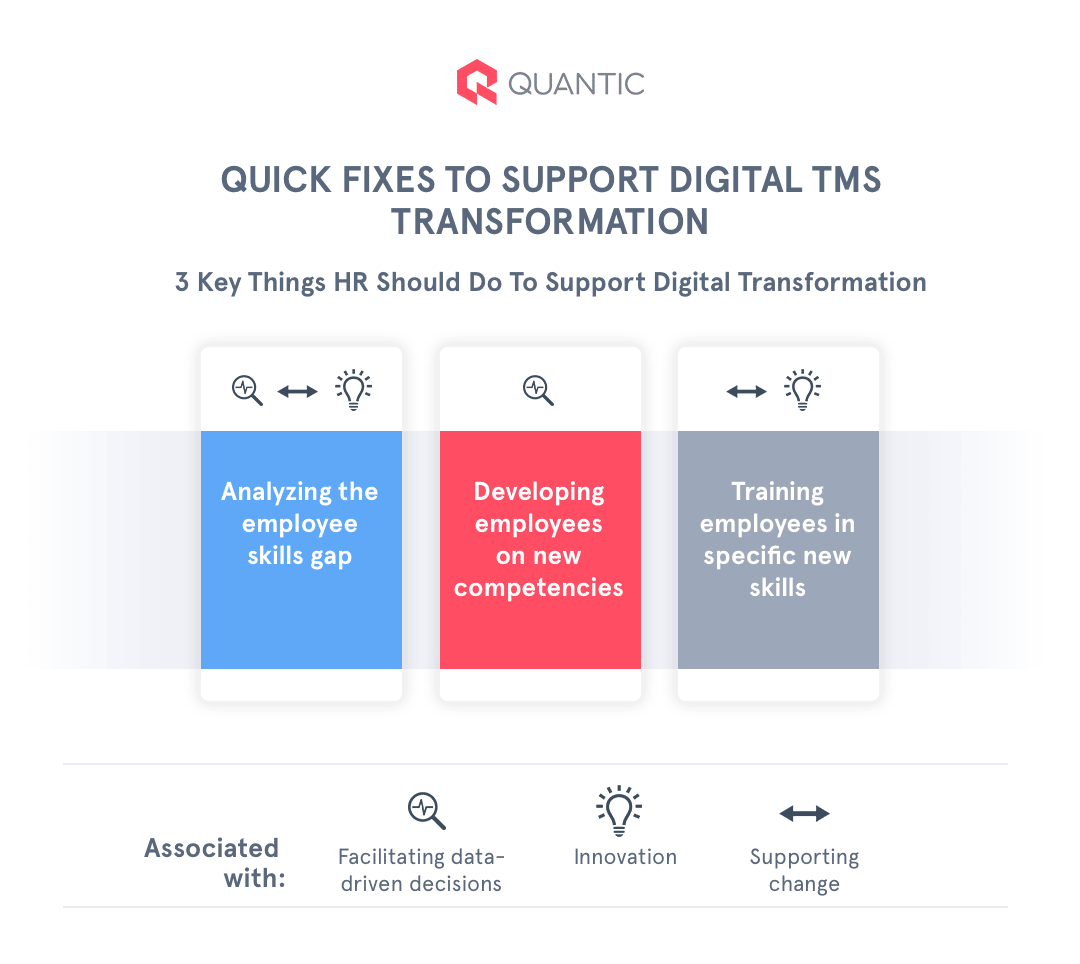
Discover the Employer Benefits of Tuition Reimbursement

People come and go — employee turnover isn’t some newfangled concept. Even the best companies will have a reasonable amount of layoffs, terminations, and resignations. 

Yet, you’ll know you have a problem when you start spotting certain patterns that reveal out-of-the-ordinary work dynamics. 

  • Are some of your top performers chronically dissipating? 
  • Could this be down to employee dissatisfaction? 

If you diagnose high employee turnover, plenty is at stake. It’s a drain on your money, time, and resources. Your staff morale and reputation can suffer too.

But how do you prevent that from happening? 

Many organizations are turning to employee reimbursement programs to keep their talent engaged. HR teams are keeping their eye on modern employee demands, and corporate training and development is huge. 

With college costs on the rise, stepping in to offset them increases your company’s perceived value.

It’s also a surefire way to attract new high performers to your organization. According to a report by Gallup, 45% of Millennials report they would change their job for tuition reimbursement benefits. 

They’re also more likely to stay with the employer.

Want to attract, develop, and retain the highest-quality workforce? Our ultimate guide to tuition reimbursement will help. 

What Is a Tuition Reimbursement Program?

Tuition reimbursement is an arrangement between an employer and an employee where a company shoulders a part (or the whole) of tuition expenses for an employee’s continuing education.

This way, people with funding issues are more likely to pursue further studies.

How Does Tuition Reimbursement Work?

No two tuition reimbursement programs are equal, and this gives freedom to organizations. 

On average, employers pay $5,250 for undergraduate and $10,500 for graduate degrees. Yet, each organization places a cap on how much they cover, what courses qualify for reimbursement, etc. 

Below are just some of the points to consider when framing your education assistance programs. 

You can weigh your options, but don’t go too eclectic with it. Some of these choices may affect your tax benefit eligibility. Do a cross-check with a licensed tax professional before initiating a program of your own.

  • Payment options Typically an employee pays upfront for a Bachelor’s degree or a graduate program. Upon class completion, a company reimburses a part of the expenses (or the full amount) to the employee. Other employers will help foot the bill right at the enrollment. 
  • Types of educational classes Some employers offer benefits only for approved educational classes relating to the employee’s existing career.

Others cover any qualified education expense, but may require that coursework is done through specific institutions.

  • Tiered payment levels Some reimbursement programs include tiered payment levels, which rely on student grades. 

For example, to qualify for a 100% reimbursement, a student must pass the course with an “A.” Those that score a “B” are in for an 85% reimbursement, and so on. 

  • Service requirements Companies typically require an employee to remain with the company for a set period of time to qualify for the reimbursement. 
  • Additional costs Some companies only bear direct tuition costs, while others shoulder extra coursework expenses such as books, internet connection fees, etc. 
  • Open applications and partnerships Many programs reimburse courses from any accredited institution. Yet forming exclusive partnerships with higher ed institutions is catching on among organizations.  

About Employer-Provided Education Assistance

An education assistance program (EAP) is a benefit that includes several types of initiatives where an employer:

  • Pays for education costs or offers tuition reductions to their employees. 
  • Offers scholarship grants to an employee’s immediate family members.
  • Assists with student loans.

If certain requirements are in check, these initiatives also benefit the employer.

For more information on educational assistance-related tax exemptions see this IRS website page. The IRS laws are in constant flux, so be sure to seek legal advice from a licensed tax professional.

How Does Tuition Reimbursement Benefit the Employer?

Organizations that provide tuition reimbursement do it for strategic reasons. It’s how they create a supportive environment and a continuous learning culture in their organization.

But here is a more in-depth business case for integrating it as one of your HR objectives:

Enhanced Recruitment

Companies that offer education assistance are likely to recruit top performers down the line.

These people are gunning for job positions that offer room for skills development. So, if you want to put yourself on the map as an attractive prospect for such workers, this factors in hugely.

A recent EdAssist study goes on to prove this in practice. 

84% of employees cited tuition assistance as an important factor in their decision to join their companies. In fact, 71% of participants rated tuition assistance among the best benefits offered by their employers after healthcare.

Better Employee Engagement

Your job doesn’t stop at raking in top talent. One of the top HR challenges is tackling complacency and keeping hard-earned hires on the ball. Even the most engaged worker will fall asleep if you put him in an unsupportive environment. 

High achievers need to be exposed to new opportunities to thrive. EAPs are a seamless solution.  

Improved Employee Retention

More than 27% of employees each year are lost to companies thanks to lack of career development. Being the first to offer in-demand learning and development opportunities gives you a head start in attracting the better portion of this fluctuating workforce. 

In more than 80% of cases, tuition assistance programs improved employee work satisfaction.

That said, tuition assistance programs  can help you rake in long-term workers and reduce employee turnover. Cigna is a good case in point here.

You can say the program moved the needle for the company. They saw a 129% return on investment partly due to reduced employee turnover. This success was paired with 43% higher pay gains for the employees as well. 

Tax Deduction Benefits

And here comes the best part: tuition reimbursement programs can help companies reduce their tax burdens. You can deduct up to $5,250 per employee a year. 

Why Is Education Reimbursement a Valuable Benefit for Employees

Education reimbursement is as valuable to employees as it is to employers.

Businesses earn their brownie points with potential hires. Employees get a well-rounded acumen in their field of work.

This is not a story-like narrative spectated through rose-tinted glasses. Education assistance programs (EAPs) help people gain a true professional advantage.

They’re being primed to advance into their dream jobs. 

Below is how they play out in the real world (backed up with the data from Lumina Foundation research). EAP participants are:

  • 10% more likely to be promoted.
  • 43% more likely to advance to higher-paying positions. 
  • 7.5% more likely to receive an internal transfer.
  • 8% more likely to stay with the employer.

Without an EAP, pursuing educational goals is not an option for many people. Paying for a potential hire to round out his or her education is a true perk.

Why Companies Should Pay for Employees’ College Tuition

Still not convinced employee assistance programs make business sense? Stay tuned as we’re bringing you some more note-worthy statistics from well-grounded research. 

How Many Employees Use Tuition Reimbursement?

In the meantime, only two to five percent of eligible employees utilize tuition assistance programs. A staggering 43 percent of working professionals are unaware of this employee benefit.

How so? Information doesn’t always get to people — and this can be the possible culprit. But most of the time, the conditions people have to meet to qualify may thwart their plans to apply in the first place.

  • Employees are often required to pay back tuition reimbursement if they leave within a certain timeframe.
  • Time pressure and the money factor may also add to the low response rates.
  • High levels of student debt should also be factored in. 

Monetize from what you’ve just learned. Initiate and promote your training and advancement programs. Also, consider pre-paying for your employees’ coursework to prompt them to participate. 

Tuition Reimbursement and Employee Engagement

A tuition reimbursement program can enhance your team’s academic development prospects. This alone carries weight that is likely to impact employee engagement in your organization.

But there’s more. Research shows these programs also make people better strategic thinkers. This, in turn, makes them more prone to assume higher leadership roles.

The graph below shows what a powerful driving force tuition assistance programs can be. It shows how effective they are in creating a highly-skilled team committed to their organizations. 

The graph below is drawing from the data on a 2018 EdAssist study. The respondents assessed how tuition reimbursement programs impacted their career growth. 

Companies That Provide Tuition Reimbursement

Many companies still have their educational assistance initiatives lined up, but which ones are already leveraging these impactful employee benefits? 

Companies run policies with different cost coverage and eligibility requirements. 

To illustrate, oil giant BP grants a generous 90 percent coverage of tuition costs, books, and fees. To qualify for the program, employees must enroll in approved classes and receive a passing grade.

Other big-name companies that provide tuition assistance programs: 

  • JetBlue
  • Starbucks
  • Home Depot
  • AT&T

Designing Your Education Assistance Program 

Kicking off a tuition reimbursement program is a complex long-term enterprise requiring strategy. Only a masterfully crafted plan will have overarching positive effects on your business. 

So, first off, make sure you include expert guidance from accountants, attorneys, and consultants every step of the way. 
The human resources department should make sure the initiative is in line with the organization’s strategic objectives. 

Having an education assistance program in place is an excellent way to create new career pathing opportunities. If a CEO is not aware of such a policy’s benefits, an HR professional should present a business case and draw out the basic strategy.
Below are some factors to consider: 

  • Align company goals and employee goals. Draw up a plan for your company’s education assistance program. What’s the end goal? Once you have it figured out, see how to fit your employee’s goals within that framework.
  • Weigh in your options before developing a learning plan. Is your program flexible enough, so it fits the unique needs of your employees? What about providing added flexibility by offering online education options? 
  • Stay transparent and maintain good internal communication. Staying on the same page with the participants will help you design a program that directly influences your business’s trajectory in the ways you want.

Corporate Tuition Reimbursement at Its Finest

Ready to up your HR game? Offering a tuition reimbursement program through Quantic School of Business and Technology will make you a magnet for top talent. 

We pride ourselves in bringing rigorous MBA education to both early-career high achievers and well-rounded, highly accomplished leaders. And we’re radically affordable.   

Our Executive MBA accredited degree program is your reliable ally in leadership development.

Don’t waste your organization’s human potential: join the list of companies that offer tuition reimbursement through Quantic.

Why, you ask? Well, the reasons are quite simple.

Here’s the sampling of a few companies that have offered tuition reimbursement to employees enrolled in Quantic’s programs: 

  • Salesforce
  • Apple
  • Adobe
  • GE
  • IBM
  • LinkedIn
  • JP Morgan Chase
  • Oracle

And there’s more. Our up-to-date accredited degrees are highly competitive — and for the following reasons. They:  

  • Are highly cost-effective. You can get our MBA programs at a fraction of the cost of traditional top business school programs. 

While some of those programs run upwards of $200K, our program is available for just $950 USD per month over the 15-month duration of the program. 

  • Save you valuable time. Thanks to mobile-first technology, our programs are fast and flexible. Our 100% online coursework allows students to learn on a flexible schedule, allowing them to complete a degree within 15 months.  
  • Bring enviable results to organizations. Quantic is a digital alternative to top traditional MBA programs. Our programs are proven to be as effective as top-ranked business schools like Harvard, Wharton, and Fuqua.   

Why waste your best resources — human potential, money, and time? 

Join the world’s top companies that reimburse their employees for Quantic’s degree programs.