How Many Fortune 500 CEOs Are Women? And Why So Few?

When Katherine Graham rose to become the CEO of The Washington Post, she carried the hopes of millions of women worldwide. 

Suddenly a woman could dream of life outside housekeeping and child-rearing. Not only that, a woman could work her way to the very pinnacle of career success.

It was the start of a new era of women leaders, or so we thought.

Marion Sandler became the second Fortune 500 chief with Golden West Financial, but alongside Herbert Sandler.

It took a decade for Linda Wachner to become the third Fortune 500 CEO with Warnaco Group and another ten years for Jill Barad to become the fourth with Mattel.

In the years that have followed, we’ve seen more female Fortune 500 CEOs, but not much has changed; women are still a minority with 8.1% as of 2021. That’s 41 female executives out of 500 Fortune CEOs.

We’ve gathered together more data on women executives according to race, industry, and how to improve gender diversity in upper management. 

Female CEOs Statistics

The following statistics cover the number of female Fortune executives, Black female CEOs, and women in the technology sector. In some sections, we’ll compare different years and comment on noticeable trends.

How Many Women Are CEOs?

According to a 2010 publication by the BLS (Bureau of Labor and Statistics), 24% of CEOs in the US were women. They also earned 74.5% as much as their male counterparts.

By 2015, 27.9% of chief executives in the US were women, which represented a growth rate of 3.9% in 5 years. The following graph illustrates the average distribution of executive roles between men and women in 2015. 

In their most recent 2020 survey, the BLS estimates that women occupy 29.3% of the chief executive roles in the US.

From this estimate, female executives grew by 1.4% between 2015 and 2020, which was a slowdown in growth from 3.9% between 2009 and 2015.

While this general growth suggests that more companies are working on gender equality, the low rates mean more needs to be done.

How Many Fortune 500 CEOs Are women?

The following table highlights the distribution of Fortune 500 CEO roles according to gender from 2000 to 2021. The number of female executives has increased since 2000, but the distribution is uneven, with men holding most positions.

YearWomenMen
20002498
20013497
20027493
20037493
20048492
20059491
200610490
200713487
200812488
200915485
201015485
201112488
201218482
201320480
201424476
201524476
201621479
201732468
201824476
201933467
202037463
202141459

Source: Fortune

  • In 2020 there were 37 female Fortune chiefs (7.4%). In the following year, this number rose to 41 (8.1%), increasing 0.8%.
  • Five years ago, in 2016, there were 21 female Fortune 500 CEOs (4.2%). Since then, this number rose by 4% to 41 as of 2021.
  • Ten years ago, in 2011, there were 12 women in the Fortune 500 CEO role (2.4%). Since then, this number rose by 5% to 41 as of 2021.

From these statistics, the percentage of women in CEO roles has steadily increased since 2000, albeit slowly. At 41, Women are still the minority; we’ll delve into reasons for this later on.

Black Women CEOs

In 2018, Donte Robinson and Rashon Nelson—two Black men—went into a Starbucks Philadelphia store for a business meeting. In a bizarre turn of events, both men were soon in handcuffs and under police escort.

Their charge? Trespassing.

The incident made national headlines and brought to center stage the issue of racial bias. It was a PR disaster for Starbucks and an opportunity for then COO Rosalind Brewer and her team.

Following the incident, Starbucks closed all its US stores to conduct racial-bias training, inclusion training, and empathy training for employees. The company also updated its policy to accommodate non-paying guests and allow them to use their restrooms.

Today Rosalind Brewer is the CEO of Walgreens Boots Alliance and one of four Black women to lead a Fortune 500 company. The following statistics demonstrate the underrepresentation of Black women in Fortune boardrooms: 

  • Since 2000, the number of female Fortune 500 CEOs hit an all-time high of 41 in 2021. In the same period, there have only been four Black women Fortune 500 CEOs.
  • For the first time, in 2021, two Black females are at the helm of Fortune 500 companies at the same time: Roz Brewer and Thasunda Brown Duckett.
  • With two Black women running Fortune companies out of  41 women executives in 2021, they represent 4% of female Fortune 500 CEOs.

Women Tech CEOs

According to a 2011 BLS report on gender inequality, women often feature more in some industries than in others, like tech.

For instance, a 2010 DoL (Department of Labor) study found that women mainly feature in industries like education (68%), health, and social services (79%). They feature less in professional, scientific, and technical services (43%) or construction (8.9%).

Today, the tech industry largely remains a boy’s club; only about 14% of US startups have a female CEO. Plus, the likelihood of a female CEO depends on the founding team and whether there is a woman on it. Only 2% of startups with all-male founding teams have a female CEO.

The good news is that there’s still much to accomplish for gender equality in the tech industry, like getting more women into STEM fields and subjects.

The Women CEOs of Fortune 500

In a landmark study of what makes women CEOs different, Korn Ferry (a consulting firm) realized that women executives shared STEM (60%) and business (19%) backgrounds.

These are fields that involve precision and definable outcomes. As such, they served as springboards for these women’s careers in upper management.

Another defining trait of Fortune 500s women CEOs is their resilience. The study revealed that women CEOs were 4 years older than their male peers and worked in more positions to get to the top. The following are a few such executives.

Susan Wojcicki: CEO of YouTube

Wojcicki attained an MBA from UCLA Anderson School of Management and a master’s degree in economics. Soon after, she became Google’s first marketing manager.

During this time, she introduced AdSense and was in charge of Google Videos when a free video-sharing website caught her attention: YouTube.

Ultimately, Wojcicki convinced Google’s cofounders to buy YouTube and became senior vice president in charge of ad products. Later, she succeeded Salar Kamangar as the CEO of YouTube, where she still works today.

“Tech is an incredible force that will change our world in ways we can’t anticipate. If that force is only 20–30% women, that is a problem.”

— Susan Wojcicki, CEO of YouTube.

Mary Barra: Chair and CEO of General Motors

Mary Barra started her GM career at 18 when she participated in a program that helped pay for her tuition. 

She graduated from Kettering University with a degree in electrical engineering in 1985 and an MBA from Stanford Graduate School of Business in 1990. With that, her career in management was underway.

Since then, Mary Barra went from GM manager to Senior vice president (2011), to GM executive vice president (2013), and then CEO of GM (2014).

“Education will open doors, talent will open worlds, but it is hard work that will enable you to accomplish more than you ever imagined.”

— Mary Barra, CEO of GM.

Ursula Burns: CEO of Xerox (2009-2016) 

From her early years at Cathedral High School, Burns excelled in math. This interest led her to a bachelor’s degree in mechanical engineering from the Polytechnic Institute of New York University and a master’s degree in mechanical engineering from Columbia University.

Burns later joined Xerox as a full-time employee, and her first role was in product development. Gradually, she moved through various positions before becoming senior vice president in charge of product operations.

This new role exposed Burns to global research, marketing, and eventually led her to become president of Xerox in 2007. In 2009, Ursula Burns became the first-ever Black CEO of a Fortune 500 company (Xerox) and the first to succeed another female in that role.

After stepping down as CEO of Xerox, Ursula Burns still serves as a board director of American Express, Exxon Mobil Corporation, Datto Inc., and Nestlé.

“Dreams do come true, but not without the help of others, a good education, a strong work ethic, and the courage to lean in.”
— Ursula Burns, former CEO of Xerox.

Highest-Paid Women CEOs

According to Fortune, the following is the list of the top 10 highest-paid female CEOs of 2021 and their companies: 

  • Karen Lynch, CVS Health
  • Jane Fraser, Citigroup
  • Julie Sweet, Accenture
  • Carol Tomé, UPS
  • Mary Barra, General Motors
  • Rosalind Brewer, Walgreens Boots Alliance
  • Gail Boudreaux, Anthem 
  • Abigail Johnson, Fidelity Investments
  • Ruth Porat, Alphabet Inc
  • Thasunda Brown Duckett, TIAA

Why Women Aren’t CEOs, Traditionally Speaking

Despite progress over the last two decades, women face significant obstacles in advancing and remaining in executive positions. Among them is not being taken seriously.

Nancy McKinstry is the CEO of Wolters Kluwer and has an MBA from Columbia University. For all her credentials, all one newspaper had to say about her strategy press conference was that McKinstry’s suit reassembled a KLM stewardess’.

As McKinstry’s suit illustrates, women leaders’ experience differs significantly. If a male CEO talked about strategy, it’s unlikely that anyone would focus on his clothes. The following are further reasons why more women aren’t CEOs.

Work-Life Balance

Most businesses operate on a culture of constant availability to stay competitive. From full-time employees to managers, companies expect overtime, out-of-hours phone calls, and emails, etc.

As you rise in ranks and responsibilities, these expectations also rise. As a result, it becomes harder for women to compete effectively with males when the extra burden of family responsibilities factors in.

Most women today still take care of household duties, even when working a full-time job. This fact limits their availability and locks them out of potential leadership roles, creating a pipeline issue in the process.

As such, there are fewer and fewer women as you move up the corporate ladder, with fewer women than men to replace them.

Graduate School Timelines

Some companies allow their staff time off for educational purposes, even paying for it. However, in today’s always-available work culture, most companies prefer part-time working arrangements. 

With this system, workers advance their education and skills while companies retain their workers, albeit part-time. As a result, companies don’t need to hire extra staff or train existing ones, and work continues.

It seems like a win-win situation, except it’s not for women. Most graduate programs coincide with childbearing years. As such, it becomes difficult to juggle between work, graduate school, and family.

Often, it becomes a choice between putting off graduate school or shying away from it. As Korn Ferry noted, most women CEOs are generally older than their male counterparts, possibly because they took some time off for family.

Segregation by Gender

Within management functions, women are comparably concentrated in specific roles compared to men.

In a recent report by the ILO (International Labor Organization), women are more likely to work in human resources, public relations, finance, and administration, rather than operations and sales, research and product management, or general management. Men dominate these roles.

This trend reflects a corporate culture that confines women to specific roles, limiting their exposure and experience; both are crucial for top positions. What’s surprising is that this isn’t a recent phenomenon.

On March 16th, 1970, 46 women researchers from Newsweek and their lawyer held a press conference. Together, they announced that they were filing an EEOC (Equal Employment Opportunity Commission) lawsuit against Newsweek—the first-ever female class action lawsuit.

Newsweek had a “female ghetto” (the research department) where women from prestigious schools would work and never rise to editorial positions. It was a segregation system that separated research work and editing roles according to gender.

Despite Newsweek agreeing to a settlement, not much changed. Women still couldn’t rise to editorial and writing positions and had to sue a second time.

This lawsuit triggered subsequent lawsuits at Time, Sports Illustrated, and the New York Times, shedding light on the extent of the problem (sexism). 

Unequal Networks and Mentoring

Networks significantly impact careers. They provide access to sponsorships, job opportunities, mentorship, referrals, build reputation, etc. Ultimately your network influences how fast you can get a promotion.

The problem is that men occupy most boardrooms and leadership positions. Consequently, women are less likely to have strong professional and mentorship networks, social ties, or insider information. There just aren’t enough women in powerful positions. 

Without access to such networks, it’s hard to imagine more Women CEOs. Essentially, it represents a lack of infrastructure.

How To Overcome the Disparity Of Women CEOs

Voluntary Targets by Companies

Boardroom quotas often seem like the best solution to gender inequality. Germany made it mandatory for some of Europe’s largest companies to have women in 30% of boardroom seats.

Unfortunately, to stay competitive, companies must hire according to needs, skills, and abilities. In some cases, this may be disproportionate to specific quotas.

An alternative approach is for companies to set voluntary targets that push for more women in boardrooms.

Flexible MBA Programs

Experience, exposure, and an MBA education go a long way towards climbing the corporate ladder. 

Despite their importance, traditional MBAs are notoriously expensive and not accommodative enough. From rigid timetables to high accommodation costs, it can be inconvenient even for part-time workers.

The good news is that accredited online MBAs offer equal opportunities to traditional MBAs, with more flexibility and fewer costs. One such course is the Quantic MBA program.

In today’s always available-work culture, Quantic’s MBA programs fit right in. The program features a comprehensive curriculum covered at your pace, so you won’t have to miss work.

Plus, Quantic’s program gives you access to a network of employers, mentors, and investors that’s sure to speed up your career growth.  

Apply for our MBA here.   

“Quantic was a great way for me to obtain additional business acumen without needing to commit to the time and cost of a traditional MBA.”
— Liza Graziano, Verizon, HR

Quantic Student Spotlight

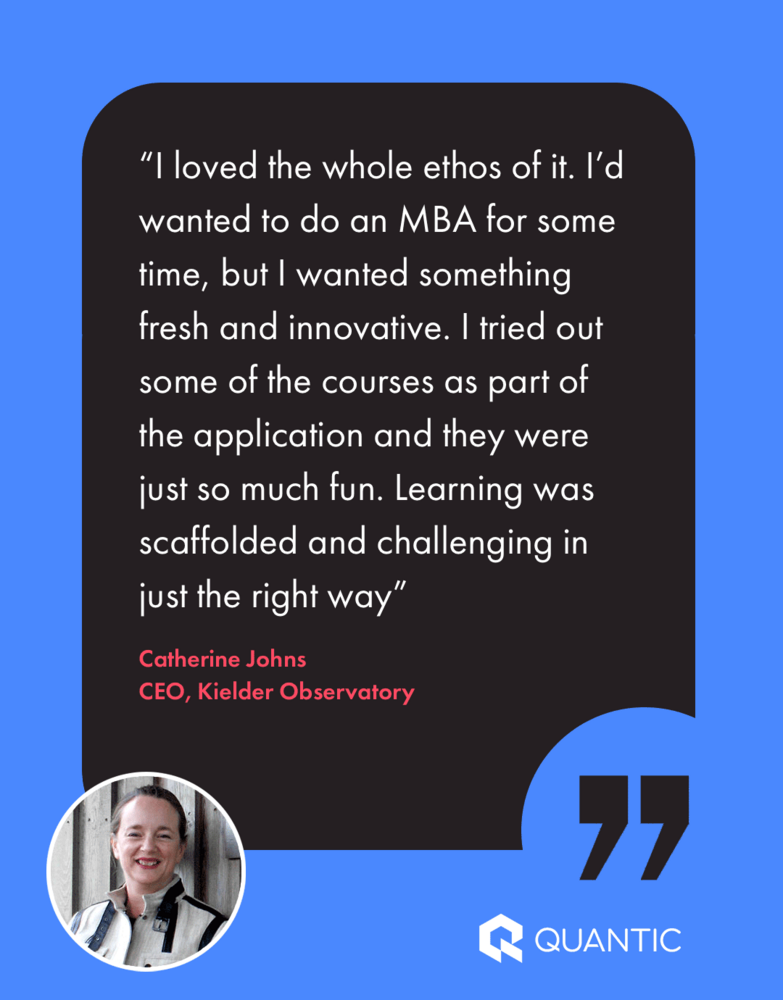
Catherine Johns’

Her background in the space industry and her current position as the CEO of Kielder Observatory, a public astronomical observatory, demonstrate her leadership and management skills that are essential for being a Fortune 500 CEO.

Her passion for space exploration and astronomy has driven her to create opportunities for people of all backgrounds to experience moments of inspiration, revelation, wonder, and hope through observing the cosmos.

Moreover, her experience in launching new projects, such as Kielder Constellations, and her focus on expanding innovative ways to learn, such as taking Quantic’s Executive MBA program, highlights her ability to adapt to changing circumstances and think outside the box.

Girl Up’s Virtual Summit

Naomi Naik, a Girl Up Communications & Digital Media Associate, helped in adapting the global leadership summits of Girl Up, a leadership development movement that engages, trains, and mobilizes girls around the world to take action to achieve global gender equality, from in-person events to virtual ones due to the COVID-19 pandemic.

Naomi and her team worked diligently for weeks to create an interactive experience online that could increase their reach given that the summit was usually in Washington, D.C. and capped at 450 attendees. The virtual summit gained the attention of global leaders and changemakers like former U.S. First Lady Michelle Obama, Meghan Markle, the Duchess of Sussex, and Facebook COO and Lean In Founder Sheryl Sandberg.

Frequently Asked Questions

What is the average salary of a Fortune 500 CEO?

According to Fortune, the top CEOs earned an average of $12.3M as of 2020.

Which are the top 5 Fortune companies?

According to Fortune, these are:

  • Walmart
  • Amazon
  • Apple
  • CVS Health
  • UnitedHealth Group

Who is the youngest female Fortune CEO ever?

At 34, Katrina Lake became the youngest female CEO with Stitch Fix.

Women Who Lead: Virtual Summit Success

Inspiration, motivation, and connection: 

Our Quantic community is filled with strong women leaders and we were thrilled to see the incredible turnout, during our first Women Who Lead Virtual Summit! 

Hundreds of students and alumni gathered virtually for a motivational keynote, educational panels and workshops, and networking mixers to help empower women to excel in their professional and personal endeavors. 

Workshop themes included: Pathways to Leadership, Who Are You Going to Be in 2022, and The Future of Work. Our Keynote to kick off the week’s events was given by Elizabeth Yin, General Partner at the Hustle Fund. The event was moderated by our very own Alexie Harper, Quantic co-founder and Chief Academic Officer. Elizabeth explained the importance of democratizing opportunities in different industries, empowering women to take leadership roles, and maintaining a positive attitude along the journey.


Throughout the week-long conference, we also asked some of the leaders in our Quantic community to share their inspirational thoughts on female leadership. 

Here are some of those highlights:

The Importance of Coaching in the Workplace and How to Do It

The goal of every business organization is to have a highly effective and productive workforce. Without this, the organization may plunge into loss-making, or worse still, it may close shop.

A report by Gallup on the American workplace found that stress levels among workers worldwide have reached an all-time high.

So, what’s the way forward for managers? The simple answer is coaching.

Coaching is invaluable if an organization is to achieve its goals. It should be part of the continuous employee performance management by managers to maximize the potential of the employees.

Failure to coach employees leads to an unproductive and disengaged workforce. At worst, it can cost your organization money.

There’s an urgent need for HR directors to act swiftly to ensure their organizations remain in the competition. They can effectively achieve this by accessing some of the best training programs for both managers and employees.

We’ve curated for you the most effective coaching techniques in 2023, their importance, and how to carry them out. Here is all you need to know:

What is Coaching in the Workplace?

Workplace coaching is the process of equipping employees with the knowledge, tools, and opportunities necessary for them to be effective.

It involves a professional helping relationship that focuses on the needs of the employees and the goals of an organization.

We can further define workplace coaching as a leadership strategy that aims at addressing workplace objectives. It also empowers employees to meet the same goals.

Please take note:

  • Although it makes use of specific management skills, coaching isn’t a repackaging of management skills. Coaches handle employees’ growth and development, unlike management, which deals with supervision.
  • Although it uses some of the communication processes, workplace coaching isn’t counseling or therapy. Coaching entails creativity, action, and performance, while counseling involves listening to and empathizing with an employee.
  • Although coaches will use their experience, workplace coaching isn’t mentoring or consulting. Coaching goes a step further to enable employees to create their practices and resources.
  • Although coaches give information, workplace coaching isn’t training. Coaches support employees to develop their skills and knowledge.

So, who does workplace coaching?

Coaching can occur in two different ways — 

Leadership style: Here, coaching occurs internally. Managers and leaders engage their employees in either formal “sit-down” coaching sessions or informal “on-the-run” sessions.

Intervention: According to (Grant, 2017),  intervention is when coaching happens externally. In this case, organizations bring in an external coach to work with the leaders.

Great and successful managers and leaders are putting forth consistent efforts to enhance their coaching skills. These efforts aim to support and improve employee development and performance.

Managers with coaching skills also do peer-to-peer coaching in the workplace. With this, they support and guide each other in challenging environments.

Either way, workforce coaching should focus on:

  • engaging employees
  • making employees aware of company objectives
  • helping employees reach organizational goals independently

The best workplace coaching isn’t just for providing a context for feedback. It goes further to offer support for changed behavior.

The best workplace coaches aren’t those who follow a cookie-cutter approach. On the contrary, they understand and develop their coaching style.

The Growing Importance of Coaching in the Workplace

The business field has become highly competitive.

Successful organizations such as IBM, Hewlett Packard, MCI, and others have put in place ongoing coaching of their workforce to remain competitive.

As many large organizations are discovering, the traditionally used “command and control” management style no longer works in today’s environment.

The current environment calls for quick response, resilience, leveraged creativity, individual effort, and performance. These aspects are what will make an organization remain competitive.

Coaching is the key to retention, which is critical in any organization.

Workplace coaching ensures employees gain career or professional development and satisfaction. In return, it helps to retain the most valued employees.

Coaching employees in the workplace to performance, rather than managing them, makes them more committed to their work. They are also more dedicated to the achievement of organizational goals.

According to the Gallup report, the American workforce has over 100 million full-time employees. Unfortunately, the report paints a bleak picture of engagement of workers as shown below:

Engagement statusPercentageDisposition
Engaged33%Love what they doMake their organizations and country great
Disengaged16%Miserable at their workplaceDestroy what the engaged employees have built
Not engaged51%They are just there

Why is coaching critical now and in the future?

For organizations, change will be the norm moving forward. Likewise, team and organizational success will be dependent on individual resilience and performance.

The essence of coaching is that it leverages individual abilities and strengths for maximum performance.

Coaching is critical because it provides just-in-time learning tailored to the particular situation. It also offers direct on-the-job learning.

Coaching promotes behavioral changes, which makes it easy for people and projects to move forward with ease.

Today, business changes require swift shifts into entirely new models. Workforce coaching prepares employees for such shifts necessary to meet changing business demands.

Thus, managers and leaders must coach their employees to become career self-reliant. They should also encourage them to engage in continuous career development.

Benefits of Coaching in the Workplace

Alt: Employee training in the workplace

A coaching culture in an organization fosters the following benefits:

Engages Employees

We can almost use “coaching” and “engaging” interchangeably. The two go together like peanut butter and jelly (or whatever your favorite combination is).

Coaching is an excellent way of engaging employees in an organization. Organizations thrive more with engaged employees than with unengaged ones.

A study by Gallup on the effects of engaged employees on an organization shows that on such organizations, there was:

  • 10% higher customer metrics
  • 21% more sales
  • 41% lower absenteeism
  • 20% more sales

Are these not the kind of results any manager would want to see in their teams?

Coaching makes employees feel more connected to the company. Consequently, this creates a sense of loyalty and trust.

Decreases Employee Turnover

Employee retention is one of the greatest challenges facing many organizations today. In today’s recovering economy, small and large organizations have made employee retention their priority.

One of the best ways for any organization to retain its best talent and maintain productivity is to focus on job satisfaction, engagement, and loyalty.

A manager can create an engaging environment with his employees by spending time coaching them.

Employees engaged through coaching tend to stick around longer. According to the Gallup report, organizations that engaged their employees through coaching reported less than 59% turnover.

Employees interpret coaching by their managers as a sign that they are cared for. They feel valued and necessary in the organization. Such employees desire to stay longer in the organization.

Increases Productivity

Engaged employees and lower turnover rates lead to increased productivity, both individually and corporately.

When you engage your employees, they get direction, purpose, and goals to work towards. Employees also become more confident as you help them reach the set goals.

Remember, the accomplishment of goals equals greater productivity.

Similarly, employees who remain in an organization for long become more competent in their roles. Their competency gives you room to improve their skills instead of hiring and training new employees.

Coaching, therefore, is an effective tool in engaging employees, decreasing turnover, and increasing an organization’s overall productivity.

Creates Stronger Bonds

Workplace coaching helps create stronger bonds within teams in an organization. Coaching helps employees become more comfortable with their leaders and thus feel free to seek help in case of problems.

According to a study at Stanford University, working together boosts employee motivation.

Another advantage of bonding with team members is that it creates opportunities for positive communication and feedback.

Are you a manager wondering how to be a better coach? You can consider Quantic training, which you can do at scale and is more practical.

Benefit of Coaching in the Workplace for Managers

Stepping into a managerial position comes with numerous responsibilities. Managers need to acquire new skills that are critical for leadership.

Leadership coaching is critical for managerial success. Its benefits will also trickle down to the entire workforce.

The benefits of workplace coaching for managers include:

Better Management Skills

Coaching for managers provides them an opportunity to hone their skills, especially those related to management.

Some critical skills for a manager include being a better communicator and learning how to provide high-quality feedback. With these skills, managers are in a better position to support and develop their teams.

Managers can acquire new skills by themselves. However, having a leadership coach accelerates the process and provides first-hand knowledge.

Improved Productivity

As a new manager, you may find it challenging to balance all your new responsibilities. A manager’s responsibilities range from holding one-on-one sessions to attending strategic leadership meetings.

As a manager, you need to know how to manage your time well. Failure to do this may result in a struggle to be productive.

It may also lead to dissatisfied team members who feel that you are not effectively attending to their needs.

Coaching helps a manager to know how to balance the responsibilities. A coach will teach you better time management skills and how to prioritize responsibilities.

Researchgate carried out a study on the effects of executive coaching. In the study, 31 managers had one-on-one managerial training that involved:

  • Goal setting
  • Practice
  • Collaborative problem solving
  • Feedback
  • Supervisory involvement
  • Evaluation of results

The one-on-one training increased productivity by 22.4 percent, thus clearly indicating that leadership training is key to improved productivity.

Coaching in the Workplace Examples

Atul Gawande and Medical Coaching

Dr. Atul Gawande realized that his growth as a surgeon was on a plateau. Determined to change this, he decided to hire a coach to observe him in the operating room.

This coaching set him back on a progressive trajectory in his career. Having rekindled his progress, he further created a program that has coached doctors in Uttar Pradesh, India.

Coaches also played an instrumental role in helping doctors to execute the steps of child delivery. This coaching has helped save many lives.

You can catch the full story on this TED Talk.

Saba Mathieu and Workplace Coaching

Saba Mathieu is a specialist workplace coach. She specializes in creating coaching cultures within her clients’ organizations.

She focuses on three critical needs for employees:

  • Autonomy
  • Relatedness
  • Competence

According to Saba Imru, meeting the three needs gives employees satisfaction at work. In addition, they become more productive for their employer.

You can check out more on her approach in this TED Talk.

When to Use Coaching in the Workplace

If used in the right situation at the right time, workplace coaching makes the life of a manager easier.

On the flip side, it can be frustrating if a manager tries to coach employees whose problem doesn’t require it.

A manager should recognize situations that call for coaching and those that require a different approach.

For example, an employee may have the necessary skills and ability to complete a task. However, this employee may be struggling with motivation, confidence, or drive. Here, coaching can help.

Struggle among employees is usually because of three things:

Skills and abilities: They lack the ability or skill to do the current work (aptitude).

Themselves: They lack focus, motivation, commitment, or the confidence to complete their current work (attitude).

Outside factors: Employees get affected by external things that are out of their control, such as a lack of resources and changing market trends.

For an employee who lacks specific skills and abilities, coaching is not necessary.

Coaching vs. Counseling in the Workplace

The difference between counseling and coaching is how both are time-driven. Whereas counseling is past-oriented, coaching is future-oriented.

Counseling takes care of behaviors and thoughts that affect performance and productivity.

You can recommend counseling for an employee after they have received a disappointing performance review. Here, counseling will involve listening to the employee before deciding on how to help them out.

You can also recommend counseling for an employee dealing with personal issues that are affecting performance and productivity.

Some of the common issues include:

  • Substance abuse
  • Health issues
  • Divorce

Effective Coaching in the Workplace — 5 Steps 

As an HR manager, effective coaching will ensure your team is prepared to achieve the set goals.

The following steps will help you achieve effectiveness in coaching.

Decide What You Want to Accomplish

Be clear with what you want your employees to accomplish before you go to them.

Coaching can either be about improvement or training on a new process. Whatever the reason, keep your focus on how the result should look.

Be clear about your expectations with your employees right from the start. Let them have a clear picture of your intended result.

Choose the Right Path

Set specific criteria for achieving the set goals and a timeline for the same.

Ensure there is a continuous flow of communication before, during, and after the coaching process.

You can determine the best approach if you know your employees’ skill sets and areas of expertise. In most cases, some employees will require extra instructions on some topics than others.

Don’t forget to inspire your employees as you move towards the desired direction.

Stay on Top of the Process

Always come back to check progress and encourage employees. However, avoid micromanaging your staff.

Guide, instruct, and offer encouragement, but give them space and autonomy.

Correct without using a negative tone and keep measuring the employees’ progress against the timeline.

Give Feedback

Ensure you give straightforward feedback by:

  • Avoiding being vague
  • Providing examples where necessary
  • Being clear on what the employees didn’t do right
  • Showing them how they could do it differently
  • Being clear on why it should be done in a certain way

Combine Coaching With Education

Lastly, make your coaching effective by combining it with education. Our Quantic programs are currently the best go-to education programs.

The programs allow you to educate your workforce at scale. They are very pocket-friendly. Moreover, at Quantic, we utilize active learning, which makes our programs very practical.

Take action now and book a call with us today.

Online MBA Trends | The Changing Landscape After COVID

Since 2018, regular MBA programs have witnessed a 70% application decline. 

William Boulding, dean, Fuqua School of Business at Duke University, states that: 

In the wake of COVID-19 travel restrictions, social distancing, and the tenacity of the coronavirus, many campuses have closed doors.

Consequently, many business schools have embraced online learning.

A 2020 report by the Graduate Management Admission Council reveals that top business schools increased online enrolment by 67%. 

Many young professionals have little earning power to raise enough fees for a regular MBA. Others can’t leave their full-time jobs for a two-year, on-campus commitment.

66% of students today prefer distance learning to the traditional classroom. Its flexibility beats the constraints of money, time, and physical location.

Today, you’ll learn more about the online MBA and its impact in a post-COVID world.

The Graduate Management Admissions Council (GMAC) admits that the traditional full-time MBA is declining.

In 2017, US business schools witnessed an average 48% decline compared to 2018, especially international students.

The following report is from 767 interviewed graduate program correspondents:

  • 32% of the correspondents have reported a significant decline, at 21%.
  • 17% have reported a moderate decrease of 11–20%.
  • 19% have reported slight reductions of 1–10%.

Contrarily, the online MBA is on the rise. A 2019/2020 GMAC report states that of the programs interviewed, 90% admitted that their applicant pools went up by at least 24% compared to a year earlier.

The hiring trend also shows demand for online MBA students. GMAC indicates that before COVID-19, 92% of organizations wanted to hire MBA graduates. This fell to 89% during wave I and 77% during wave II. It went back up to 89% in 2021.

These trends show a rising acceptance of an online MBA degree in the industry, especially during the global pandemic. This also owes to the affordable nature and flexibility of an online program.

Top business schools witnessed an explosive influx of prospective students, including those who wanted to continue their business school journey during the pandemic’s lockdown. 

The Indiana University’s Kelley School experienced a 64% increase in uptake over the last year alone. The Jack Welch Management Institute also saw an 84% rise (from 3,103 to 5,321 in the past year).

Between 2018 and 2020, Washington State University saw an 89% rise (from 614 to 1,159).

Brooke Elliott, the senior associate dean of online programs at the Gies College of Business (University of Illinois), ties the rising number of applications at the university to intake flexibility.

By allowing students to enroll five times per year, they saw a 75% intake surge last year. This program has moved from zero to 4,000 students between 2016 and 2020.

Is An MBA Still Relevant In 2021

GMAC business school data shows that applicants increasingly adopted online programs in the 2019–20 admissions cycle.

Gies online MBA program, for instance, reported 2,400 new students in 2020. At the same time, they project a 30% annual uptake.

Conversely, traditional MBAs are facing a crisis. Between 2018 and 2019, the top business schools in the US saw an average 5.9% application deadline (53,907 from 57,311). 

The table below shows the decline in regular MBA application among major universities in 2018-2019:

Business schoolPercentage decline
Yale’s School of Management15.6
Duke Fuqua14.6
Dartmouth College22.5
Wharton School (University of Pennsylvania)5.4

Andrew Ainslie (associate dean, Simon School of Business at the University of Rochester) predicts that 10 to 20% of top US MBA programs will close in the next few years. The Gies College of Business, for example, has already shut down its full-time MBA program.

Flexible and personalized learning options are inevitable drivers of change. Institutions must equally adopt technology, data analytics, and institutional collaboration. 

Quantic’s innovative online MBA program helps learners grasp their lessons by collaborating with other students or reaching out to our strong alumni network. 

How Online Learning Failed During The Pandemic

A few months into COVID-19, the world saw the largest experiment with virtual communication. 

Unfortunately, many students have struggled with isolation and lack of resources. 

In the second quarter of 2020, several countries estimated that students lagged by up to 6 months in their typical academic milestones.

The results of the global shift as a result of the coronavirus pandemic can be disastrous. Academic progress has been on the line, which has affected other success components of life for many learners. 

Online MBAs During COVID

2019 presented a 50% application boost for online MBA programs. This statistic rose to 84% in 2020, the highest across any degree type. 

However, more people still desire in-person contact alongside an online education experience. 

According to OneClass, 75% of the 1300 students interviewed indicated that pure online teaching doesn’t meet their expectations.

Online MBAs after COVID

COVID-19 has shown the world just how archaic a traditional MBA program can be. Executives and employees were forced to learn new rules that solved business problems in real-time. 

As many schools plan to reopen when the coronavirus pandemic wanes, there is a growing affection for hybrid programs. This type of program is the perfect blend between the flexibility of an online program and a physical campus experience.

GMACs director of industry insights, Rahul Choudaha, explains: 

Another method schools are using to navigate the time/financial challenges posed by COVID-19 is using certificates, which provide an alternative to the intense, 2-year MBA program. 

Students can concentrate on specific areas of concern within a shorter time, then get certified for that.

Some schools offer specialized online MBA programs in marketing etc. These are courses programmed with qualities that are partly degree and partly certificate. This is different from the traditional MBA, which comes with 50% credits that students don’t prefer. 

Best MBA Programs For The Future 

Future business leaders will be required to package a digital mindset alongside an acumen for data-driven decisions, continuous learning, and critical thinking.

In the GMAC Corporate Recruiter’s Survey, 2 in 3 recruiters agree that managing tech disruption is the most essential skill. This includes remote team administration and supporting an organization’s digital strategies.

Over 50% of the respondents agreed that strong communications skills, the ability to innovate, an adaptable mindset, and strategic thinking are crucial to career survival after COVID-19.

To choose an online MBA specialization, please consider the following:

  • Know your interests: Ask yourself crucial questions that will help you align to an online MBA specialization that meets your core interests.
  • Consider your career path: Make a sound decision that will assist your career pursuits.
  • What are your strengths? Choose a program that leans toward them.
  • Specializations: Find out the specialties and subspecialties you’ll benefit from.
  • Cost: Match the program with your financial ability.
  • Duration and Schedule: How long does the program take? Consider the number of weekly study hours, and whether the program requires physical attendance, or has a flexible, distance-learning option.

Below is a list of top online MBA programs, with their corresponding specialization features.

Quantic is your go-to choice for your online MBA needs. Our rigorous program gives high-potential learners new skills for leadership and management. We also help our students network with top achievers from the best companies around the globe.

Online MBA Rankings 2021

The post-COVID world has made online learning a solid alternative in these uncertain times.

Today, students want the benefits of a physical network, motivation, and an active learning lifestyle, while enjoying the flexible schedule of distance learning. 

Quantic’s programs are readily accessible, with an online MBA application volume that combines that of all the top 10 US business schools. We also have a well-distributed global representation across 119 countries.

Our students love the affordability, high caliber network, and convenience of our programs. 

Our interactive approach to remote learning augments social practice. This helps you keep your job, and study on a flexible schedule that helps increase your earning power.

Our accredited, app-driven curriculum enables interactive self-study. Our online case studies align with online and in-person meetups in partner sites around the globe. 

Apply today to begin your online MBA career journey with us.

The Two Best UX Designer Career Paths | How To Advance

The business world has finally perceived design as a Unique Selling Point of change. According to research from Forrester,  every $1 spent on UX today brings in $100 more (9900% ROI).

This tectonic shift has sparked Design Thinking, which takes the UX career beyond marketing, to the design methods that solve familiar business problems. These include organizational management, statistical analysis, and competitive strategy.

The UX career goes beyond photoshop and UX tools. It puts UX designers in a collaborative position where they need to buy in all the right people in the company.

David A. Norman, founder of UX, wisely put it this way:

Choosing the right UX career path is therefore crucial to your service offering. An understanding of what it takes to succeed is vital at this point of practice.

Understand the UX Designer Career Path

According to the US Bureau of Labour Statistics, the annual industry increment rate for UX designers stands at 3% (up to 2028). CNN Money supports this, predicting an 18% growth in demand for UX designers (since 2015).

All UX career varieties merge into two main career paths: managerial and technical.

You’ll learn more in the sections below. Meanwhile, you can get an overview from this Reddit thread.

What Does a UX Designer Do

Just like the UI designer, a UX designer is a generalist who covers all design aspects, including the user interface (in collaboration with a UI designer). 

His role, similar to a UI designer, involves a 5-step process called Design Thinking.

The Design Thinking development process can further be broken down as follows:

 This applies in principle to both the UX and the UI designer.

UX Designer Skills

UX designers (just like UI designers) perform either technical or managerial tasks. Their skill requirements are further classified as follows:

UX Manager Skills

A UX Manager needs to be a visual designer who is creative, analytical, and task-driven. To effectively manage the team as a UX director, the right candidate should be:

  • Software Proficient: He should be conversant with project management software, customer research tools, and graphic design software.
  • Business Savvy: A UX Manager should comfortably analyze business goals and match the right team for the project.
  • An excellent communicator: He should synergize output from different teams, including researchers, designers, engineers, UI designers, writers, and the business team. 

UX Technical Skills

A technical UX expert does the activities that deliver the actual design projects. Their UX job involves:

  • User language and empathy: A UX researcher understands how the user interacts with the product. They perform user testing/usability testing as part of optimizing human-computer interaction (HCI).
  • Story-telling: He incorporates screen presentations, verbal explanation, and writing for UX that build a compelling story of the final product.
  • UI Prototyping and Wireframing: Wireframing and prototyping help clarify key design functionality. Using tools like Justinmind, you supplement UI designer roles and help create a functional user interface.
  • Collaboration: Teaming up with UI designers and other professionals helps to complement your skills.

At Quantic, we embrace an Active Learning approach beyond the course content and help you think as a decision-maker. Our sessions are heavily interactive, aimed at making your UX design career more effortless and faster to navigate.

UX Designer Salary Statistics

According to PayScale.com, the average pay for a UX designer is $76,429 per year. 

Competing Career Pathways in UX Technical Track vs Managerial

How To Become a UX Designer With No Experience

The following steps will help you transit from a complete newbie to a master in the skillset you prefer:

Step 1: Understand your transferable skills

From your previous career, there are positive aspects you can carry over to your UX career path. These include empathy, collaboration, time management, and clear communication.

Step 2: Find the right mix of mentors and friends

Design mentors will help you strike new levels of UX design since they already know what you’re struggling to learn. They could also point you to UX job opportunities.

Step 3: Keep learning

Make continuous learning a habit through UX courses, blogs, communities, and podcasts. Get well versed with current trends in the field. 

Step 4: Get experience

Get hands-on experience with UI design. Enroll at the next hackathon opportunity and learn through collaboration. This exposure will help you gain the exposure you need.

Step 5: Work on your UX portfolio and apply for jobs

Develop a minimum of 3 varied UX case studies to demonstrate your UX work portfolio. For instance, one could showcase front-end web development skills, the other a mobile development, and the other a desktop app design.

Technical Track

To do well in the technical path, you need to:

Learn and Improve your visual design skills

You could sign up for UX courses that will help you build a solid portfolio, and pair you up with an industry expert. 

Master a UX Prototyping tool

A UX prototyping tool like Sketch and InVision will help you physically practice what you learn from books and courses. 

For more information, have a look at this mammoth 200+ tool list for UX designers.

Build an Online Portfolio Site

A good portfolio site should clearly introduce you (through a photo and contact information) and list your best works built using industry-relevant tools.

Make an Awesome Resume

Only highlight strong points relevant to the job you are eying or the type of clients you want. Be brief and clear, and avoid pitfalls.

Practice To Become a UX Designer

An easy way would be through volunteering at a site like VolunteerMatch, doing an unsolicited redesign challenge, or just applying UX methodologies to your current job. 

Managerial Tract

To effectively lead a design team as a manager, you will need to:

Get a Bachelor’s Degree

This is a prerequisite to a master’s degree, which is today’s minimum standard for UX and design managers. Consider a course like business administration, economics, or engineering.

Get First-Hand Experience

A bachelor’s degree will help you land a job as an entry or middle-level expert. Furthermore, you could master:

  • Interactive design: As an interaction designer, you need to understand user research to enhance their experience with the product. 
  • Analytical acumen: Observing and interpreting customer needs, market conditions, and competitors, with a view of explaining this to stakeholders.
  • Problem-solving: Spotting issues with the current design/processes to enhance positive user interaction.
  • Collaboration and team-building: UX chiefs are project managers who deal with clients, UX designers, UI designers, the overall product development team, and company stakeholders.

Get a Master’s Degree

A Master’s program arms you with industry knowledge, equipping you with the confidence senior UX designers need to meet the organization’s business goals. According to Coursera, getting an MBA also gives you a 50% chance for a pay hike.

Career Trajectory for a Software UX Designer After MBA

Why Do UX Designers Pursue an MBA?

As a designer, you may feel distant from the reality of business as a strategy. While you’re technically conversant with front-end stuff, Photoshop, and other similar tools, it seems daunting to convert and relate these to a corporate audience. 

Luckily, you’re not alone. This is a reality most UX researchers and visual designers like you face.

An MBA will introduce you to concepts like financial accounting and corporate ethics, which will give you an elevated approach to UI design and customer impact.

The Best MBA for UX Designers

At Quantic, we believe that an MBA helps a UX professional better understand business, pain points, workflows, and business processes. These help shape the entire production process, from the initial strategy to the final concept.

We take a pedagogical, interactive approach to learning, making it easier and faster. 

You can trust our mentors and tutors to give valuable feedback and aid in your learning and career advancement.

Is an MBA for UX Design Worth It?

Yes. Taking the managerial path requires the necessary skills offered by an MBA.

Our award-winning MBA program provides a curriculum meant for mid to late-career professionals. It comes packaged with the right mix of in-person and virtual meetups, career networks, and conferences to help you advance. 

Within 15 months, Quantic students acquire skills and insight that help them scale to senior roles or start a new company. 94% of our alumni acknowledge that they’ve achieved their career dreams after graduating.

Quantic Alumni Who’ve Found UX Success

Lindsey Allard

After working at several startups, Lindsey Allard co-founded PlaybookUX to solve the pain points of user research, which is a crucial aspect of UX design.

PlaybookUX provides video-based feedback, recruiting of the right participants, transcribing of sessions, and analysis of videos with A.I. to extract actionable insights, making user testing accessible and affordable to everyone.

Allard’s career path from product manager to co-founder of a user research company demonstrates how UX designers can leverage their skills and expertise to pursue entrepreneurial ventures in the field of UX design. Read the full case study here.

Amy Dalton

Amy Dalton’s mindset, self-motivation, and passion for learning have played a significant role in her career success. She is now the Senior UX Designer at GE Aviation and has a passion for empowering women and girls to pursue technology-related careers. Read the full case study here.

Summary

The UX design field has a bright future. If you want to branch out into a senior UX designer role, then getting an MBA is a rewarding choice.

So far, you’ve learned about the two broad career paths (managerial and technical) of UX design. You’ve also grasped the Design Thinking process and the skills that administrative and technical users require.

Better yet, you can take up a UX designer career without prior background experience.

At Quantic, we help you take the right trajectory that better your career. Our MBA degree programs are structured for interaction, networking, and relevance. 

.

10 Higher Education eLearning Trends To Watch | 2024 and Beyond

Whether you’re a parent, student, or teacher, you need to keep yourself updated on the latest eLearning trends. Once you know what to expect, you can find the perfect MBA program to unlock your career potential while avoiding spending time and money on the wrong program.

Keeping up with eLearning tends can help improve student engagement and the learning experience. 

Below we explore the top eLearning trends for 2024, so you know what tech training strategies to implement.

What Is eLearning?

eLearning is an education system where instructors leverage electronic technology to facilitate learning. Students access learning content via computers. It’s popular in higher education for: 

  • lowering education costs 
  • allowing self-paced learning
  • enabling remote lessons

eLearning examples

Many educational institutions and companies depend on the eLearning industry. Some prominent universities like Harvard offer free courses on justice and climate change for anyone willing to sample an Ivy League education.

Also, many companies are leveraging e-Learning for workplace learning and filling skill gaps. For instance, firms like Estee Lauder partner with Linkedin Learning to find practical personalized learning solutions and development programs for their staff.

eLearning methods

Students and instructors have several eLearning and teaching options. For example, eLearning for higher education can take place through:

Distance Learning 

With this type of arrangement, learning takes place in the absence of a teacher. Teaching material like instructional videos and lectures is accessible from any location.

Blended Learning

eLearning here is a tool that supplements the teaching process. Classes continue taking place traditionally, in a classroom led by a teacher, with online learning remaining in the background.

Quantic Methodology

The most effective eLearning tools are the ones that make it easy for people to learn. Quantic Education uses interactive learning and pedagogy because these methods are some of the most efficient ways to help learners retain their knowledge, skills, and attitudes.

Active Learning 

Quantic learners have outperformed Ivy League institutions like Wharton, Harvard, and Duke in standardized tests thanks to engaging learning through active participation.

Pedagogy

Quantic’s unique pedagogy makes the learning experience accessible, engaging, interactive, and practical. You’ll have access to a community of collaborating professionals at every stage in a learner-centered classroom.

Quantic Learning Vs. Other Programs

MIT researchers have conducted studies to explain why traditional MBAs have failed to live up to expectations:

Traditional MethodsQuantic Learning
Very few facilitate mobile learningMobile accessibility gives an edge
Slow course development due to logisticsRapid course development 
Skills getting outdated Transfer of futuristic skills like blockchain
General admission policies attract students not keen to complete their coursesStrict admission policy to attract the best, with a high self-drive to complete courses

Inferior methods that disregard pedagogy and active learning failed to live up to expectations during the pandemic. This is because institutions have been investing in education technology for the sake of reaching more students. 

Yet it’s about time that this stops. While scaling is important and valuable, what matters most are quality results from educators who know how to use these digital learning tools appropriately.

The Future Of Online Education?

Changes in online learning will be for the betterment of students reliant on technology. This kind of learning allows everyone to pursue higher education. Engagements like work and distance are no longer a problem.

Bing, immersive learning, and gamification are bound to attain new heights for active learning in higher education. Many organizations and learning institutions are bracing for these changes by making financial and strategic investments.

Finally, most institutions will adopt adaptive learning strategies to boost student engagement. When adaptive learning integrates with other instructional methods, students get a chance to practice skills, significantly enabling content mastery and retention.

As more people turn to the internet for informational needs, it’s necessary to embrace eLearning trends to cater to this new breed of learners. Technology has been a game-changer for higher education.

Keeping up with the evolving trends in higher education is no longer an option but a necessity. There are ten eLearning trends that you should be watching for in 2021 and the foreseeable future. 

These trends are:

  • Mobile learning 
  • Career advancement 
  • Microlearning 
  • Immersive learning 
  • Data analysis 
  • Social learning 
  • Video-based learning 
  • Personalized teaching methods 
  • Learning management systems
  • Tuition fee reduction

Growth of Mobile Learning

Mobile learning is now a mainstream activity with higher institutions. Learning apps take up 50% of all app downloads. At Quantic Education, students learn on the go while using their mobile devices to get information. A few modifications make this possible. For instance:

  • Columns are narrow/vertical and easier for mobile devices to read
  • Mobile learning can be more informal: open-ended and exploratory vs. structured and teacher-led 

Career Advancement Now the Main Priority

Moving to the next job isn’t just about money. It’s also about building a more meaningful and fulfilling career. 48% of students enroll in online programs seeking to get employment or to advance their careers.

The “lifelong learner” concept is no longer new and thanks to eLearning, working adults can pursue learning throughout their careers. Online training gives a lifeline for professionals who aren’t in a position to attend class.

Focus on Microlearning 

Microlearning in shorter time frames (15 – 30 minutes) has become a trend, with a growth of 700% between 2019 and 2020. With the hectic pace of life, it can be challenging to commit to long lessons. Traditional courses may lock out working professionals.

However, microlearning is an effective way for busy professionals like teachers and healthcare providers to learn at their convenience. 

Immersive Online Learning Experiences

Higher education institutions turn to artificial intelligence, virtual reality, augmented reality, mixed reality, and 360 learning experiences to help trainees visualize complex concepts.  It’s little wonder that AR market size is predicted to surpass $50 billion in 2024.

Students can perform in labs that mimic the real world by creating operating room simulations or advanced workshops for students through virtual reality. Learning through experience has been proven to boost retention up to 80%. 

Data Analysis in The Elearning Industry

Data has found its way into all industries, and higher education has started collecting and analyzing data. Higher education institutions will use learning analytics to optimize curricula and determine what works best and needs improvement from user data.

Predictive analytics can improve student engagement by reducing dropout rates based on student feedback. For example, through insight from Apex data, Santa Ana High School managed a 100% graduation rate, something most institutions only dream about.

Greater Investment in Social Learning 

People are social beings, and over 70% of our knowledge in life and work is through social learning. It’s simple and effective for retention. One benefit of social learning is that students who derive knowledge from others will strive to pay it back 一 a win-win situation for all.

Social media is one of the primary tools used today to connect people and create a sense of community. As online education becomes more mainstream, institutions will need to invest in social learning technology capabilities to help foster virtual campus communities.

Incorporation of Video Learning 

The online educational experience requires a new creative and versatile pedagogy design, including simulations, games, interactive videos, and other forms of digital content such as animations or infographics. 

Video-based learning allows students to absorb material more effectively by up to 9% through presenting multiple perspectives and incorporating real-world examples. For instance, using interactive videos can direct students through exercises.

Personalized Learning Approaches

Personalized learning is an adaptive learning model that tailors learning to the individual student. This is possible by analyzing each student’s previous results to determine what they did well and where they struggled.

As a result, students have a higher chance of success with improvement rates of up to 3% noted and positive experiences. The goal is to allow students to take ownership over their learning by giving them choice and control over their learning activities. 

Learning Management Systems (LMS)

A learning management system is a website that allows users to create and manage courses. Learning management systems are now a standard part of higher education. They help track students’ progress, provide resources, and facilitate collaboration.

These learning platforms can be either integrated or independent, and when integrated with the curriculum platform, LMS provides more value than those that aren’t. Examples include Schoology and Edmodo. By 2027, the LMS market is projected to exceed $38 billion.

Efforts Towards Reducing Tuition Fees

According to recent research, 75% of learners expect to pay less tuition for online courses.

The US government is determined to reduce the debt burden for students. With online education providers, tuition fees will likely fall either by scholarships or lower costs. 

Why You Should Consider an Online MBA

Do you fancy learning and earning without ever leaving home? This is the future of higher education. Online MBA programs are more popular than ever, as they offer students a flexible path to success in an increasingly competitive workforce. 

Rising to the forefront of online MBA education, Quantic provides more than just an MBA. An interactive, flexible curriculum lets students develop diverse skills and deep expertise in a range of fields.

With Quantic’s fully accredited business courses, you can take your time exploring different business topics before committing yourself to one specialization while still gaining valuable insight into real-world situations and facilitating better jobs and career success.

Pursuing your MBA should be fun and in tune with modern learning. Why learn the old-fashioned way when you can get the latest education and earn an Ivy League MBA online?  If that sounds good to you, contact us for information on our affordable MBA program.

5 Lessons From Women in Tech Jobs

Say ‘tech,’ and the images that come to mind are of a bespectacled Steve Jobs, Bill Gates, or even Mark Zuckerberg. 

Despite the whole world screaming themselves hoarse about gender equality, tech continues to be a male-dominated field. Making it challenging for women to climb up the career ladder.

During a study conducted by PwC on women in tech, only 27% of female respondents said they would consider working in technology, and a meager 3% named tech as their primary career choice.

However, with the tech industry expanding women now have more opportunities. 

To put matters in perspective, let’s give you some background and statistics, along with a few pointers for smoother career growth.

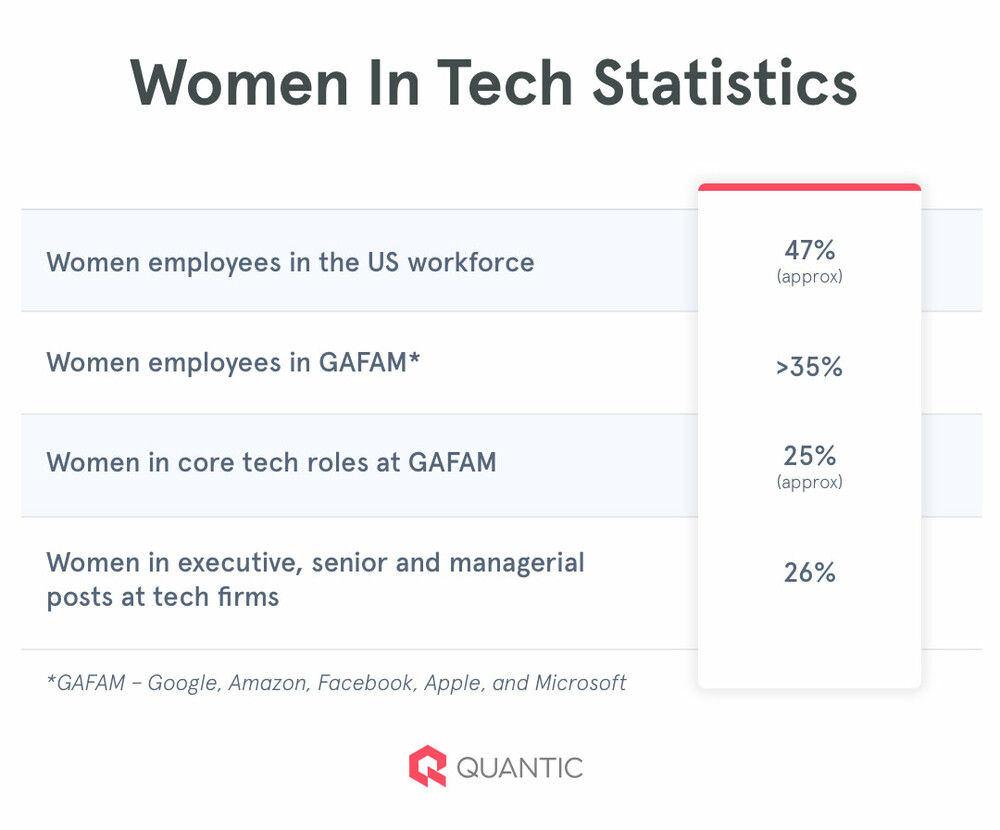
Women In Tech Statistics

According to Zippa, women hold only 28% of tech jobs in the USA in 2022. 

The figures improved over 2018 and 2019 when the percentages stood at 25.9 and 26.2%, respectively (AnitaB.org Institute stats).

So it’s definitely possible to progress in tech by upgrading your skills and staying abreast of the latest developments in the industry.

Here are some more industry statistics.

Yet, the ongoing COVID 19 pandemic has significantly affected women, found a study by business technology reviewers TrustRadius. Out of the women surveyed, 57% admit to feeling more burnt out at work than 36% of male respondents. 

Moreover, the study also found lockdowns have forced over 40% of women to do additional housework compared to 11% of men.

Is There a Gender Pay Gap in Tech?

While the workload for women in tech may be equal or, in some cases, more than their male colleagues, the pay scale paints a different picture.

Globally, women earn less than men in almost every field. 

In 2023, women in the USA earned 83.7% of what men did, according to the Bureau of Labour Statistics. 

The story is the same in technology, with female programmers earning almost 30% less than their male counterparts. 

While discouraging to see these disparities, there is another emerging trend that’s more optimistic. Business schools, which have long been dominated by men, are witnessing a steady rise in the number of female applicants. In the USA alone, the ratio of women in MBA programs increased from 32% in 2011 to 39% in 2019. Moreover, 60% of business schools worldwide reported a rise in women applicants in 2020. In fact, Wharton, one of the top b-schools in the world, recently admitted more women than men to their program. Quite a feat for a school that didn’t even allow women to enroll until the 1950s. Why does it matter? The median salaries for MBA graduates are 75% more than those with just a bachelor’s degree — a rising tide in female applicants is certainly a step in the right direction. 

Students in Quantic School of Business and Technology will likely witness a 23% jump in median salary within six months of graduation.

Why Are Women Underrepresented in Tech Jobs?

Given the pay disparity and ingrained biases against women, it’s no surprise that the field of tech has a skewed gender ratio. Several surveys conducted by independent organizations have identified the following hurdles to women’s progress in tech: 

  • A pervasive ‘bro culture,’ according to TrustRadius findings
  • Gender bias leading to a lack of confidence in their abilities and barriers to promotion
  • Racial discrimination towards women of color
  • Lack of mentorship and absence of clear ways forward in their careers
  • Significant pay disparities
  • Rigid working conditions in terms of location and hours

Women in Tech Scholarship

The rise in women applying to business schools has also led to increased scholarship opportunities for women. 

While some new scholarships focus specifically on women business owners and women in specific roles and fields, Quantic awards a scholarship specifically dedicated to women in tech — the Leadership Award for Women in Tech. 

Regardless, pursuing an MBA is a significant financial investment. That’s why Quantic’s 13-month online executive MBA and MBA degrees have unique fee structures that enable our low tuition. And many students attend free of cost through employer funded reimbursements.

How to Recruit Women in Tech Jobs

To date, only 5% of leadership positions in tech are held by women. There are just 5 women CEOs in Fortune 500 companies.

Over the last two decades, the tech industry has been actively encouraging women to choose and stick to careers in the field. 

Yet, with company policies often failing to account for women’s needs, finding and retaining female staff is a challenge. 

The tech industry must focus on prioritizing certain aspects of jobs to appeal more to women. For instance, a woman with children will be interested in a position that allows flexibility and lets her work from home.

Research suggests that a few simple changes to the hiring process and work environment can help bridge the gender divide, and women in STEM (science, technology, engineering, and mathematics) agree. 

Some basic steps to help companies hire and retain worthy women include:

  • Having more women in hiring panels
  • Ensuring equal average base pay irrespective of gender
  • Conducting mandatory unconscious bias prevention training
  • Providing mentorship and learning opportunities for women
  • Promoting more capable women to leadership positions
  • Allowing flexible work cultures and family-friendly policies
  • Making women visible and their opinions heard

Recruiters can also reach out to us for access to our updated database of motivated, high-performing graduates. 

What Advice Would You Give to Women Looking for Jobs in Tech?

For women who’ve made their mark in the world of tech despite the many hurdles, the road has been a learning curve. Five pearls of wisdom they’ve picked up over the years and would love to share with the next line of women in the community are:

  • Network, network, and network
  • Continue to develop your skills
  • Radiate confidence and stand your ground
  • Seize every opportunity
  • Pass on the legacy

Network, Network, and Network

Personal connections are crucial to getting opportunities, especially in a competitive industry like tech. Interact with as many people as you can, attend industry events, and be involved in peer groups.

Networking can sometimes come across as a transactional and uncomfortable pursuit. Especially for those who are reserved and introverted. However, research has found that investing sincerely in relationships pays off in due time. 

People won’t think twice about supporting a sincere woman, and when you’ve ardent supporters, the world is yours to take. 

Survey findings also suggest that women who’ve built successful tech careers have had peers back their ideas at brainstorming sessions and ensure they receive due credit. 

Over 50% of senior women executives in tech also say their peers were instrumental in helping them secure jobs and connect with industry leaders.

Continue to Develop Your Skills

When trying to make headway as a woman in tech, your skills are your greatest asset. Successful women in STEM have broadened their horizons beyond the scope of their designations and job descriptions. 

Honing existing skills and building new ones outside your niche opens up a host of possibilities. It helps you think outside the box and inspires game-changing ideas.

Quantic’s innovative approach to business education marks the beginning of creative thinking for students. They’re encouraged to develop their critical and analytical skills by asking questions and engaging in discussions.

Senior women in tech advise new entrants to learn to code, even if they don’t want to be developers. Understanding how coding functions will make employers at tech companies value you over your peers.

If you’re still testing waters and haven’t figured out what skills you’d like to pick up, make it a point to be good at whatever you do.

Radiate Confidence and Stand Your Ground

In the male-dominated tech industry, women’s confidence often takes a beating from biases and implications that they’re less likely to succeed. People have gone as far as to suggest that ‘innate’ gender differences make women less suitable for STEM careers.

Women often feel ignored at work, are frequently spoken over at meetings, and even robbed of their ideas. In a field where ideas spark change and are key indicators of contribution, women must stand their ground and claim credit when due. Quantic alumna Amy Dalton offers powerful advice around women speaking up about their accomplishments. Amy is a Senior UX Designer at GE Aviation and a major advocate for bringing more women into tech fields. She started a program at GE, Bragging Rights, after learning that men are 4x more likely to ask for a raise than women. The program teaches and encourages women to speak up about their strengths, ideas, and accomplishments. What started in her local GE office, is now being taught at GE in offices around the world and is expanding.  

Like Amy, successful women in the tech industry insist on speaking up when necessary. Taking a stance for themselves and tactfully handling difficult situations has helped them make their mark. This is why they advise the next generation of women in STEM to do the same.

Besides, they also insist on empathetic communication, active listening, and effective collaboration as team leaders.

Seize Every Opportunity

Given the challenges they face, women are often afraid to speak up or volunteer for work. Nothing is more detrimental to progress than letting opportunities pass you by.

Senior women tech executives admit to having moments of doubt, but their breakthroughs came when they convinced themselves of their capabilities. They’re proactive in seeking opportunities that spur personal growth and help drive the organization forward.

Women leaders in STEM strongly advocate the demonstration of accountability by stepping up to solve problems. Often, this helps them build new skills, keep themselves relevant and contribute to the greater good of the teams they lead and the people they serve.

Nearly 80% of women feel they’ve to work significantly harder than their coworkers to make their mark. This means an increased workload every time they choose a new opportunity.

That’s where Quantic’s executive MBA grads have the edge over their peers. The program allows students to earn a world-class education while working full-time jobs, effectively training them to handle multiple responsibilities in the process.

Pass On the Legacy

Most women who’ve been successful in tech have mentored or sponsored someone at their companies or in their fields. They’re genuinely interested in seeing their protégés flourish.

They’re also able to help the next generation of women identify their strengths and weaknesses, guide them towards more fulfilling job roles and give them constructive feedback.

Tech’s star ladies have found that reaching out and passing on their learning has earned them stellar reputations as leaders who groom great talent. And in the process, they’ve ended up learning new skills that have helped them maintain their relevance.

As a woman looking to work in technology, you can benefit significantly from embracing and implementing these lessons in your lives. You should also read up about Quantic’s affordable online MBA that prepares students to deal with difficulties they might face at work and while running businesses. 

5 Ways To Find Funding For Your Career Change | at Any Age

A quarter of Americans are actively planning to leap into an alternative career path in 2023. You are not alone.

The first roadblock will be to market yourself in a new field with no proven track record. You’ll hit another roadblock (funding) if you decide to beef up your skills with an MBA or other professional training.

How do you pay your bills and have a life while your resources are tied up in a career pivot?

Changing careers is like taking an exit off a highway. You have to slow down and navigate across lanes to your exit.  

Today, we’ll break down: 

  • The important questions to ask when changing your career
  • The age-specific points to consider in making your career choice and transition
  • How to fund your dream career

Table of Contents

How to Go About Making a Career Change

Challenge

Curiosity

Competency

What Career Should I Pursue?

5 Ways to Find Funding for Your New Career

Downsizing, Liquidating Assets and Saving

Government Career Change Assistance

Scholarships for Adults

Career Change Grants for Entrepreneurs

Crowdfund Your New Career

How to Deal With a Career Change

How to Go About Making a Career Change 

The 3 Cs—competency, challenge, and curiosity—will help you narrow down what’s missing in your current job and what you need to do to move forward.

Challenge

How often does your job push you out of your comfort zone?

Feeling challenged is a key ingredient in a fulfilling career:

  • Can you find new challenges and learning moments within your current job or organization by taking on new projects or changing departments?
  • Do you need to change organizations or find an entirely new career to achieve the level of challenge you desire?

Curiosity

Challenge and curiosity go hand in hand. It’s nearly impossible to feel a genuine interest in something that you could navigate hog-tied and blindfolded.

Are you interested in learning about additional aspects of your current scope of work? 

The more pressing question is, can you unearth interesting facets of your current job? 

If not, you may need to pivot to a new career which often requires additional skills. This brings us to the final C—competency.

Competency

Any career coach worth their salt will tell you to invest in yourself first. Spend time and resources acquiring skills that will set you up for success. Professional development ensures that you don’t become stale on the job. 

Building baseline skills for your current or future career prospects will vary across professions:

  • Getting an MBA or equivalent graduate-level qualification could help you advance your career or be marketable to new employers
  • Volunteering for projects where you have limited skills can give you valuable work experience  
  • Taking part in job shadowing to learn by observing a master at work

Before charging into the first training program available, do an audit of your current skills and their relevance:

  • Job-specific skills are the technical skills that apply to specific fields, such as coding and design.
  • Transferable skills are the soft and hard skills that apply to any career, such as integrity and customer service.

Your value system and skill set will change over the years. Be cognizant of the evolving career needs you may have during different seasons of your life.

Age of career changeAge-specific career tips you should know
Career Change at 30Choose a career path that solves a problem in your communityTarget careers that require your natural strengths and abilitiesLeave the herd behind and discover what suits youDon’t settle for the next best option
Career Change at 40Leverage your past work and transferable skills in your new pathAssess the changes in your career preferences and values Lean into side gigs, consulting, and adult internships as low-cost ways to discover your path 
Career Change at 50+Be open to working with and for younger peoplePersonal satisfaction and self-actualization are more important than moneyPersevere through the fear of monumental change late in lifeBe realistic in your expectation of the new job market

The Quantic MBA helped graduate, Jeffrey Chai Zhi Yang to become a more employable and competent candidate. Here’s how…

  1. He gained new domain knowledge in diverse areas such as finance, innovation, analytics, organizational strategy, and leadership, which helped him to perform better in his job as a Product Manager.
  2. Our online platform’s bite-sized interactive lessons and mobile application enabled him to manage his work-study schedule with minimal compromise on either of these commitments, becoming a more effective learner.
  3. The Quantic student community allowed him to interact with like-minded students across the globe, expand his professional network, and gain global exposure.

What Career Should I Pursue?

The top reason career changers give for looking to new pastures is work-life balance. Remote working has sharpened our collective awareness of career satisfaction.

Many of us are looking to make an impact and find fulfillment in our careers beyond the monthly paycheck. For those whose kids have flown the coop, money may be no object, but challenge and fulfillment are.

Interrogate the source of your job dissatisfaction as you and your values develop.

Establish your new value system, assess your skills, and look for careers where they apply. 

Here’s how your unique skills could match specific careers.

SkillsCareers that match your skills
Leading projects and people
Selling products or ideas
Advertising executiveLawyerReal estate agentStockbroker
OrganizationEvent plannerFinancial plannerInsurance adjusterLogistics coordinator
Problem SolvingLife CoachSpeech-Language therapistCounselorNurseNutritionist
Math or ScienceSystems analystVideo game designerStatisticianConservationistData security officer
Being CreativeWriterProducerMarketing ExecutiveAnimatorDesignerMusic Therapist

Now that you’ve narrowed down the reasons behind your career change and the direction you want to take, how do you fund it?

How to Find Funding for Your New Career

The biggest fear holding people back from changing to their dream career is money—or the lack of it. 

We typically associate new careers with juggling multiple opportunities, part-time work, and bootstrapping.

You might push through decades of career dissatisfaction just to make sure you can pay your bills and meet your financial obligations.

What if there was a way to fund your dreams?

Downsizing, Liquidating Assets and Saving


Alt: Saving for the future

One of the most accessible ways of funding a new career is to look for the money right where you are. You’ll have control over your choices without feeling indebted to anyone. 

  • Don’t quit just yet. Look into in-house training programs and employer reimbursement of training programs.
  • Downsize your living expenses by moving back home or living cheaper. 
  • Liquidate assets such as vehicles and homes, opting for cheaper ones.
  • If you’re over 59½, you can withdraw from your 401(k) and other retirement accounts without incurring penalties.

Government Career Change Assistance

While governments don’t give grants to individuals, they do provide help through organizations and community-based projects.

The U.S. Department of Education spends billions of dollars on education aid through organizations and community-based programs.

In 2020, they proposed a $1.1 billion spend on the Career and Technical Education (CTE) State Grants program and over $600 million on Adult Education state grants. 

Similar grants and bursaries are also available in the UK. 

The benefits of government-funded career change grants are:

  • You don’t have to pay back the money once you finish studying.
  • They’re also available as living assistance, childcare support, and tax credits.

How do you apply for financial aid from the government?

  • Research your eligibility for grants in your region. Grants.gov and benefits.gov are the best place to start in the U.S. UK, India, and other countries have equivalent sites detailing scholarships and government assistance. 
  • Register and apply through relevant organizations. Most governments offer grants through universities, colleges, and other private organizations.
  • Prepare your grant proposal. Career change grants often require a proposal from the applicant detailing the use of the funds.  

Scholarships for Adults

The future of elite business education is online. Not only is it more affordable, but it also offers students flexibility in learning and funding their master’s degree.

Quantic offers a unique hybrid of scholarships and employer funding to help students receive quality higher education, debt-free.

Quantic scholarship programs award full or partial tuition to students who show excellence in a variety of ways. Academic excellence, exceptional leadership skills, entrepreneurial spirit, and a drive for technology are qualities students can leverage in their scholarship applications.

Thanks to the flexibility of the Quantic master’s programs, students don’t have to take a hiatus from work to complete their education. Hundreds of companies reimburse their employees for Quantic’s degree programs. 

A unique feature that employers can benefit from is a volume account. The company pays reduced tuition fees when colleagues sign up together. 

Our built-in career network enables us to offset tuition costs. Prospective employers pay to recruit and we shift those funds towards sponsoring student tuition. It’s an innovative way for us to offer financial aid to promising students.

Career Change Grants for Entrepreneurs

Non-profit organizations and socially conscious firms recognize the value of supporting entrepreneurs from marginalized groups. There are a variety of grants targeted at small businesses run by women and other marginalized groups.

If your career pivot turns you to the entrepreneurship bandwagon, consider looking into such grants as:

How do you win a small business grant?

  • Hire an experienced grant proposal writer who will give your proposal the professional touch.
  • Write an in-depth business plan that will show specific and prudent ways you plan to use the money.
  • Emphasize the positive impact that your business will have on your community.
  • Study your competition so that you understand and can demonstrate what makes your proposal unique.
  • Grow your network so that you get early bird access to grant opportunities and establish name recognition with potential grant judges.

Crowdfund Your New Career

Some business and career ideas are worth their weight in gold. Your business may be the next unicorn startup that your online community will gladly invest in.

Crowdfunding is a type of alternative finance that enables you to raise capital for business or study from small deposits made by many people. 

Sites such as GoFundMe, Crowdfunder, and Kickstarter are a good jump-off point for crowdfunding your training or startup idea.

Advance Your Product Design Career: Mid-level to Senior Role

If you’ve risen through the ranks from an entry-level junior designer to a mid-level role, kudos to you. You’ve come a long way in your product designer career advancement. However, as far as career development goes, there’s more room at the top. 

Unfortunately, from here on, how your career path progresses depends on skills outside of your product design education. 

A senior-level managerial role demands business and people management skills. You will also need financial know-how, administrative acumen, and a host of other business-related skills. 

All these skills don’t come included in your training. All the same, this isn’t the end of the road for you; you can still move your career a notch up. 

Today we’ll talk about:

  • The typical career progression in the product design field
  • A plan to propel your career growth 
  • What you need to do to set the plan in motion

When we’re done, you’ll have a firm grasp on how to put your career path on an upward trajectory. Let’s get right to it. 

Product Designer Job Description 2023

In product design, you are responsible for bringing the finished design project to the consumer. The design process often involves putting in long hours to compose, layout, develop and construct the finished product. 

The product designer’s role starts by defining the problem. The designers clearly define what the customers want and need. Once they have a straightforward mission, they are now responsible for visualizing and creating a tool that serves the consumer well. 

A product design position also entails making improvements to existing product designs. They will also keep tabs on competitors’ product concepts and any similar designs, so competitors don’t outshine the quality and functionality of their products. 

With the strides in technology and the internet, the product design role has evolved from previous years. 

For starters, the speed at which new products are rolled out has affected the product life cycle. If you don’t want to be buried under your competitors, you constantly have to improve and design better and faster products. 

In addition, as a result of internet advancements, modern products are seldom a single entity. Product design now entails not only the design itself but also how to smoothly integrate with other products like AI or voice assistance to improve user experience. 

This brings in many variables like:

  • How customers will react to the product and ease-of-use with integrated platforms
  • How connected devices will affect the products life cycle
  • Potential changes in technology that can potentially cause redundancy
  • Security against hacking via integrated platforms 
  • Data security

Plus, design thinking has to be more spontaneous to catch up to fast-moving trends. The user research and prototyping phase of the design process takes less time.

The fast-paced nature of technology changes means product designers need to stay on their toes. Their product designer skills need to stay sharp and fluid to keep up with changes. 

On top of that, design projects require more complex analytical skills to consider all the different variables and create products with market appeal and a longer life cycle. 

Product Designer vs. UX Designer vs. Management

UX Designer

A UX designer’s role involves understanding the end user’s needs and anticipating the user’s interaction with the system. They do this through in-depth research to understand the user’s pain points and the context within which the user will interact with the product. 

Once they set their sights on what the product needs to do, the next step for a UX designer is setting up the product’s main components like the design layouts and user scenarios. 

They may also be responsible for redesigning the project at a later stage. 

Product Designer

A product designer’s job starts with understanding the user, then proceeds to the design phase of the product. Once they have a suitable design on lockdown, the designer will also be responsible for keeping an eye on how users interact with the product.

They will continue to define, ideate, validate, design, and keep up with developments while collaborating with marketing to push the product in the market. 

Product Manager

Product managers pinpoint the customers’ needs and marry these needs with the main business objectives. Once it’s a match, they are responsible for overseeing the ideation, design, and validation process. 

They will also have a hand in marketing the final product, monitoring the financials, and watching how the market interacts with the product to implement redesigns if necessary. 

ParameterProduct DesignUX DesignProduct Manager
Research✓✓✓
Planning✓✓✓
Design and Development✓✓✓
Launch✓✓✓
Marketing✓✓ for small organizations
X for larger companies
✓
Monitoring✓✓ for small organizations
X for larger companies
✓
FinancialsXX✓

It’s easy to see that these roles have a great deal of overlap. In larger organizations with more personnel, the distinctions may be more noticeable because UX designers work together with product designers up to the product launch. 

After the launch, UX designers move on to other products. Product designers nurse the product in its infancy by tweaking and adjusting it. Managers go a step further and oversee the project including the financial aspects. 

In smaller organizations, however, there isn’t such a clear-cut distinction. The same design team works together from the research and stays on to launch and watch over the project regardless of job title.

Dwelling on the semantics can limit your skillset. It’s a good idea to enrich your skills rather than defining yourself as a UX designer or strictly product designer. That way, you can function effectively; regardless of how your organization defines your role.

Some companies forego these titles altogether, opting for titles like design strategist, product lead, interface and experience lead, graphic designer, information architect, or interaction designer. 

Whichever way you are referred to, the primary role is inherently the same until you reach the management level. 

Product Designer Career Ladder 

The typical career path for product designers starts with junior-level roles. At this stage, your involvement is usually limited to a contribution and not directly involved in influencing the workflow in a significant way. 

When you gain more experience, you can progress to mid-tier roles. You will now have a more prominent involvement and greater responsibilities on the projects you work on. 

Then, as you progress, you can be promoted into senior designer and management roles, which give you more oversight of projects. You will take part in launching, marketing, or pulling the plug on loss-making products. 

You’re responsible not just for managing people but also for contributing to keeping the business afloat.

To move up the career ladder, you will need to deepen your skillset. While managerial roles don’t usually require hands-on design work, you will still need to be highly skilled at design. Plus, you need an extra layer of skills that covers the business side of things.

Let’s get into more detail about each stage of the career path. 

Junior Product Designer 

The junior design job is an entry-level role that requires knowledge of design methods and tools. Some of the tasks include:

  • Creating wireframes
  • Developing detailed visual designs
  • Making interactive prototypes and UX flows
  • Support and collaborate with the senior designers to bring the final product.

Mid-level Product Designer

Mid-level designers are responsible for brainstorming and executing product development. They’ll take on tasks like:

  • Planning, making designs, and modeling products
  • Creating and testing prototypes 
  • Analyzing competitors’ working concepts
  • Bringing the final product to market
  • Keeping tabs on development and latest design trends

Senior Product Designer

Senior roles involve more oversight and responsibility. The main functions include:

  • Outlining project goals, including collaborating with the client and other designers to clarify product vision
  • Creating project budgets and forecasts
  • Negotiating time-frames
  • Overseeing product development and user testing 
  • Working with sales and marketing 
  • Staying aware of product performance 

Product Designer’s Salary

Designers earn different salaries depending on the stage of their career progression. Here’s a breakdown of the salary at each level. 

Junior Product Designer Salary

According to Zip Recruiter, junior product designers earn an average of $64,144  per year, which translates to $31 an hour.

Mid-level Product Designer Salary

Mid-level designers make a median salary of $71,120 per annum, according to Zip Recruiter statistics. 

Senior Product Designer Salary

Zip Recruiter says, on average, senior-level product designers earn an annual salary of $117,598. 

Product Design Advance Your Career Plan

Interested in climbing your way up the ladder? Here’s the plan: gain new business-related skills to become eligible for senior roles. 

With a new set of skills, you can handle the tasks that come with senior roles.

Understanding the business side will help you develop products that provide a great user experience and rake in profits.

As a product manager, Lindsey Allard had to know a little about a lot of things, and the Quantic MBA program helped her to gain a broad range of business knowledge. This, in turn, helped her to co-found PlaybookUX, a video-based user feedback solution for B2B companies. PlaybookUX’s success is largely due to the company’s ability to solve pain points related to user research, such as being time-consuming and expensive. PlaybookUX uses AI to extract actionable insights, which saves time and money for businesses that want to conduct user research.

Here are some of the primary skills you need to thrive in senior-level roles. Maybe you can even follow in Lidsey’s footsteps and start your own company.

Leadership Skills

Developing and launching a product involves many people. Once the product is launched, it will involve even more people to market and move the product to help it rise above the competition. 

It takes a strong leader to plan and coordinate the different personnel involved in any project. 

Without solid leadership skills, you can crumble under the pressure of managing different personalities. Plus, once you get the hang of the right techniques, you won’t fall into the trap of micro-managing. 

Communicating Effectively

If you don’t have concrete communication skills, it’s not easy to rally people toward a vision. Knowing what, when, and how to convey information makes the difference between excellent management and those who just get by. 

When you learn effective communication, you can clearly articulate the vision behind a design project. You can talk to people at various levels in the organization through proposals, charts, memos. 

On top of that, you can collaborate with peers and subordinates for the business to stay on track. 

In addition, these skills can help you thrive as a manager by:

  • Consolidating a warm culture in your organization
  • Improving employee engagement 
  • Lowering fatigue and burnout in your team 

Staying Flexible 

The world of design and business is fast-paced. That’s why flexibility is key to moving up in the product design chain of command. 

If you’re flexible, you keep your eye on the price. Setbacks and challenges don’t phase you; instead, you adjust accordingly. This includes both when designing products and handling business affairs. 

Business and Financial Management

No matter how good a product is, if it doesn’t make a good profit or at least break even, it makes no business sense to keep it.

If you wait until the product launch to crunch the numbers, you won’t succeed in business. You will need to start every product ideation with:

  • Forecasts
  • Financial models that predict the product’s profitability 
  • Budgets 

Once the development is underway, you have to track and monitor spending within the budget. Plus, find ways to reduce costs. 

With all the calculations you have to run through, it’s easy to see why financial skills are critical for top-level positions.

Priority Problem Solving 

Problem-solving skills come easy to you. You can focus for hours on a design system, and you won’t come up for air until it meets user expectations. 

However, management roles require a different kind of focus. You will need to solve a series of complex problems simultaneously. This kind of multi-tasking calls for priority problem-solving skills.

You will need to organize your tasks and tackle them in order of priority without the option of skipping anything. With priority problem-solving skills, you can figure out how to allocate time effectively to each task and ensure overall success.

MBA Course Curriculum for Product Designers

Here’s the next step of the plan— take action to acquire all the skills you need to move up. 

You can read up on each skill set and maybe scour the internet for hours on end to find as much information as you can. 

Alternatively, take up a good MBA course like Quantic’s MBA program. 

With a Quantic MBA program, you’ll learn all the skills you need to progress quickly and effectively through advanced pedagogical methods. Plus, it comes at an affordable cost allowing you to scale greater heights in your career minus the huge loan burden. 

A good MBA course will walk you through the following:

  • Business. When advancing your product design career, you need to get a handle on the business side, including finance, projections, statistical probabilities, and marketing. 
  • Strategy. In a senior role, you will need to develop strategy and effective plans that help the business stand head and shoulders above competitors. 
  • Decision Making. Business is all about critical decision-making. You will need to know how to choose the best outcome using all the data in front of you. 
  • Leadership. Overseeing a design team takes exceptional leadership skills. 

Product Design MBA?

We’ve established that an MBA can help you with your career development, but why a Quantic MBA over a product design-specific MBA? 

You’ll learn more or less the same skills with both programs. So, it all comes down to what else you can get from the program besides skills. 

Unique Teaching Style

Forget boring lectures and tonnes of study material. Quantic MBA is fully interactive and collaboration-based. That way, you’ll stay fully immersed throughout the course. 

Flexibility 

Quantic’s MBA program is flexible. You can pick up your lessons at any time that suits your demanding work schedule. There are no strict timetables or lesson times. 

Apply to Quantic MBA now to take your career to the next level.

Summary

Product designer career paths start from junior-level roles then progress to mid-level responsibilities, which involve hands-on product development.

The next step in career progression is the senior designer and management roles that involve more supervision and higher pay.

You will need a unique set of business skills to move up the ladder. The fastest and most cost-effective way to progress is through a well-structured comprehensive MBA program like Quantic’s MBA. 

Operations Management Career Path & Best MBA to Advance

It’s no secret that every company includes several departments performing varied functions. 

The departments facilitating seamless coordination between them — ensuring products and services of the highest quality reach consumers at the earliest — are the operations managers.

In most corporations, Business Operations Manager is a designation earned after years of experience. To become one, you need hands-on knowledge of the different aspects of running a business such as customer service, manufacturing, retail, etc which takes years to acquire. 

Moreover, every job description for an operations manager also mentions great communication and organization skills, to be able to coordinate across departments.

But, don’t worry. It’s not as complicated as it sounds. We wrote this article to simplify matters and help you understand the responsibilities of an operations manager better.

Today, we’ll discuss:

  • The perks of being an operations manager
  • Employment opportunities 
  • Key responsibilities and organizational duties
  • Educational qualifications required
  • Possible career pathways
  • The merits of an MBA

Why Choose Operations Management?

An effective operations manager is an organization’s backbone.

Positions in operations often don’t have a clear job description, and responsibilities span across departments. The lucrative salaries compensate for the challenges.

According to Payscale, operations managers in the USA can earn anywhere between $54,000 to $136,000 per year. This depends on experience and efficiency. The annual median salary is $88,887.

In operations management, the possibilities and career paths are varied and many. You can be an engineer working in the operations arm of a technical company, or a food services expert overseeing the functioning of a restaurant.

In 2023, Educations.com listed Development Operations Manager as one of their top 25 highest paid entry level salaries for graduates.

BLS data adds to this rosy picture. They predict a faster than average projected growth rate (6.1%) in jobs in this field from 2021-2031. During that timeframe 209,800 jobs should be created.

Operations Management Jobs

Increased organizational diversification in every industry has led to a boom in operations jobs and related titles. Let’s explore some of the common ones.

Supply Chain Management

With the internet melting geographical boundaries, the world is now an open market. Supply chain management bridges the gap between demand and supply in this global bazaar, from procuring raw materials to delivering finished products.

What Careers Are in Supply Chain Management?

Supply chain management jobs may involve sourcing raw materials, maintaining inventory; overseeing manufacturing; coordinating storage, transportation, distribution, etc. Supply Chain Management Executives must also be skilled at communication and managing human resources. In the future supply chain manager may also have to manage AI systems.

Roles in supply chain management include:

  • Purchasing agents
  • Logistics analysts
  • Transportation managers
  • Inventory managers
  • Supply chain designers
  • Storage and distribution manager.

How to Get a Career in Supply Chain Management?

A business degree with a supply chain focus is a great way to gain entry into the field. A degree in logistics is also a good option. While in school, invest time in:

  • Networking and building connections
  • Marketing yourself through hiring platforms
  • Interning at reputed companies.

After gaining experience, students may opt for higher studies via a graduate or MBA program to progress as operations managers.

Operations Management Consulting

Consultants help improve an organization’s value chains by boosting its functioning, efficiency, and growth. They do so by:

  • Studying existing systems
  • Identifying problem areas
  • Formulating new strategies
  • Helping implement them

Internal Auditing

Internal auditors (or operational auditors) help analyze key procedures, optimize management, and use of resources in an organization to boost productivity.

Operations Strategy

Strategists formulate innovative plans and progressible roadmaps to help corporations stay relevant and beat the competition.

Distribution and Logistics Planning

Executives oversee tasks like storage, packaging, and transportation of products via effective delivery channels to ensure they reach consumers at the earliest.

Inventory Planning and Control

This job involves predicting demand, deciding the number of stocks to order, and scheduling their distribution.

Business Process Improvement or Reengineering

Executives implement thoughtful approaches to create robust operational procedures and improve existing ones to manage a corporation’s cost, quality, and time goals.

Strategic Planning

Strategic planners conduct SWOT (strengths, weaknesses, opportunities, and threats) analyses of production networks and design optimal supply chains to boost efficiency.

Manufacturing Strategy

An executive’s duties are to make ‘decisions that, over time, enable a business unit to achieve the desired manufacturing structure, infrastructure, and set of specific capabilities.’ (Hayes and Wheelwright, 1984) 

Support Activities in the Services/Financial Industry

Aspirants can also become operations managers by working in ancillary services like:

  • Supply chain finance
  • Human resources
  • Quality control
  • Sales and marketing

Operations managers need to be generalists rather than specialists, and recruits often perform similar duties irrespective of initial designations.

Operations Management Career Pathway

Standard organizational designations in leadership roles include vice-presidents of operations or chief operating officers (COOs). They’re a firm’s second-in-command, responsible for bringing the chief executive officer’s (CEO) visions and ideas to fruition.

Let’s show you one of the many routes you can take to get to the top.

What Is an MBA in Operations Management?

MBA in operations management teaches business administration with a focus on managing operations and logistics. While the curriculum varies among schools, common courses include:

  • Business fundamentals
  • Accounting and finance
  • Leadership
  • Economics
  • Data analysis
  • Quality control processes

Reputed schools provide students with a thorough understanding of all operational aspects of a business – from procurement to delivery processes.

Additionally, top executives across sectors have a 4-year bachelor’s degree, BLS data says. You can earn one in business or allied fields and follow it up with an MBA.

MBA in Operations Management Career Path

While a business degree followed by an MBA is recommended, don’t worry if you’re already employed with a non-business qualification. You can always opt for an executive MBA at Quantic to bridge the gap.

Most MBA programs have six-figure fees – an investment, which usually doesn’t disappoint. Graduates gain an edge over their peers resulting in higher pay and faster promotions.

Research suggests that for an MBA-holding operations manager, salary amounts can be 45% more than others.

Besides business acumen, an MBA in operations teaches students about –

  • Inter-departmental cohesion
  • Data-backed decision-making
  • Complex problem-solving tactics
  • Effective communication methods.

All these skills directly impact responsible leadership abilities, which is why MBA grads often advance faster than their peers.

What Can I Do With an MBA in Operations Management?

The Princeton Review ranks operations among the Most In-Demand MBA Specializations. Here are a few reasons why the degree is worth your time and money.

Aspiring operations managers learn data analysis to formulate long-term strategies. Hiring teams highly value considerable data management skills.

You don many hats, and your job description lists many responsibilities. Manager, IT guy, hiring expert, customer service executive – you’re all in one. Consequently, the accolades you earn are many.

Operations management teaches you teamwork because your duties will need you to oversee several departments and individuals to ensure efficiency and productivity.

It’s a lucrative field for women who comprise over 30% of operations managers in the United States. In 2021, they earned 87% of what their male colleagues did – higher than the 2023 trend of earning 77%.

What Is the Scope of an MBA in Operations Management?

An MBA program should be aligned with your expectations and aspirations. There are 3 common paths to earn a degree.

A Dedicated Operations Management MBA

Generally, dedicated courses primarily concern themselves with the internal workings of a corporation. Students learn how to run businesses effectively by:

  • Forecasting sales,
  • Analyzing production techniques,
  • Adhering to quality standards, 
  • Boosting productivity
  • Ensuring customer satisfaction.

Operations management also teaches analytical skills and stresses technological acumen.

Related Programs in Fields Like Supply Chain or Logistics

Supply chain or logistics management focuses on a corporation’s external operations like raw material procurement, storage, and product delivery. An MBA in these disciplines teaches:

  • Negotiation skills to handle vendors and other stakeholders
  • Auditing to evaluate suppliers and manufacturers
  • Resource management
  • Financial acumen to ensure cost optimization

An MBA With Operations Management Modules

Such a program helps graduates build a strong foundation in business administration with enough room for flexibility.

There are courses in business law, finance, accounting, and money markets, besides electives in subjects like HR, logistics, operations, healthcare, and investment banking, to name a few.

Given the generalized job description, this is the best option for aspiring operations managers.

Best MBA to Advance Your Operations Management Career

The right MBA program will be the best thing to happen to your professional life. Pay hikes, promotions, successful entrepreneurial endeavors – an MBA can help you have it all.

With offices progressively migrating to the digital space and embracing a remote work culture, an online MBA is the way to go. If you’re wondering whether hiring teams will accept an online degree, the answer is yes.

At Quantic, we offer a 10-month MBA program and a 12-month executive MBA program; both are taught online. Besides fundamental business courses, we offer specializations in supply chain processes and operations management, imparting skills to meet the job description and fulfill duties as an operations manager.

Our vast interactive network lets you collaborate with classmates from all over the globe and build connections. You also gain access to our career network with multiple job listings from top companies.

Best Companies for Operations Management

While every company requires operations management personnel, 3 firms that have consistently been named among the favorites in the field are –

  1. Management consultants McKinsey & Company — world leaders in almost every practice area they handle.
  2. Financial advisors Deloitte Consulting LLP with most Fortune 500® companies among their clientele
  3. One of the USA’s largest private firms, Boston Consulting Group, who’s also part of Quantic’s career network.

A career as an operations manager might be challenging, but let nothing hold you back on your path to leadership positions. We invite you to find out more about Quantic’s rigorous MBA program with its innovative teaching methods that will prove to be a game-changer.