Quantic’s Weekly Roundup is a satisfying mix of the latest breaking news, business, STEM and social science stories. Here are your headlines for this week:
We have contact: A new Covid-19 contact-tracing app will be launched across England and Wales on September 24, the government has announced. The app will let people scan barcode-like QR codes to register visits to hospitality venues and will implement Apple and Google’s method of detecting other smartphones. Businesses are being asked to display QR code posters to support the app.
Ticket to ride: The Irish e-mobility startup Zipp Mobility has announced that the UK Department for Transport has approved its e-scooter model for trials across the UK. This approval comes as part of a strategy to explore greener and more ‘socially distanced’ methods of urban transport due to the COVID-19 pandemic. The scooters also have nano-septic handlebar wraps, which the startup states reduce the risk of COVID-19 transmission by 99.98%.
Out-of-this-world innovations: For more than six decades, space programs have been developing technologies and making new discoveries. Sometimes, this research is in service of solving hard problems we face on Earth, for instance, developing a vaccine for the novel coronavirus. Other times, astronauts spend their time with less mission critical endeavors: sneaker performance for commercial partners like Adidas. In either case, the discoveries made in orbit have applications that improve our Earth-bound lives. Read on to learn how space labs are hurtling toward the next big breakthrough.
(3D) picture perfect: A team of researchers at Google have come up with a technique that can combine thousands of tourist photos into detailed 3D renderings that take you inside a scene… even if the original photos used vary wildly in terms of lighting, or include other problematic elements like people or cars. It’s an advanced, neural network-driven interpolation that manages to include geometric info about the scene and could revolutionize how 3D renderings are created across all industries by allowing for much more variation in the source imagery.
Optimization in the healthcare arena: Quantic Alum and Vice President of Operations at Focused Software, Anne Michael, is working to streamline data entry, protect confidential health information and create overall efficiency, so that patient care can be the main focus.
Quantic Alum, Anne Michael, has always been intrigued by resource usage and constraints within the healthcare arena. She is currently the VP of Operations at Focused Software where she combines knowledge gathered during her years as an active physician, with her business knowledge to make sure both clinical and non-clinical team efforts always benefit the patient.
“Most doctors, as expected, tend to stick to the clinical side of things and do some administrative work on the side,” says Anne.
“ I realized that I wanted to focus on the administrative/business side of things, rather than split time between the two. I came to this decision following my observation that there was frequently a communication disconnect between the clinical and administrative teams at most healthcare institutions. It seemed to me that since we were all there for the patients’ benefit, working together instead of in an antagonistic fashion made more sense.”
This inspired her to pursue solutions for efficiency and optimization of processes. “The way resources are used at a macro-level really impacts the healthcare of individual patients. However, I realize that most physicians have as much as they can manage on their plates, just doing clinical work, without having to think of the economics/business side of things. Those of us who do have an interest in the actual corporate administration of medicine should seek opportunities to improve our business skill set to create better processes, conditions and resource allocation for our colleagues and patients.”
Focused Software is working to diminish this disconnect. The company provides systems that enable businesses to become more efficient in their documentation, billing, administrative and supervisory functions, so that they can maximize the time spent actually providing care for their patients. As their VP of Operations, Anne leads her team in determining corporate direction, managing change implementation, and making sure company goals and client needs are met. Anne knew she would need a business background in order to be successful in her role. “The only way I saw to do this was to get a business education for myself, so that I could better understand both sides. I know that I am now uniquely qualified to foster communication, solution generation and implementation for those in healthcare on both sides of the aisle.”
Quantic was Anne’s choice to earn her MBA degree because she could complete courses while working or traveling. “I soon realized that to truly get to the next level, I would need some sort of structured educational program that would direct and integrate essential business knowledge in a timely fashion. That’s where Quantic came in! The fact that it is online, accredited, fun, has a great network of international alumni, staff and current students made this an easy decision.”
Now more than ever, great communication is needed between clinical and non-clinical teams to create solutions that best address patients’ needs, while optimizing limited resources. “The clinical knowledge I gained during my years as an active physician helped me better understand the needs of Focused Software clients and preempt their future needs. With belief, enthusiasm, a great team and a little bit of humor, a lot can be achieved.”
You’ve been a software engineer for years, and you feel it’s now time to take a step forward. But you’re wondering: What comes next? Where do I go from here?
What catches your attention is that other software engineers are going for an MBA. As a result, they’re getting promotions and enjoying fatter paychecks. But is this the road you want to take? How will earning an MBA increase your chances of climbing the software engineer career ladder?
If this is you, we understand. We know it can be difficult to decide on the next step in your career. That’s why we’ve put together this guide specifically for you. In it we cover:
The career ladder of a software engineer (from bottom to top)
How an MBA can help you climb that ladder
The different types of MBAs, and how to choose one to match your needs
When you finish reading this, you’ll know exactly where you want to go next in your career and whether or not an MBA will help you get there. Let’s dive in!
Understanding the Software Engineer Career Path
To know where you want to go on the software engineer career path, you first need to decide what your biggest priority is. Is it to gain a bigger salary? Or is it to keep doing what you love, but on a larger scale?
Think of it like this. The higher you move up on the career ladder, the less you’ll be getting your hands dirty doing the work of actual programming. Some are happy with a lifetime of writing code and fixing bugs. Others want to go into managing complex software systems, and others want to manage teams.
To make a good decision on where you want to go, it’s important to go into detail on the typical software engineer’s career path.
The Software Engineer Career Ladder
You start as a software engineer, but it’s not uncommon for you to move to the top with a C-suite job.
Here’s what the career ladder of a software engineer looks like. We’ll start with the first rung on the ladder, junior software engineer, and go all the way to the highest rung, CTO. In between, you’ll see the different steps in the ladder and how each one requires its own set of more complex skills and responsibilities.
Junior Software Engineer
Junior software engineers are mainly responsible for building quality software. This includes writing code, fixing small bugs, and working closely with senior developers on pair programming.
The junior software engineer role is an entry-level position. The skills required are what you already have: knowledge of programming languages, operating systems, and databases. As you gain experience, you’ll start handling larger projects and working more independently.
Senior Software Engineer
Senior software engineers still write code, but this time with an eye on the bigger picture of a project. They’re in charge of designing and developing software solutions, plus coaching other developers. This is an excellent position for those who love programming but don’t like the idea of leading a team.
The skills needed for this position are basic software architecture, advanced code design, and coaching.
Lead Developer
Lead developers still write code while coordinating work and implementing decisions. Other programmers usually look to them for direction. This position is seen as a transition into a mid-level management role.
Technical Architect
Technical architects rarely write code. Their main responsibilities lie in designing complex systems that other developers create. Going for the technical architect position is the biggest leap you can make as a software engineer without going into leadership and management roles.
Development Team Lead or Software Development Manager
Mid-level managers are in charge of overseeing either projects or teams. Depending on their leadership skills, their job can include:
Managing complex projects
Coordinating between higher management and development teams
Hiring and firing developers
Besides the technical skills required for this position, mid-level managers need excellent people skills.
Chief Technology Officer (CTO)
Chief Technology Officer (or CTO) is the highest-ranking position in the IT business. The role of a CTO is to oversee all of the company’s technological needs. CTOs have executive powers they can use to make decisions and investments for the advancement of the company.
The Career Path for a Software Engineer After Earning an MBA
How far up you want to go on the software engineer career ladder is up to you. Some professionals stay at the senior engineer level their whole lives (and love it!) while others progress to CTO. It all depends on what you love doing most, whether that’s writing code, managing projects, or handling relationships between people.
If your dream is to get into leadership and management roles, getting an MBA makes sense. Here’s why.
MBA for IT Professionals: Why It Makes Sense
Of course, strong technical skills are a must if you want to climb the software engineer career ladder. However, they aren’t enough to get you to the position of CTO. This is because companies today are looking to hire executive officers who have both excellent technical skills plus strong business acumen.
Think of yourself in the position of hiring a new CTO for your company. The first applicant has strong technical IT skills and years of experience as a software engineer. The second one has all these, plus the ability to see the bigger picture and understand how technical decisions will impact the company’s finances and business outlook. Who do you think you will hire?
If you already have years of experience developing software and the next logical step for you is to go into C-level management, an MBA can help you acquire the skills to fit into this position.
Is an MBA for Information Technology Worth It?
Earning an MBA can cost upwards of $200,000. If you stop working while pursuing your studies, this amount can rise up to $400,000.
To determine if an MBA is worth the cost, you first need to ask yourself some important questions.
What do you plan to do with your MBA?
Where do you see yourself five years after completing your MBA?
How long will it take you to achieve significant ROI from your MBA?
Why Do Software Engineers Pursue an MBA?
Here are six reasons software engineers pursue an MBA despite the heavy cost.
Respect from business-side teams
Promotion to management roles
Salary increase (up to $44,000 per year)
Better chances of being hired as CTO in a new company
Greater confidence working in managerial positions
Career satisfaction from being able to climb the corporate ladder
Quantic alumnus Patrick Glauner choose to persue an MBA because he recognized that although being a specialist had its benefits, he wanted to expand his career options beyond a narrow career trajectory. Glauner felt that obtaining an MBA would help him gain knowledge and skills that would position him to move into management roles where he would oversee cross-functional teams. After completing his MBA, he secured a management job with a major mechanical engineering company, Krones, and later started his own artificial intelligence consulting company, skyrocket.ai
Renée Fishel, an Engineering Manager at IBM, also found a Quantic MBA degree to be a crucial tool in her career progression. The MBA helped Fishel legitimize and formalize her leadership instincts, and differentiated her from her colleagues. Read about her experience here.
MBA Software Engineer Salary Statistics
In general, professionals with an MBA earn more than those without one. In the U.S., MBA holders earn an average of $102,100. That’s higher than the national average of $74,378.
But it gets even better for IT professionals with an MBA. According to U.S. News, technology is one of the top three fields that pay the highest salaries for MBA holders.
According to PayScale, a software engineer with an MBA earns an average of $119,438. That’s $44,906 larger than the average salary of software engineers, which is $74,532.
An MBA for Software Engineers
Understanding the different types of MBAs is essential for mapping out your career direction. Here are three to consider.
Campus-Based MBA. Requires you to stop working and focus on earning your MBA on campus. Best for new graduates who have the time and financial stability to support themselves in school.
Online MBA. Allows students to continue working while they earn their MBA.
EMBA. Designed for professionals with many years of experience, the executive MBA is for people who want to advance their careers and move into senior leadership positions in their companies.
The Best MBA for Software Engineers
Use this as a guide to select the MBA that’s right for you.
Executive MBA for IT Professionals
If you are an IT professional looking to climb the career ladder into senior leadership, the best program for you would be an executive MBA.
An EMBA is different from an MBA mainly because of its focus. While MBAs are designed for new graduates, EMBAs are for professionals with years’ worth of experience looking to showcase their business credibility and advance their careers.
The qualifications for EMBA are also different from those of a regular MBA. While qualifying for a regular MBA requires top-notch academic scores, getting into an EMBA program requires a look into professional working experience and skills.
MBA Career Network for Tech Professionals
Since 80% of positions are filled through networking, it’s an excellent idea to look into programs that offer exposure to other top-notch professionals. Knowing great people will not only widen your chances of professional growth, but also challenge you to grow and sharpen your skills.
What’s great about joining a career network is that you can connect with thousands of the brightest minds around the world. You get access to current students, alumni, plus the chance to get discovered and hired by excellent tech companies.
MBA Course Curriculum for Software Engineers
Before selecting an MBA program, it’s essential to look into the curriculum to see if it includes these four aspects.
Business. To lead in a C-suite position, it’s important to understand the core concepts of business, finance, and marketing.
Strategy. In a management position, you’ll be in charge of top-level strategy so it’s important to find an MBA that covers this.
Decision Making. IT professionals should be able to understand how to make critical business decisions based on data.
Leadership. Since leading a team will be one of your duties, acquiring communication and interpersonal skills is a must.
MBA for Software Engineer Discussions on Reddit
Going through other professionals’ different experiences and opinions will help you weigh out the pros and cons of getting an MBA and make your decision. One great way to do it is to read Reddit threads on the topic.
Believe it or not, Reddit is an open community and discussion forum that’s influential among higher education students. Here you can ask, find specific questions from other software engineers, and get answers and suggestions from those who are in the same field and have earned their MBA.
Summary: Should You Get an MBA?
Getting an MBA is not for everyone. To determine whether it’s right for you, you first need to consider your priorities and where you want to go on the software engineering path.
If writing code is what you want to do all your life and you have no interest in managing a team, getting an MBA might not be the best fit for your needs. However, if you have your sights set on mid-level management or even CTO, earning one will give you the knowledge and credentials to get there.
Wondering how to win the top position in the marketing world? Imagine waking up every day to a fast-paced, prestigious job that leverages everything you ever learned about marketing (and pays to reflect that!)
Becoming a Chief Marketing Officer takes planning and dedication to your profession. But this dynamic, high-powered role is completely within reach for master marketers with the right experience and business expertise. We’ll show you how.
We’ll examine what a CMO does and why your professional experience matters so much. You’ll also get clear advice on what education to pursue, and insights on the types of MBAs available for you. You’ll discover common pitfalls to avoid, plus inspiration and wisdom from CMOs at some of the top companies.
By the end, you’ll know exactly where you stand and what steps to take as you advance to the boardroom.
You bring the passion for marketing – we’ll provide the answers to all your questions about becoming a CMO in this handy guide. Ready? Let’s go!
A Day in the Life of a Chief Marketing Officer
Imagine this: it’s Monday morning, and you’re perusing your email over the rim of your coffee. You’ve got emails from the:
Head of Sales: a product’s performance
Marketing Department: an interesting brand mention on Facebook
CEO: some ideas about expanding into a new market
It’s only Monday morning, and you’ve already got your hands full with product performance reviews, social media response management, market research, strategizing, a meeting with the CEO – that’s only a small part of what a CMO does.
Oh, and that meeting with the CEO? You can even expect to throw in a meeting or three with the COO and CFO to discuss some of those strategies later this week. They’ll impact the company’s budget and operations, so other board members will need to be kept in the loop.
Career Outlook: Your Experience and Education Matter
The Bureau of Labor Statistics notes that the field of marketing managers broadly is experiencing a growth rate of 8 percent per year. That’s 50 percent faster than related management positions, such as those in sales-related fields (growing at 5 percent per year).
CMOs play an especially direct role in maximizing a company’s revenue, and you can expect to be well-paid as a result. In 2023, PayScale estimated that CMOs make $178,447 annually on average.
However, that compensation is heavily dependent on how long you’ve been a CMO overall. PayScale notes that CMOs with only one year of experience in the role may earn as little as $97,000 per year, while those with over 20 years of experience will earn $202,000 per year.
Speaking of Experience…
According to PayScale, some 49 percent of CMOs have identified themselves as “late-career” individuals possessing more than 20 years of experience as a CMO. Another 35 percent identified themselves as “experienced,” with at least 10 years of experience in the role before seeking their current position.
In other words, it’s a role that people tend to stay in for a very long time. That can make it difficult for you to break into a position unless you’re experienced and educated. In other words, unless you can demonstrate the same years of experience, or you’ve got an advanced degree to make up for it.
Skills and Competencies: 5 Things You’ll Need to Know How to Do
Working with many different departments and handling such a wide variety of marketing-related responsibilities means you’ll need a combination of technical expertise and soft skills. CMOs are generally expected to master:
1. The fundamentals of marketing and digital marketing. From social media campaigns to effective marketing at events, you’ll need to know almost everything related to marketing in the physical world and marketing online.
2.Pricing strategy. Pricing strategy gets overlooked a lot, but it’s an underrated skill that can set you apart in the world of marketers. You should know how to tie pricing to value. That’s what helps your marketing strategies maximize profits.
3. Business and corporate strategy. Marketing directly impacts revenue and business growth. Therefore, you will need to understand how your efforts connect with and support broader business and corporate strategies.
4. Data analytics for marketing. Much of marketing is data-driven these days, with metrics letting us know exactly how a campaign is performing. That makes it critical to understand things like one-variable statistics and A/B testing.
5. Leadership. You’ll lead teams and manage people almost every day. To do so effectively, you’ll need to understand organizational behavior.
CMO Education Requirements
If you want to become a CMO, you’ll need a bachelor’s degree. LinkedIn, the Bureau of Labor Statistics and PayScale all agree that a four-year degree is the minimum you’ll need to achieve due to the number of technical skills you’ll have to develop. The most common degrees are business-related, but LinkedIn also notes some interesting alternative majors:
Since your competition will have a bachelor’s degree, it might have occurred to you to seek out an advanced degree to set yourself apart. That would be a great idea, especially if your bachelor’s degree wasn’t in business.
When you’re looking into going further, you’ve got three options:
Certifications. Organizations like the American Marketing Association offer certifications for marketers and marketing managers. You may also want to consider industry-specific certifications to deepen your insight. Alone, these will only be enough with your bachelor’s degree if you’ve already got significant professional experience.
Master’s degree. It may be tempting to pursue a master’s degree in marketing or a similar field. If you choose this route, round out your studies with plenty of elective courses in business-related topics.
MBA. Most job sites, including LinkedIn and Indeed, indicate that an MBA is the most popular option for advanced degrees. You’ll want to look for an MBA that offers a marketing specialization, or an executive MBA that specifically prepares you for life in the boardroom.
The CMO Career Path: What to Expect
Get ready to double down on achieving professional experience. The CMO is unique among board positions in that your ability as a marketer matters more than your industry experience. Compare that to a role like the CTO, where industry-specific technical experience matters almost as much as your business acumen.
Many CMOs, like Kate Jhaveri of the NBA, have a resume that runs the gamut of digital marketing positions across numerous industries. Others, like David Edelman of Aetna, have worked in a variety of sales, consulting, digital marketing, and business strategy roles.
Of course, if you’ve found an industry that you like, then you’re welcome to remain in it. The CMO of Warner Media Entertainment, Chris Spadaccini, has worked in marketing for the entertainment industry for over 15 years.
(By the way, all three professionals have MBAs.)
Can a CMO Become a CEO?
Yes.
However, it’s not easy. According to Diego Scotti, the CMO of Verizon, it can be difficult for CMOs to progress to CEO. That’s because the position emphasizes expertise in marketing rather than the bigger picture mentality embraced by other C-level positions. In other words, the best CMOs are ultra-competent marketers who might not have the business-mindedness to fulfill the CEO’s role.
If you’re viewing the CMO role as a stepping stone to CEO, take note. It’s one more reason to consider an MBA as it can help broaden your business expertise.
How to Become a CMO
On the road to becoming a CMO, it’s your professional experience in marketing that will set you apart and tip you toward the position. That’s why most CMOs identify themselves as “experienced” or “late-career” professionals.
As you scope out your next steps toward becoming a CMO, here’s what we recommend you do:
1. Earn a degree that lands you a marketing job. You’ve got a little bit of freedom here, but if you’re still deciding on your degree, opt for something either business or marketing related. Otherwise, get yourself into a marketing position as quickly as possible. After you’ve completed your degree, expect to spend between one and three years here.
2. Gain job experience. For the next five to nine years, it’s not necessary to stay at the same company, but you can. Build your resume by taking successively higher-level marketing jobs to help you gain deeper insights into the field and demonstrate your growing experience.
3. Earn an advanced degree. We recommend choosing an MBA with a marketing specialization as it will amplify your effectiveness in your career while giving you the business skills you’ll need at the executive level. You can go for it at any point after you’ve completed your undergrad. Keep in mind that most CMOs have between ten and twenty years of experience before seeking the role.
4. Grow your professional network. Like other C-level positions, your ability to become a CMO will hinge on who you know. This may take a year or longer, but doing this while in an MBA program with a strong professional network can accelerate this process.
5. Look for CMO roles that match your experience and interests. You may already have an industry in which you’re interested and settled in, but if you don’t, that’s okay. Keep your eye out for positions that interest you and match your background. This process can take over a year, but it can also happen quickly if you’ve got a strong network.
Choosing an MBA Program to Become a CMO
An MBA is an invaluable asset if you’re gunning for the top role in the marketing world. However, not all MBAs are created equal. You’ve got options to consider … three main ones, actually:
Traditional MBA. Well-regarded and rigorous, a traditional MBA program at a major school can put you in touch with high-caliber contacts in your field. It might also require you to stop working and can get expensive.
Online MBA. Online MBAs are ideal for people who want the flexibility to take courses while they work, or who don’t want to relocate to attend a specific school. Many don’t offer career networks, which can hinder your ability to connect with other business professionals. Others, like Quantic’s program, do. That’s something to consider when investigating this route. (Here are some more thoughts on traditional versus online MBAs.)
Executive MBA. A specialized type of MBA, it’s geared toward professionals with considerable experience who are taking steps toward the boardroom. Consider this route if you’ve got your targets locked on becoming a CMO, as it’ll prepare you for the challenges of serving on a board. We’ve covered the differences between an EMBA and MBA right here.
Summary: How to Become a CMO
There you have it – how to become a CMO! The CMO is an interesting position in the boardroom because of its emphasis on marketing expertise – according to Diego Scotti, sometimes at the expense of being able to focus on the bigger picture. Hopefully, we’ve given you a few ideas on how to avoid that pitfall.
We’ve looked at the hard and soft skills you’ll need, the types of career paths that are common when becoming a CMO, and what you should consider when pursuing an MBA. By rounding out your professional experience with solid business credentials and education, you can attain that wider focus and become a more effective corporate professional all around.
Want to discover more about why our online MBA works?
Quantic’s Weekly Roundup is a satisfying mix of the latest breaking news, business, STEM and social science stories. Here are your headlines for this week:
Play the Game:Harbor, an emergency preparedness platform, aims to gamify the process of doing everyday preparation for disasters. The program takes a look at the user’s location and the general state of their home to determine types of risks to that individual user and their property. The platform curates a weekly checklist for the user to stay prepared, whether it’s keeping track of the amount of water on hand, or checking the battery levels and functionality of a smoke alarm.
Look Ma, No Hands: In mid-August, the UK government’s Department for Transport (DfT) issued a call for evidence on the use of Automated Lane Keeping Systems (ALKS), which marks a tentative but positive step towards automated driving technology being permitted for use on the UK’s roads, which could see the first such systems hitting the pavement as early as Spring 2021.
Brain Power: The interface for Elon Musk’s brain-hacking company, Neuralink, will allow people with neurological conditions to control phones or computers with their minds. Musk will give a progress update today and hopes to create a “superhuman condition.” The device the company is developing consists of a tiny probe containing more than 3,000 electrodes attached to flexible threads thinner than a human hair, which can monitor the activity of 1,000 brain neurons.
Seas the Opportunity: Across the globe, seaweed production has doubled and is becoming a booming business. Why? Not only is it used in many cosmetics, food products and medicines, but scientists suggest it can help fight climate change and offset carbon emissions. It can now be used in other forms, working with textiles and plastic alternatives, including biodegradable packaging, water capsules, and drinking straws.
Dreaming of becoming a CEO? You can turn that dream into a reality with some sweat, smarts, and a whole lot of dedication to the climb. No matter what industry or company, you’re going to overcome many challenges while you position yourself to take a shot at the top.
We built this guide to help make the process clearer. No matter where you are in your career right now, you can start planning to become a CEO one day. We’ll cover:
What a CEO really is (and what it isn’t!)
What skills and competencies you’ll need
The degrees you should strongly consider in preparation
The different paths you can take to become a CEO
We’ll break it down so that you know exactly what you need to do right now to take that next step forward. Ready? Let’s get started.
A Deep Dive into the CEO Role
As the CEO of a company, you’re the highest-ranking individual in the organization. You’re the final authority on any and all decisions made by other executives. The buck stops right there in front of you. And if you’re cut out for the mega responsibility associated with that, the thought of it should thrill you.
Of course, it’s just as important to define what a CEO is not. There’s a tendency these days for entrepreneurs to call themselves the CEO of their startup. We’re not talking about that. Real CEOs are:
In other words, you’re a real CEO when the company is bigger than your title and when you’ve got major responsibilities and a corporation to run.
Just What Are Those Responsibilities?
The CEO is often a visionary leader who guides the overall direction of a company. Your exact role and responsibilities will vary according to your company size. In large companies, expect to:
Draft high-level corporate strategies that your board implements
Manage overall resources and operations by authorizing the decisions of other executives
Set the tone and culture of the organization itself
Represent the company at civic and professional engagements
Research and make final decisions on company acquisitions
Evaluate the company’s overall trajectory and achievement of stated goals
Meet with other executives like the CFO and CTO for advice
In a smaller company, you might find yourself engaged in lower-level, hands-on responsibilities. This may include day-to-day functions similar to those handled by the COO.
What Does a CEO Earn?
According to the U.S. Bureau of Labor Statistics, CEOs earn $193,850 per year on average … or about $93.20 hourly. Of course, major companies can easily go well over that. Some of the highest-paid CEOs rake in over $100 million per year.
What you earn as a CEO depends on your ability to run a company and your experience. PayScale notes that skills like business strategy can increase your salary by another 10 percent, which you can gain through earning an MBA. After attaining those skills, most CEOs attain the average income level at around 20 years of experience. If you’re still early in your career (such as in the first ten years), PayScale puts the average income much lower at $134,000 annually.
The Three Different Types of CEOs
Three main types of CEOs exist, and they reflect the main paths that you can take to the position. Here’s an overview of them:
Founder CEO. These are the people who founded their company. Founder CEOs can be extremely influential in a company’s trajectory. Research suggests that they tend to outperform non-founder CEOs because they consider the company to be one of their lifetime achievements.
Non-Founder CEO. ANon-founder CEO is elected or hired to become the CEO of a company. This can have several advantages, especially if the founder has other enterprises, or lacks the skills needed to truly be a CEO.
Successor CEO. Individuals who become CEO through succession are known as successor CEOs. According to Harvard, this normally happens when a CEO who is also serving as board Chairman steps away from the former role. However, successor CEOs may also be groomed and elected by a board of directors.
The Profile of a CEO: Skills, Education, Personality
The CEO position is unique among other executive roles because of the public role that you’ll take. You’ll be the public face in most cases. Should you become the CEO of a massive company like Facebook or Amazon, it’s possible you could become famous. If landing such a high-visibility position is a goal for you, consider whether you need to develop your abilities in areas like public speaking, and whether you have the right personality for it. We’ll cover both here.
Critical Skills & Competencies
To competently drive your company in the desired direction, you’ll need to know how to do a lot. The skills and competencies you require will broadly fall into six categories:
Strategic management. You’ll need to know how to manage departments, processes, and people to guide your company to success. A strong grasp of organizational behavior is a must.
Business and corporate strategy. Knowledge of corporate-level strategy is imperative to understanding how your company functions and what it needs to succeed.
Industry-specific technical skills. You’ll need industry-specific technical expertise. This is particularly important in the tech sphere, where your company will look to you to guide it through uncharted waters.
Financial skills. Competence in financial matters is critical for understanding the effects of your actions, and also what actions to take.
Ethics. As the primary decision maker in the company, expect to grapple with difficult decisions. Having a solid foundation in business ethics will make the right path clearer.
People skills. Much of your role will be a public one. From negotiating to public relations, be prepared to polish those people skills until they shine.
Education Statistics
Unless you’re the founder of a startup, you need a degree. Likely, you need an advanced one.
CEOs are well-educated. According to one survey by Study E.U., 97 percent of all CEOs worldwide hold a bachelor’s degree. Some 64 percent of all CEOs hold a master’s degree, while 10 percent hold a doctorate degree.
There are also trends regarding what degrees future CEOs pick. According to a 2018 survey by LinkedIn of over 12,000 CEOs, some 35 percent of CEOs held a bachelor’s degree in computer science. The next most popular degree choices were:
Economics
Business
Banking and finance
Accounting
CEO Personality Traits
From Mark Zuckerberg to Elon Musk and Steve Jobs, CEOs often catch the public eye with their personalities.
We aren’t saying you need to emulate any eccentric behavior. However, be aware of the research surrounding CEO personality and company success. For example, according to the Harvard Business Review, the most successful CEOs are:
Introverted and Conscientious
Companies headed by introverted CEOs or highly conscientious experience increased returns when the company makes riskier decisions.
Not Afraid of Failure
All successful CEOs have made significant material mistakes, with 45 percent making mistakes that resulted in significant career setbacks.
Quick to Act
High-performing CEOs are 12 times more likely to describe themselves as “decisive.”
Adaptable
CEOs who excel at adapting are 6.7 times more likely to succeed in a venture.
Visionary
CEOs also spend 50 percent of their time planning for the long-term, compared to other executives who spend about 30 percent of their time.
Want to Become a CEO? You’ll Need an MBA
Although the Harvard Business Review found that as many as 8 percent of CEOs don’t have bachelor’s degrees at all, you’ll need one if you aren’t a founder CEO. Some 50 percent of all CEOs of Fortune 500 companies have MBAs.
Choosing an MBA program involves a lot of considerations. Fortunately, we’ve got a few thoughts to help you with that.
Best MBA Programs for a Future CEO
When it comes to MBA programs, you’ve got three main routes:
A traditional MBA from an accredited university
An online MBA from an accredited university
An executive MBA (EMBA) that’s either online or traditional
Online and traditional MBAs both have their advantages. People choose traditional MBAs when they need structure and have the time to devote to the program. They turn to online MBAs if they prefer the flexibility to continue working. (We’ve covered both in-depth right here.)
Given the nature of the CEO’s role, however, we strongly recommend that you consider an EMBA. These programs are geared specifically to professionals seeking to enter the boardroom. They emphasize core skills like:
Corporate governance. As a CEO, you’ll need to understand how rules, processes, and practices are used to manage a company.
Supply chain and operations. You should understand how supply chains impact business costs and profits to make smart decisions.
Advanced business strategy. This will allow you to make better decisions that affect the future of the company.
U.S. business law for corporations. Corporations may be subjected to special laws and regulations – you’ll need to understand them.
An EMBA is especially valuable if you’ve already got a background in business, or you’ve got a highly technical background with deep industry expertise. With so much hinging on your ability to lead an organization and make business decisions, this specialized MBA is uniquely equipped to position you for success. (Here’s a closer comparison of the two types of MBAs.)
The Career Path of a CEO
There’s no single path to becoming the CEO of a company. Historically, many CEOs were successor CEOs, usually the COO or another executive. However, in 2019, the Wall Street Journal noted that externally hired CEOs had become more common than those chosen from an internal pool. That means you’ve got more chances than ever at landing the role without spending 20 years at the same company.
We’ll look at both the internal and external paths now:
Internal Selection: Working Your Way Up
If you want to be tipped for the role someday, prepare for the grind. It’s not uncommon for CEOs to start at an entry-level role and work their way to the upper echelons of the company. That’s what Doug McMillon, the CEO of Walmart, did. He started loading trucks as a teenager and became CEO 25 years later. Likewise, Chris Rondeau, the CEO of Planet Fitness, started as a front desk receptionist in 1993 before becoming CEO in 2013.
Working your way up has many advantages. You can:
Gain deep familiarity with the company
Make connections with internal mentors and champions who can help your advancement
Start working before you’ve gotten your degree or MBA (and often keep working while you earn them)
Establish a strong reputation and track record with the company
External Selection
Getting hired as a CEO is not easy, but entirely possible. To pull it off, you’ll need a proven track record in the position or within your industry. Generally, you can expect to hold one or more executive positions before striving for CEO – often at different companies.
Consider Satya Nadella’s resume. Before becoming the CEO of Microsoft, he sat on boards for the University of Chicago, Starbucks, and Fred Hutch. Robert Buchsbaum, the CEO of Blick Art Materials, worked in roles ranging from financial advisory to non-profits for youths.
If you choose this route, it will take you between ten and twenty years. Keep these things in mind:
Join a career network early and foster your business connections to accelerate your path.
Take a wide variety of jobs to learn as much as you can about how businesses run.
Here are some additional tips for this path…
Develop Leadership Skills
It’s essential to cultivate vital leadership capabilities that will empower you to manage your staff efficiently and propel any organization towards its objectives. These skills include communication, problem-solving, decision-making, and team building.
Communication
Imagine being able to articulate your vision clearly and persuasively while fostering trust among employees in a boardroom, that is powerful.
To improve your communication skills:
Practice active listening by giving others your full attention during conversations.
Cultivate empathy by understanding different perspectives and emotions of those around you.
Hone your public speaking abilities through workshops or online courses
Problem-Solving & Decision-Making
Problem-solving involves identifying issues within an organization and finding creative solutions to address them. Effective decision-making requires evaluating various options based on available information before choosing the best course of action. Enhance these skills by:
Analyzing past successes and failures in order to learn from experience.
Gathering input from diverse sources when making decisions in order to consider multiple viewpoints.
Here are a few ways you can practise that at your current workplace, before you even become a CEO!
Host a team “hackathon” where everyone works together to solve a business problem
Organize a “speed networking” event to encourage cross-functional collaboration
Host a “show and tell” session where team members share their hobbies or personal interests
In addition to honing these leadership skills, you should also seek mentorship from experienced business leaders who can provide valuable guidance on your journey towards the top of the corporate ladder.
Building a robust base of leadership capabilities can help you to tackle the obstacles that accompany being a CEO and direct your company towards success.
They also give you valuable ammunition for those dreaded job interview questions.
Network, Network, Network
To become a successful CEO, it’s important to connect with other professionals in your industry, attend networking events, and join relevant organizations. This will help you stay up-to-date with industry trends, gain valuable insights into the business world, and increase your visibility as a leader.
Here are a few ways you can do that:
Attend industry-specific events such as conferences, seminars, workshops, or meetups. These gatherings provide opportunities to connect with like-minded individuals and share ideas or experiences related to your field.
Being promoted from Chief Operating Officer to Chief Executive Officer at Abveris, with the support of the company’s former CEO and founder who believed she was the perfect fit for the role due to her elite scientific background and education.
Tracey’s passion for science and biology, combined with her experience in antibody discovery and business operations, equipped her with the skills and knowledge needed to lead Abveris.
CEO Homework! 5 Books You Should Read
To round things off, we want to leave you with five of our favorite books that you should read on the road to becoming a CEO:
1. Bounce: The Myth of Talent and the Power of Practice by Matthew Syed. It’s a close look at the relationship between talent and effort – and why we should praise the latter, not the former.
2. Linchpin: Are You Indispensable? by Seth Godin. Do you have a job or a career? There are two sides to organizations: management and labor. This book explores where you fall and how you can land where you want to be.
3. Scaling Up by Verne Harnish. Why do some companies make it, but many others don’t? That’s what this book explores. It can help you change your attitude toward business.
4. How to Win Friends and Influence People by Dale Carnegie. One of the best self-help books of all time, it can help you improve your people skills at work and in life.
5. The Five Dysfunctions of a Team: A Leadership Fable by Patrick Lencioni. A story of a CEO facing a leadership crisis, it provides thoughtful points for building a cohesive, effective team.
Summary: How to Become a Great CEO
Becoming a CEO isn’t quite like attaining other executive positions in the boardroom. You’ll need a rock-solid foundation in business, plus a visionary outlook that can guide your company into the future. That can make determining what to do a little tricky, but we’ve provided our best tips right here. However you choose to do it, make sure that you develop a strong understanding of the business world, cultivate the personality you’ll need, and choose your MBA program wisely.
The road to becoming a CEO requires vision, planning, and a lot of hard work. But whether you pursue the top role internally or externally, it’s entirely within your reach.
Quantic’s Weekly Roundup is a satisfying mix of the latest breaking news, business, STEM and social science stories. Here are your headlines for this week:
To the moon and back: A Japanese startup company, ispace, is working to put a private lunar lander on the moon sometime in the next few years. The company raised more than $28 million in a Series B funding round. It will also launch a new data platform that will allow businesses to use the information it collects to help with commercial development.
Lots of buzz around this experiment: Local officials in Florida have approved the release of 750 million mosquitoes that have been genetically modified to reduce local populations. The aim is to reduce the number of mosquitoes that carry diseases like dengue or the Zika virus. The British-based, US-operated company, Oxitec, produces the bugs and has already seen positive results from field trials in Brazil.
A tradition unlike any other: Medieval ‘wine windows’ in Italy have reopened to serve wine, Aperol Spritz, gelato and more. These windows, built around 1530 and once part of everyday life, are now becoming essential again for restaurant and cafe owners. Now, several wine windows have re-opened for the first time in generations, and are being used to serve food and drinks in a socially distanced way.
Calories not included: A breakthrough with biomorphic batteries could allow robots to store up to 72-times more energy through a system similar to biological fat reserves. This type of biomorphic technology is based on living forms and is ideal for humanoid robots being developed to work and operate within environments designed for humans.
What if blankets had the power to advance healthcare technology, during the coronavirus pandemic? Executive MBA Students, Olivia Lin and Edward Shim, developed a Studio 1 Labs bed sheet that can be used in hospitals to monitor patients’ vitals and respiratory distress.
Love product planning, product launches, and everything in between? The Chief Product Officer role is for you! This dynamic, well-paid position is the hottest position in the boardroom right now.
We’re going to tell you exactly what you need to do to land it.
Becoming a CPO requires a few particular things:
In-depth knowledge of the entire product lifecycle
A strong grasp on your industry
The right degrees, skills, and levels of experience.
We cover all of that and more right here. By the time you’re through, you’ll know exactly where you stand and what moves you need to make next.
What Is a Chief Product Officer?
The CPO is the executive who oversees the product portfolio of a company. In other words, you’re the one leading all of the activities that help your company build and maintain great products. You’ll oversee activities such as discovery and conceptualization all the way to post-launch performance reviews.
CPOs are sometimes called by a few different names. In a smaller company or a startup, you might find the title labeled:
VP of Product
Head of Product (Management)
Director of Product (Management)
Director of Product Strategy
Product Design VP
In a larger company, however, these usually refer to different positions within the product management hierarchy. (Officially, the CPO isn’t a product manager, although product management may encompass some of your responsibilities.) We’ll look at this in detail below.
The CPO vs. CTO
Like we explored in our section on how to become a CTO, the CTO is responsible for making sure a company’s technology aligns with a company’s overall goals and mission.
What happens when a company’s product is technology?
The line between product and technology is blurry. This is especially true when you start thinking about things like Software-as-a-Service (SaaS), but you’ll come across it anywhere companies use technology to enhance the customer experience. Think about it:
Cars feature sophisticated interfaces to aid in navigation and driving
Athletic clothing uses engineered synthetic fabrics to aid moisture wicking
Banks develop online services that let people invest their money themselves
In each case, the how, what, and why of a product have become intertwined. It’s not possible to separate the technology from the product. In these cases, the company has one of two choices:
The CPO works alongside the CTO to address the technological aspects of a product.
Become a CPO and Secure a High-Powered, High-Earning Future
The CPO is zooming toward popularity as more companies realize the value of having on board an expert in products and customer experience. According to the U.S. Bureau of Labor Statistics, these professionals are experiencing a job growth rate of 20 percent (compared to just six percent of other top executives).
Several major companies have hired their first CPOs recently. Overstock brought on a CPO in March 2020. A couple of months later, The Economist hired Deep Bagchee – the former VP of Product and Technology for CNBC.
Even the U.S. government is brought on a CPO for its Department of Health and Human Services.
If you’re thinking about making the jump to CPO, now’s a perfect time.
Here’s What You’ll Earn
According to Payscale, CPOs earn, on average, $183,724 per year, with the ability to earn as much as $291,000 for those with over twenty years of experience at the job. Glassdoor bumps those numbers a bit higher, noting an average of $193,636 annually, with top earners bringing in around $312,00 per year.
Payscale notes that it’s mostly experience that will impact your salary. Expect your salary to rise dramatically at about 10 years of experience at being a CPO. Likewise, 78 percent of your competition for the role will have 10 years of experience or more
What Does a Chief Product Officer Do?
Ever wonder why large brands ax seemingly popular products, or suddenly bring on new features for their services that you didn’t expect? Decisions like that are the result of the CPO’s work.
As a CPO, you’ll be responsible for making sure that every product a company has on the market is serving the overall company mission. If it’s not, you’ll be the one to identify what changes need to be made and implement a strategy to change them.
You might have your hands on a lot of different roles. On any given day, expect to find yourself:
Leading and supervising project management teams
Meeting with department heads or other top-level managers
Interviewing, recruiting, and supervising product employees or teams
Creating strategies, timelines, and processes for meeting product goals
Working with the COO or the CFO to streamline operations and budgets
Spearheading product development strategy
Conducting market or product research and analysis
Advising on marketing strategies
Understanding Product Team Organizational Structure
As a CPO, you’ll constitute the head of your company’s product team. Depending on your company’s specific hierarchy, that often means working with a series of professionals who lead the product and project management processes themselves.
In a large company with extensive hierarchy, you’ll take on more of a guidance and advisory role to help teams understand how a product aligns with a company’s missions. Directly reporting to you will include positions such as the:
Director of Product Management
Director of User Experience
Head of Product Analytics
Head of Marketing
However, many smaller companies don’t use super hierarchical structures for their product development. Instead, they opt for a structure where a product manager heads smaller teams of developers. This boosts the overall autonomy of the team and makes it easier for the company to respond to rapid market changes. In this case, you’ll primarily interface with the product managers, who relay essential information to their developers.
How to Become a CPO: Skills, Education, Career Path
If you want to become a chief product officer, you’ll need to think carefully about the education you acquire and the career choices you make. The good news is that you have more freedom regarding things like the choice of your undergraduate degree. However, the actual career path for a CPO is a bit more well-defined than other executives.
There are certain things you absolutely need to do. We’ll look at that next.
What Skills Do I Need to Become a CPO?
The skills you need to excel at this role fall into five distinct categories:
Leadership. Get used to leading teams because you’ll consistently do it. People will look to you for guidance and direction. We strongly recommend taking a course in Leadership Fundamentals if you haven’t already.
Management. You’ll work with an array of people every day. From managing project managers to mentoring employees, you’ll need a firm grasp on organizational behavior and how teams function.
Data analytics. Product analytics will guide many of the decisions you make regarding a company’s product portfolio. You’ll need to know how to research the right information to make informed decisions. Specific skills understanding one-variable statistics will aid you with this.
Product strategy. Integral to a successful product includes the ability to identify market and positioning opportunities. Expect to leverage skills like blue ocean strategy, which can help your organization sail into more profitable waters.
Marketing. As the CPO, you’ll market and evangelize products from concept to launch. This includes getting other board members to buy into ideas, discussing product potential with investors, and even exciting employees to turn them into product ambassadors. You may also provide input to the marketing department on campaigns, so make sure you’ve got marketing fundamentals down well.
CPO Education & Degrees: Your Options
You’ll need a bachelor’s degree at the minimum to achieve the position of CPO. However, some 53 percent of CPOs have a master’s degree (another 7 percent have a doctorate), so you should consider going beyond the minimum to secure this job.
We’ve found that CPOs tend to have a broader range of undergraduate degrees than other types of executives. Some options include:
Business administration
Economics
Information technology
Product management
Marketing and advertising
Psychology
Engineering
What’s the Best MBA for a CPO?
At the executive level, you’re going to make decisions that directly impact the course and performance of the business. Therefore, if you’re eyeing that advanced degree that over half of all CPOs have, consider an MBA. This will make sure you’ve got the perspective and tools you need to make smart, informed decisions.
There are a few different routes you can take. Here are a few considerations to help identify which is the best option for you:
Traditional MBA. A traditional MBA occurs on campus and typically requires fulltime attendance. You’ll enjoy a rigorous, structured experience that lets you connect and network with peers. Likewise, traditional MBAs are well-regarded in the business world.
Online MBA. Many people turn to online MBAs because of their flexibility. This is ideal for self-motivated, working professionals who can’t or don’t want to stop working. Many online MBA programs have historically lacked the valuable benefits of a traditional MBA, such as the ability to network. However, that’s beginning to change, with more MBAs featuring career networks and other communities.
Executive MBA. An executive MBA is a specialized MBA program that focuses on the skills and knowledge individuals need who are specifically interested in gaining a position on a board. Typically, individuals who opt for this route are mid-career or experienced professionals who may already have some background in business but need to bolster it to be effective in the boardroom.
Becoming a CPO doesn’t just happen overnight. In fact, we recommend that you pursue the job after you’ve got around 10 years of experience in product-related fields. To maximize your success, we recommend that you do two things:
Stay within an industry. While it’s okay to move around between companies, you’ll need to demonstrate industry knowledge. For example, consider Tamar Yehoshua, the current CPO of Slack. She’s worked with cloud services since 1997. Or, Aaron Kissel, the CPO of Politico, who earned his degree in Industrial and Labor Relations in 1993.
Take on many product-related roles. The more knowledge you can demonstrate about the product lifecycle, the stronger candidate you will be. Consider Lisa Collier, the CPO of Under Armour, who has worked every position in clothing retail over the past 36 years.
Beyond that, here’s what your career path should look like:
1. Get a bachelor’s degree. We noted above that you’d got more freedom in this choice. If you already know what industry you want to work within, a technical degree is perfectly acceptable.
2.Get into a product-related role. There’s no substitute for work experience here. You should take on product development, product management, and similar roles. Each successive position should demonstrate more responsibility than the last. Expect this to take five to seven years.
3. Get your MBA. You can start on an MBA as soon as you finish your undergrad if you like. During this time, make a point of connecting with other professionals in your industry.
4. Continue to grow your network and seek additional opportunities. Once you’ve hit about ten years of experience, you’ll start to catch the eye of companies looking for a new CPO. Your professional network will come in handy.
Summary: Next Steps to Becoming a Great CPO
There’s no better time than right now to get started down the path to becoming a Chief Product Officer. This evolving, high-energy role is gaining importance as more companies realize the value of a product expert on the board.
We’ve covered what a CPO does, what sorts of skills they have, and what sort of experienced, educated professionals you’re up against when you start seeking the role. Now you know where you stand and what you can do right now, no matter where you are in your career.
An Executive MBA (EMBA) is an advanced degree targeted at mid-career professionals.
The average EMBA candidate is between 32 and 44, with at least eight years of work experience. They have competitive resumes and are poised to move into senior leadership roles.
As one such candidate, your choice in the Executive MBA program is critical. You want a globally competitive program that will allow you to advance your career. Ideally, you also want it to be flexible enough to allow you to keep your job.
Thankfully, today’s best EMBA programs are designed to help you achieve just that. They offer accelerated programs to suit the busy schedule of working executives.
Typically, the courses take a more applied approach and focus on developing:
Business acumen
Organizational leadership
Industry-specific knowledge
Some programs even offer online or hybrid formats. This gives you more flexibility, and thus more balance between your work, school, and personal life.
But, an Executive MBA can also be a costly venture. Tuition from a top-ranking program averages north of $100,000. And although the courses are accelerated, they often run for up to two years.
Choosing to pursue an EMBA is a big decision and a considerable investment. With so much on the line, it’s only reasonable that you should wonder if the degree is worth it.
In this article, we’ll explore the different features of an EMBA. We will also take a look at their value and potential for return on investment to help you make the right decision.
How Much Does an Executive MBA Cost?
When considering an EMBA, an institution’s reputation is critical. And as you will find out below, the cost of a program rises along with an institution’s reputation.
Average Cost of an EMBA
According to a survey conducted by Ivy Execs, the average cost of an EMBA in the U.S. is $75,000.
The average cost of an EMBA from a top tier program amounts to almost twice that, averaging at about $133,000. For example, an EMBA from:
The Wharton School, University of Pennsylvania costs $210,900 for a 24-month program.
With tuition fees like these, you’d be remiss not to wonder if your investment will be worthwhile.
Thankfully, you’d be pleased to learn that it often is.
According to a 2017 survey by the EMBA Council, the average EMBA student’s salary is $172,498. This saw an increase of about 14% after graduation taking the average income to about $197,719.
This sizable increase in pay means that you will see a return on your investment soon.
“Graduates can expect to earn a bonus for obtaining their degree and an average salary of $164,845. With a significant jump in income, EMBA graduates are able to quickly pay off any loans and completely cover the cost of going back to school in less than two years.”
Dan Scalco, Contributor Huffpost
We also learn that 41% of EMBA students receive a promotion after graduation, and 52% saw an increase in responsibility.
However, an Executive MBA from a traditional program is not always feasible. Thankfully, there are more accessible options through online programs. These offer candidates a more flexible, digital-first, and remote-friendly alternative.
Some of these are affiliated with long-standing top tier business schools. While others are from accredited independent schools like Quantic School of Business and Technology.
It’s important that you understand the nuances of the different programs available to you, so we’ll do our best to shed light on all your best options.
The Quantic program is based on a proprietary pedagogy developed in collaboration with professors from elite institutions like Georgetown, and Insead Business School.
This helps make elite business education more accessible. Especially considering we charge modest tuition of $950 USD per month over the 13-month duration of the program for this program.
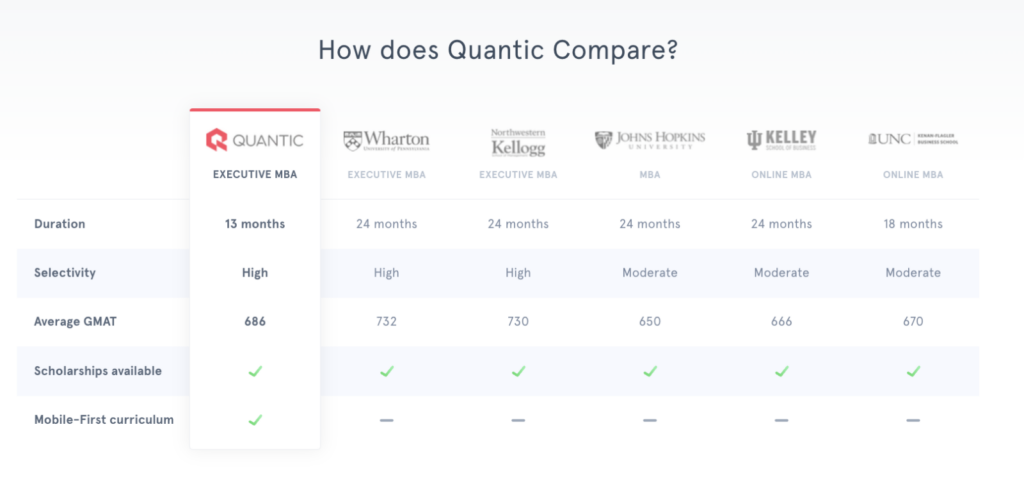
Consider the following cost comparison between Quantic and other top-tier programs:
20% of EMBA students have full scholarships from their employers.
34% of EMBA students have partial scholarships from their employers.
The remaining 46% are self-sponsored. But they often have access to financial aid or tuition assistance.
In addition, 59% of the institutions that offer EMBA programs offer their candidates scholarships and fellowships.
Clearly, despite the high tuition of an EMBA, you have options to help offset some of the costs. Be sure to check with your employer and school to determine those options.
This is key information that will determine your return on investment.
However, unlike most institutions, we don’t have a separate application process. You will be considered based on your application and notified along with your admission decision.
Executive MBAs come with many benefits, including:
#1: New Networking Opportunities
An EMBA brings together a diverse group of people from different fields. It also gives candidates access to an international student and alumni community.
These give a foundation to expand your professional network across the globe. Alumni communities, for instance, help overcome some of the networking challenges executives face.
Additionally, most programs offer an international experience option. According to a 2018 Executive MBA Council survey, 93.2% of the programs offer international trips. Some programs even offer global topics as elective and concentrations.
#2: New Challenges and Learning Experiences
After a few years of working and moving up the ladder in an industry, you develop skills in your discipline. An EMBA curriculum is designed to help refine these skills and turn them into expertise.
It also gives insight into the most pressing factors affecting business today. You will also get to learn accounting and financial acuity.
These are skills that will help catapult your career forward. Moreso if you are looking to move into an executive leadership role.
#3: An EMBA Helps You Become a Better Leader
Most EMBA curriculums include business coaching and leadership training. These help you learn about your managerial style, making you a more effective leader.
Other leadership skills you can expect to learn from an EMBA program include:
Analytic Thinking
You will learn how to dissect and understand different areas of business. This helps you develop critical knowledge in your field, enabling you to make more educated decisions.
Problem-Solving Skills
As you work and learn at the same time, you can apply the knowledge you gain in real-time. The program encourages you to analyze your environment and use your newly acquired skills to solve any issues.
Confidence
An EMBA program will help you build confidence in your knowledge. This will come in handy if you are looking to break off and start a business of your own. Or even looking to get into C-level management.
Communication
This is one of the most critical skills, especially for those in leadership. An EMBA equips you with the tools to communicate within your business environment.
#4: Better Earning Potential
As an EMBA graduate, you can expect to see a salary increase much sooner than you would with a regular MBA.
On average, you can expect an increase of about 13.5%, according to a 2019 Executive MBA Council survey.
It also indicates that you are 53% more likely to receive more responsibilities. And 40% more likely to get a promotion.
In addition to these, an online facility like Quantic also comes with a few added advantages. These include:
#1: Student Peer-To-Peer Learning
You will have access to a group learning platform. Here, they can receive class exercises, interact, and build each other’s knowledge.
#2: Executive MBA Student Network
This refers to a platform where you will be able to interact with other students and alumni. Here, you will be able to exchange ideas, grow your networks, and even take part in events.
#3: Group Projects
In the Quantic program, you will get to work in groups on several projects throughout the program. You will also work on a final project where you will get a chance to showcase your newly acquired knowledge.
#4: Optional In-Person Weekend Conferences
These conferences offer an opportunity to meet and network with classmates and alumni. The conferences span multiple days and happen four times every year around the world.
Previous locations have included: Copenhagen, Seattle, Singapore, and Washington, D.C.
#5: Full-Time Job Placement
An EMBA will also afford you specific opportunities after graduation. This is because certain programs offer networking and career support to graduates.
Is an Executive MBA Worth It?
Given the information above, you must be wondering whether an EMBA is right for you. Right off the bat, let us clarify that the degree is an excellent investment. But it might not be the best fit for everyone, or where they are in their career.
Consider the following instances:
The key takeaway from an Executive MBA is that it prepares you to move up the corporate ladder.
However, if you are new to your industry or management, then the degree is probably not the best fit for you. It’s also not a great fit if you are a recent graduate looking to get ahead in the business world.
In this instance, you will be better off with a traditional MBA. Or better yet a few years of real-world experience managing projects and people.
Additionally, you have to consider whether you can manage the time commitment required to complete the program.
If you are unable to commit this amount of time, then perhaps it might not be the right time to start your EMBA.
Another critical factor to consider is employer support. Remember, support is not just financial; they might also need to adjust your work schedule.
Ensure that you and your employer see eye-to-eye before starting your course.
However, if your career has hit a plateau, then you might want to consider an Executive MBA. Fresh technical skills, training in soft skills, and decision making will help you take on more responsibility.
Additionally, the connections you forge during your EMBA will also help propel your career to the next level.
Finally, to work out whether an EMBA is worth it, you need to first determine your career goals.
Ultimately, Executive MBAs are designed to get you to top-level management. If this is your end goal, then the answer is YES. An Executive MBA is worth it and will prepare you for this role.
If you would still like to pursue an Executive MBA but cannot meet the commitments of a traditional program, then you should consider an online program.
Non-traditional programs like Quantic’s EMBA offer more flexibility and low financial barriers.
The online delivery method means that you can learn through bite-sized lessons at your own pace and receive individualized feedback.
An online program will also give you unique insights into the evolving workplace. It will equip you with the skills to succeed in a changing work environment.
Your Executive MBA ROI Analysis
Investing in yourself through an Executive MBA pays off in both ways you can and can’t measure.
You gain business knowledge, broaden your perspectives, and build your networks. An EMBA also positions you to earn the highest salary of any postgraduate program.
But this is not all that goes into calculating your ROI.
The Figures
EMBA candidates are usually above 35 years old with about eight years of work experience. They often hold a management position upon entry into an EMBA program.
On the other hand, most MBA students are in their late-20s with about five years of work experience. They often hold sub-management positions when joining a postgraduate program.
Comparatively, EMBA candidates tend to be more senior, and thus are paid better.
On average, EMBA programs charge about $75,000, 50% more than MBAs. And EMBA graduates end up earning an average of $175,000 compared to $121,000 for MBA graduates.
From this, we can work out the ROI for an average EMBA degree is 133%. This places EMBAs as the most valuable degree in terms of post-education remuneration.
But raw figures are not enough to give a full picture of an EMBA’s ROI.
Education Value
Executive MBAs, unlike traditional MBAs, put equal value on both soft and hard skills. You will learn just as much about people management, as you will about the process under which the same people operate.
This makes for one of the EMBA program’s most valuable ROIs.
Of course, in terms of investment, this does not qualify as a financial return because technically, knowledge is invaluable.
However, when you choose to pursue an EMBA, you invest more than just money in the course. Therefore, the soft and hard skills you gain from your EMBA are among your most valuable ROIs.
Intangible Benefits
The greatest ROI you can earn from your EMBA is the networks you form through the course.
Open networks bring together people with different areas of interest and expertise. Closed networks include individuals with similar interests, professional fields, and acquaintances.
“People in open networks have unique challenges and opportunities. Because they’re part of multiple groups, they have unique relationships, experiences, and knowledge that other people in their groups don’t.” Micheal Simons, Author.
Being part of an Executive MBA program provides exactly that – the opportunity to be part of an open network.
This is arguably the most valuable (and the most unquantifiable) ROI from your EMBA degree.
The Quantic Executive MBA Program
Unlike a traditional MBA, the Quantic EMBA focuses on leadership, strategy, and governance. All while still allowing you to learn everything you would in a regular MBA curriculum.
It does away with time-consuming lectures and focuses on fast-paced, personalized modules. Note, however, that this is not an indication of a lighter curriculum.
Quantic’s EMBA program is based on a proprietary pedagogy that uses active learning. This helps ensure the same learning outcomes as that from top business schools.
The courses are developed in partnership with experts and business school professors. They ensure the program suits the evolving needs of executives from across the globe.
The program also offers you the opportunity to focus on relevant topics in today’s workplaces. These include subjects such as data science, digital marketing, and entrepreneurship.
This, combined with the social learning environment and worldwide classmates, delivers:
Financial benefits,
Personal growth,
An expanded worldview.
Should You Get an Executive MBA?
An executive MBA can expand your career opportunities substantially. It also equips you with the set of skills and knowledge you will need to move up your existing career. Or to launch a new one.
Although EMBA curriculums vary, most focus on professional skill development and leadership. These give you insight into real-world management problems and how to overcome them.
An EMBA will also equip you with knowledge from the following fields:
Economics and Finance
Operational Management
Organizational Leadership
Entrepreneurship
Business Policy
Business Ethics
Communication
Marketing
In light of this information, it’s evident that an EMBA is a worthwhile investment. Given how impactful an EMBA can be to your career, your choice in school is all the more important.
Your first instinct might be to consider a traditional EMBA program, and rightly so.
However, non-traditional programs are steadily gaining traction. They offer more flexibility, less overhead costs, and are more adaptable to your schedule.
Some even partner with professors from top business schools. This helps make Ivy League business education more accessible on a global scale
Please consider the following quick overview of the Quantic Executive MBA program:
The Quantic Executive MBA program is specially designed to suit the needs of a working professional. The curriculum provides a world-class education in a flexible, technology-driven learning environment.
The program is also enhanced by the diverse knowledge and experiences the global students bring to the program.
This makes for the perfect setting to network with a diverse group of experts. A feature we’ve discovered is one of the key ROIs from an Executive MBA.
And all this at a fraction of the cost of a traditional EMBA brick-and-mortar program.
Quantic’s Weekly Roundup is a satisfying mix of the latest breaking news, business, STEM and social science stories. Here are your headlines for this week:
Water, water everywhere: A new invention called QuenchSea is on its way to help people turn seawater into freshwater. Hydro Wind Energy has created a 1.5-pound hand-held desalinator, which is manually operated and can make up to 3 liters of potable water per hour. The company says the desalinator will go into full production after the London and Dubai-based tech startup passed its crowdfunding goal by more than 700 percent.
Don’t stand so close to me: Britain started testing a new smartphone app Thursday to help people find out whether they’ve been close to someone infected with COVID-19. This comes after security concerns torpedoed an earlier effort to use technology to track the disease.
Pour one out: A global coffee crisis may be in our future. Coffee is becoming harder to grow, due to climate change and environmental conditions. A recent study estimates that by 2050, the amount of land that can sustain coffee will have fallen by 50 percent.
Has your office officially hit Zoom fatigue? Don’t worry! From trivia to scavenger hunts, try one these new virtual team-building activities.
Girl Up, United Nations Foundation Communications & Digital Media Associate and Quantic Alum, Naomi Naik, helps girls broaden their social impact skillset, apply STEM for good, and create policy change. This leadership program, founded by the United Nations Foundation, reaches tens of thousands of girls around the world.