Our first annual Quantic Moonshot competition aims to inspire and support our student’s visionary journeys to create groundbreaking businesses. We wanted to make the grand-prize even more special and representative of the innovative nature of entrepreneurship.
That’s why we decided to award the winning team an NFT, or non-fungible token. NFTs are digital assets that represent ownership of a unique item or piece of content, such as a digital artwork, a tweet, or a video clip. NFTs have been making waves in the art world, with high-profile sales reaching millions of dollars. But beyond their financial value, NFTs offer a new way to think about ownership and creativity in the digital age.
Our NFT design is not just an ordinary digital asset. It’s an artistic representation of our Quantic Moonshot competition and the intricate startup process. We worked with an incredible designer for months to find the perfect representation of entrepreneurial spirit and came up with the vision of “Multiplicity.”
At the center of the NFT is an anchor, representing the core idea, inspiration, and passion that drives entrepreneurs to pursue their dreams. This anchor is the focal point that fuels the orbiting rings around it, which represent the various core functions of entrepreneurial acumen.
The movement of the rings is both chaotic and cohesive, representing the dynamic and ever-changing nature of entrepreneurship. However, ultimately, they land perfectly centered and aligned, like a perfect bullseye, symbolizing the ultimate success of the entrepreneurial journey.
Our Quantic Moonshot competition is a challenge for entrepreneurs to develop innovative and game-changing business ideas. The winners of this competition possess the skills and mindset to create something truly groundbreaking, and “Multiplicity” serves as a testament to their accomplishments.
In addition to being an exclusive NFT artwork, “Multiplicity” is a representation of Quantic’s commitment to entrepreneurship and innovation. It is a reminder that success in entrepreneurship requires a combination of diverse skill sets and the ability to navigate the complexities of the entrepreneurial journey.
This NFT artwork is an excellent example of how blockchain technology can be used to create unique and meaningful art. The use of NFTs has exploded in recent years, and they have become an essential tool for artists, musicians, and creators to monetize their work and create unique and one-of-a-kind pieces.
“Multiplicity” is an exclusive NFT artwork that represents the power of entrepreneurship and the many layers that come with it. It is a celebration of the winners of the Quantic Moonshot competition and a testament to the many challenges and rewards of the entrepreneurial journey.
We are thrilled to announce that Kenneth Anand will be the Master of Ceremonies for our first annual Quantic Moonshot Finals on May 6 in New York City! Kenneth’s entrepreneurial and creative spirit, combined with his successful and innovative career path, make him the perfect fit for this role.
As the CCO of CANVVS, an accomplished author, and former Yeezy General Counsel, Kenneth has always been driven to pursue his passions. His love for hip hop and pop culture, as well as his self-proclaimed “Sneakerhead” status, have always played a big role in his life.
After 15 successful years in private law practice, Kenneth realized that he wanted to pivot and focus on his passion for the sneaker industry. He became head of business development and general counsel for Yeezy, where he found the perfect blend of his interests in sneakers, fashion, and pop culture.
Inspired by his experience at Yeezy, Kenneth pursued his MBA with Quantic to further his business knowledge and put it to use in his daily life. This led him to write the groundbreaking textbook, “Sneaker Law,” which combines the legal and business side of the footwear world. Kenneth and his partner, Jared Goldstein, are now changing the way law and business are taught. “Sneaker Law” has already been incorporated into classes at schools like Harvard Law School, Parsons School of Design, Fashion Institute of Technology (FIT), University of Miami Law School, Georgia State University, and others.
Interested in learning more about this legal bible for the sneaker industry? Covering areas such as reselling, design, counterfeits, the law of sneakers, licensing, collaborations, manufacturing, distribution, marketing, starting your own business, branding, and much more, “Sneaker Law” contains all you need to know in order to navigate through the $80-billion global market. You can purchase the textbook here. Kenneth’s success is a testament to the power of pursuing your passions and giving it your all. We can’t wait to see him in action as our MC at the Quantic Moonshot Finals. Also, make sure to stay tuned to watch the ceremonylive on our LinkedIn channel, when we reveal the grand-prize winner!
AI was still science fiction only a decade ago. Sure, we had early chatbots and novel applications. However, today artificial intelligence literally moving the world.
Supply chain and logistic companies recently discovered the value of AI. From loading trucks to predicting the future, machine learning is posed to revolutionize the industry. But how is this happening? How does AI help move real-world objects from point A to point B?
Well, that’s exactly what we’re exploring today. We’re going to take a look at the role AI is playing in the modern supply chain and what it’s doing for logistics.
AI in Supply Chain Management
In its simplest terms, supply chain management is all activities that go into sourcing, producing, and delivering goods. The exact details will depend on the industry. For example, manufacturing supply chains focus on the process of sourcing raw materials to delivering the finished products.
Logistics are the activities within supply chain management focused on delivery and transport. How does raw material A reach point B and how does the finished product reach the customer from there? Answering that question in the most efficient and cost-effective way – that’s logistics.
Needless to say, supply chains and logistics are the very lifeblood of business, if not civilization as we know it. Grocery stores would be empty and factories would stand idle without it.
But what does this all have to do with AI?
Artificial intelligence is the simulation of human intelligence. That is what differentiates it from your standard computer algorithm. AI ingests large swaths of information and uses that to accurately predict outcomes. In our increasingly data-rich world, this has become remarkably viable across many industries – including supply chain management and logistics.
The types of AI that exist today primarily consist of artificial narrow intelligence, ANI for short. These AI focus on very specific tasks.
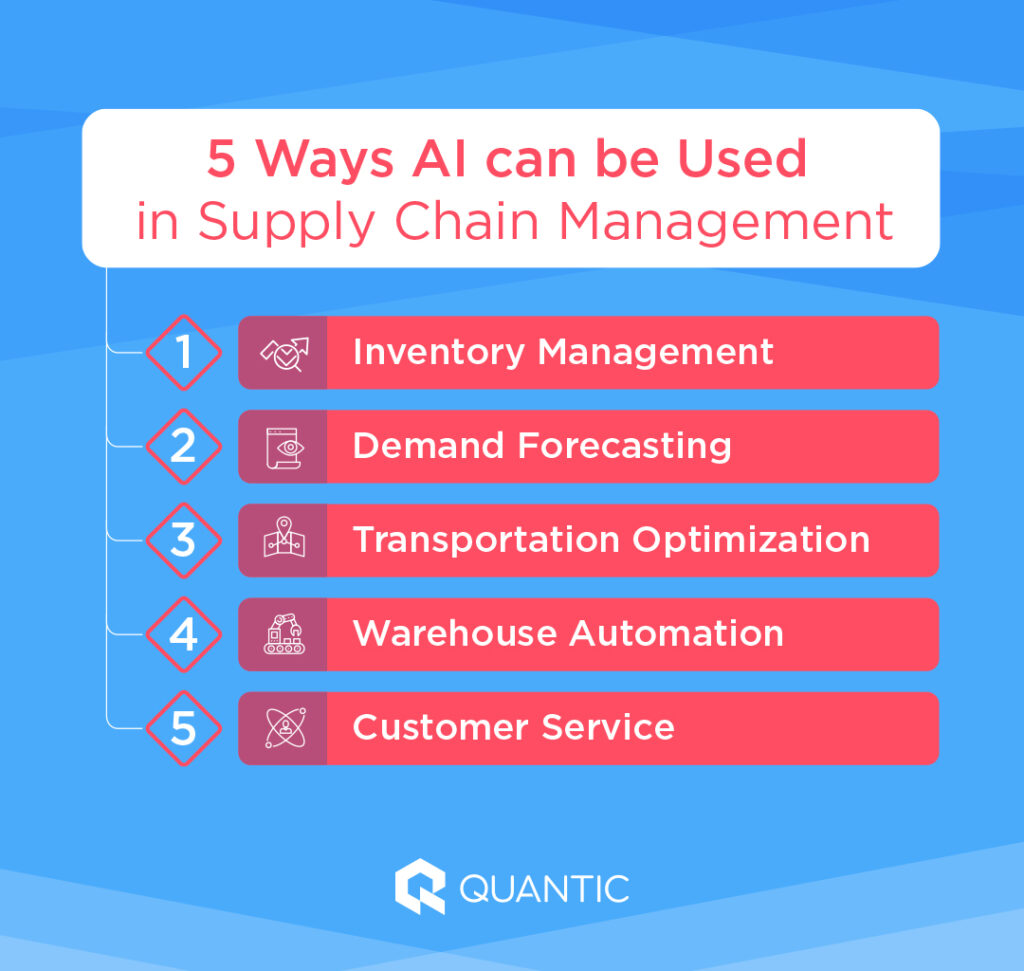
Here are some of the ways that technology is being used in supply chain management and logistics today:
Demand Forecasting
Optimizing Routing and Delivery
Improving the Loading Process
Generative AI in Supply Chains
If you’ve heard of ChatGPT, you’ve heard of generative AI. This form of AI refers to algorithms that “generate” new information and content such as blogs and even computer code.
Demand forecasting is just one example of generative AI in supply chains. It can also be applied to automating clerical work, predicting operational results, and factoring in tariffs into operational costs. The sky is the limit for generative AI – provided that it has enough data to go off of.
For example, the company Echo Global Logistics utilizes generative AI to negotiate shipping rates, procure transportation, and automate carrier management.
Examples of AI in Supply Chain Management
With all of this in mind, let’s take a look at how AI is already assisting supply chain management and logistics.
Inventory Management
A major aspect of every supply chain is knowing what product is where and how much of it. To this end, AI has enabled companies from retail stores to mail carriers to accurately track inventory. This includes tracking orders as they move across the globe while keeping track of stored inventory via automated surveillance checks in warehouses.
AI can oversee numerous variables, including:
Volume
Lead time
Temperature
Errors
Downtime
All of this frees staff to work on human-specific inventory tasks rather than repetitive jobs.
Demand Forecasting
Many of us joke that we’re stalked by the algorithms responsible for targeted advertisement. However, the real fact of the matter is that human behavior is predictable. Machine learning models can ingest market data to create accurate predictions of future customer behavior and automatically act on those predictions.
For supply chain management, that means predicting what will be needed where, when, and even foreseeing shortages before they happen. This ultimately reduces inventory losses and prevents out-of-stock scenarios.
Transportation Optimization
Modern customers demand fast and accurate delivery. AI-powered GPS and optimization solutions make that possible. They identify and create the most efficient of the possible routes using real-time data combined with existing map information. What’s more, they can do it in moments whereas human intelligence would have to rely on intuition and hours of mapping to come to the same conclusion.
In terms of logistics, AI can also optimize how we utilize shipping containers. Where most people see a cargo container as e a big empty box. Those in the logistics industry see an economy of space. How can we safely load a cargo container to maximize the space used? Again, AI provides a solution.
AI tools are already in use today to help optimize this space to quickly and efficiently load cargo containers and semi-trailers.
Warehouse Automation
Many warehouses, such as Amazon Fulfillment Centers, utilize AI to automate a lof their day-to-day operations. AI organizes both people and autonomous robots to store, locate and pick orders stored throughout the facility. In this system, the AI predicts where robots or human employees will be, and organize their activities accordingly.
This all creates a system where workers spend less time traversing the warehouse, and more time getting products where they need to be whether that be storing or shipping.
Customer Service
Chatbots are certainly not new technology. However, they’ve been as advanced as they are today. That’s why many companies are utilizing AI to automate a lot of their customer service activities.
Customers often come with the same concerns and questions that involve the same solutions. As such, an customer service AI has plenty of data to pull from and answer customer concerns. This saves customer representatives time from answering the same questions over and over, and allows them to focus on complex customer problems and requests outside the scope of your typical AI.
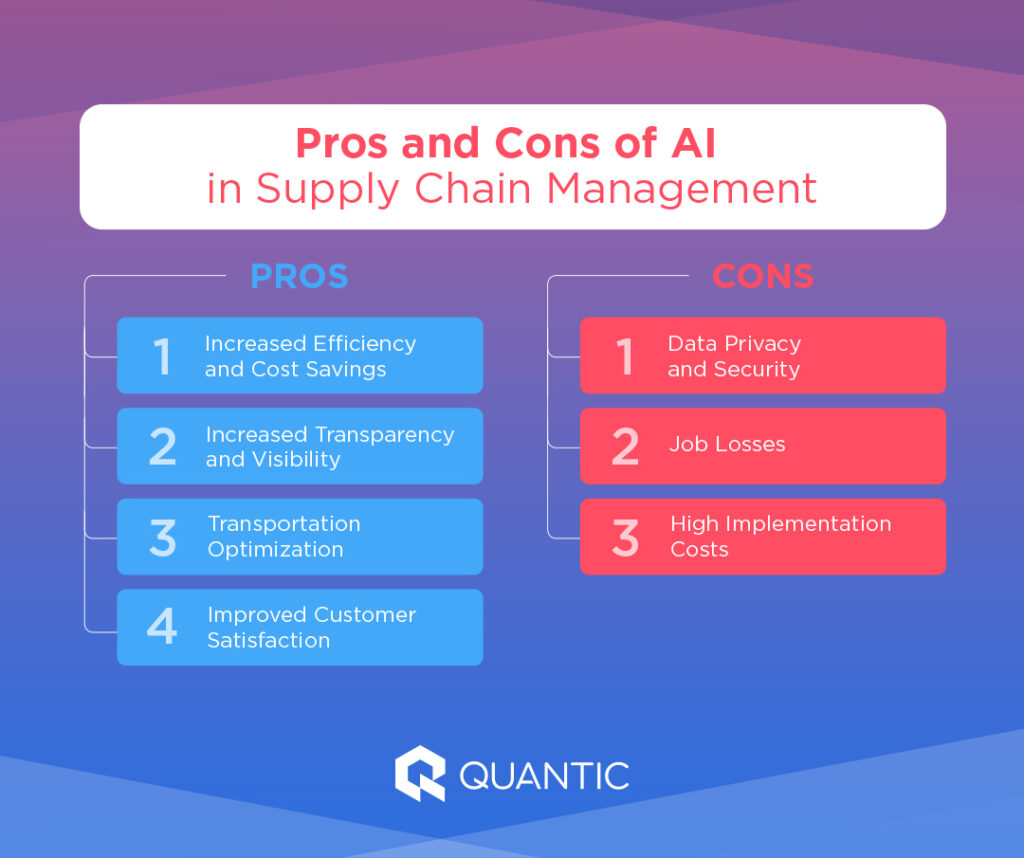
Benefits of AI in Supply Chain Management
Increased Efficiency and Cost Savings
No matter the task it’s applied to, AI can help logistics companies find the most cost-effective and efficient way to do it.
Let’s take a look at repetitive tasks like inventorying and transportation routing as examples. These tasks can take humans several hours a day to perform. AI, on the other hand, can do it in a manner of moments. Consequently, human labor is freed to focus on human-specific tasks. This improves both ROI and workers’ overall efficiency.
Increased Transparency and Visibility
When a supply chain spans the entire globe, it’s easy to see how things can get lost in the shuffle. Deliveries get lost and misplaced. Nature delays logistics. The wrong shipping label is placed on the wrong container. The list goes on.
AI helps mitigate these problems by collecting massive sets of logistic data and presenting it in a way humans can understand – and fast. That includes shipping times, inventory locations, predicted delays and shortages, and much more. For the first time in history, organizations have the potential to see the entire scope of their supply chain.
Improved Customer Satisfaction
As we mentioned before, the modern customer expects fast delivery. This is true on an individual consumer basis as it is for a B2B client. AI helps logistic companies meet that expectation.
That’s not even to mention customer service chatbots that can answer customer questions in moments rather than waiting for hours on hold to speak with an overwhelmed representative.
Disadvantages of AI in Supply Chain Management
There are very few things in life that come without drawbacks. AI is no different.
Data Privacy and Security
One of the biggest challenges to implementing AI in any industry is how data is handled. As AI solutions require massive amounts of data to create accurate results, it’s important to be conscious of where this data comes from. This is a solely human task. To AI, data is data.
Relatively new regulations, such as the EU’s GDPR, requires personal data to be handled with particular care. Otherwise, organizations risk breaking compliance, and the repercussions that entails. That means taking responsibility for how AI and machine learning algorithms utilize data.
Furthermore, there’s the matter of security. Should an AI utilize sensitive company information, it’s possible for it to unintentionally reveal that information.
That’s not even to mention the prospect of cyberattacks on AI systems. These include adversarial machine learning attacks where the system is fed to manipulate incomes and cause the AI to deliver incorrect results.
As such, we can expect growth in cybersecurity jobs that specialize in AI compliance and security.
Job Losses
It is no secret that many people fear that AI will “take their job.” And this fear is not unfounded. McKinsey predicts that automation could displace between 400 and 800 million jobs by the end of the decade. As more tasks are automated, less human labor is required, and that means companies interested in maximizing revenue will likely reduce headcount.
However, it is important to remember that this is not the first time we’ve seen this. Between the 18th and 19th centuries, we saw massive numbers of workers displaced by new machines and ways of doing things. Although it was a painful transition, society recovered quickly as new jobs appeared around these changes.
We can expect the same from an AI-tech revolution. Thankfully, unlike the industrial revolution, we can see this one coming. Professionals today can prepare by expanding their skills and education with AI-conscious courses to adapt to the new AI-driven workplace.
High Implementation Costs
AI is an amazing tool, but it comes at a cost.
For one, existing systems were not designed with AI in mind. Adapting or changing them will require significant investment. And that’s not even accounting for AI itself whose cost will depend on the level of intelligence desired as well as the processing power it will require. In fact, according to Analytics Insights, a custom AI alone could cost anywhere from $20,000 to $1,000,000.
These costs make AI out of reach for many companies today. However, like most technology, we can expect these costs to decrease as AI solutions are further developed.
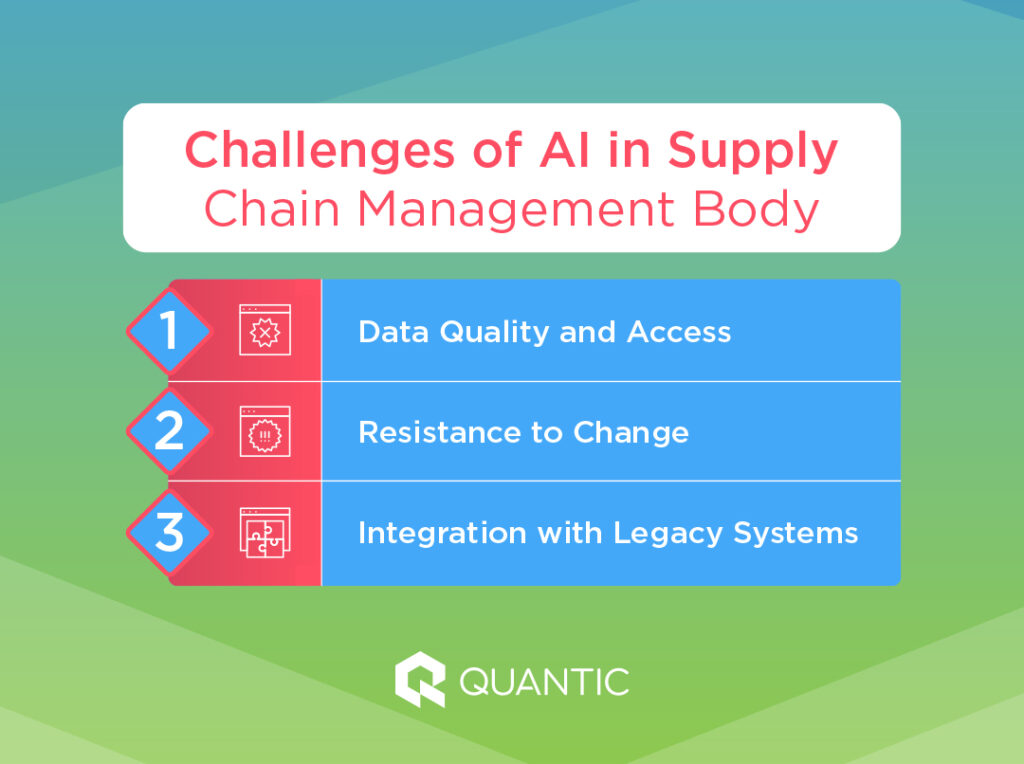
Challenges of AI in the Supply Chain
Data Quality and Access
Data, data, data. If you take anything away from this, you need to know that AI is useless without data.
Providing this data is possibly the biggest challenge to implementing AI in the supply chain. As we mentioned before, legacy systems were not built with AI in mind. That means many companies will need custom solutions to take their existing data and make it available to AI solutions.
What’s more, this data will need to be available in a form that the AI can ingest and effectively use.
Resistance to Change
Change is hard. To some, it’s even scary. As such, the cultural resistance to AI that we’re seeing today is only natural.
We can divide those resisting AI into two groups: philosophical and practical.
In the practical camp, we see those who fear losing their jobs to AI; a disadvantage we just discussed. These individuals include those that work in creative industries and the clerical tasks that AI seeks to automate.
In the philosophical camp, we see those who object to AI on fundamental and ethical grounds. Here we see individuals that see AI as soulless simulations of human abilities. These critics voice concerns that AI will do more harm than good in the long term.
Regardless of their reasoning, these voices will continue to push against widespread AI implementation.
Integration with Legacy Systems
An inherent problem with any new technology, not just AI, is that existing legacy systems were developed for the technology of the time.
As such, AI systems will have trouble communicating with existing hardware and software. This poses a particular problem for large organizations that cannot simply tear their system down and build a new one. Too much important data is held in their current systems, and the cost of transferring it to a brand-new system would be astounding.
That means existing companies will need to integrate. And that means custom software development, and a good amount of troubleshooting before AI can become viable.
On the other hand, this represents an opportunity for new companies and start-ups to build systems from the ground up with AI in mind.
Overall Impact of AI in Supply Chains
We already see AI creating a positive impact on the modern supply chain, and we can only expect these benefits to grow as the technology develops.
AI has allowed us to increase the speed and accuracy of our logistical systems around the world. Shortages are anticipated. Transportation is optimized.
Supply chain managers now have enhanced visibility in their supply chain. We have a better idea of where goods are.
More and more tasks are being optimized and automated. That means we’re seeing greater ROI on the greater logistical efforts throughout the entire supply chain.
All of this ultimately means AI is pushing us to a fast, efficient, and cost-effective supply chain that was unthought of at the start of the century. And that’s only what we’re seeing today.
Future of AI in Supply Chain & Logistics
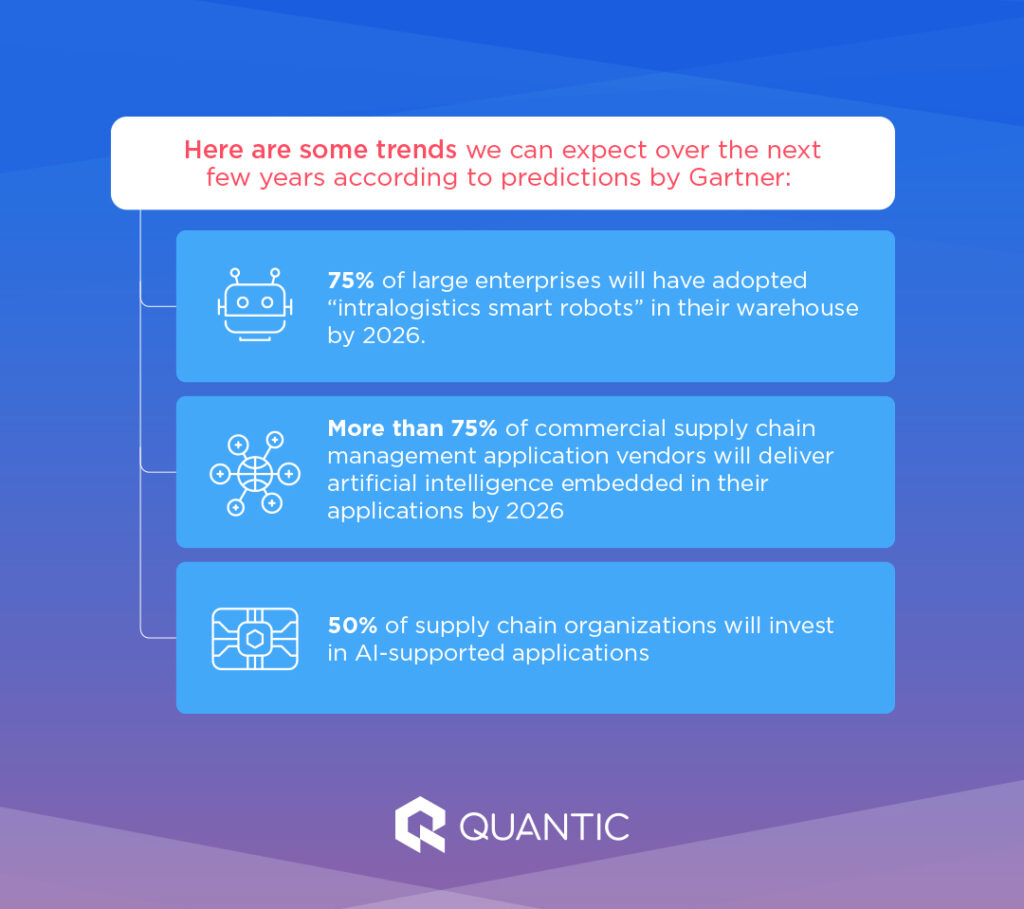
AI is still a fledgling technology. What are we seeing today is only the start of many things to come as it matures. Expect serious change to come by end of the year.
75% of large enterprises will have adopted “intralogistics smart robots” in their warehouse by 2026.
More than 75% of commercial supply chain management application vendors will deliver artificial intelligence embedded in their applications by 2026
50% of supply chain organizations will invest in AI-supported applications
And these are only predictions made for the next few years. However, the possibilities seem almost endless. For example, as AI matures alongside smart vehicles, the prospect of autonomous long-haul vehicles becomes more and more likely – a goal that companies such as Uber Freight are currently working towards.
As for what this all means for those working in the supply chain and logistics industry, we can expect a push to adopt these new technologies in the interest of efficiency and cost-effectiveness.
AI in Supply Chain Courses
The expected growth in AI over the next decade means we can expect the demand for AI professionals to grow as well. If you want to be involved, you’ll want to pursue the relevant courses and certifications today.
That’s why numerous institutions and companies are offering coursework dedicated to AI.
These include
The United States Artificial Intelligence Insitute – Offers a certification program for AI engineers
Coursera – Offers numerous courses on AI and deep learning.
Harvard University – Offers multiple courses in AI and machine learning for business applications.
Yale University – Offers a general course on artificial intelligence.
Pursuing an education with an AI in supply chains and logistics components will make you a strong candidate in this burgeoning field.
However, these organizations fail to offer where Quantic succeeds. Quantic’s MBA program offers a specialization in supply chain management that includes AI. Not only will this prepare you for an AI-driven future, but it’ll also teach you the skills to understand why it matters.
Quantic MBA graduate, Gilli Aliotti, is a seasoned senior executive driven by a passion for building high-performing teams and products that deliver the highest ROI. With over 25 years of experience in technology, media, entertainment, and learning, Gilli has led executive positions in Fortune 500 companies as well as startups, optimizing planning, execution, delivery, and the rhythm of business at scale. As Head of PMO and Support Operations at Google, she manages the technical program delivery for Google’s worldwide portfolio of Geo products, including Google Maps and Google Earth. With certifications as a Business Executive Coach and Agile Transformation Coach, Gilli is a sought-after speaker and author, and she is also a mother of 9-year-old twins.
Gilli has always been a passionate and goal-oriented leader. But how did her journey begin? Has she always been clear about her goals and had a plan in place? Did she know what she wanted when she was in her mid-twenties? What experiences and decisions drove Gilli through the early stages of her adulthood and eventually guided her to becoming the CEO of her career and life? Gilli’s journey, like many of ours, has not always been a linear one. In our recent Quantic Conversation with her, she shares how her experiences, openness, and ambition have helped her unlock opportunities and find success in work and in life.
Exploration
“At 25, I was clear that I needed a purpose to steer my life, yet I didn’t think intentionally about what I would do in the future. Instead, I was an adventurer looking to try out all of life’s flavors around the world,” said Gilli. Travel and new experiences guided her and she set out on a journey taking her throughout Europe and North America. “I tried out multiple things, from playing music in bands to writing songs, dabbling with early tech developments — involving everything from event production, car launches, and trade shows — I hopped from city to city in the US, meeting people along the way — even if it meant sleeping on couches here and there.” Though her North Star had not yet taken shape, Gilli’s ambition pushed her forward.
Balance
Gilli has always led a parallel life — the artist’s life that she loves and is passionate about, and the work life that she thinks sometimes means achieving the greater good for most people. Ten years ago, Gilli decided to put the same effort and enthusiasm into her chosen career as she did with her artistic pursuits. To Gilli’s surprise, this resulted in an unexpected joy that enabled her to combine both passions into one role. As she’s gained more experience — both in life and in work — she’s gained new appreciation for each, and developed ever-deepening clarity on who she is and the active roles she plays in defining what’s next. “I am all of it. And it is okay because I actually love both. I have new dreams now,” says Gilli.
Education
Despite a successful career and having traveled the world, Gilli found something was still missing in her life. “At first, I couldn’t quite put my finger on it until the pandemic. Working from home while raising 9-year-old twins — it changed everything. That is when I realized that what would be most useful to add onto this plate of mine was the one thing I always wanted but never had: pursuing a graduate degree that could shape my leadership for the work I knew I would be in, in the next ten to twenty years,” explained Gilli. “With this degree, people are much more likely to take me seriously as a senior leader in my field and it shows the world what I can truly accomplish.”
Gilli was looking for something different when it came to getting her MBA, the traditional route just wasn’t quite right for her. That’s when Quantic came along — she fell in love with its self-paced online learning model that worked perfectly on her smartphone. It felt like a more modern way for people who work in cutting-edge industries to earn a degree. “Quantic is much more than an app — if you go through the modules, you’ll feel like, wow, this is refreshing! I really enjoyed my experience and learned a ton while having fun along the way,” says Gilli. “Now I found myself armed with useful tools and a better understanding of organizational development and strategic planning. In addition, its practical applications enabled me to apply the knowledge I’d gained in real-world situations. During my time studying with Quantic, I worked on team assignments that not only provided me with excellent opportunities, they also resulted in lifetime friendships!”
Passion
Life is an ever-unfolding journey where exciting and unexpected paths await at every corner. “Let your passion be your guide. Don’t let anything hold you back from taking advantage of this unique opportunity that allows us to create our own balance between career and life. We can now find ways to flourish in a hybrid workforce with greater flexibility than ever before,” says Gilli. “So go forth, prioritize what feels right for YOU!”
Being a CEO, whether in your career or life, means acknowledging and embracing the fact that you can chart your own course. Gilli describes the sense of feeling like you need to fit a certain mold to progress — that others look at your LinkedIn profile and ask how you got from point A to point B “and feeling like you have to put yourself in a box so others understand who you are… I didn’t want to be put into that box.” Gilli’s skills and success are a direct result of her varied experiences and diverging passions. She urges others to follow their passions and to “be all of it,” meaning, embrace the left turns, the round-abouts, the forks in the road that lead you to new adventures and new experiences. Resist the urge to shed your passions because they don’t “fit” within a narrowly defined path to success. Being the CEO in your life is about keeping an all-encompassing view and taking proactive ownership over what comes next — charting the course to make it exactly how YOU want. So while Gilli shares that crafting your path takes time and effort, and is often full of unexpected turns, ultimately, you’re in the driver’s seat. As Gilli said, “You are all of it. Follow your heart. We’ve all been flying by the seat of our pants!
Watch Gilli’s live and more of our Quantic Conversations with inspiring our Quantic students and alumni:
AI in HR is revolutionizing the way companies recruit, manage and engage their employees.
As the technology advances, it’s becoming easier for businesses to leverage its power to streamline processes like recruiting and performance reviews.
According to SHRM AI is already being utilized in some capacity for HR by 88% of companies worldwide.
With AI in HR, organizations can improve employee engagement while gaining access to valuable insights into how they are performing as a business.
In this blog post we will explore the benefits of using AI in HR along with some potential drawbacks that need consideration before implementing such systems.
Join us on our journey as we discover how leveraging artificial intelligence can help you get ahead!
What Is AI’s Impact on HR So Far?
HR departments have seen a major shift in their operations due to the introduction of AI, allowing them to streamline various manual tasks and become more effective.
AI algorithms enable HR to process a wealth of data swiftly, enabling the discovery of patterns that can be utilized for recruitment, training and staff retention decisions.
Here are a couple of quick examples of AI in HR…
AI-powered chatbots can also be used to answer employees’ questions about benefits or other topics quickly and accurately.
AI algorithms can also be used for predictive analytics, helping employers anticipate potential issues with staff retention or productivity before they become a problem
Now, let’s take a look at these in more detail. So you can start leveling up your HR department with AI.
Predict Talent Needs
By integrating AI into their HR departments, leaders can create an inclusive workplace that attracts top talent while also ensuring that important tasks are completed quickly and efficiently. Here’s how…
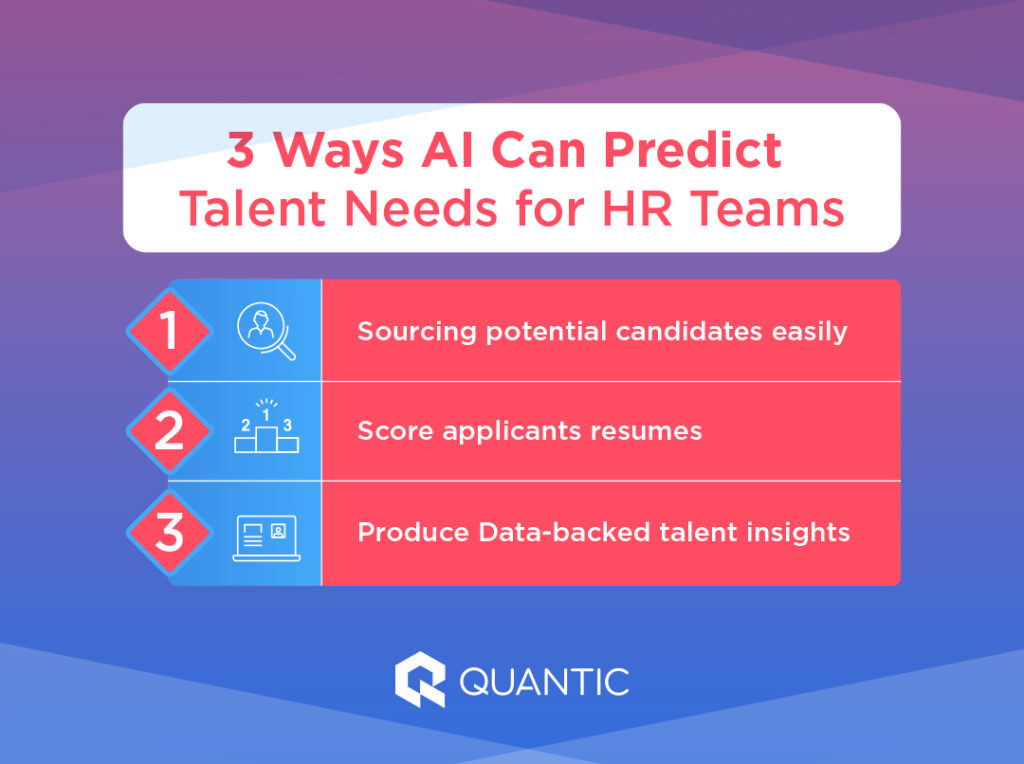
Sourcing potential candidates easily
Learning capabilities, such as NLP, can swiftly pinpoint personnel who possess the appropriate qualifications for a given position.
This helps streamline the recruitment process by reducing time spent on manual searches through resumes or other sources of information.
Score applicants resumes
Algorithms can be used to score applicants’ resumes automatically so recruiters don’t have to manually review each one individually—saving them valuable time in the long run.
At Quantic a human being still reviews all of our MBA applications. To ensure that we are selecting the highest quality students.
Data-backed insights
Data backed insights gathered directly from employees can help HR teams make informed decisions about how best to allocate resources within their organization.
Real-time analytics can be employed to gauge staff engagement and identify which strategies are most successful at raising spirits or efficiency.
Additionally, predictive analytics can be used to forecast future hiring needs based on current workforce data such as turnover rates or skills gaps within teams—helping organizations stay ahead of changing trends in their industry landscape while preparing for upcoming growth opportunities.
Predicting talent needs with AI can help businesses identify the right candidates for their positions and maximize efficiency in the hiring process.
Enhancing Employee Experience with Chatbots
These automated programs can provide real-time responses to employee queries, streamlining processes like scheduling interviews or identifying workers with certain skills gaps.
Chatbots employ NLP techniques to decipher human speech and reply suitably. This enables organizations to provide personalized learning pathways for their employees, helping them realize their full potential while improving the overall working lives of staff members.
Chatbots may be a game-changer for the interaction between employers and staff, providing quicker feedback times as well as improved customer service.
Potential Drawbacks of AI in HR
While AI has brought significant improvements to HR operations, there are some potential drawbacks to consider before implementation.
Lack of Human Interaction
One primary concern is the possibility of losing the human element of HR due to excessive use of technology. HR is a people-oriented function, and AI cannot replace the human touch that is essential in building trust and developing relationships with employees. Especially when it comes to things like conflict resolution…
Quantic Alumna who specializes in Conflict Resolution and DEI Strategy, shared valuable insights with us. During her discussion, she spoke about her career journey, ways to create an inclusive work environment, and her admiration for the Quantic community.
Bias in AI Algorithms
Another concern is the risk of bias in AI algorithms. Since these algorithms are created by humans, they may contain inherent biases that could lead to unfair recruitment, selection, and promotion decisions. Companies need to ensure that their AI systems are transparent, ethical, and free from bias to avoid any legal or reputational risks.
Dependence on Technology
Relying heavily on AI systems in HR could result in over-dependence on technology. This could pose a problem if the technology fails, leading to delays in critical HR functions, such as payroll processing or benefits administration. Companies need to have backup systems in place to prevent disruptions in their HR operations.
High Initial Costs and Implementation Time
Implementing AI systems in HR can be expensive and time-consuming, requiring significant investments in software, hardware, and personnel. Additionally, companies need to train their HR staff on the new technologies, which can take time and resources.
But doom and gloom aside, let’s explore some successful implementations of AI in HR.
Examples of Successful AI Implementations in HR
Despite the potential drawbacks, many companies have successfully implemented AI in their HR operations, achieving significant benefits. Here are a couple examples:
Unilever
Improving Recruitment with AI – Unilever has automated its recruitment process using AI, saving time and increasing efficiency. The company uses AI-powered chatbots to screen candidates and conducts video interviews with potential hires.
Trying to break into the pharmaceutical industry? Read our guide to discover whether you need an MBA to do that.
IBM
Enhancing Employee Engagement with AI Chatbots – IBM has implemented AI-powered chatbots to improve employee engagement. The chatbots provide real-time responses to employee queries and help to automate HR processes like scheduling interviews and onboarding new employees.
We have 59 Total IBM Students & Alumni at Quantic. 37% of IBM applicants are also eligible for tuition reimbursement find out more here.
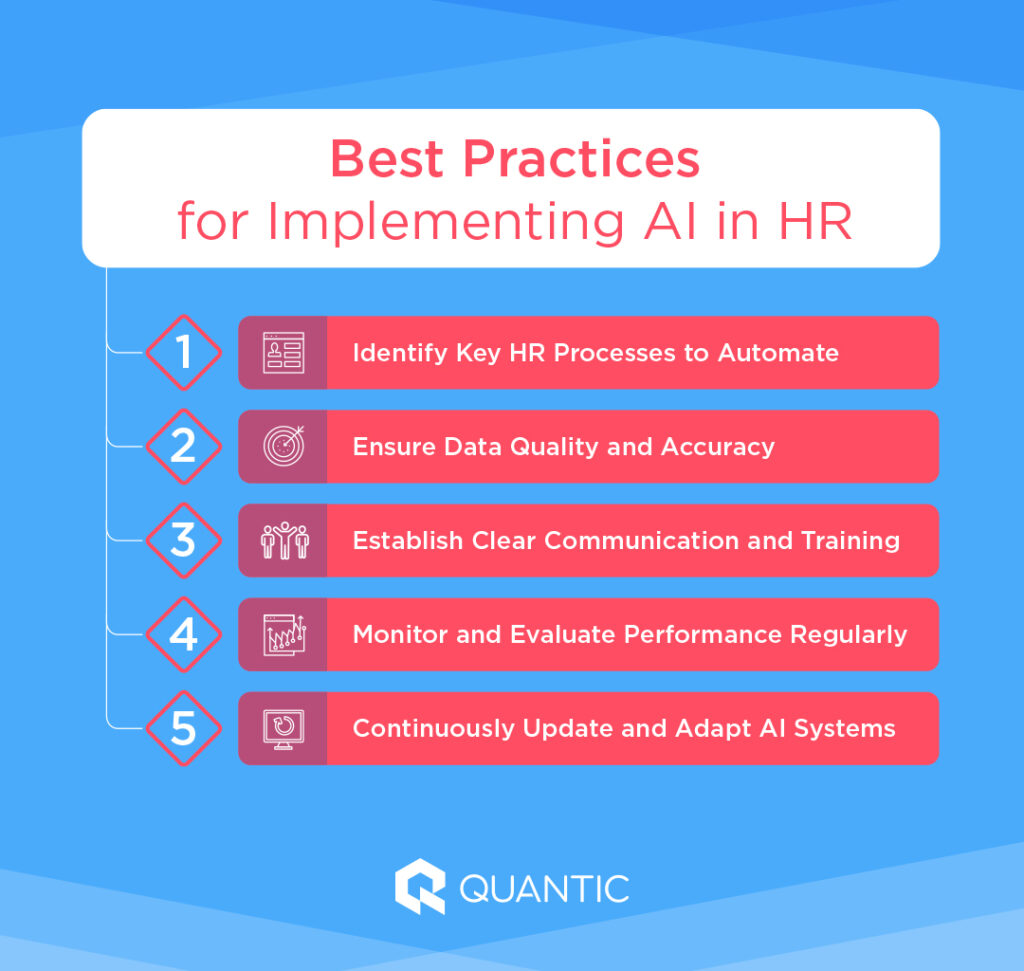
Best Practices for Implementing AI in HR
To ensure successful implementation of AI in HR, companies should follow these best practices:
Identify Key HR Processes to Automate
Companies should identify the HR processes that can be automated using AI and prioritize them based on their potential impact on the business.
Ensure Data Quality and Accuracy
AI systems rely on high-quality data to provide accurate insights. Companies need to ensure that their HR data is up-to-date, complete, and accurate to avoid any biases or errors in the AI algorithms.
Establish Clear Communication and Training
HR staff should receive training on the new AI systems to ensure they understand how to use them effectively. Clear communication channels should also be established to address any concerns or questions.
Monitor and Evaluate Performance Regularly
Just as companies have a performance management process in place, they should also monitor the performance of their AI systems regularly. This ensures they are delivering the desired results. Any issues or problems should be addressed promptly to avoid any negative impact on the HR function.
Continuously Update and Adapt AI Systems
AI technology is constantly evolving, and companies need to keep their systems up-to-date to stay competitive. They should also be prepared to adapt their AI systems to changing business needs and evolving HR trends.
Conclusion
AI in HR is a powerful tool that can be used to streamline recruiting, automate performance reviews, and enhance employee engagement.
However, it should not replace human resources completely as AI has its own set of limitations. By understanding the benefits and drawbacks of AI in HR management, businesses can use this technology strategically to improve their operations while still providing meaningful support for employees.
Join Quantic School of Business and Technology to explore the cutting-edge opportunities in AI for HR professionals. Our online education programs will equip you with the knowledge and skills needed to maximize success in this rapidly evolving field.
Related reading: See how Quantic Alumna Ian Saville handled his career transitions and pivots in our student spotlight article.
We are thrilled to launch our first annual pitch competition, Quantic Moonshot, where our Executive MBA students get to showcase their game-changing ideas and business innovations. Our judges have narrowed down the teams to five finalists, who will all be competing to win the grand-prize.
One of the five finalist teams, toTable, creates a sustainable and cost-effective method to prevent food waste for consumers and grocers.
toTable Moonshot Business Pitch
At its core, toTable aims to solve the economic and environmental harm caused by consumer and grocer food waste due to the lack of connection between consumer food demand and grocer supply that needs using at the stage of consumer planning/intent.
The primary use case of toTable is to reduce food waste, benefiting the environment and economically benefiting all participants of the ecosystem.
Consumers can plan meals to address dietary restrictions, health goals, nutrition, budget, and waste reduction, while grocers can actively reduce waste by pushing items to consumer meal plans before expiry, thereby saving the grocers money, reducing waste, and reducing strain on the supply chain. The surplus becomes available for others to consume.
To make money, toTable takes a small share of consumer grocery orders and operates a marketplace for additional goods and services, such as supplements and nutritionist consultations, as well as digital goods, such as additional recipes or integration access linking to popular recipe websites.
The founder of toTable is motivated by the intersection of the planet, people, and technology. With functional experience across sales, marketing, product, operations, people and talent, leadership, and more, and domain expertise working with startups globally across various industries ranging from deep tech AI to Enterprise SaaS to gaming and more, the founder is well-equipped to build a high-performing team and run a lean, scalable business. With a focus on hiring smart and avoiding major pitfalls along the way to reduce risk, the founder is confident in their ability to make toTable a success.
With a well-developed business plan, conversations with leadership in grocery businesses, and steps taken to bring the product to market, toTable is an ambitious startup with a noble mission. With the potential to make a significant impact on both the environment and the economy, toTable is a business worth watching.
toTable Founder
Phil Diamond, Partner, Asia at Think & Grow, Singapore
And a special thanks to his incredible support team: his wife and kids, Caroline, Koda, and Kieryn.
What inspired you to work on this business?
(PD) I’ve been passionate about food my whole life. Meal planning has been a tedious task for me and my wife so we can enjoy a variety of healthy food. Since having kids, making sure our kids get the nutrients they need adds even more complexity to meal planning and is proving to be a herculean challenge.
What has been the most valuable lesson you learned while working on this project?
(PD) Show things to people when they’re not finished because they’ll never be finished.
What advice would you give to Quantic students currently working on their capstone projects?
(PD) Start with an outline in a logical order, fill in details as you gather them (rather than all at the end), and keep adding to and refining each section. They build on each other and so if you’re working on a team, you need access to the full picture to tell a compelling story and draw meaningful conclusions.
Any final words of encouragement for other entrepreneurs?
(PD) If you want to change the world, you can’t do things the way everyone else does them. So when it seems like “nobody could possibly say ‘yes’ and back me,” keep pushing.
Be sure to stay tuned to our social channels for more #QuanticMoonshot updates, and tune in LIVE to the NYC finals on May 6th, where we will announce grand-prize and fan-favorite winners!
We are thrilled to launch our first annual pitch competition, Quantic Moonshot, where our Executive MBA students get to showcase their game-changing ideas and business innovations. Our judges have narrowed down the teams to five finalists, who will all be competing to win the grand-prize.
One of the five finalist teams, The Last Taboo, has developed a plan to change the healthcare industry for the better.
The Last Taboo Moonshot Business Pitch
In today’s world, sexual health is often a taboo subject that is rarely discussed, leading to a lack of awareness and testing. This is where The Last Taboo (TLT) comes in. TLT is an eHealth platform that aims to help people take control of their sexual health. With the meteoric spread of sexually transmitted infections (STIs) in the US, there is an urgent need for a solution that addresses the lack of testing, stigma, and trust in sexual health.
The primary use case for TLT is simple and effective. Users receive STI test kits at their homes, which they can self-test and return via mail. Test results are uploaded to their secure HIPAA-compliant app, and users receive postable Proof-of-Testing Certification Badges to place on their phones, dating profiles, and social media sites if they wish. This allows users to share their test results and/or ask others to do the same when they interact with someone. In addition, TLT offers opt-in contact tracing, where users receive health alert notifications if they’ve been in contact with other TLT members whose health status has changed since their initial meeting.
The business model for TLT is based on a subscription model, where three testing kits will be sold, and every three months, the test expires, and users must retest to receive a new sharable certification badge and test results.
TLT is an innovative solution that addresses a significant problem in today’s society. With a strong business model and dedicated team, TLT has the potential to make a real difference in the world of sexual health.
The Last Taboo Founding Team
Allan Fan, Director of Finance at Kinetic Brands, USA
Ayodeji Razaq, CEO at RED for Africa and Co-Founder of X-Holdings Africa, Nigeria
Members not pictured:
Millan Ash, The Last Taboo, USA
Jeremy Collins, USA
Travis Kallman, USA
Shamsuddin Ladha, USA
What inspired you to work on this business?
(MA) Health has always been a passion of mine. I strongly believe prevention is the best medicine. I’ve seen too many people pay a steep price for a moment of pleasure or miss opportunities due to uncertainty. Both of which are due to uncomfortable conversations or healthcare barriers. Live your best life!
(AR) I have always wanted to create something new, and working on TLT with the team has been an amazing opportunity to do that whilst building something amazing at the same time.
(AF) I want to do something bigger than myself.
(JC) It is a great and world-changing idea, and TLT will impact the world-view about sexual health.
What has been the most valuable lesson you learned while working on this project?
(MA) Everyone has their own opinion. If you plan to take your idea live, trust your own.
(AR) Trust the process. Sometimes the ideas didn’t seem to fall in-line; but we believed in the vision, and using the learnings from our EMBA, made our project easier to complete.
(AF) Getting people passionate to work on the project is more important than getting experienced people.
(JC) How to work with a team in a remote and distributed manner has been a great experience.
What advice would you give to Quantic students currently working on their capstone projects?
(AR) Don’t discard or discount any of the knowledge. The entire program has elements that would make the capstone process easier.
Secondly it’s better to work in a team. I have a strong marketing background but very limited knowledge of core finance and product development. Working with the team, we have a strong Finance person, Product Development person, Ops general e.t.c, basically everyone pulled their weight and it helped immensely. Like the saying goes, if you want to go fast, go alone, if you want to go far, go with others.
(AF) Do not treat your capstone project as just a project. Try to work on something that you will take on after your Quantic studies.
(JC) To think outside the box! It’s important to think logically, and about new concepts.
(MA) If you’re working as a group, be sure that each person is invested and produces.
It makes for a quality project.
How has your Quantic Executive MBA prepared you for future career growth?
(AR) I got a full scholarship to this program and I am truly blessed for the knowledge, the network and experience I have gained. This has been one of my most rewarding academic pursuits and I can’t wait to do even more exploits with the team.
(AF) Try to be honest and figure out if you are the right co-founders for the business, otherwise share the idea and maybe somebody else will take it and do better.
Be sure to stay tuned to our social channels for more #QuanticMoonshot updates and tune in LIVE to the NYC finals on May 6, where we will announce grand-prize and fan-favorite winners!
We are thrilled to launch our first annual pitch competition, Quantic Moonshot, where our Executive MBA students get to showcase their game-changing ideas and business innovations. Our judges have narrowed down the teams to five finalists, who will all be competing to win the grand-prize.
One of the five finalist teams, Replica Biomaterials Ltd, is proposing to revolutionize fashion and environmental industries by creating a sustainable leather alternative.
Replica Biomaterials Moonshot Business Pitch
The leather industry has a significant impact on the environment and animal welfare. It contributes to deforestation, water pollution, and toxic chemical waste, making it one of the major contributors to global warming. The production of leather hurts not only animals but also the workers who manufacture it.
Replica Biomaterials is creating a sustainable high-tech alternative that provides the same look, feel, and performance as real leather, without its carbon footprint. The company produces a leather-like material that is entirely animal-free and acquires color without undergoing tanning and dyeing. This biotechnology innovation significantly reduces carbon footprint, and our planet will be greener.
The primary use case for Replica Biomaterials’ product is for environmentally conscious consumers and animal lovers who are dissatisfied with products made from animal and petrochemical-based leather materials. It’s a guilt-free alternative for accessories, clothing, footwear, and automotive products.
The company’s product offers the same look, feel, and performance as real leather. With the increasing demand for sustainable and animal-free alternatives, Replica Biomaterials is well-positioned to succeed in the market.
Replica Biomaterials Founding Team
Ana Silva, PhD, Business Development Specialist at Imperial College London, United Kingdom
What inspired you to work on this business?
(AS) I wanted to leverage my biotechnology background to address specific challenges facing society, such as the need for more environmentally friendly products. With Replica Biomaterials, I wanted to create a new and innovative leather-like material that is more sustainable, and has the same look, feel and performance as real leather.
Additionally, starting a biotechnology company is an exciting and rewarding entrepreneurial endeavor. It offers the opportunity to develop cutting-edge technology and collaborate with other scientists and entrepreneurs to bring innovative products to market.
What has been the most valuable lesson you learned while working on this project?
(AS) The most valuable lesson was to learn how to think critically about my business idea and how to clarify my vision for Replica Biomaterials. This helped me evaluate the feasibility of my business idea, and to create a roadmap for decision-making.
What advice would you give to Quantic students currently working on their capstone projects?
(AS) Choose a topic that you are genuinely interested in and motivated to explore. This will help keep you engaged and focused throughout the project.
Be sure to stay tuned to our social channels for more #QuanticMoonshot updates, and tune in LIVE to the NYC finals on May 6th, where we will announce grand-prize and fan-favorite winners!
We are thrilled to launch our first annual pitch competition, Quantic Moonshot, where our Executive MBA students get to showcase their game-changing ideas and business innovations. Our judges have narrowed down the teams to five finalists, who will all be competing to win the grand-prize.
One of the five finalist teams, Outgrowers, has the potential to disrupt the current supply chain of coffee by promoting fairer and more efficient trade.
Outgrowers Moonshot Business Pitch
Outgrowers, a next-gen Web3 coffee sourcing platform, is creating a direct B2B digital marketplace platform that allows for digital transactions between customers and farmers, integrating logistics, storage, finance and insurance services from producers to roasters. The platform aims to eliminate the unnecessary layers of costs in the supply chain by utilizing AI for demand forecasting, IoT for yield and crop improvement, and blockchain for traceability of the bean’s journey from farm to cup.
Outgrowers solves the core problem of the current inefficient and fragmented coffee supply chain, which is based on outdated 19th-century practices. This results in poor value distribution lacking transparency, reduces bean quality and exploits farmers and the environment. Outgrowers replaces the central aggregators that add extra costs and fragment the supply chain, creating a more streamlined and transparent system.
The primary use case for Outgrowers is to become the #1 ethical B2B digital marketplace of high-quality Arabica beans with a personal touch, putting the farmer, quality, and customer first, from farm to cup. The platform allows roasters (customers) to find key information about the coffee beans, including their origin, quality, and producers. The stories of the farming communities where the coffee has been carefully hand-picked and processed are gathered by Outgrowers’ local team, which works on the ground in Ethiopia, building relationships with smallholder farmers and ensuring transparency. Outgrowers also gives back to these farming communities (producers) through a profit-sharing model, so they can continue to sustain their farms and improve their livelihoods.
Outgrowers plans to launch their MVP in the Gulf region, which is a rapidly growing and underserved area. Specialty consumption is a booming industry in the Middle East, with increasing demand for high-quality specialty coffee beans that have been ethically-sourced and are willing to pay a premium for specialty coffee. They have partnered with a distributor (DMCC Coffee Centre in UAE) to store and supply their ethically-sourced, high-quality coffee beans to local roasters.
Overall, Outgrowers is a promising business that aims to revolutionize the coffee industry through technology and ethical practices. With a tech specialist on their team and a clear Proof-of-Concept, they are well on their way to creating a successful and sustainable business that can make a positive impact on the lives of smallholder farmers and the environment.
Outgrowers Founding Team
Andrew Stratton, General Manager, IRE OIL & GAS FZE, United Arab Emirates
Mesfin Tesfaye Tefera, CEO of Leapfrog Software Technology Africa PLC, Ethiopia
Rizwan Aslam, Co-founder of Satori Effect, United Kingdom & Cambodia
Saher Zafar, Co-Founder of Satori Effect, Cambodia
Not pitcured:
Sam Beatson, Economics and Data Consultant and Lecturer, UK Government and Nottingham University, United Kingdom
What inspired you to work on this business?
(SB) Love for great coffee and the elegance and simplicity of the roasting business, holding the industry and supply chains to higher ethical standards, and the opportunity to work with an awesome international team.
(PK) The social aspect of the project, understanding that farmers only get paid 2% of the price of the cup of coffee and that is insufficient to make ends meet living in poverty. For the laborious job, they should be paid fair wages.
(MT) I’ve always loved bringing solutions using technology, and impacting people’s lives to help bring positive change.
(AS) The opportunity to approach a thriving and growing industry with fresh eyes, and to re-think how it can best serve those who provide the biggest contribution to the value chain.
(SZ) Our MBA Capstone project presented us with a unique opportunity to make a real difference in the world. We knew that we wanted to find a problem that could be solved through innovative means, and one that would have a positive impact on people’s lives. As someone who has worked on multiple social impact projects in different countries, I knew that I wanted to find a purpose-driven business that would allow me to apply my skills and make a meaningful contribution to society.
Coffee is a beverage that is loved by people all over the world and is a multi-billion dollar industry. However, despite its massive potential market, we were surprised to discover that the coffee supply chain is complex and outdated, and coffee producers make less than 2% of the profits from their hard work. This is a reality that needs to change. After conducting extensive research and speaking with one of our co-founders, who has firsthand experience with coffee farming in Ethiopia, we realized that there is a significant opportunity to revolutionize the coffee industry through technology and tap into the “fourth wave” of coffee, which seeks to empower underrepresented groups in the coffee sector.
Our team is passionate about solving this problem and disrupting an industry that continues to rely on outdated practices, leading to inefficiencies in the supply chain, wastage, and exploitation. We are determined to create a transparent digital marketplace that can help coffee farmers receive a fairer price for their beans while improving supply chain efficiencies. We are focusing on the smallholder farmers surrounding commercial farms, known as “Outgrowers,” and we aim to bring them to the forefront.
For us, the business is not just about developing a profitable business model; it’s about fulfilling the needs of our customers whilst also creating a positive impact on people’s lives. Our goal is to provide roasters with easy access to sustainably sourced, high-quality coffee beans while simultaneously empowering coffee farmers to help create a more equitable coffee industry. We believe Outgrowers has the potential to drive real change in the coffee industry. By working together, we can create a world where everyone has the opportunity to thrive and succeed, starting with the coffee farmers who have been overlooked for far too long.
(RA) My inspiration to establish this business alongside my team stemmed from my professional experience as a venture builder. I’ve collaborated closely with start-ups, venture capital firms, and corporate venture builders, offering valuable guidance in launching and scaling their startups. These diverse experiences have provided me with in-depth knowledge and insights into various industries, revealing opportunities for innovation and impact.
Fueled by my passion for driving positive change, I wanted to develop an impactful, market-based solution that tackles supply chain inefficiencies while empowering communities and promoting sustainable development.
Outgrowers is more than a business; it represents a movement characterized by the adoption of disruptive technologies to overhaul traditional operations. Utilizing AI, IoT, and blockchain, we can revolutionize the coffee industry through a demand-driven approach, championing fair trade and enabling coffee farmers to improve their living standards.
Our mission is to redefine the way coffee is sourced and traded, providing greater value to farmers, roasters, and consumers alike. I have faith in the power of technology to create a more transparent and efficient supply chain, ultimately contributing to the global movement towards ethical and sustainable coffee consumption.
What has been the most valuable lesson you learned while working on this project?
(SB) The process of working in a team, division of labor and team building together a full business plan from the ground up.
(PK) Everyone has their strengths and weaknesses, leverage upon the strengths of team to drive to an end objective/goal
(MT) The most valuable lesson i learned is that planning requires a lot of details. You should look forward on how you can execute a project before planning. That is key for the execution success.
(AS) No one thing in particular, but more the challenge of coordinating our group meetings with team members spread across the globe.
(SZ) One of the most valuable lessons has been the importance of collaboration, teamwork and good communication throughout the process. We quickly realized that everyone on our team brought unique strengths and perspectives to the table, and that by working together, we could accomplish far more than we ever could have individually. Leveraging each team member’s expertise and knowledge, we identified potential issues and generated a range of ideas. While there were times when team members had differing opinions, we made a point of creating space for communication and sharing perspectives. This allowed us to work together and develop a unified outcome.
A supportive team environment can foster creativity, motivation, and innovation. By collaborating and supporting one another, we could create a positive culture that allowed us to overcome challenges and achieve our goals. Additionally, we recognized the importance of having roles and responsibilities within the team so that everyone understood their contributions.
Over time, we learned and refined our ability to work together, recognizing the critical role of building a strong and cohesive team, and valuing the diversity of perspectives and expertise.
(RA) The most valuable lesson I’ve learned while working on Outgrowers is the incredible power of unity and collaboration. This project has shown us that when passionate individuals come together, driven by a shared vision and purpose, they can truly make a difference in the world.
Through our journey, we’ve encountered numerous challenges – from understanding the intricacies of the coffee industry to experimenting with innovative solutions that can disrupt a centuries-old supply chain. Yet, at every step, we have been inspired and motivated by the people we serve – the farmers, the roasters, and the coffee lovers who believe in a fairer, more transparent, and sustainable future for coffee.
Through teamwork, we have been able to develop a concept that has the potential to transform the lives of coffee farmers and reshape an entire industry. This experience has reinforced our belief in the importance of collaboration, open-mindedness, and empathy – not only within our team but also within the communities we engage with.
As we continue to test our Outgrowers’ pilot, we will carry this invaluable lesson with us, knowing that by working together and staying true to our mission.
What advice would you give to Quantic students currently working on their capstone projects?
(SB) Form a group as early as possible and commit 1-2 hours per week to meeting as a group and 1-2 hours per week for completing your own actions and tasks from kick-off to submission.
(PK) Have a diverse team with multitudes of backgrounds whom you could learn from
(MT) My advice is to get a motivated team to work with. It is easier if everyone is motivated by the topic. And start early.
(AS) I would suggest finding a group of people as quickly as possible. If you can complement each other’s skills that is fantastic. I would highly recommend working with people outside your region, culture, etc. as it will provide a richer learning experience.
(SZ) To ensure your business idea is successful, it’s crucial to solve a problem that addresses a genuine need. Spend time researching the problem space to identify an issue that has a real impact on people’s lives. Your ultimate goal should be to develop a business idea that people want and will pay for. You can conduct research by using various methods such as surveys, focus groups, and speaking with experts in the field. By gaining a deeper understanding of the problem and the people it affects, you’ll be better equipped to develop an effective solution.
Once you’ve identified the problem, focus on creating a solution that genuinely helps people. This may involve iterating on your initial idea and gathering feedback from your team, stakeholders, and potential end-users. Be receptive to constructive criticism and be willing to pivot your approach if necessary.
Throughout the project, keep your focus on the problem you are trying to solve as your guiding star, even if the process gets chaotic. Although it’s easy to become attached to an idea, it’s essential to be adaptable and open to making adjustments along the way. Outgrowers, for example, underwent numerous iterations and ideas that required us to adapt constantly based on what we were learning.
Make sure you also test your solution with the people who will use it. This will help you validate your assumptions and ensure that your solution is meeting the needs of your target audience. By testing and iterating on your solution, you can create a final product/service that truly addresses the underlying need.
(RA) To ensure the success of your capstone project, start early and choose a topic that genuinely captivates your interest. Embrace the journey of ideation, experimentation, validation, and if necessary, restarting the process, ensuring you address a genuine problem.
Actively seek guidance from customers, advisors, professors, and industry experts, while fostering collaboration with your peers. Let these stakeholders co-design the solution with your team. With Outgrowers, we got feedback from over 300 customers, suppliers, experts, and other stakeholders to learn as much as we could and test our idea early.
Throughout the process, maintain effective communication and demonstrate adaptability in the face of new insights by being open to feedback. This way, you’ll be better prepared to navigate the various stages of your project and achieve a successful outcome. Good luck!
How has your Quantic Executive MBA prepared you for future career growth?
(MT) This EMBA has been very interesting. It was worth it to sacrifice the time and do the hard work. And it was fun.
(SZ) Working with a team from different parts of the world has been an incredible experience, where we came together and collaborated to create something that we are all passionate about. It’s inspiring to see how far we have come since our initial meeting, and I’m proud of our progress. I’d like to express my gratitude to Quantic for providing us with this wonderful opportunity and their guidance throughout the process. This project has taught me a lot, and I’m excited to see what the future holds for Outgrowers.
While this experience has had its challenges and required a great deal of hard work, it’s also been an opportunity for personal and professional growth. Every obstacle we faced provided us with a valuable lesson, and every setback offered a chance to re-evaluate and pivot our approach. We’ve learned to embrace the process, stay focused on our goals, and be receptive to feedback.
Good luck to all the current and future teams working on their Capstones! With determination, hard work, and a willingness to take risks, there is opportunity for any team to turn their capstone project into something even bigger!
(RA) Margaret Mead once said, “Never doubt that a small group of thoughtful, committed citizens can change the world; indeed, it’s the only thing that ever has.” This serves as a reminder that, united in purpose, our combined efforts, fueled by inspiration and motivation, can create meaningful change and foster economic prosperity. With the right business mindset, we can truly make a difference. Thank you to Quantic and my team for the opportunity to embark on this transformative journey together!
Be sure to stay tuned to our social channels for more #QuanticMoonshot updates, and tune in LIVE to the NYC finals on May 6th, where we will announce grand-prize and fan-favorite winners!
We are thrilled to launch our first annual pitch competition, Quantic Moonshot, where our Executive MBA students get to showcase their game-changing ideas and business innovations. Our judges have narrowed down the teams to five finalists, who will all be competing to win the $50,000 grand-prize.
One of the five finalist teams, CELLZ, has worked tirelessly to develop a concept that has the potential to create sustainable battery usage and hinder climate change.
CELLZ Moonshot Business Pitch
CELLZ is a digital marketplace and ecosystem enabler for the second-life battery value chain. Their mission is to create an entirely integrated marketplace for pre-loved electric car batteries with the right support ecosystem, enabling seamless execution of transactions between suppliers, manufacturers, consumers, recyclers, refurbishment companies, and other battery energy stakeholders.
The core problem that CELLZ solves is the lack of infrastructure for battery disposal, which poses a significant risk to the environment and reverses climate change efforts. By providing a click-of-a-button marketplace where customers can safely get rid of old Li-Ion batteries in return for money, and buyers can find a reliable, quality-assured, and usage foot-print traceable source of second-life battery supply, Cellz is helping the world reduce its carbon footprint.
The primary use case for CELLZ’s product is for customers who own electric vehicles, such as private users, dealers, or fleet companies, and are looking for a safe and reliable way to dispose of their batteries. The demand for energy storage systems compatible with used EV batteries is steadily increasing, and CELLZ provides a real-time solution to enable battery buyers, such as recycling companies, companies repurposing batteries, or car manufacturers, to purchase suitable batteries for their applications.
CELLZ Founding Team
The founders of CELLZ come from automotive, tech, and banking backgrounds, and are incredibly passionate about changing the way things are being done today. With a sound business plan, well-planned milestones, and a clearly monetizable value proposition, they are well-positioned to break-even within the first three years of their operations and provide sustainable returns. Investing in CELLZ means supporting a business that will transform the way the world looks at its battery disposal problems.
Magdalena Wochnik, Head of Strategy & Future Business at Kia Europe, Germany
Fredrik Ahlberg, Head Of Engineering & Support at Schneider Electric, Sweden
Team members not pictured:
Kseniia Krivtcunova, Program Purchasing Manager at Panasonic, Germany
Sofia Krogerus, Business Applications Sales Executive at Microsoft, Finland
Jayaraman Subramanian, Associate Director at UBS, Poland
What inspired you to work on this business?
(KK) I’m inspired by the idea that I am a part of the team working to bring new and better technology to the automotive market, while contributing to a reduced carbon footprint and making our world a better place for the future generations.
(MW) The opportunity to shape an idea that can genuinely have an impact on society has been driving our team the entire time. The opportunity area, i.e. battery end-of-life, will grow significantly over the next decade, and being part of that transition in an innovative way feels rewarding and fun at the same time. Having a team that is passionate, dedicated and fun to work with has made this business even more exciting.
What has been the most valuable lesson you learned while working on this project?
(KK) Definitely it’s an importance and a value of a good teamwork. I was lucky to work with the most amazing people from whom i have learned a lot. It was truly amazing to see the progress of our project step by step from the very initial idea to the final solid business plan.
(FA) The practical application of tools and methods to develop a business model in a structured, systematic way.
(MP) There are no right or wrong answers and it’s imperative to give yourself time to create assumptions and play around with various ideas, whilst also ensuring that you dedicate time to validate those assumptions with subject matter experts and customers. Furthermore, as a team we found it valuable to align around the ‘problem area’ first and then define the solution and vision afterwards. This allowed us to create an idea that is new to the market and becomes a potential business rather than just a theoretical project.
What advice would you give to Quantic students currently working on their capstone projects?
(KK) Keep going, push the limits and believe in yourself! It’s going to be worth it 100%, you will see.
(FA) Learn and work in a way so that you can use the knowledge, skills and tools when your situation requires. My feeling is that most often, one is not in the right place in life to absorb the knowledge in the best way, exactly during the time period for the training.
(MP) Make sure you stick together as a team and align on the problem you’re trying to solve first. This will allow you to find a ‘white space’ opportunity, which makes this project exciting and opens up more potential to learn and start your own business.
How has your Quantic Executive MBA prepared you for future career growth?
(KK) I would like to say thank you to the whole Quantic team for the given opportunity, impeccable work and constant support. I feel proud to say that I’m a Quantic graduate. It’s funny to look back now and to see such a difference in myself – in just 2 years there has been so much growth. You are giving us a great chance to change our lives, and I feel truly blessed for taking this step.
(FA) The decision to sign up for EMBA at Quantic was absolutely great, and the concept works perfectly for me. To have all this knowledge, tools and methods available on-demand is really the future!
Be sure to stay tuned to our social channels for more #QuanticMoonshot updates and tune in LIVE to the NYC finals on May 6, where we will announce grand-prize and fan-favorite winners!