What Is AI Marketing? Use Cases, Benefits & Predictions

Looking to stay ahead of the curve in the world of marketing? Our comprehensive guide to the future of AI marketing covers everything you need to know.

The digital marketing landscape is rapidly changing with the introduction of AI.

With its powerful capabilities, it has revolutionized how marketers use data to create campaigns and strategies for better customer engagement.

Businesses are increasingly turning to it as a means of optimizing their ROI and staying ahead in the market. In fact, 35% of companies are already using it according to TechJury.

But what exactly is AI Marketing? How can you benefit from using it? What are some potential future predictions that could come true in this field?

In this blog post we will explore these questions by looking at the various use cases and benefits associated with AI Marketing as well as examining how it’s already being used today and predicting where things may go in the near future.

Table of Contents:

How Is AI Used In Marketing Already

AI technology helps marketers understand customer behavior, create personalised experiences, automate mundane tasks, and more.

Here are some examples…

Personalization

Allows marketers to tailor messages according to individual customer needs or interests while creating content that resonates with them.

For example, customers may be offered discounts on products they have previously shown interest in or receive emails tailored specifically for them based on their past interactions with the company’s website or mobile app.

The following framework is an example from Amazon Personalize, which allows developers to “quickly build and deploy curated recommendations and intelligent user segmentation at scale using machine learning (ML)”.

Diagram showing how Amazon Personalize processes your data, delivers personalized recommendations, and continually trains and optimizes the model based on evolving insights.

Chatbots

These can automate mundane tasks like responding to customer inquiries or providing support when needed without any human intervention required.

Chatbots use natural language processing (NLP) techniques which allow them to respond quickly and accurately depending on the query posed by customers giving companies an edge over competitors who don’t have this technology available yet.

Below is an example of Drift’s AI Chatbot:
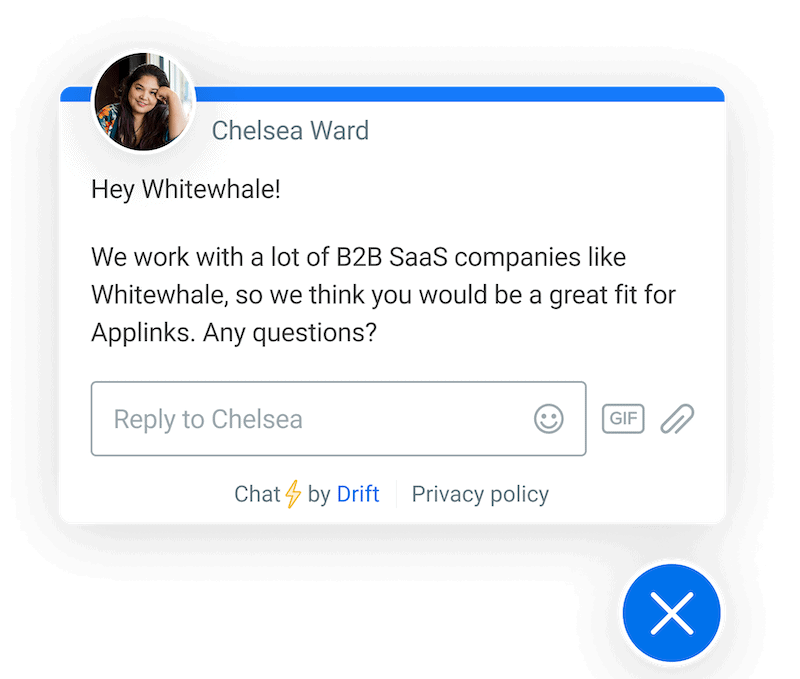
artificial intelligence bots

Predictive analytics

Marketers can capitalize on customer behavior from past activities to accurately predict future behavior and thus target potential customers with relevant promotional material at the opportune moment.

The chart below (based on data form CMO Survey) from MarketingCharts shows the popularity of predictive analytics for customer insights.

CMOs' Top Uses For AI: Personalization and Predictive Analytics - Marketing  Charts

AI In Digital Ads

This has allowed companies to not only optimize targeting but also creative applications through automated decision making processes.

These processes take into account what customers learn about themselves after engaging with certain brands, allowing for increased relevance between product offerings and target audiences. This helps customers find what they need quicker than ever before, leading to higher conversion rates across all channels including email and social media postings.

AI has already altered the way that marketers interact with their desired demographic, enabling them to craft more tailored initiatives and refine user experiences. This is only set to become even more powerful in the future as AI technology continues to evolve and reshape digital marketing.

For example, Facebook Ad’s popular “lookalike audience” feature uses machine learning to build hyper-targeted audiences of prospects most likely to convert into customers.
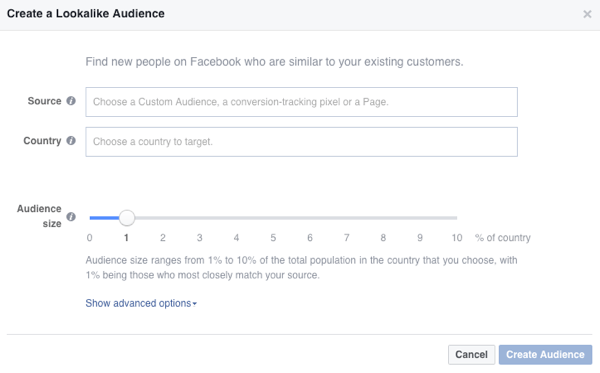
4 Ways to Build Facebook Lookalike Audiences to Expand Your Targeting :  Social Media Examiner

How AI Is Reshaping And Changing The Future Of Digital Marketing (Future Predictions)

AI is revolutionizing the digital marketing industry. Utilizing AI-driven technologies, marketers can now gain greater insights into customer behavior and develop more targeted campaigns to maximize ROI.

AI tools such as machine learning, predictive analytics, NLP and computer vision are allowing marketing teams to gain insights into customer actions that were not possible before.

By utilizing these AI technologies, marketers can create highly customized campaigns that meet the specific requirements of each customer.

Programmatic ad buying and email marketing

Here are some ways that AI is likely to change these industries:

  1. Programmatic ad buying: AI algorithms can analyze vast amounts of data in real-time to optimize programmatic ad buying decisions. For example, AI can analyze user behavior, demographics, and other data points to determine the best ad to display to a particular user at a specific time. AI can also adjust ad placement, frequency, and other factors to maximize the ad’s impact.
  2. Email marketing: AI can help email marketers personalize their messages and increase engagement rates. AI algorithms can analyze user behavior, preferences, and other data to recommend personalized products or services that a user may be interested in. AI can also help optimize email subject lines, content, and send times to improve open and click-through rates.

A flood of products that use AI technology from OpenAI and other vendors have recently hit the market promising to help marketers automate redundant tasks related to email marketing, ad buying and more. The tool below, for example, uses ChatGPT models to help marketers automate personalized email outreach.

In the future, we can expect AI to continue to refine these capabilities, becoming even more adept at predicting user behavior and personalizing marketing messages. AI may also be used to automate more aspects of programmatic ad buying and email marketing, freeing up marketers to focus on higher-level strategy and creative tasks. However, it’s also important to note that AI is not a panacea and that marketers will still need to use their judgment and creativity to craft effective marketing campaigns.

Predict future behaviors based on actual customer behavior patterns

AI does this by using predictive analytics and deep learning techniques.

For example, by analyzing past purchase history or website visits from potential customers, marketers can accurately target audiences with relevant messages at the right times throughout their journey towards conversion – leading to increased conversions and improved ROI for their campaigns.

The latest iteration of Google Analytics (GA4) has incorporated “predictive metrics” like purchase probability, churn probability and predicted revenue to help marketers predict the future behavior of their users and website visitors.
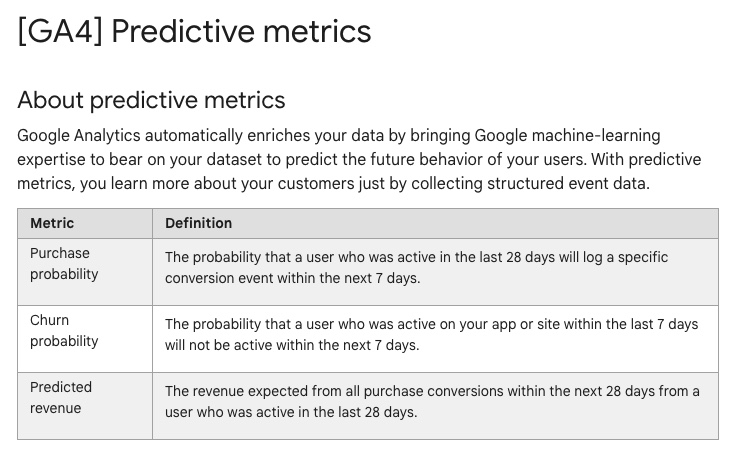
GA4 Predictive Analytics

AI is transforming digital marketing, and companies can take advantage of its potential to sales. But the first step towards doing that is to gain an understanding of marketing fundamentals. Quantic’s MBA program stay fresh, up to date and relevant. Even during times of uncertainty and disruption. You can brush up on your marketing chops by applying for our MBA here.

 
Key Takeaway: AI is revolutionizing the digital marketing industry, allowing marketers to automate mundane tasks and use predictive analytics to accurately target audiences with relevant messages. By leveraging these powerful AI technologies, companies can improve their ROI while providing an enhanced customer experience.

Best Practices

To ensure successful AI marketing strategies, there are several best practices that you should consider when incorporating AI into your marketing operations.

Step 1 – Understand how AI can be used in various areas of digital marketing

This includes email campaigns, programmatic ad buying, content creation and curation, social media postings and demand forecasting. Companies must also evaluate potential applications for AI technology within their existing marketing strategies and determine which ones would have the greatest impact on achieving their goals. Once these use cases have been identified it’s time to integrate AI tools into the process or create new ones from scratch using creative applications of machine learning algorithms.

Step 2 – Focus on collecting high quality data

When implementing an AI-based system for digital ads or recommendation engines it’s essential to focus on collecting high quality data from actual customer behavior. Relying solely on potential customers’ demographic information or purchasing habits isn’t smart. High quality data will help marketers better understand what drives customers find value in products/services so they can target audiences more accurately while increasing conversion rates across all channels. Moreover, utilizing predictive analytics can be utilized to forecast potential outcomes based on existing patterns in order to adjust strategies as needed and maximize returns over time.

Step 3 – Focus on the customer

By leveraging data science techniques such as natural language processing (NLP), companies can craft smarter bots that act as virtual assistants, providing tailored recommendations through automated conversations with customers via chatbot platforms or voice interfaces like Alexa/Google Home devices etc., thus upping overall customer service levels and strengthening the bond between brands and consumers. By following these best practices, you will be able to maximize the potential of integrating AI into your organization’s marketing operations. Now that you understand the potential of AI in digital marketing, we can now explore the question: will AI replace digital marketers?


Will AI Replace Digital Marketers?

Incorporating AI into a marketing team’s workflow can help increase campaign ROI and improve the overall efficiency of their operations. Marketers have already started using machine learning algorithms to learn from customers’ data, analyze external factors that influence buying decisions, suggest products or services they may like and create personalized experiences tailored to each individual user. Additionally, AI-powered chatbot technology can be leveraged to provide 24/7 customer service support without needing additional personnel resources. Marketing execs must remain cognizant of the swift alterations in the field to make sure they maintain a lead when it comes to using AI technologies for their plans. One way of doing that is to continue your education. Choosing a program like Quantic’s Excutive MBA is one way to stay “ahead of the curvve”. At this stage, however, to suggest that AI will supplant digital marketers in the near future would be premature and inaccurate. Humans still play a critical role when it comes to developing effective campaigns that target specific audiences while considering both short-term goals and long-term objectives set forth by business owners today. Although there is no denying the fact that incorporating AI into existing processes could lead to greater efficiency within organizations worldwide – especially when combined with human creativity – the impact of this technology on digital marketing should not be overstated.

 
Key Takeaway: AI is quickly becoming an indispensable tool for digital marketers, automating mundane tasks and providing more accurate customer insights. By utilizing machine learning methods such as deep learning, AI can gain insight from large datasets to make precise predictions and offer suitable recommendations based on past customer interactions; however, humans still play a critical role when it comes to developing effective campaigns.

FAQs in Relation to What is Ai Marketing? Use Cases Benefits & Future Prediction

What are the future uses of AI in marketing?

AI has the potential to facilitate predictive analytics, customer categorization and individualized experiences, automated content production and optimization, plus natural language processing for sentiment evaluation. Chatbots powered by AI are already being deployed by many companies to deliver personalized customer service and assistance. In the future, AI will continue to improve upon these capabilities so that marketers can create more effective campaigns tailored specifically to each individual customer’s needs.

What is the benefit of using AI in marketing?

AI in marketing offers numerous benefits, such as increased accuracy and efficiency. AI can assist marketers in pinpointing the most suitable customers to target with more accuracy than ever, providing them with individualized experiences that meet their specific requirements. AI-driven analytics also provide insights into customer behavior patterns and preferences so marketers can make better decisions about which strategies will yield the highest returns. Finally, AI technology is capable of automating mundane tasks, freeing up time for more creative activities like brainstorming new ideas or strategizing campaigns.

What are the use cases of AI for HR managers?

AI can be utilized to measure staff involvement and effectiveness through analysis of data from questionnaires, interviews, and other sources in order to discern patterns that indicate levels of employee contentment or discontent. AI can process info from polls, interviews, and other sources to recognize trends that point to worker contentment or dissatisfaction. AI can also be used to monitor employees’ activities on the job, such as how much time they spend on specific tasks or projects. This allows HR managers to better understand where their resources are being allocated most effectively and which areas may need more attention. Additionally, AI-driven chatbots could provide personalized feedback for employees when asked about their work experiences and suggest possible solutions for any issues identified. Finally, AI can be used to identify and recommend high-performing employees for promotions or other recognition.

Conclusion

With its use cases, benefits and future predictions being more apparent every day, it’s no surprise that AI will continue to play an important role in reshaping the way marketers do business in years to come. Although AI may not replace human marketers anytime soon, it certainly has the potential to revolutionize how they operate – making them smarter and faster than ever before. In the current job market, a strong resume typically requires both robust work experience and prestigious educational credentials. However, at some point, individuals may face a dilemma of whether to pursue further education or gain more work experience to progress in their careers. Luckily, Quantic’s MBA program is mobile-friendly and offers the best of both worlds, enabling students to achieve both goals simultaneously.

With Quantic MBA, you’ll gain a deep understanding of the latest AI marketing technologies and strategies, as well as practical experience applying them to real-world marketing challenges. You’ll also benefit from our flexible, online learning model, which allows you to learn at your own pace and on your own schedule. Take the next step in your marketing career by exploring what Quantic MBA has to offer. Click the link below to learn more and see how we can help you reach your full potential in the exciting world of AI marketing.
 

The Unquestionable Benefits Of AI In Accounting & Finance for 2024

AI is revolutionizing the way we make financial decisions, forecast future trends, and prepare for a future with increased automation. 

From improved accuracy in data analysis to more efficient ways of managing transactions, it’s clear that AI has immense implications for this field. 

In fact, AI in the Accounting industry is projected to grow 30% year on year from 2023-2027: according to the Mordor Intelligence statistics report. 

This blog post will explore how AI is being used in the present and its effect on financial decision-making, as well as its potential for forecasting and automating finance processes. 

We’ll also take a closer look at how businesses can utilize AI for predictive analytics and what potential opportunities exist to incorporate AI into financial operations. 

Join us now as we dive deep into understanding these innovative technologies.

How is AI used in accounting and finance?

AI is being applied to automate mundane duties, like bookkeeping, data inputting and reconciliations. This allows professionals to focus their efforts on more meaningful work that requires higher-level problem solving skills.

AI-based tools are also becoming an invaluable asset to financial professionals by helping them make better decisions faster than ever before. With its ability to quickly analyze large datasets, it is revolutionizing the way accountants work today.

Exploring the Benefits of AI in Accounting and Finance

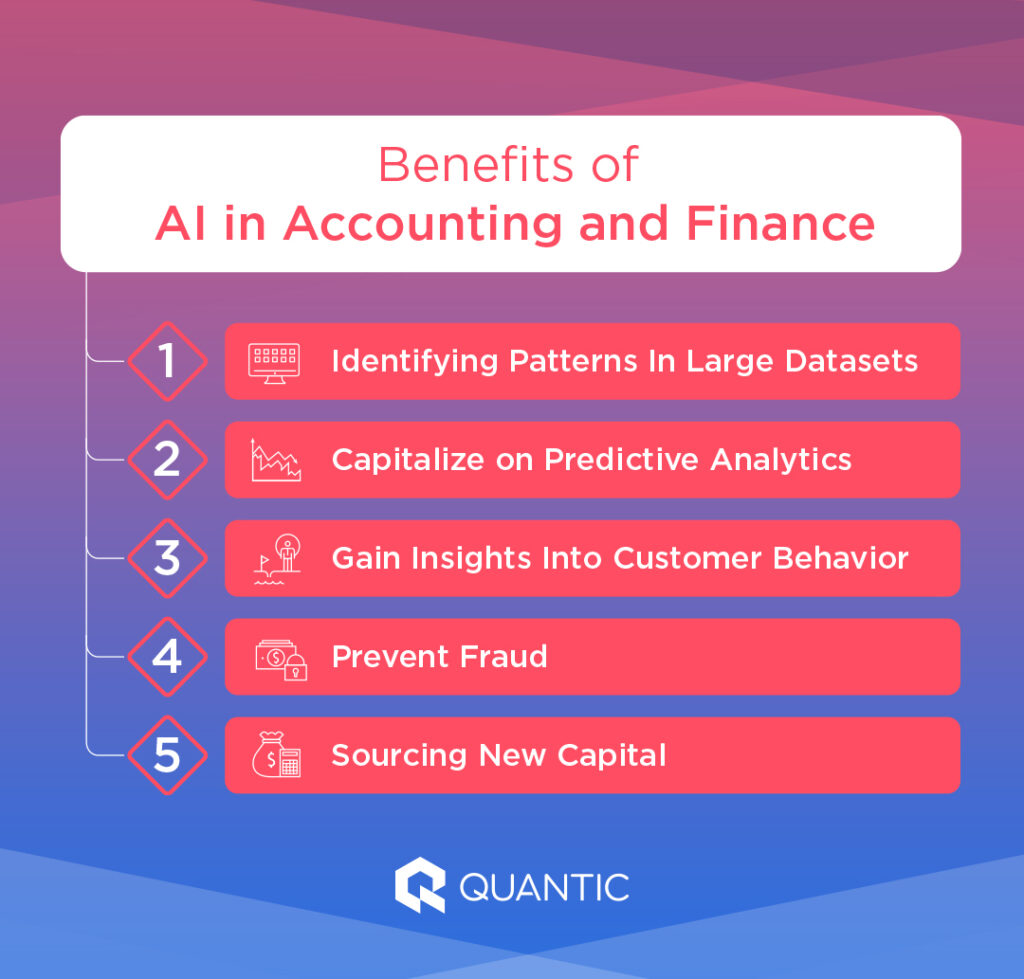
Benefit 1 – Identifying Patterns In Large Datasets

One key benefit of AI in accounting and finance is its ability to quickly identify patterns in large datasets. 

By utilizing ML algorithms and NLP technology, businesses can swiftly detect patterns or discrepancies in their financial data that may have been previously undetectable. For example, an algorithm could analyze past transactions and flag any suspicious activity before it becomes a larger issue. 

This capability gives organizations greater visibility into their finances while also providing them with the opportunity to take proactive measures if needed.

Benefit 2 – Capitalize on Predictive Analytics

Sophisticated algorithms can accurately anticipate future trends based on past data. 

By leveraging AI-driven analytics, organizations can gain a strategic advantage by being able to make informed decisions about their resource allocation and future strategies. 

Taking an active approach to utilizing advanced insights from historical information allows executives to be one step ahead of their competition. 

Executives can remain agile when dealing with ever-changing market conditions. 

Benefit 3 – Gain Insights Into Customer Behavior 

AI-powered systems can provide valuable insights into customer behavior by analyzing past transactions or predicting future outcomes based on current market conditions. 

This allows financial institutions to better understand their customers’ needs and develop strategies tailored specifically for them. 

However, in order for a company to properly utilize this data companies need someone who understands business operations as a whole. The Quantic MBA can provide this background knowledge. 

According to a study conducted by independent researchers at Stanford academics, students in Accounting and Finance at Quantic achieved similar or superior results compared to traditional MBA students from some of the world’s top 10 business schools, such as Stanford, Harvard, Wharton, and Fuqua. 

Additionally, Quantic students accomplished this feat in a fraction of the time, completing their studies over five times faster.

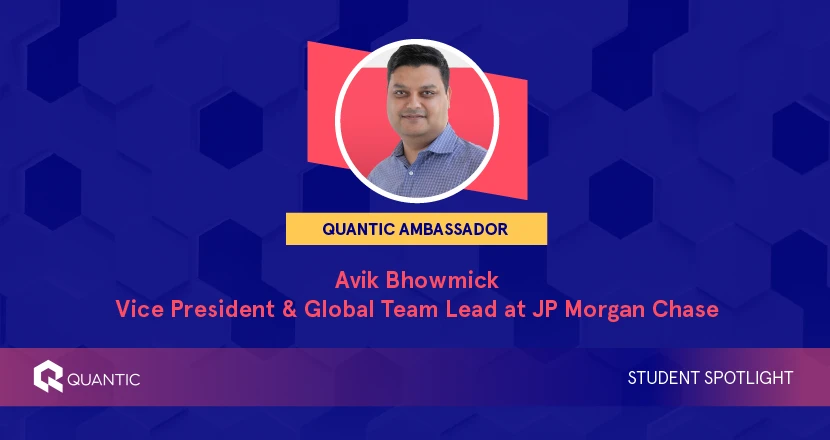
Quantic student Avik Bhowmick started his journey in software engineering and advanced into a position as VP & Global Team Lead @ financial giant JP Morgan Chase. Click here to learn more about his journey into leadership in finance, in the age of AI:

Benefit 4 – Prevent Fraud

AI can also be utilized to detect and prevent frauds by quickly analyzing vast amounts of data, allowing companies to respond promptly and reduce losses. 

By analyzing large datasets in real time, AI-based systems can detect suspicious activity much faster than traditional methods allowing companies to respond quickly if a problem arises while minimizing losses due to fraudulent activities. 

In addition, AI tools are also being used in the banking sector where they help banks assess creditworthiness of applicants through detailed analysis of their financial history thus reducing loan defaults while increasing profitability at the same time.

Benefit 5 – Sourcing New Capital

Advanced machine learning techniques have enabled organizations to access new sources of capital through automated trading platforms, allowing them to buy and sell assets from anywhere around the world without manual intervention. 

The automated trading platforms have enabled companies to optimize their profits margins and efficiency, allowing them to gain a competitive advantage in the market. 

The potential benefits provided by this technology has already started transforming industries ranging from healthcare and retailing all the way to finance and banking; leading many experts to believe that it will continue playing an even bigger role going forward.

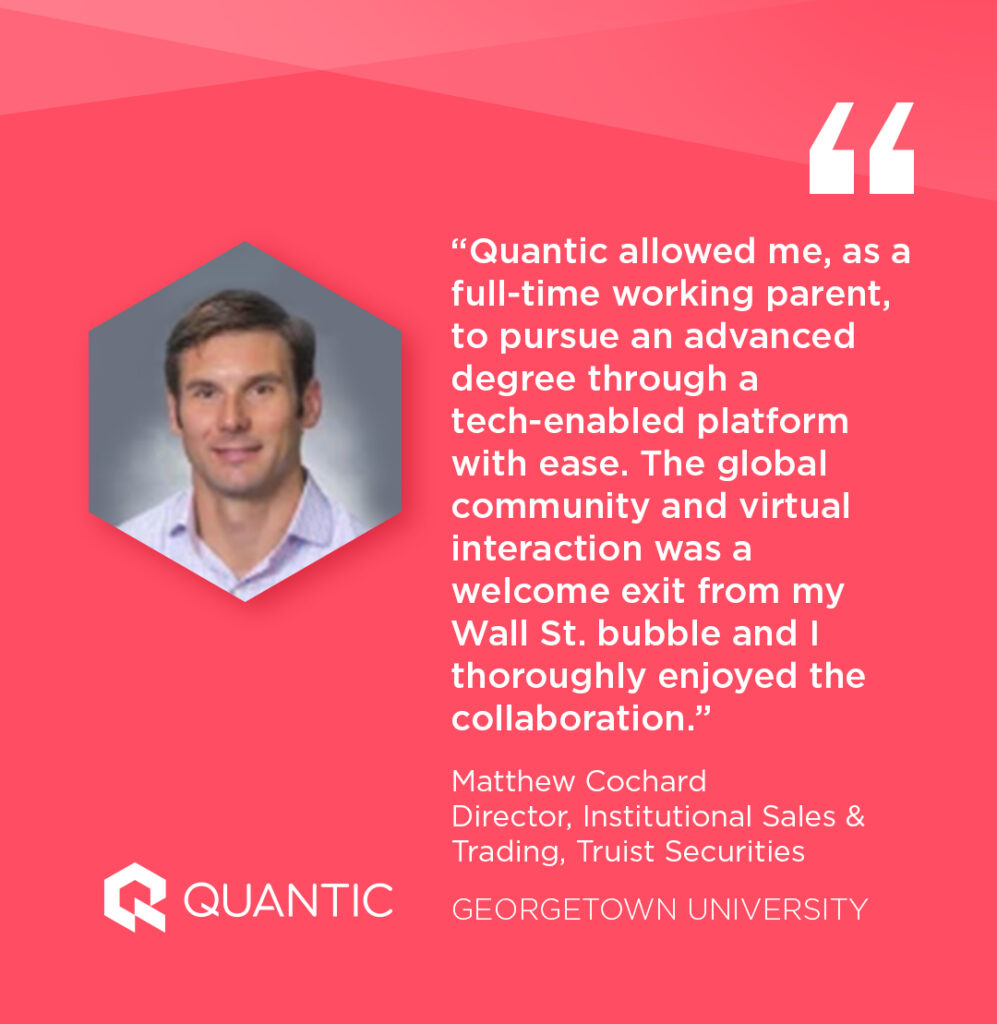
Quantic merges a technology-enabled platform with a high-quality Executive MBA program. This unique approach allows individuals like Matthew, who are smart traders, to acquire additional skills and knowledge. What’s impressive is that this can be achieved despite Matthew’s busy schedule as a full-time working parent.

Harnessing the Power of AI for Financial Forecasting

Artificial intelligence (AI) also has the potential to revolutionize financial forecasting. 

Why? Because AI can do the following…

  • Offer more precise forecasts of future market movements by utilizing data-driven algorithms and sophisticated analytics.
  • Examine prior customer conduct to identify which elements sway demand the most
  • Scour through data from various sources such as news articles, social media posts and financial statements to detect potential risks before they become issues
  • Optimize portfolios by recommending specific stocks or bonds that have higher expected returns given current market conditions and individual investor preferences (e.g. risk tolerance levels or desired return rates)

Harnessing the power of artificial intelligence for financial forecasting enables businesses and investors alike to gain an edge when making important decisions related to money. 

Ultimately, with advancing tech, these abilities will become increasingly sophisticated and provide deeper understanding of global markets.

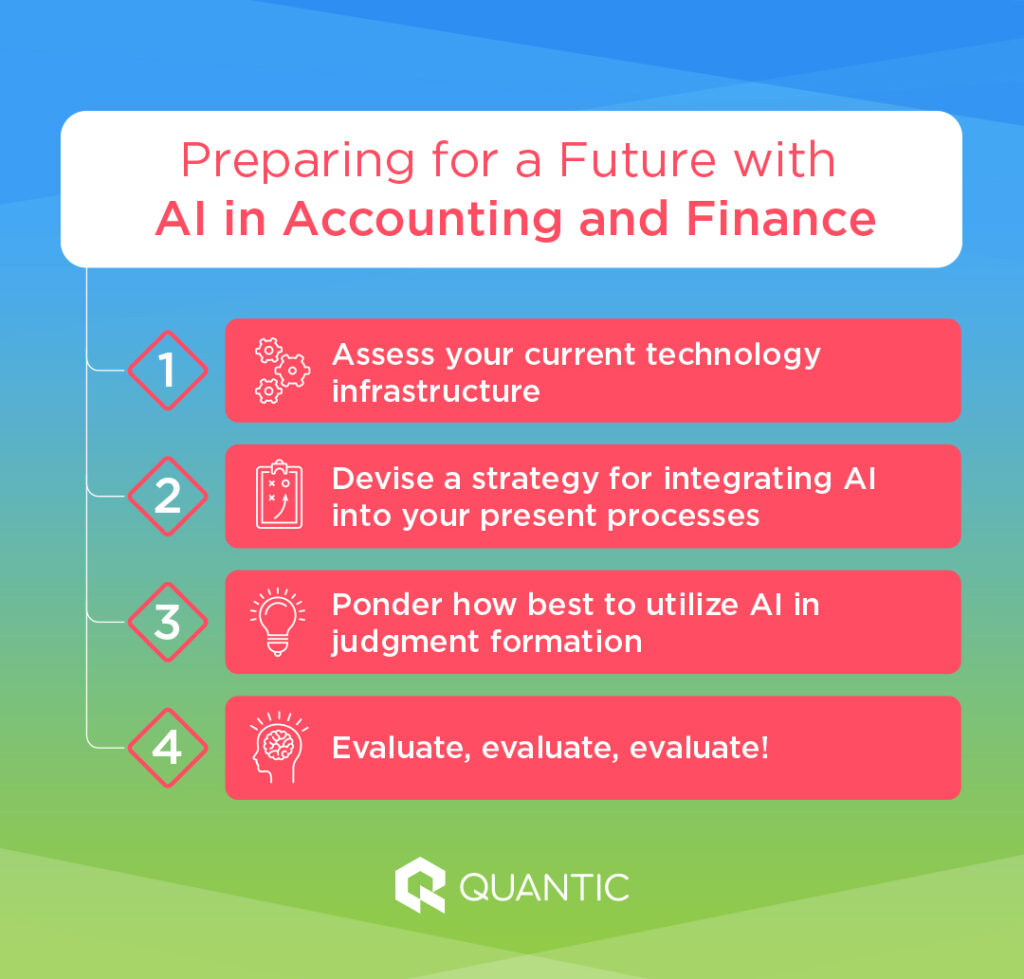
Preparing for a Future with AI in Accounting and Finance

Organizations must take proactive steps now to ensure they are prepared for the future of accounting and finance, which is increasingly automated through artificial intelligence (AI). 

Here are some tips for doing that…

Tip 1 – Assess your current technology infrastructure

Is it up-to-date enough to support AI? If not, investing in new hardware or software may be necessary. 

It’s also important to identify any existing data silos and develop a plan for breaking them down so all relevant information can be accessed quickly by an AI system. 

Businesses should devise a plan for the incorporation of AI into their operations, guaranteeing that it adheres to sector guidelines and regulations.

It is also vital to recognize any existing data silos and concoct a plan for dismantling them so all pertinent information can be retrieved expeditiously by an AI system. 

Tip 2- Devise a strategy for integrating AI into your present processes

This strategy should also ensure conformity with industry regulations and standards.

Tip 3 – Ponder how best to utilize AI in judgment formation

For example, when employing predictive analytics models driven by machine learning algorithms such as neural networks or deep learning techniques; managers ought to ascertain what criteria will inform predictions – this could incorporate historical data points or customer feedback surveys – together with set parameters around accuracy levels mandatory before action is taken on those forecasts.

Tip 4 – Evaluate, evaluate, evaluate!

Evaluate effectiveness of an AI system after implementation. To guarantee it is performing correctly and delivering the expected outcomes long-term. 

This might involve tracking key performance indicators such as return on investment (ROI) from specific projects or customer satisfaction scores from services provided by the company’s chatbot platform powered by natural language processing (NLP).

Organizations must proactively leverage AI in order to stay competitive, or else they will be at risk of falling behind.

Will artificial intelligence take over accounting?

AI can detect previously hidden correlations and insights from a variety of data sources quickly, allowing for more precise financial reporting with lower associated costs. This will lead to greater efficiency and accuracy for financial reporting while reducing costs associated with traditional methods of analysis.

But, artificial intelligence will not take over accounting. 

Accounting is a complex profession that requires an understanding of financial regulations and processes which cannot be replicated by AI. 

Furthermore, the ability to interpret data and provide insight into trends requires human judgment which AI cannot replicate. 

Therefore, while AI may help with certain accounting tasks such as bookkeeping and tax preparation, it will never substitute for the expertise of an experienced accountant who can interpret data to make sound decisions.

Conclusion

The possibilities of artificial intelligence in accounting and finance are endless. AI has the capacity to completely transform how decisions are made financially, prognostication and even business operations as a whole. To remain competitive, professionals must stay abreast of AI’s progress to leverage its potential for their organization’s future success.

Transform your career with Quantic School of Business and Technology‘s cutting-edge online education programs that explore the potential of artificial intelligence in accounting and finance. Join us to gain the knowledge you need to stay ahead in this rapidly changing field!

3 Ways Quantic Helped Me Achieve Greater Success in Life

Special thanks to MBA graduate, Jeffrey Chai Zhi Yang, for authoring this piece.

First of all, I am very thankful for the opportunity to be a part of the Quantic community. Even now, I can remember vividly the moment I received the letter of acceptance into the Quantic MBA back in March 2021. It felt surreal, knowing that this is a global MBA program where many talented individuals from other parts of the world would be giving their best shot for enrollments.

Time flew really quickly and I was able to complete the program by 2022 – in just a year’s time!

The Quantic MBA has given me a very enriching experience. Beyond the program, I can truthfully say that it has transformed my life for the better; not just my career, but personal development as well. Here are just a few of the ways Quantic has helped me achieve greater success in life.

  1. New Domain Knowledge in Diverse Areas
    The Quantic MBA has certainly helped me accelerate my professional growth through gaining and deepening knowledge in many areas – notably finance, innovation, analytics, and most importantly organizational strategy and leadership. As someone who majored in mechanical engineering for his bachelor’s studies, this knowledge is both insightful and essential for performing better in my job. Today, I work as a Product Manager which requires me to constantly interact with different stakeholders from various corporate functions within the company. I was able to crystallize their concerns more effectively during our product discussions, and propose solutions that are more contextualized to their business/operational needs. 

    The program has also prepared me to be more confident when it comes to leading conversations about product development (strategy, roadmap, resource planning, and metrics mapping) and also trailblazing ground-level engagement initiatives with my end users in the hope of getting any new user sentiment to improve my product.
  2. Better Work-Study Balance and A More Effective Learner
    The online platform uses bite-sized interactive lessons that are made available on both web-browser and mobile application! The latter was certainly a life saver for me as I was able to learn and catch up on lessons anytime, anywhere: waiting times while taking public transport; short breaks in between work meetings; or before I turned in to bed on some days, I would spend 1 hour or so to review the past week’s curriculum. Such flexibility allows me to manage my work-study schedule with minimal compromise on either of these commitments. 

    Furthermore, because of how I attended these lessons on-the-go during my idle times, which are usually very short in period, I have somehow trained myself to pick up any new information much faster and effectively. This is a bonus that I did not expect out of this MBA program, but is worth mentioning as it really helped me in many aspects of my life, as far as learning is concerned.
  3. A Well-Rounded Individual with Immense Global Exposure
    The fact that Quantic has a very strong student community is what I felt stands out the most among all the educational programs that I have attended thus far. For the group project assignments, everyone was given the freedom to form their own desired teams, and that would mean any like-minded students that they wished to work with across the globe. 

    There is also a central messaging platform set up for the entire Quantic community where anyone could interact with one another – sharing articles, blog posts, and even exchange innovative business ideas, etc. Such modes of cross-cultural interactions helped me become more confident as I had to step out of my comfort zone to articulate and present my thoughts during the engagements. 
Man wearing glasses and smiling while typing at an HP laptop computer, sitting on a blue chair in front of brown wooden cabinets with a world map and an image of a boat.

Quantic is also proactive in keeping the student and alumni communities engaged by organizing frequent meet-ups and speakers’ series with distinguished guests from influential companies. I personally benefited from these sessions as they helped me expand my professional network, and also provided avenues to learn about industries I was interested in for paving my future career path.

In summary, the Quantic MBA is an exceptional learning journey that has transformed my life, and my way of thinking. The program is undoubtedly challenging and intensive, but at the end of the day, it has rewarded me with a mastery of both hard and soft skills.

To the prospective students who are reading this and are still considering if the Quantic MBA is the one for you:

Have an open mind to learning new knowledge and skills. Never underestimate your own potential and don’t be afraid to take that first step to venture into something new or unfamiliar. It is part of the learning process.

Jeffrey Chai Zhi Yang, Quantic MBA

MBA in the Pharmaceutical Industry – Do You Need One? 

It’s no secret that the pharmaceutical industry is a lucrative one. With the right skills, you can go far. However, it’s also easy to become trapped in your current position with no chance of advancement in sight. This is a struggle many young professionals face today. Thankfully, there are options.

Pursuing the right MBA program can help you advance your career and get you into that leadership position in the pharmaceutical industry that you’ve always wanted. However, what is the right program? What about an MBA in pharmaceutical management or maybe healthcare management? Is it really necessary? Are there alternatives?

Well, that’s exactly what we’re going to look at today. We’re going to explore whether you need an MBA with a specialization in pharmaceuticals to advance your career in this industry. 

But first, let’s look at your specialization options for your MBA and what they can do for you. 

Pharmaceutical MBA Types 

There are a variety of pharmaceutical MBAs you can choose from to further your career, and we’re going to cover a few of them so you don’t walk away from this article confused.

Here are a few pharmaceutical MBA types you can consider: 

  • Pharmaceutical Management – A popular pharmaceutical MBA, pharmaceutical management students focus on developing the skills to manage and administer businesses in the pharmaceutical industry. It combines the study of basic and pharmaceutical sciences as well as marketing and management courses. 
  • Pharma Marketing – Whereas pharmaceutical management courses include marketing, pharma marketing focuses on it. Students in these programs learn the necessary skills to market drugs and medical devices to great effect. As such, it’s typically pursued by those seeking to become marketing specialists in the pharma industry.
  • Healthcare Management – Healthcare and pharmaceuticals are close to one another in the industry. This MBA specialization focuses on how to manage and administer healthcare systems in both the private and public sectors.

And these are only three of the specializations you can pursue with your MBA. You no longer have to wonder what is an MBA in pharmaceutical management or how it differs from pharma marketing.

Mind you, a typical pharma MBA, regardless of specialization will require at least 2 years to complete, and require them to adhere to a strict schedule of in-person courses. 

Contrast this with Quantic’s MBA program which can be completed in as little as 15 months. What’s more, a Quantic MBA can be completed remotely and flexibly so as to not interrupt your professional life. As such, it offers a strong alternative to other MBA programs. 

Is an MBA in Pharma a Good Option? 

As with any choice in life, you’ll need to weigh the pros and cons of an MBA in pharma.

Let’s start with the positives. Of course, an MBA in pharma will provide you with the necessary business and financial knowledge to understand the inner workings of a pharmaceutical business. This includes the necessary soft skills such as communication and leadership to perform well in the cross-company collaboration required for a healthy business. That’s not to mention that MBA holders often earn higher salaries than their peers. 

However, this all comes at a cost. Your typical MBA requires a serious time commitment of 2 years of in-person classes and time is taken off to attend said classes. As such, pursuing a traditional MBA can be similar to hitting pause on your professional life – something the young professional often avoids. And there is the cost. According to Investopedia, the average program can easily cost $40,000 per year. That’s $80,000 to complete the entire degree.

With this all in mind, whether we can call an MBA in pharma good highly depends on the needs of the person seeking it out. It offers quality education to become a leader in your company. However, a pharma MBA also typically comes at a prohibitive cost and time commitment.  

MBA Jobs in the Pharmaceutical Industry

So, with that in mind. What can you do with a pharmaceutical MBA? That’s to say, what is the scope of an MBA in pharmaceutical management? After all, the primary reason to pursue this degree is to advance in your career. Where can you advance to? What kind of MBA marketing jobs are there in pharmaceutical companies?

To answer that, take a look at these pharmaceutical management jobs available to MBA pharmaceutical graduates. 

  1. Pharmaceutical Purchase Manager 
  2. Quality Assurance Manager 
  3. Regional Healthcare Manager
  4. Senior Project Manager
  5. Statistics Director
  6. Drug Development Director
  7. Director of Regulatory Affairs
  8. Senior Consultant
  9. Senior Quality Control Analyst 
  10. Health Care Manager

MBA in Pharmaceutical Management Salaries in the US 

We briefly mentioned the high salary that an MBA in pharmaceutical management can bring before. So, let’s explore that further and how that salary compares to other MBA specializations. 

mba pharma slaries
MBA SpecializationAverage Salary*
Pharmaceutical Management Salary$125,000
Pharmaceutical Sciences$137,000
Pharmaceutical Marketing $110,000
General MBA$94,000

*Salary Ranges Sourced from PayScale. 

Pharmaceutical Recruiters 

Now, when you’re looking for a high-paying position in pharmaceuticals, you’re likely looking to work for the biggest companies in the pharma industry. To that end, consider pursuing your MBA with Quantic. Quantic graduates work with many of the top pharma companies today. 


Quantic MBA graduates have been hired by:

  • Pfizer
  • Roche
  • Biogen
  • AbbieVie
  • Novartis
  • Merck
  • DSK
  • Sanofi
  • Takeda
MBAs in Top Pharma

But your choices are certainly not limited to these companies. There are many more pharmaceutical companies looking for talented MBA graduates.

These include: 

  • Reaction Search International 
  • Advanced Clinical 
  • Allen-Jeffers Associates
  • The Bandish Group
  • Beckford Search Partners
  • Bio-Partners and Lennon Search Associates

Best Online MBA for the Pharmaceutical Industry 

When you’re looking for the best MBA for your career in the pharmaceutical industry, you should take into careful consideration the potential downsides of specialized MBAs such as those in pharmaceutical management. As we discussed, these programs are costly and time-consuming – requiring you as a student to make a significant investment. Even then, it will take time to see return on your investment pursuing a traditional MBA.

The same can be said of EMBA in pharmaceutical management, perhaps even more so. 

An MBA in pharmaceutical industry management does offer the specialized knowledge to work within the industry and take on leadership roles. However, it has the same problem as pharmaceutical management – cost, time, and overall risk on ROI.


So, in light of this, consider Quantic’s MBA program to help you find your dream job in the pharmaceutical industry. With Quantic’s flexible and innovative approach to advanced education, you’ll enjoy an accelerated 15-month education that’s both cheaper and more effective than other MBA programs.

66% of Quantic graduates report receiving a promotion during their first year out of the program. This is because Quantic’s MBA is designed for early career professionals looking to get ahead. Quantic provides exactly that with an award-winning curriculum that combines interactive technology and collaborative group study.

Plus, you don’t have to put your career on pause with Quantic. You enjoy a quality education alongside a cohort of fellow talented professionals via our remote learning model so you can approach your education on your terms.  

So, apply today to get a Quantic leap on your career.

Meet Avik Bhowmick: Vice President and Global Team Lead at JP Morgan Chase

Quantic Advocate Avik Bhowmick is currently a VP and Global Team Lead at JPMorgan Chase. His passion for education and strong work ethic drove him to overcome many personal challenges in his life. With a growth mindset and a dedicated thirst for knowledge, Avik tutored local children in order to fund his schooling. Graduating at the top of his BSc class, Avik launched his career at international tech firm Cognizant; however, his academic journey was far from over. First, he went on to pursue an MS in Software Engineering. Then, in order to lead more confidently with a well-rounded view, he pursued an Executive MBA degree from Quantic.  He states that this allowed him “to achieve my elusive dream for pursuing education from a top business school along with such an accomplished group of classmates.”

“Since moving to the US, I have wanted to earn an MBA, but family and job responsibilities have made it difficult. It’s the Quantic style of learning that finally paved the way for me to achieve my goal. Looking back at my academic achievements now, I feel quite accomplished.”

We asked Avik about his experience studying at Quantic. Keep reading to see what he has to say.

What motivated you to pursue an MBA?

My main reason in pursuing an MBA is to help me be more confident as I grow in my leadership role.

Why did you select Quantic?

In my critical and demanding job function, I needed flexibility if I were to pursue higher education. Quantic effectively solves this dilemma for busy professionals, using a smart use of technology and modern digital channels.

How would you describe your experience with Quantic?

Quantic delivered a career transforming experience for me.

As you consider your Quantic learning experience, what’s been most impactful, most beneficial to you, most valuable to you?

In my job role, I didn’t quite understand the full spectrum of the business that I was helping enable through technology. Quantic delivered solid foundational knowledge that I am able to apply to my work to create enormous value for my team. It’s very selective for EMBA candidates, which resulted in such a powerful professional network. Lastly, the digital app-based learning spoiled me so much that I find it difficult to go back to video-based remote learning models.

What most interests you about being a Quantic advocate?

Continuous association with this organization.

Meet Renee Fishel: Engineering Manager at IBM

Renée Fishel’s initiative has been a driving force throughout her career. 

For women in male-dominated industries, certain tools are critical in order to stand out and progress through your career. To Renee Fishel, Engineering Manager at IBM, the quintessential tool is an MBA degree. 

The Quantic MBA encompassed her passion for inclusivity, diversity, and tech innovations. “After reaching out to many alumni and current students of the program, I was happy to hear that they unanimously informed me of its effectiveness, the wide-networking opportunities, and the engagement platform on which the program was built. All those elements put together convinced me that Quantic was the program for me.”

Renee knew that she had the technical expertise, but the MBA was an instrument that legitimized and formalized her leadership instincts and differentiated her from her colleagues. She gained the confidence to put herself forward for promotions and she advises other female engineers to be confident in the pursuit of managerial positions earlier in their careers. 

When Renée’s not working with incredibly brilliant teams at IBM, she’s mentoring Women In Tech, speaking at conferences (such as a recent Quantic Conference), and writing content for TheHealthyMBA.com. In addition to her MBA from Quantic, she is also a CSM and PMP. 

She emphasizes the role of leadership in working to build diverse teams and foster a more inclusive environment.

Continue reading to learn more about Renée’s career and experience at Quantic.

What motivated you to pursue an MBA?

I was exploring how to further advance my career and when looking up job descriptions of roles I wanted to pursue, many of them said that an MBA was preferred. That was the catalyst that motivated me to explore MBA programs.

Why did you select Quantic?

For a long time I was skeptical about getting an MBA due to the sheer cost of it. Additionally, the idea of needing to quit my current job to pursue a degree seemed counter-intuitive. Knowing Quantic was flexible enough to let me keep my day job and use what I was learning on a daily basis within my current career was a real ‘eureka’ moment for me. When checking the cost, I couldn’t believe how reasonable it was, especially considering what I was gaining.

I also wanted to make sure that this program was competitive and offered a similar curriculum to what I would get at a more traditional institution. After reaching out to many alumni and, at the time, current students of the program, I was happy to hear that they unanimously informed me of the effectiveness of the program, the wide-networking opportunities and the engaging platform that the program was built on.

All of those elements put together made me convinced that Quantic was the program for me.

How would you describe your experience with Quantic?

It was great. I loved the projects which got me connected with other members of my cohort and helped me learn from them while reinforcing how much I bring to the project as well. I especially liked the adaptability of the platform.

I also really like the opportunities to speak with the professors to prepare for upcoming exams.

Overall it was an amazing experience. I definitely spent a significant amount of time studying, preparing the capstone project with my team, and working on case study projects; however, I can’t imagine having been able to do that with any other program and still maintaining a work/life balance. I know for a traditional program, I would have needed to quit my full time job to make time to attend in-person/virtually scheduled lectures, as opposed to a self-paced learning structure.

Quantic was an experience I will always be grateful for.

As you consider your Quantic learning experience, what’s been most impactful to you?

As I was going through the Quantic program and learning different concepts and strategies, I noticed myself getting more confident to join conversations with others that previously I would have felt unqualified to be in. I started chiming into more strategic discussions, providing my opinion and insight and really focusing on the business value behind the work.

It was definitely acknowledged by my management that I was working very hard to achieve a level of recognition through my work and outside education. When I originally asked about getting a promotion to the position I wanted, I was told it was common practice within the company to have to wait for 2 years or more to fully prove yourself before having that conversation. I was given additional responsibility after just a few months in the company, and then moved to a more strategic role just after the year mark. Then a few months later, I was promoted to a manager and now manage a team of 10. That all happened in less than 1.5 years.

I think the greatest gift that Quantic gave me was the understanding of how companies define success and the tools needed to get there. That helped me position myself in a way that showed I was on a path to make my team and my company more successful.

What most interests you about being a Quantic advocate?

The ability to guide others on their continued education journey. I’ve already spoken to a lot of people through LinkedIn answering their questions on why I chose Quantic and what I gained from the program. I suppose in a way, I was already acting like a Quantic advocate without realizing it. I love promoting a program that gave me so much. I also see such a bright future for Quantic that I love the idea of being there alongside its journey to greatness.

Do You Need an MBA for Consulting? A Comprehensive Guide

An MBA is one of the most and lucrative popular post-graduate degrees for consultants. However, do you really need one? What are the benefits? Why would you pursue an MBA if you’re already a consultant? 


These questions are exactly what we’re going to answer today. We’re going to looking what an MBA does for a consultant, how it affects their pay, and how they can go about obtaining their MBA. For additional information from real people, join the conversation on the best MBA for consulting. Reddit often discusses the subject.

But first, let’s look into exactly what consulting is. 

What is Consulting? 

Consulting is a very loose term. So, it’s little wonder the exact definition depends on the context. However, consulting is essentially providing business advice and guidance on various business topics that range from marketing and IT to overall corporate strategy.

Consultants define problems and opportunities for a business and help plan implementation strategies and more across the company. 

How Does an MBA Help Consultants? 

An MBA is a post-graduate degree that gives you holistic management knowledge that stretches across an entire business. MBA graduates also learn and develop vital soft skills and leadership principles to prepare them for a top-down approach to business. Plus, MBA holders leave the program with a professional network and a diversified perspective on business as a whole. 

All of these are beneficial when you’re considering a career in consulting. 


Here’s a quick list of the things you’ll learn and gain from an MBA program, and how they directly help consultants: 

  • Strategic Thinking – If you’re going to help solve a business’s problems, you’ll need to be able to think strategically. MBA programs teach their students how to develop this skill to solve complex problems for themselves and the businesses that employ them.
  • Project Management – It’s one thing to tell a business they have a problem, but it’s another thing entirely to help them solve it. Project management skills empower consultants to advise their clients on the projects they undertake to improve their businesses.
  • Negotiation – Sometimes a consultant will face a conflicting situation that will require them to mediate a communication breakdown or another such complication. MBA programs provide students with entire courses dedicated to the art of negotiation.
  • Knowledge of Disruptive Trends – MBA programs will help you develop your knowledge of current trends and what to watch for in the future.
  • Communication – An MBA will strengthen your ability to work with and lead diverse teams by developing your communication and presentation skills.
  • Diverse Perspective – MBA graduates learn how to develop and draw from diverse perspectives to solve complex problems. This is an essential skill for any successful consultant.
  • Professional Network –   The key to consulting is building trust with your clients, and that means building a meaningful reputation and network. 

Why MBA for a Consulting Career?

And that list is only a few of the ways an MBA will benefit a consulting career.  As such, MBAs are remarkably useful to consultants as it builds on all of the necessary skills they will need. What’s more, an MBA will allow you to specialize further in your field with options to pursue concentrations, which we will cover in detail later on. 

Overall, an MBA provides a wide base of business knowledge that consultants can leverage throughout their career. You will also learn how to lead teams and consult with confidence, using strong communication and presentation skills.  

Quantic’s MBA program provides all of this and more. Consider joining our 17,057 students and Alumni that enjoy a 66% rate of 1st-year job promotion rate and an average 21% 1st-year salary increase. 

MBA Consulting Salary 

Speaking of salaries. There is a significant difference in pay for consultants with and without MBAs.

Here are the salary ranges of undergraduate and master’s hires compared to MBA hires at the top consulting firms:

  • Undergraduate Consultants: $77,000 – $100,000
  • MBA Consultants: $145,000 – $175,000
average consulting salary

Do You Need an MBA for Consulting? 

From what we have discussed thus far, you know that an MBA is not strictly necessary for a career in consulting. However, you also know of the benefits. An MBA provides a marked salary increase and the tools you need to be a better consultant.

However, as we just said, it’s not strictly necessary.

The people who would benefit the most from an MBA are those looking to work for the best consulting firms in the business. Even if you don’t land the job out of the gate, an MBA will build you up and get you started on the path. The increase in pay and marketable skills don’t hurt either. 

If you want to hear firsthand how Quantic’s MBA provides students with the tools to make a bigger impact with their existing skill set, check out this video. 

[Embed Video]

How an MBA Helps You Prepare for Consulting 

As we discussed before, when you pursue an MBA, you gain more than just a broader understanding of how a business functions. It prepares consultants with the skills to improve their trust and credibility among their clients. What’s more, you gain a network of similarly minded and ambitious fellow alumni to reach out to throughout your professional career. 

MBA vs JD for Consulting 

For some who enter consulting, they’re torn between pursuing an MBA or JD for their career. Not everyone can pursue both. That’s why we’re going to take a quick look at who should pursue one over the other.

An MBA prepares you for consulting in business. This includes management, entrepreneurship, and business consulting. It is broad reaching and flexible. 

A JD, on the other hand, should be pursued only by those who wish to focus on legal consultation. Management consultants with JDs use legal knowledge to help their clients. Contrast this with the MBA’s holistic business approach which does not include this legal component. 

Is an MBA Worth it for People Already in Consulting? 

Even if you’re already a consultant with multiple years of experience, an MBA will still be worth it for you. Only those with more than 10 years of experience would need to stop to consider the returns.

As an established consultant, there are many benefits an MBA can provide. 

One is the networking opportunities. Pursuing an MBA will allow you to revitalize or expand your network. This will expand your reach and reputation in the professional world. 


Another is your opportunity to update your knowledge. Business is constantly changing. A consultant absolutely needs to stay up to date with the latest developments. Pursuing an MBA will allow you to do exactly that, and prepare you with the skills to stay on the edge of new developments in business.

And last, and certainly not least, an MBA can lead to a meaningful boost in your salary. 

What MBA Concentration is Best for Consulting 

The beauty of an MBA program is the diversity of concentrations. Each allows a student to focus on the niche part of the industry they wish to pursue. This specialization is appealing to employers and useful to students. 


Here are some of the best MBA concentrations for consultants.

  • Corporate Strategy – A concentration in corporate strategy helps you discover how companies create value, develop portfolios and work with other organizations. This provides consultants with an excellent background in inter-business dealings.
  • Entrepreneurship – The entrepreneurship concentration teaches you how to build a company from the ground up. As a consultant, this gives you valuable insight to help start-ups and venture capital
  • General Management – This middle-of-the-road concentration gives you a broad overview of business functions, focusing on finance, leadership, and data analysis. 
  • International Management – Enterprises today are more global than they’ve ever been, and the international business community is becoming more connected every day. An MBA in International management equips you with the knowledge to consult for worldwide enterprises.
  • Project Management – As we mentioned before, consultants should know how to implement the advice they give their clients. As such, a concentration in project management allows you to aid in organizational efficiency for industries such as information technology, construction, and manufacturing.

What Consulting Firms Look for Post-MBA

Unless you already worked as a consultant before you got your degree, post-MBA is the time to start looking for a position. Consulting firms are looking for candidates with certain qualities, and these can vary between companies. These include leadership, initiative, and communication. You will have developed these skills during your MBA program. 

Do Consulting Firms Pay for MBA?

Many of the top consulting firms pay for their employee’s MBAs. In fact, this is one of the best ways to earn an MBA without any cost to yourself. MBA holders are considered valuable and worthy investments in many firms.

Here are a few firms that offer sponsorship options:

  • Deloitte
  • PwC
  • KPMG
  • McKinsey

It is important to note that most firms, such as EY-Parthenon, do not sponsor MBAs. However, if your company is among them, you still have options.


If your company doesn’t offer MBA sponsorship, you’ll have to build a case. Consider the revenue of your company, the education of leadership, and what an MBA holder would bring to the team. Compile this information, find a program that provides the skills that meet your company’s needs, and prepare a training request letter.

With a convincing pitch, you may well find your employer amicable to paying for your MBA. 


Even then, Quantic’s MBA program offers tuition assistance and even tuition reimbursement for the right candidates. 

Quantic – The Best MBA Program for Consulting!

Consider Quantic when pursuing an MBA for consulting. We offer a unique and innovative MBA program that provides the student with a mobile-first active learning experience. What’s more, Quantic sparks a connection with fellow professionals with a network-first approach to build a meaningful network.

Quantic provides everything in an MBA that a consultant could ever need.

So, sign up with Quantic today to begin your MBA and become a better consultant. 

8 Incredible Careers You Can Get With an MBA in Finance 

The challenge for any young professional is to decide where they will take their career, and how they can do that. For the financially minded, an MBA in Finance cannot only provide you with the skills to excel in the field of finance but to understand the options available to you as a finance MBA graduate. 

That’s why today we’re going to take a look at 8 amazing career paths available after an MBA in Finance.

But first, let’s discuss precisely what an MBA in Finance is and what you can expect.

What is an MBA in Finance? 

An MBA in Finance is exactly what the name implies, a master’s in business Administration degree that includes specialized course material directly related to finance. The core course material is similar to other MBAs, however as the student proceeds with the degree, their coursework becomes increasingly focused on finance. Thus, an MBA in finance creates a well-rounded graduate ready to lead others in the finance industry.

An MBA in finance is not to be confused with a finance concentration MBA. The primary difference is that rather than focusing on finance as a profession, a finance concentration is a focused look at how money moves within an organization and throughout the economy. This produces a person well versed in how money works in business, but not how money works as a business. 

A finance concentration is therefore best for those looking to understand cashflows and how the economy affects a business.

An MBA in finance, on the other hand, is best for those looking to make a profession of how this money works, and be able to utilize that understanding to achieve their professional goals. 

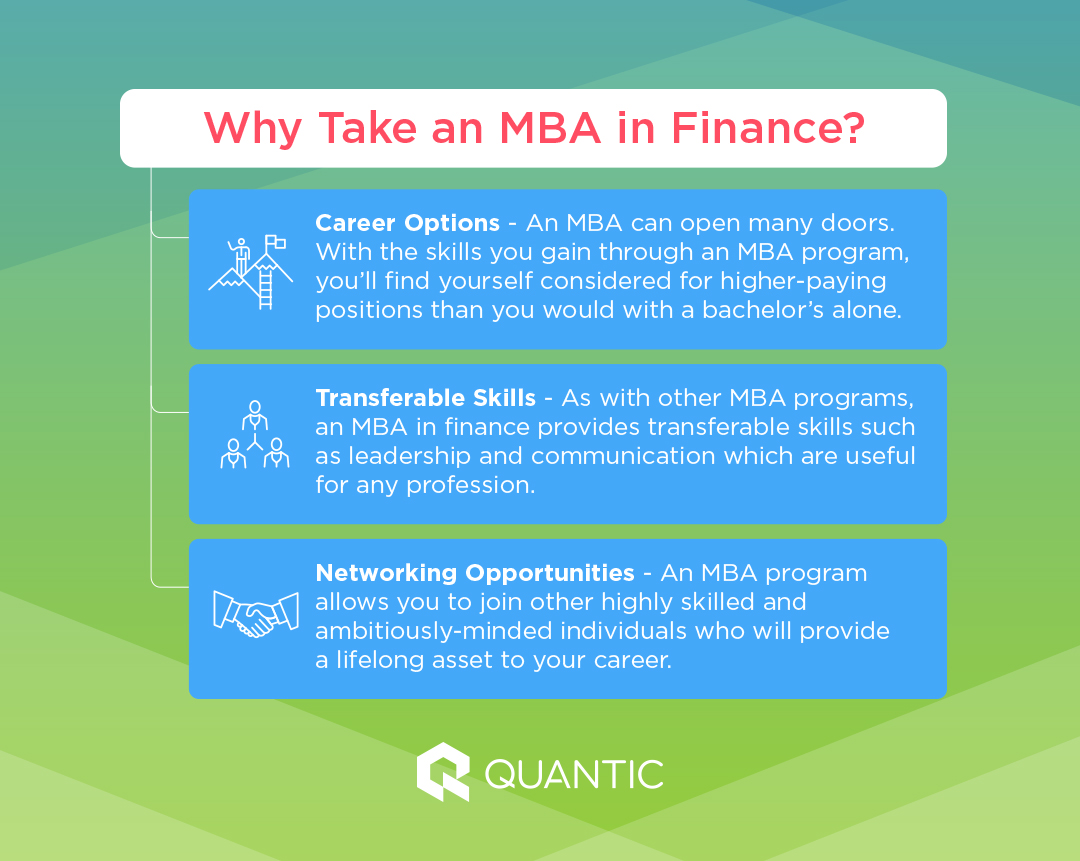
Why Take an MBA in Finance? 

Why take an MBA in Finance?
  • Career Options – An MBA can open many doors. With the skills you gain through an MBA program, you’ll find yourself considered for higher-paying positions than you would with a bachelor’s alone.
  • Transferable Skills – As with other MBA programs, an MBA in finance provides transferable skills such as leadership and communication which are useful for any profession.
  • Networking Opportunities – An MBA program allows you to join other highly skilled and ambitiously-minded individuals who will provide a lifelong asset to your career. 

How Many Jobs are Available in Finance? 

There is a persistent need for finance professionals as the role extends across industries of all kinds. Every major enterprise employs financial professionals to make the number work.

Jobs in finance are expected to grow by at least 7 percent between now and 2031, according to the U.S. Bureau of Labor Statistics, for a total of 715,100 new jobs over the next decade. Accounting for workers expected to leave their occupations either for retirement or other career paths, this number grows to 980,200 openings each year. So, there are plenty of opportunities in this field. 

MBA in Finance Career Path 

A natural question when pursuing a career in finance is “What kind of jobs can you get with an MBA in finance, and where do I go from there?” Well, we’re going to answer exactly that by exploring the career scope of an MBA in finance.

Let’s start by looking at a typical career path.

  1. Junior Analyst – Performing security analysis of stocks and bonds.
  2. Senior Analyst – Focusing on specific industries and sectors, analyzing important financial data, and developing relevant research reports.
  3. Investment Manager – Overseeing investments, buying and selling securities based on data
  4. Senior Investment Manager – Same as investment manager, but entrusted with overseeing and managing considerable sums of money.
  5. Chief Financial Officer – Managing an entire organization’s financial needs. 

MBA in Finance Salary Range 

Naturally, the next question you will ask is “What do finance jobs pay?” After all, salary is an important motivator for any job seeker, and it’s on the mind of many young professionals. So, let’s take a look at the salary you can expect 

MBA in Finance Salary Range
Salary Range*
Average Salary for MBA in Finance$101,000
Entry Level MBA Finance Salary – Financial Analyst $53,000 – $93,000
Mid-Level MBA Finance Salary – Finance Manager$76,000 – $134,000
Highest paying MBA Finance Salaries – Finance Director $91,000 – $178,000

*Salary Ranges Sourced from PayScale. 

8 Incredible Careers You Can Get With an MBA in Finance? 

An MBA in finance can open many doors for a young professional, no matter where they are in their development. The potential is limitless, from getting a position as a financial accountant to an investment manager to even the chief financial officer of a major enterprise.

Check out this MBA finance job list for the career you dream of. Don’t be tempted to skip around the list, you may miss a position you never knew you wanted.

careers you can get with an mba in finance

Financial Accountant 

The career of a financial accountant is a remarkably rewarding career for those skilled in and passionate about communication, attention to detail, and possessing an analytical mindset. Whether you’re interested in working in the public or private sectors, this career path has something for you.

In this career, you can expect to spend your time preparing financial statements and reports while advising organizational leadership on investment strategies. Financial accounts are responsible for analyzing the economic stability of a company and providing thorough financial information to internal and external entities. The bottom line, you’ll be the person that makes the finances work. 

To get into this career, you’ll need to at least begin with a bachelor’s degree in a related field such as finance. However, progressing in this field is another story entirely. You will need to complete several years of entry-level experience before advancing to a better-paying position such as management accountant or financial analyst. Alternatively, career advancement can be expedited by furthering your education with a CPA certification or pursuing a finance MBA. 

According to Salary.com, the typical salary for a financial accountant falls between $53,810 to $65,140. 

Financial Analyst 

In a similar vein, financial analysts evaluate investment opportunities that help organizations make the best investment decisions possible. This is true no matter what industry you enter, whether that be real estate, nonprofit organizations, or even government. Regardless of where a financial analyst works, they’re essential assets to any serious organization.

It’s perfect for anyone looking to perform meaningful financial work, and enjoy diving into financial data to guide investments

To become a financial analyst, you’ll need a bachelor’s in a relevant field. Then accrue work experience in a position such as a financial accountant. To best advance into a financial analyst position, you should also consider obtaining a relevant certification such as the Chartered Financial Analyst (CFA) credential.

From there, the best way to progress further in your career is to continue building your experience, and taking your education to the next level. An MBA, for example, provides a student with everything they need to know about a business with a top-down view – an essential skill for senior financial positions. 

According to Payscale, a financial analyst’s salary averages around $63,000 with a range of $49,000 to $84,000. 

Financial Advisor 

Everyone needs help from time to time with their finances. That is, except for financial advisors. These finance professionals provide financial advice to their clients which can be individuals or organizations – unlike financial analysts and accounts. 

In this role, you would find yourself helping others plan their finances and achieve a better financial future under your expert guidance. As such, this offers a great career for those who enjoy being more than problem solvers. Consider this for your career if you find pleasure in providing expert advice. 

Again, this is another finance position that typically requires a bachelor’s degree. However, this degree can be in broader fields of study such as social science or mathematics. From there you will need to consider whether you need to pursue certifications or licenses according to where you work and your employer.

To advance in this career, don’t be afraid to go the independent route and file to have your practice registered with the SEC. Many financial advisors have gone on to run their own firms. And whether that is your intention or you intend to stay with the traditional route, you’ll benefit from a finance MBA as well. You’ll learn all the skills both to run a business and utilize a top-down knowledge of business practices. 

According to Indeed, the average starting salary for an entry-level financial advisor position is $65,998 with a range of $41,957 to $103,813. 

Finance Manager

A career as a finance manager comes with significant benefits that include, but are not limited to, high salaries and reasonable bonuses. It is only a matter of getting there.

However, with extensive benefits come extensive responsibilities. That is the nature of things. In some small organizations, finance managers are responsible for the finances of the entire day-to-day operations. Larger businesses, however, see finance managers overseeing more specialized areas of finance such as reporting and cash management.  Overall, they do the work that keep organizations financially strong. 

Advancing in this career not only takes a Master’s level education but several years of experience in the finance space in roles similar to what we have discussed to this point. As the role requires money management on a large scale, a degree such as a finance MBA with Quantic stands to give you the complete business view you need.

According to Payscale, the average finance manager earns $95,517 a year with a range of $55,000 to $129,000

Certified Public Accountant 

Many finance, business, and accounting students aspire to be a CPA – a certified public account. Not only does this position come with a higher salary than average roles, but it also leads to improved job prospects. A CPA license shows employers that you have the education and experience to uphold financial and ethical standards in a company. 

In a CPA’s daily responsibilities, you will see yourself advising individuals, businesses, and other organizations on a wide range of financial matters. These include tax preparation and personal financial planning. Some CPAs even specialize in specific areas such as forensic accounting and personal financial planning.

If you’re looking to advance in this career, you’ll have to not only keep up with the fintech developments of today, but you’ll need to develop your network and soft skills. Much of this industry is about who you know and how you approach a problem. As such, an MBA program such as Quantic’s which includes strong networking opportunities is sure to accelerate your career as a CPA. 

According to ZipRecruiter, the average entry-level CPA Salary is $63,194 with a range of $44,500 to $79,000. 

Financial Controller

Financial controllers are high-level leadership positions that oversee a business’s overall accounting activities from the day-to-day to long-term financial strategies. It takes an extensive knowledge of finance and accounting, as well as the soft skills needed to lead people. As such, those who pursue this career are passionate about people and finances. 

In your day-to-day as a financial controller, you would find yourself handling short-term financing, managing information tech, insurance, sales tax reporting, federal taxes, and much more. A financial controller really is a top-down financial professional of an entire enterprise.  

This position in itself is an advanced career path. However, if you really want to reach higher, you have to build on those skills that make a good financial controller reach a position such as CFO. That means building on your leadership skills and networking with the right people to show you have what it takes to take the next step.

According to Indeed, the average financial controller’s salary is $98,383.

Investment Manager

For those looking for a position where they develop strategies to manage large portfolio investments, the position of investment manager is for you. These professionals are responsible for implementing fund investment strategies and managing trading activities on the behalf of individuals and organizations with the intent of generating ROI.

Your typical day as an investment manager would involve monitoring financial asset performance and judging which securities to buy and sell. They do so while working closely with their client or parent organization to assess financial goals and strategy.

Although you can begin this career with a bachelor’s degree, most employers are looking for their investment managers to possess additional certifications, education, or a healthy portfolio of relevant work experience. Therefore, these are worth the effort to obtain to progress in this position. 

The average salary for an investment manager, according to Indeed, is $83,285 a year. 

Chief Financial Officer

Many young professionals dream of joining the C-suite. A finance MBA can make that possible by setting you on the path to becoming a chief financial officer. This position will offer new challenges every day for the rest of your career and will be remarkably satisfying for those who relish that environment.

CFOs make the decisions that impact the direction of entire companies. In this position, you’ll find yourself leading and directing an entire organization’s finance and accounting teams while advising fellow C-suit members on the financial implications of current plans and events.

According to ZipRecruiter, you can expect a starting salary of $115,831 a year as a CFO.

Quantic – The Best Finance MBA Program 

When you’re looking for the best finance MBA program, look no further than Quantic. Our graduates outperformed those from any of the top 10 professional business schools in the world including Harvard and Stanford universities. Best of all, they did it five times as fast in our innovative and accelerated 15-month program. 

This is all thanks to our best-in-class active learning method that creates a more effective and engaging learning experience to learn faster and retain more. It enables you to take a leading role in your education while our experienced instructors provide feedback that individualizes your education. What’s more, our students only move on once they’ve mastered a skill. They learn by doing, not reciting.

best finance mba

See what an MBA with Quantic can do for your career in finance today. 

Should You Get a Healthcare MBA or an MHA?

MBA or MHA, that is the question. Both healthcare MBAs and Masters in Healthcare Administration offer their students the potential to grow as leaders in the healthcare industry. For many, that makes it a difficult choice as to which to pursue.  

That’s why today we’re going to discuss the differences between healthcare MBAs and MHAs. We’ll cover what each entails, and what are the expected outcomes for each such as salary and job opportunities. Along the way, we’ll help you decide which is right for you. 

But first, let’s take a look at exactly what an MBA and MHA are. 

What is an MBA in Healthcare?

An MBA in healthcare is an MBA with a healthcare concentration. More precisely, it’s a graduate business degree that prepares you with everything you need to oversee operations and strategy in healthcare environments such as hospitals and clinics. The curriculum will typically cover finance and management principles mixed with healthcare-specific management fundamentals. 

This degree typically comes in two forms: Healthcare management and healthcare administration. These are easily confused and overlap in nature. In fact, many organizations use the terms interchangeably. That’s why we’re going to cover them both here.

An MBA in healthcare administration focuses on the handling of the day-to-day staffing and human resource demands of healthcare organizations as well as departmental operations. Those seeking this degree are looking to specialize specifically in this role.

Healthcare management on the other hand focuses on the organization as a whole. That means logistics, staffing, operations, and almost anything else you can think of. Pursuing this degree is for those looking to oversee operations on a larger scale. 

What is a Master in Healthcare Administration? (MHA)

Now that we’ve covered MBAs in healthcare, it’s time to answer “what is an MHA?” A Masters in Healthcare Administration is a degree that teaches students how to advance their careers and fill leadership roles in the healthcare industry. The overall purpose is to equip graduates to with the skills to plan, direct and coordinate a variety of healthcare organizations. These skills include a deep understanding of the healthcare industry and problem-solving and innovation as they relate to healthcare. 

The requirements for a masters in health care administration can vary depending on the school. However, the general requirements include a bachelor’s degree with a cumulative GPA of 3.0 or higher, a resume, official transcripts, and any letters of recommendation.

In terms of time, it takes an average of 2 years to earn this degree.  

Why Pursue an MBA in Healthcare? 

An MBA in healthcare can open many doors and provide students with the opportunity to grow in their careers. This comes in many forms which we will outline here. 


Earning an MBA in healthcare can provide:

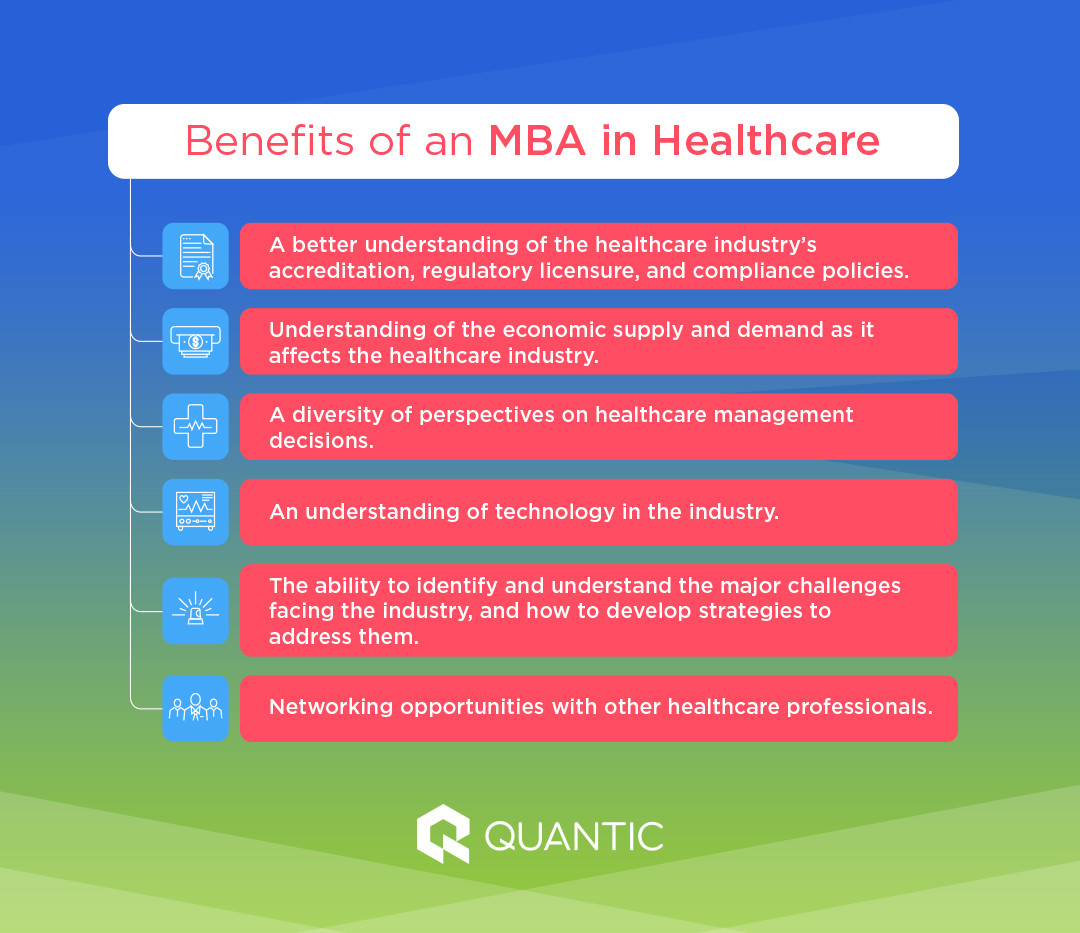
  • A better understanding of the healthcare industry’s accreditation, regulatory licensure, and compliance policies. 
  • Understanding of the economic supply and demand as it affects the healthcare industry
  • A diversity of perspectives on healthcare management decisions 
  • An understanding of technology in the industry. 
  • The ability to identify and understand the major challenges facing the industry, and how to develop strategies to address them. 
  • Networking opportunities with other healthcare professionals. 

Beyond these immediate benefits, an MBA in healthcare can prepare the student for a career in healthcare administration. According to the U.S. Bureau of Labor Statistics, the demand for healthcare administrators will grow by at least 20% by 2026 as the U.S. population continue to grow and age. As such, an MBA in healthcare will increase your chances of securing one of these high-demand positions. 

Why Get a Masters in Healthcare Administration? 

Similar to an MBA, an MHA degree can open a lot of doors in the healthcare industry to higher-paying leadership positions.

Here are some other reasons to consider an MHA. 

  • A competitive edge when applying for hotly contested positions
  • An MHA provides leadership skills specific to the healthcare industry
  • Potential to specialize in specific healthcare organizations 

What can I do with an MBA in Healthcare? 

When a student graduates from an MBA program, it’s only natural to ask what to do after an MBA in healthcare. It’s also naturally a difficult question to answer, and not for a lack of options. Rather, answering this question is difficult as there are so many options available to MBA healthcare graduates that it can be hard to choose. 

These include positions such as healthcare policy analyst or strategic project management.

Here are some entry-level and other jobs you can expect from an MBA in health care as well as what you can expect to earn in each position. 

Entry Level Jobs for MBA in Healthcare

Other Jobs for MBA in Healthcare 

What Can You do With a Masters in Healthcare Administration? 

MHA graduates face a similar problem – a graduate degree can open so many doors that it can be difficult to choose. If you find yourself asking what jobs can you get with a masters in healthcare administration, take a look at the list below.

MHA graduates will find there are many entry-level positions suited to them such as hospital unit clerk or medical office manager. What’s more, those pursuing this education will find themselves posed to take more senior positions such as clinical director or hospital administrator. 

Entry Level Jobs for Masters in Healthcare Administration

Other Jobs for Masters in Healthcare Administration

  • Hospital Administrator – According to Payscale, this position earns an average salary of $88,447.
  • Health Information Management Manager – According to Salary.com, this position earns an average salary of $94,691

Average Salary Comparison 

With these job opportunities in mind, it’s worth asking how much does an MBA in healthcare agent make as opposed to an MHA holder. On average, MBA graduates earn more than MHA holders. What’s more, MBA holders typically experience more opportunities for promotions and pay raises.

66% of Quantic’s MBA graduates, for example, see a promotion within the first six months of graduating. Another 23% see significant salary increases within that 6 months. 

MBA in healthcare management salaryMasters in healthcare administration salary
$84,000 $79,000

*Estimated averages for MBA and MHA from Payscale

Are These Degrees Worth it? 

Advancing your education is always worth it as a matter of personal growth, but a boost to your career certainly doesn’t hurt either. However, for those that are strictly conscious of the cost-to-benefit ratio, we’re going to explore what makes these degrees worth pursuing. 

Is a Healthcare MBA Worth it? 

When calculating the ROI of your MBA, you need to look at what the education cost you and how long it will take you to recoup those losses. This is more than just tuition money, however, we have to consider the additional costs as well as the benefits that come with an MBA program. For example, should you have to stop working to pursue a program, you must consider the lost income during that time.

In terms of benefits, we’re talking more than just the salary of your new position after graduation. We’re talking about networking opportunities and differentiation in the job market. An MBA program provides its students with the opportunity to meet similar-minded professionals from around the world to add their network of friends and colleagues. Meanwhile, an MBA alone will set you apart from the competition in the hiring process. 

On the other hand, the primary downside to an MBA is that it typically does little for those well-established in the healthcare industry for many years.

At the end of the day, though, a healthcare MBA is certainly worth the investment of time, money, and effort to achieve more in your career.

If you’re looking to maximize the ROI on your education, consider Quantic. Quantic not only provides a superior education with networking opportunities with exceptional fellow classmates but also offers scholarships and an employer-funding tuition model to help students afford the program. 

Is a Masters in Healthcare Administration Worth it? 

The same principles of measuring the ROI of an MBA apply to an MHA. You have to consider the cost of the degree compared to the time it will take to recoup those costs. With a marginally smaller average salary than MBA earners, naturally, this will take longer. 

In terms of the time it will take to earn the degree, the average program typically takes two years to complete. For part-time students, this extends to three years. However, during that time, graduates of MHA programs often earn a year of work experience as part of their studies under the supervision of existing healthcare leaders.

MHAs also typically do not provide the same networking opportunities that we see in the MBA program. 

However, despite the drawbacks, an MHA still equips graduates with a variety of opportunities across public service, health, and policy positions in the healthcare industry. As such, this degree is also worthy of consideration.

So, is a masters in healthcare administration worth it? Reddit users discuss the subject on a regular basis. It’s worth joining the conversation to find more information.

Masters in Healthcare Administration vs MBA in Healthcare

Both MBA and MHA programs typically take approximately 2 years to complete. In terms of costs, an MHA is, on average, less expensive than an MBA. However, MBA alumni receive a higher average salary than their MHA counterparts. 

However, the key difference comes down to what each program focuses on.

Those interested in working with the business side of the healthcare industry rather than healthcare will be interested in the MBA. Typical MBA in Healthcare programs focus on a business-first approach to education. That means their students will take more classes in finance, economics, marketing, and accounting than their MHA counterparts. At the end of the day, MBA graduates possess a broad understanding of management with specialized knowledge on the business side of healthcare.

Naturally, this means those pursuing MHAs can expect the opposite. Although there is much overlap between the programs, MHA is less business-focused.  Rather, the MHA curriculum focuses on healthcare-specific topics. These courses, for example, will likely include care delivery, the ethics of medicine, healthcare policies, and health law. As such, an MHA is best for those looking to focus on the medical side of healthcare management. 

Best MBA for Healthcare? 

Although both of these options are valid and worthwhile options for many potential students, some will find an MBA in a non-healthcare specialization the best option for them. Quantic provides an innovative and effective approach to MBAs, allowing students to achieve more in their fields in ways they never thought possible.

For example, as technology continues to rapidly advance, the need for that technical expertise branches across industries. As such, a software degree stands to be the modern-day equivalent of medical or law degrees when it comes to administration. 

Quantic’s MBA program allows STEM-minded individuals to succeed in almost any industry today with the right application of education and experience. Quantic students enjoy an accelerated 15-month program of study designed specifically for the early career professional with leadership potential. Our innovative approach combines interactive technology and collaborative group study in a structured and flexible format. 

So, if you’re ready to advance your career, Quantic is here.

An online MBA from Quantic can help you every step of the way from having no experience to being a seasoned professional. Apply today. 

How to Get Your First Software Engineer Job in 7 Steps

Software engineers are the professionals who make most of the online world possible. They undertake the daunting, but rewarding, tasks of designing and building applications that we enjoy online. As such, it’s both a lucrative and attractive job. 

However, breaking into this industry can be a challenge. Many organizations have high standards for their software engineers, and there’s plenty of competition out there in the labor pool.

That’s why today we’re going to take a look at the steps you can take to get your first software engineering job, the hardest part of the journey.

But first, let’s take a look at what software engineering entails. 

What is Software Engineering?

Software Engineering can be considered any technical field which helps design, develop, build, and test computer software. It requires a strong understanding of computer science, various engineering skills, and in-depth technical knowledge. Software engineers often work as part of a team of developers to produce new and innovative software. 

There is a common misconception that software engineers inherently equate to programmers. However, the position is much more complex than that. Whereas a software engineer does require an understanding of programming languages, their main daily tasks involving code are focused on writing code and creating the framework for software that a developer will in turn build upon.

Software engineering is more than coding. It’s about collaborating as a member of a team, helping guide the final product of a given software. That means software engineers require a mix of additional skills including teamwork, pair programming, and general problem-solving.

Starting on the software engineer career typically begins as a junior software engineer, the entry-level position in this field. Here you will work to build software, hammer out code, and fix bugs in said code. From here, you will likely progress to a senior software engineer, performing many of the same tasks while coaching entry-level developers.

Senior software engineers eventually become lead developers who coordinate entire teams while still writing code. This will continue onward, providing you continue to develop your skills, to the top of the career ladder to chief technology officer, managing an entire organization’s technical needs. 


But first, you need to get that entry-level job. It can seem daunting, but developing the right skills will get your foot in the door. And once you get that foot in the door, it’s only a matter of time before you’re climbing that ladder yourself. 

software engineer careers

How to Get Your First Software Engineer Job in 7 Steps 

Getting your first software engineer job won’t be easy, but with the right steps, you’ll get there. In this guide, we’re going to look at every step you need to take from choosing your choice of engineering role to applying for the position. Along the way, you’ll learn how to get an entry-level software engineering job.

For additional reading, you can join the conversation on how to get a software engineering job on Reddit. 

how to get your first software engineering job

Step 1 – Decide What Type of Role You Want 

There are many types of software engineers. Before you can begin on your journey, you should consider which role you want. To help you do just that, we’ve compiled a list of some of the different types of software engineer roles.

  • Front-End Engineer – Front-end software engineers specialize in the development of user interfaces – the UI. These are the visual elements including layout and aesthetic that the end user will interact with. As a Front-End Engineer, you can expect to work with code that runs across different user devices, browsers, and operating systems while creating responsive applications.
  • Back-End Engineer – As the name implies, back-end engineers work on the parts of applications that the end user doesn’t see. This includes the underlying logic and overall performance of a piece of software. In this role, you will find yourself designing and implementing the core logic that runs entire applications while working with Application Programming Interfaces or APIs.
  • DevOps Engineer – Unlike Front-end or Back-end engineers, the DevOps engineer’s role revolves around the technologies necessary to develop, integrate and administer back-end software. That’s to say, they focus on application infrastructure such as databases and servers.
  • Security Engineer- Security engineers specialize in creating systems and procedures to test the security of software systems. As such, they look to exploit and fix any security flaws in a given software to protect it from malicious intent. These engineers are more commonly known as “white hats” or “ethical hackers.”
  • Full-Stack Engineer – You can think of this role as a combination of both front-end and back-end software development. Full-stack engineers provide the skills to create a fully functional piece of software.

Each of these roles is unique in its tasks. As such, take this step into serious consideration. An entry-level position in any of these roles will be the first rung of the ladder in your software engineering career. 


However, if you’re looking for the easiest role to start with, consider becoming a front-end engineer. These professionals often work in coding languages such as Java to create appealing user interfaces, a well-known coding language that’s friendly to newcomers. Plus, learning front-end coding will give you the opportunity to see direct, visual results of your code. 


On the other hand, if you’re looking for a challenge. Start with cybersecurity. This role may be the hardest role to break into when you’re just starting out. Cybersecurity software engineers depend on an in-depth and advanced understanding of software and coding languages.

Step 2 – Get the Relevant Qualifications and Training

Once you’ve decided on a direction, you need to develop your qualifications. That means pursuing training and other resources to help you get that entry-level engineering position. So, what should you learn to get a software job? 

Well, the answer to that question is not simple. Software engineers need a diverse set of skills, and that requires a fair amount of education, training, or a combination of the two. Regardless, you will need to develop your understanding of coding languages, database knowledge, debugging knowledge, and similar technical skills starting out as a software engineer.

This is best done by attending various coding boot camps or even pursuing a bachelor’s in computer science. However, the cost of an advanced education can be a major roadblock to many. As such, this brings is us to a very common question: how to get a job as a software engineer without a degree?

It is possible without a degree, but it’s certainly not easy. You’ll need to be a self-starter, ready to learn everything you need on your own. There are many resources available online to do this.

Here’s a list of some of those resources:

  1. Free Code Camp
  2. LearnPyhton.org
  3. Try.GitHub.io
  4. Learn Git Branching
  5. CodingBat 

Beyond these, consider pursuing an MBA for Information Technology. An MBA will not only help you understand your role in a business but put you in a position to climb the corporate ladder much faster than your peers. That’s not even to mention that, according to U.S. News, technology is one of the top three fields that pay the highest salaries for MBA holders. 


It’s only a matter of the right MBA program for you. Quantic’s MBA program, for example, has a higher level of student satisfaction than both Harvard and INSEAD, and provides an innovative curriculum tailored specifically for early-career learners like yourself. Check it out if you’re interested in pursuing an education with an active learning method and strong networking opportunities. 

Step 3 – Get the Relevant Experience 

The next step on your journey is acquiring experience. To this end, let’s explore how to get a software engineering job with no experience. This will be of the biggest hurdles in your software engineering journey.

To this end, you’ll need to continue working on your coding skills. Along the way, pick up personal projects or coding gigs to add to your portfolio. In the process, you should also be looking to build your network and online presence to show potential employers that you have the right skills. Certifications and applying to internships will also help.

During this process, continue applying to entry-level positions that will help you build professional experience in the end, and ultimately help you climb the ladder to your dream job. 

Now, how long it will take to get a software engineer job with no experience will highly depend on where you are right now. It could be a matter of years if you’re starting from absolute ground zero – no skills, no network, and no experience. However, with perseverance and the right programs, you could cut this down to a matter of months. Quantic’s MBA program has helped thousands of students to get jobs in major tech companies including Microsoft, Google, and Deloitte. 

Step 4 – Write a Winning Resume 

As with any other job, you’ll need a good resume to even catch the attention of recruiters. 

Start with the structure of your resume. You’ll want to lead with your most recent job followed by your most relevant previous positions. In terms of format, use professional fonts, spacing, and ensure your resume is in the format specified by your potential employer. Should no format be listed, PDF is your safest choice. 

A stellar resume will highlight your strong points. Showcase your most relevant skills at the top of your resume according to the position you’re applying to. To this end, take the job posting into careful consideration and identify the keywords and skills the company is looking for. This will allow you to tailor your resume to the position. 

With a good resume and a little luck, you’ll be invited to the interview stage. 

Some strong software engineer interview tips include: 

  • Familiarize yourself with the company – Many tech companies have preferred coding languages in which they work. Ensure you are familiar with the ones your chosen company prefers. Your interviewer will likely ask you questions relevant to the language.
  • Study potential coding questions – On the subject of coding, consider the common challenges you may face in this position. Recruiters often use these as screening questions to test your knowledge.
  • Prepare for other assessments – Every software engineering job is going to be more than coding. Be prepared to answer questions regarding your communication skills and other soft skills.

Step 5 – Network with Other Professionals 

We’ve all heard it before, “It’s not what you know, it’s who you know.”

This old adage survives for good reason – it’s often true. Many new software engineers find themselves in their position as someone has vouched for them with their employer. As such, network with software engineers and other aspiring software engineers whenever possible.

This is another benefit of pursuing an MBA. Quantic, for example, puts you in a host of high-ambition, highly-skilled individuals looking to advance in their careers that you can rely on for the rest of your professional career.

Step 6 – Attend Job Fairs 

Job fairs offer excellent opportunities for meeting potential employers in person and yet another opportunity to network with others in your field. It also gives you a chance to share your portfolio and resume directly with employers and directly communicate your interest in any open positions they may have.

Overall, a job fair is a great opportunity for career development, even if you’re just getting started. 

Step 7 – Apply, Apply, Apply

So, you’ve developed your experience. You’ve earned qualifications. You’ve networked. You’ve done everything we’ve discussed here today. It’s time to apply, and don’t stop applying while continuing to work on yourself. With perseverance, you will find yourself in an entry-level software engineer position. 

Kickstart Your Career With Quantic

As we’ve discussed, getting your first software engineer job is no easy task, but it’s certainly not impossible. With the right tools and determination, it’s not a matter of if you get the job. It’s when you get the job.

Looking for an edge over the other applicants?

An online MBA from Quantic will show employers that you’re more than a software guru, you’re a business professional. Apply today.