Since starting her first web company 14 years ago—an act which sparked her technical curiosity and drive for innovation— recent Quantic graduate, Catie Marolt, has worked in all areas of the technology industry. This diverse technological background, spanning from startups to Fortune 100 organizations, gave her the understanding and experience to “bridge the gap between business challenges and technology solutions.” As technology continues to change and progress, she is eager to apply new knowledge to help organizations overcome these challenges.
Read more about Catie’s career and experience at Quantic below.
What motivated you to pursue an MBA?
I am a lifelong learner and have a passion for personal development. As an aspiring entrepreneur, I wanted to round out my corporate knowledge with the fundamental education needed to run a successful business. I was interested in meeting people around the world to share ideas and collaborate in the creative process.
Why did you select Quantic?
I loved Quantic’s technology-first approach and its modern, unique pedagogy. The blend of self paced yet structured learning was a perfect fit for my learning style. I wanted to be part of a diverse global alumni community and appreciated that the course content was focused on both organizational application and entrepreneurship.
How would you describe your experience with Quantic?
My Quantic experience was amazing! I loved that I could learn anywhere, any way, despite my busy schedule. I have made so many wonderful friendships and colleagues and networked with people all over the world. I loved participating in an organization focused on innovation with a mission of expanding global access to education.
As you consider your Quantic learning experience, what’s been most impactful, most beneficial to you, most valuable to you?
The most valuable parts of my Quantic learning experience are the lifetime access to course content and the lifelong friendships that I have made across the world.
How did you get to where you are today? What’s your background?
I have spent the past 14 years working in all facets of technology, from startups to Fortune 100 companies. My passion is coaching and leading agile and digital transformations of all sizes. I love to travel and have scuba dived all over the world.
What most interests you about being a Quantic Advocate?
I am most interested in educating others about the unique opportunities that the Quantic MBA program offers, and expanding the company’s mission to increase global access to higher education.
Quantic Alum, Richard Lim, has had a professional career that spans twenty years around the globe, most recently in New York City, where he is the Technical Consultant Manager at Datorama, a Salesforce Company. However, it’s his Cambodian French background that sets him apart from other technical professionals. He has assembled a diverse, global network and that’s what led him to get his EMBA from Quantic.
Richard offers a unique international perspective on business and education. He believes that his global experience has taught him to become more open-minded, adaptable, and curious, allowing him to be more inclusive of other people and communities in a business setting. Richard stresses the importance of this inclusivity, saying “everyone is different and my norm is not necessarily the norm of someone else; this is key to being a citizen of the world.”
“Two classmates graduated from Quantic and posted on Linkedin. I reached out to them to get more information. I knew the people behind Quantic had something brilliant, so I applied. Then I tried the app, and as a tech person, I fell in love.”
Now, Richard Lim is an Alumni Advocate and wants to spread awareness about the power of networking and inclusivity. Continue reading to learn more about Richard’s experience at Quantic completing his Executive MBA program.
What motivated you to pursue an MBA?
I had a MS in Computer Science and always kept in mind that I wanted to get business knowledge. At work, I was learning less than I was at the beginning, and then COVID hit. It was then the right time for me to do an MBA.
Why did you select Quantic?
Two former classmates graduated from Quantic and posted about it on LinkedIn. I reached out to them to get more information, then I tried the app. As a tech person, I fell in love with the way lessons were structured and how interactive it was. I knew right away that people behind Quantic had something brilliant, so I applied.
How would you describe your experience with Quantic?
My experience with Quantic was great. It was sometimes very challenging to keep pace and stay on track, but the overall experience is very good.
As you consider your Quantic learning experience, what’s been most impactful, most beneficial to you, most valuable to you?
The most beneficial aspect to me is learning and understanding the right concepts, with the ability to return to the lessons when facing issues in the professional world. I don’t have my own company, but if one day I would like to start one, I know that I have the tools now.
How did you get to where you are today? What’s your background?
My parents are Cambodian immigrants in France – I was born, raised and studied in France. I had opportunities to work and live around the globe: US, Australia, France and am now I’m settled in the US.
What most interests you about being a Quantic advocate?
Being able to share my experience, help people, and advertise this high level education at an affordable cost.
If you’ve found yourself looking for a job in the tech industry, you’ve no doubt already discovered just how hard that can be.
The tech industry is notoriously competitive, and the big companies have remarkably high standards for their employees even at the entry level. It’s easy to become disheartened. What are you to do when you hit this kind of wall?
Thankfully, there are several ways to improve your chances, and that’s exactly what we’re going to look at today. We’re going to start at the beginning and work our way through the interview process in 7 simple steps. They’re no overnight fix, and you’ll have to put in the work, but it’ll be worth it when you land your dream tech job.
But first, let’s take a look at the tech industry itself.
What Qualifies as a “Tech Job?”
There’s often some confusion as to what qualifies as a tech job. When we talk about these roles, people often envision coders and server managers immersed in the esoteric world of computer technology. However, the truth is that the tech industry is incredibly diverse.
For the sake of simplicity, we can divide tech jobs into three categories: role-based, product-based, and company based.
Role-based tech jobs are the most straightforward and are not limited to working for a tech company. These are the technicians and coders we traditionally associate with the industry. In these roles, you can expect to work closely with technology and possess a specialized skillset to do so. Role-based tech jobs include software engineers, web developers, and data scientists.
Product-based tech jobs are not necessarily technical in themselves. Rather, working in his role will see you supporting technicians within the greater tech ecosystem. You could call it “tech-adjacent.” However, these positions will require a high level of technical understanding and knowledge. Product-based tech jobs include product designs, product managers, and UI designers.
Company-based tech jobs mean you work for a major tech company, a business that specializes in producing new technology. These roles often are a lot less technical than you’d expect from the tech industry, but support it all the same. Arguably, anyone in sales, marketing, or finance of a major tech company such as Google or Microsoft could consider themself in a tech role.
There’s something for everyone in the tech industry.
How Many Jobs are Available in Technology?
According to Zippia, there are at least 585,000 tech companies in the US alone, and these companies were projected to add 178,000 new tech jobs by the end of 2024 with an industry growth of 6.7%. And these numbers are expected to rise.
This growth is expected to continue into 2023 at 6%, according to Forrester. Should this rate continue, we will see more and more new tech jobs every year. As a result, the number of jobs for some roles are expected to grow as much as 22% by 2030.
And when we consider the rate at which technology is advancing between AI and other digital solutions that were accelerated by the Covid-19 pandemic, we can expect these trends to continue into the foreseeable future.
Is Technology a Good Career Path?
With this information in mind, we can safely say that technology is a great career path. As technology advances, so will the demand for tech for jobs. The industry requires an entire ecosystem of roles to maintain, innovate and evangelize. Although your career probably won’t look the same in 20 years as it does today, tech professionals will always be in demand.
With this ever-increasing demand, compare tech to the jobs that are in decline in other fields. For example, data analysts and scientists are growing in demand while data entry clerks are consistently declining.
However, this brings us to the real question: is technology a good career path for you?
To answer that, you’ll need to answer some questions about yourself. Are you curious? Are you continuously learning and love a fast-paced, big-reward environment? If you said yes, then the short answer is – yes, a career in technology is for you.
The tech industry is constantly changing. Change is really its only constant. Many people who were working as software developers in the early 00s are now working on cloud technology and other tech solutions not even dreamed of 20 years ago. It is only fair to expect this of the future as well with the rise of new technologies such as Blockchain predicted to grow over the next decade.
That means you have to be comfortable with change and willing to develop your skills to meet the new tech demands as they come.
A tech career is one full of discovery, development, and, most of all, hard work.
However, if you’re averse to the stress of keeping a frequently changing skillset, the tech field may not be for you. Stress is one of the biggest drawbacks to tech jobs, and if you don’t thrive in that sort of environment, we cannot recommend it for you.
What do Technology Jobs Pay?
The average tech salary in 2021 was $104,566. Of the fastest-growing tech positions, we see a salary range of $77,179 to $151,983.
However, salary ranges depend on your role. Here’s what you can expect:
Sales Tech – According to Glassdoor, technical sales range from $65K to $196K with an average of $111,944 a year.
Support Tech – According to Salary.com, support IT technicians can expect an average salary range of $50,463 to $62,889.
Remote Tech – According to ZipRecruiter, a remote IT support technician can see an average salary of $59,962 per year.
For those looking to earn on the higher end of these ranges, you’ll need an education that will get you there. Quantic’s MBA alumni on average see a 23% salary increase within 6 months of graduation, earning more on average than their peers in the same roles across industries.
How Hard is it to Get a Job in Tech?
It’s no secret that is difficult to get into the tech industry. Even entry-level positions are incredibly competitive as many others strive to break into the industry themselves. However, there is a good reason for this. The tech industry offers incredible opportunities for upward mobility. As such, there’s little wonder how many even consider how to get a tech job in Silicon Valley when homeless as a solution.
With so much competition, it’s easy to wonder how long does it really take to get a job in tech. However, there are steps you can take to improve your chances.
For example, Quantic’s MBA program others a variety of skills and assets to its graduates that allow them to get into their dream job faster. These include developing soft skills and a professional network that will serve them throughout their professional lives. That’s why many of our graduates go on to work in big tech companies such as Amazon, Google, and Microsoft.
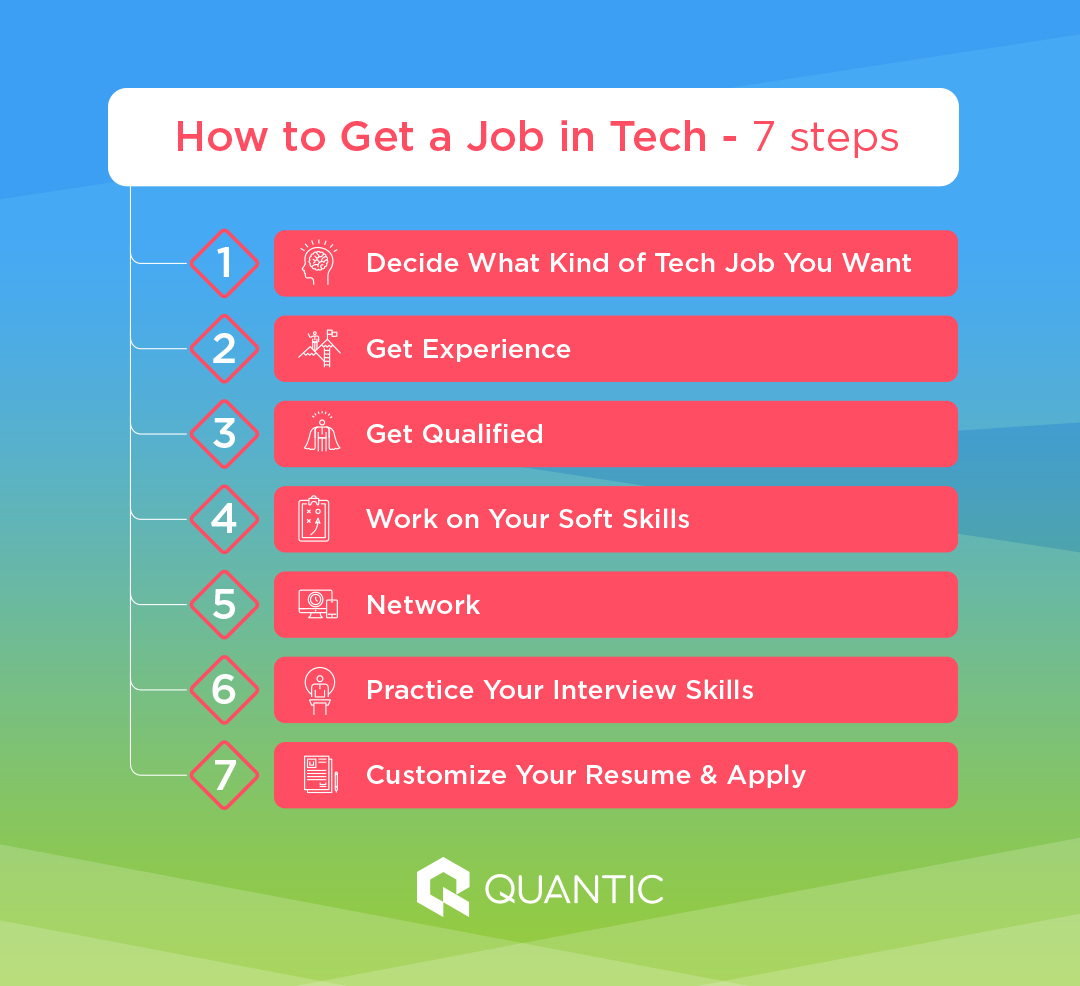
How to Get a Job in Tech – 7 steps
You’re not alone if you’ve found yourself asking how to get a job in tech. Reddit users often discuss the topic of getting into with no experience to how to get past the experience. After you read these 7 steps, feel free to join the conversation to find out what else has worked for others.
But for now, we’re going to take to look at 7 concrete steps you can take to get a job in tech.
First, we will consider what kind of tech job you’re looking for. From there we will take a look at what you’ll need to get into that job from your hard and soft skills to your qualifications to how to approach building a resume.
Step 1 – Decide What Kind of Tech Job You Want
Before you can truly begin your job hunt, it’s important to know what type of role you’re looking for first. As we’ve discussed, the tech industry is more than technicians and server rooms. Sure, that’s part of it, but it takes all kinds to make the industry run. So, decide what you’re looking for in the tech industry first whether that be as a technician, tech salesperson, support tech, or remote tech.
If you’re looking for a pure tech job, a technician position, you’ll need to brush up on your hard skills and specialize in a given field such as coding or computer science. It’s a highly technical position that demands expertise. Expect to help maintain complex systems or work with various software and hardware on a daily basis.
If that isn’t for you, then consider a tech sales position. You will still need a solid understanding of technology, but you won’t be working directly with it. Tech sales primarily focus on selling software or hardware solutions. As such, focus on building sales experience while supplementing it with some form of tech background through either independent study or coursework.
Support tech jobs are another indirect tech job. Rather than working with technology, you’re helping others with setup, maintenance, and troubleshooting hardware problems. As such, these positions require a solid amount of technical knowledge as well as communication skills. Expect
Remote tech jobs offer all the benefits of working in the tech industry with the benefits of remote work. This is a good option for self-starters that like to choose their own schedules. However, you’ll still need all of the same skills, if not more, to be considered.
Step 2 – Get Experience
So, you’ve chosen the kind of tech job you want. Now that you have a goal, it’s time to work towards it. Like any other industry, you’ll need to build experience to find your dream role. That brings us to the question, “How to get tech experience?”
This is probably the biggest hurdle for anyone looking to start a career. Many positions are looking for someone with at least a year of experience. But how do you get experience if you need experience?
Well, the first and most natural solution for those still pursuing a degree is to find a tech internship. An internship will get your foot in the door with a tech company, and give you experience for when you leave school. For competitive tech internships, be sure to list personal passion projects and what you’ve achieved in your relevant coursework to make a good impression.
On that note, personal projects are also excellent for anyone regardless if they’re pursuing a degree. Not only do they demonstrate your skills, but they also show your dedication to the field.
Beyond personal projects and internships are entry-level positions. Though many call for some degree of experience, pursuing internships and personal projects for your portfolio will likely be enough to help you land that first job. It’s only a matter of perseverance.
Step 3 – Get Qualified
Experience is the work you’ve completed that helped you grow as a professional. Qualification, however, is the formal training and education you’ve undergone to prepare you for your profession. Remember this distinction.
It takes both qualifications and experience to go far in any field, and that includes the tech industry.
Pursuing an MBA not only improves your tech job prospects but prepares you for reaching senior positions sooner in your career. That’s because an MBA provides you with the skills that the top tech companies are looking for – communication and a holistic understanding of the work they do. That’s not even to mention the networking opportunities with similar-minded professionals that come with pursuing an MBA.
Quantic’s MBA program is an accelerated 15-month program designed for the early career professional. As such, It combines interactive technology and collaborative group study around the world in a flexible format. This all comes supplemented with an online library, paid research databases, and resume consultations.
And the benefits of Quantic’s program continue after graduation. When you pursue your MBA with Quantic, you join a network of exceptional alumni and corporate employers to expand your career options post-graduation and build lifelong personal connections.
As such, Quantic’s MBA program is perfect for those looking to break into the tech industry. 54 of Quantic’s 2021 graduates found themselves working in the top 50 tech companies.
Step 4 – Work on Your Soft Skills
Equally important to your hard skills are your soft skills. These are the personality qualities that allow you to blend into a company’s culture and show recruiters your long-term potential. Developing your communication skills, information processing, and problem-solving will allow you to outshine the other applicants with similar hard skills to you.
This is yet another way an MBA can help you land a job in tech. Furthering your education will always provide you with hard skills, but pursuing the right coursework will allow you to develop the ever-vital soft skills that tech recruiters are looking for – particularly in leadership and teamwork.
Step 5 – Network
We’ve all heard it before: it’s not what you know, it’s who you know. It’s a common saying, but that’s because it’s true. Having a network of like-minded professionals can provide you with references and opportunities to meet other professionals within your given field. Plus, the people in your network provide you with someone you can go to with questions and help you stay updated on the latest trends.
You can build you were network by seeking out others in your field through industry-specific networking groups. By doing so, you’ll be able to learn more about your profession through others interested in it.
The Quantic Network is another excellent option to improve your network. Pursuing an MBA with Quantic puts you in contact with corporate employers and lifelong connections with peers in your field. So, consider an education that will connect you with the brightest minds around the world.
Step 6 – Practice Your Interview Skills
The recruitment process for tech companies can be extensive. This is especially true for top companies such as Google and Microsoft whose interview process consists of several rounds of interviews. As such, you have to be ready for whatever the interviewer has for you.
You’ll likely encounter both behavioral and technical questions to measure your soft and hard skills. To prepare, consider and research the most common tech interview questions. Compile how you would answer these questions with technical information and your experience.
Step 7 – Customize Your Resume & Apply
Finally, it’s time to apply. You have the skills. You have the qualifications. You know who’s who.
However, there’s one last thing to do. Research the job you’re applying for, the company, and study the job posting. Take all of these into consideration as you prepare your resume. You may be tempted to make the same resume and send it to everyone with an inbox. However, you’re far more likely to get a position if you show the recruiters exactly how you match the job description.
Identify the keywords in the job description, and, where possible, work that language into your resume. The closer you match their exact expectations, the more likely you’re to get an interview.
Conclusion
As you can see, there are several steps you can take to get into the tech industry. It’s no small feat, but it’s possible with determination and the right tools at your disposal. You just need to follow these steps and focus on tailoring your skills, qualifications, and network to improve your chances of getting your dream job.
It’s hard to go at it alone. Thankfully, you don’t have to.
An online MBA from Quantic can help you every step of the way from having no experience to being a seasoned professional. Apply today.
In the world of accounting, there’s a serious decision to make when you’re ready to further your career. That is the choice of whether to pursue an MBA with an accounting focus or a Master’s in Accounting. Both will do wonders to advance your career. However, there are nuanced differences between the two.
Whereas a Master’s in accounting offers specialized knowledge and skills for the profession, an MBA can serve the same purpose while providing you with a more diversified skillset.
Whichever is best for you is highly dependent on what you’re looking for in your career.
That’s why today we’re going to take a look into what exactly each of these degrees are, their key differences, and, along the way, help you figure out which one is right for you.
What’s an MBA Degree?
A master of business administration, or MBA, is a graduate degree that focuses on providing theoretical and practical training for business and investment management. In essence, it’s designed to grant a holistic perspective across a variety of business management areas including options to specialize in accounting.
Focusing on accounting with your MBA, you’ll gain more than the hard skills to perform your job. It means getting a fuller, deeper understanding of the effects your role has on the business as a whole. As such, MBA accountant graduates become valuable assets to any company.
An MBA shows employers that you possess a big-picture understanding of business practices as a whole.
Consider applying for an MBA today if you’re interested in advancing your career to leadership positions. Graduates of Quantic’s MBA program, just for example enjoy a first-year job promotion rate of 66%.
What’s a Masters of Accounting?
A Master’s of Accounting is a graduate degree program that prepares students for more advanced positions such as mid-level management positions. Beyond entry-level accounting skills, these programs typically include material on how to conduct research, analyze accounting data, and understand risk management.
Furthermore, MSA students learn how to create improvement processes, compliance strategies, and reimbursement procedures. Unlike the MBA, these graduates learn the overall management process specific to accounting departments.
An MBA with a finance focus and a Master’s in Accounting has several similarities. These similarities are in part what makes it so hard to choose between the two. So, let’s take a quick look at the similarities between these degrees before diving into the differences.
Like many other graduate degrees today, you can receive both an MBA and a Master’s in accounting online. This digital approach to learning has allowed for a meaningful and necessary flexibility in the way people approach their education. Today’s graduate students no longer need to take a break from their work to finish their degrees. Rather, they can work on both their educational and professional development.
Quantic’s online MBA curriculum provides a student experience not offered by other online graduate programs. Quantic students learn through an innovative Active Learning method, collaborating with classmates in case studies, projects, and events. What’s more, Quantic students can earn their MBA in 15 months, unlike most graduate programs that take 2 years.
Career Advancement
Both options offer to further your career beyond entry- and junior-level positions. Regardless of which you choose for yourself, both offer the tools and education to accelerate your career. However, it is important to know the direction your career takes will be highly dependent on this choice.
Both can Become CPAs
Many people who pursue an education in finance do so with intention of becoming a certified public accountant, or CPA. These professionals represent clients before the IRS and file audited financial reports with the SEC. As such, CPAs often bring home 6 figure salaries.
Whether you pursue an MBA or Master’s in accounting, you’ll find yourself empowered with the tools and knowledge to improve your chances of earning a CPA license.
MBA vs Masters in Accounting Key Differences
Despite the many similarities between the programs, there are key differences. MBA and Master’s in accounting programs have different requirements to be accepted into the program, and these must be considered before applications. What’s more, many of the differences you will see in the programs are the final results – MBAs offer many career paths and opportunities outside of accounting.
And finally, as both programs are designed for specific outcomes for the students, there are significant differences in the topics covered in each program’s coursework.
Experience Requirements
One of the key differences between an MBA and a Master’s in accounting is the prerequisites to enter the program. While you can go straight from achieving your bachelor’s to your master’s, many MBA programs require some work experience beforehand. That’s why an MBA carries such a heavier impact on a resume than a Master’s.
Career Paths and Options
Both degrees prepare students for senior and management positions in accounting. However, a master’s in accounting only prepares students for positions exclusive to the accounting industry. An MBA offers the same benefit.
However, the key difference we see here is that the curriculum MBA students receive prepares them for a larger variety of fields and positions beyond accounting alone. MBA programs are specifically designed, regardless of concentration, to produce well-rounded business professionals with broad career options.
Coursework
MBA’s and Master accounting programs particularly differ in their course work. In a typical master’s program for accounting, you will topics such as accounting ethics, advanced auditing, and forensic accounting. Whereas in MBA programs you’re more likely to see topics that cover organizational leadership, information systems, and risk management.
Conclusion
At the end of the day, there are several nuanced differences between an MBA and Master’s in Accounting. The chief of these is ultimately the outcome of the program. MBA programs produce well-rounded business professionals well-equipped to deal with the high-level management of accounting departments. However, these individuals also enjoy additional options and career paths they could take if they so choose, offering their potential employers a candidate with a swath of interdisciplinary skills.
Contrast this with a master’s in accounting which limits the candidate exclusively to the accounting department. This is fine if you intend to specialize and spend your entire career in accounting. However, these programs simply lack the versatility offered by an MBA program.
So, when determining which program is right for you, keep these key points in mind.
An MBA offers several career paths should you wish to shift focus later in your life, but a Master’s in Accounting will offer you specialized skills to focus specifically on accounting.
Quantic offers more than an online curriculum. While pursuing an MBA, you will be connected with thousands of other high-caliber students like yourself to grow your professional and professional network. Additionally, Quantic’s approach to education provides students with the skills and perspective they’ll need to achieve senior roles. 94% of Quantic’s alumni report meeting their career goals post-graduation.
See what an MBA with Quantic can do for your career today.
Microsoft is renowned as one of the biggest tech companies in the world. As such, it is something of a matter of prestige to be hired. Getting a position with Microsoft means you beat out potential thousands of other candidates for a single position. The process can be extensive, with several rounds of interviews between applying and receiving an offer.
You’ll need to be able to prove to the recruiters at every stage that you have the skills that set you apart in this massive candidate pool.
That’s why today we’re going to take a look at what it takes to get a job at this tech Giant. We’re going to explore what you can expect from the recruitment process and the different positions available at Microsoft. Along the way, we’re going to look at what you can do to develop your skills and experience to make you the right candidate for those positions.
How Many Employees Does Microsoft Have?
As of September 2022, Microsoft employs approximately 221,000 people in full-time positions around the world. Every one of them went through the daunting Microsoft hiring process that you will, and they came out the other side a full-fledged Microsoft employee. With effort, you can too.
Don’t worry if you don’t get the offer your first time. Many employees for the tech giants such as Microsoft try and try again before they finally land their dream job. It’s this persistence that Microsoft recruiters look for in their candidates alongside a desire to learn, grow and adapt with a real passion for technology.
Microsoft recruiters are also looking for technical and analytical skills that allow a person to learn through hands-on experience. If these traits describe you, Microsoft would love to have you.
How Hard is it to Get a Job at Microsoft in 2022?
Forbes listed Microsoft as one of the top five tech companies people wanted to work for in 2020. Now it’s 2 years later, and it remains true today. As such, they receive millions of applications every year to fill their open positions.
This makes it a difficult task to get a job at Microsoft, especially if you’re light on education and experience.
Due to this high competition, the Microsoft hiring process involves 4 to 5 rounds of interviews before you’ll land an offer. According to Zippia, this process takes a median of 22 days for non-technical positions and 32 days for technical positions.
However, despite competition and inherent difficulty, getting a job at Microsoft is still very much an attainable goal. To join the discussion on how to get a job at Microsoft, Reddit’s community of techies discuss the subject somewhat regularly.
Microsoft Jobs Salary
One of the major benefits of working for Microsoft, beyond the prestige, is the more than fair salaries offered to full-time employees.
To start your journey from candidate to new hire with Microsoft, you’ll begin like any other job hunt. Begin by comparing how you measure up to Microsoft’s desired qualifications.
Microsoft primarily divides its job postings into preferred qualifications and required qualifications. Let’s take a look at some of them.
Digital Sales Representative – Cloud Acquisition
Required: Extensive sales and negotiation experience
Or a Bachelor’s Degree in Business Management or a related field with 1+ years of sales experience.
Preferred: ABachelor’s in Business Management or a related field with 3+ years of sales experience.
Data Analyst
Required: Either 1-year experience and a Bachelor’s degree in business, marketing, or related fields
Or 2+ years of experience in research, marketing, data science, or finance
Preferred: 4+ years of experience and a Bachelor’s degree in business, marketing, or related fields
Or 5+ years in research, marketing, data science, or finance.
Or 3+ years in research, marketing, data science, or finance with a Master’s degree in business, marketing, or related fields.
An MBA or equivalent with a strong academic background.
Principal Researcher
Required: Ph.D. in applied mathematics, computer science, or a related field.
Relevant post-PhD experience in the field.
Working knowledge of python.
Preferred: People management experience.
If you find that your experience and qualifications already match the criteria of the position you’re looking for, go ahead and skip to step 4.
If you find yourself on the other side of the coin, you still have options to pursue a career with Microsoft. In these next steps, we’ll look at how to get a job at Microsoft without a degree or experience.
How to Get a Job at Microsoft Without a Degree
Take a second look at the qualifications of the first two positions we discussed. You will notice that Microsoft is willing to accept equivalent experience in some cases instead of a degree. This is because Microsoft is looking for skilled candidates, not good grades.
Begin by developing your skills either through entry-level positions. These jobs are not ideal, but allow you to earn the necessary experience to get you considered in the Microsoft hiring process.
Alternatively, you could expand your skills through other approaches. For example, Microsoft is the third largest employer of Quantic graduates, and only 43% of those students possess Master’s degrees.
How to Get a Job at Microsoft with No Experience
Perhaps you already have the degree, and you’re just struggling to find a position that works for you. Similar to getting a job with no education, no experience means you’ll need to pursue internships and entry-level positions.
Applying for an internship also gives you a good opportunity to make an impression. It gets your foot in the door, and you’ll be able to learn what the company is looking for firsthand. However, these positions are not easily won either. You’ll have to prove you have what it takes, i.e. the passion and knowledge of technology, to beat out your internship competition.
If you’re looking for another way to ahead of the competition, consider expanding your skillset with an MBA through Quantic. This provides you with an education to see the big picture and a network-first approach to making meaningful connections with other skilled and ambitious individuals like yourself.
As such, you’re more likely to meet someone while pursuing your MBA with Quantic that can help open doors for you at businesses such as Microsoft in the future.
Decide What Type of Role You Want
So you have the qualifications. It’s time to decide which role best suits you. Thankfully, Microsoft has hundreds of open positions for you to consider.
These include
Researcher
Scale Customer Success Associate
Data Center Technician
Strategic Account Strategist
Presales Specialist
Product Manager
Electrical Engineer
Mechanical Engineer
HR Consulting Manager
Data Scientist
Each of these roles has unique requirements and qualifications. To help you help land your dream Microsoft job, here’s some advice for four of the roles you can pursue at Microsoft.
How to Get a Software Engineer Job at Microsoft
First up, to get any software engineer job, you’ll need to learn how to code either through formal education or free resources. The safest languages to start with are either JavaScript or Python due to their high demand, but the choice depends on your interests. However, if you’re looking for bonus points with Microsoft, it wouldn’t hurt to learn that language they created: C#.
Afterward, you’ll be able to land your first programming job or an internship to further your experience toward being ready to apply for a position with Microsoft.
However, getting a job at Microsoft is more than technical skills alone. Microsoft is looking for team members that understand their roles and the effects their work has on the whole organization. Quantic’s software engineer MBA graduates not only learn this valuable skill but see their promotion prospects grow.
Here’s what the typical Software Engineer Career ladder looks like…
How to Get a Mechanical engineering Job at Microsoft
To become a mechanical engineer for Microsoft, you’ll need to meet some basic qualifications. These include a Bachelor’s degree in mechanical engineering and a college-level understanding of a niche within the engineering field. This could include knowledge of HVAC systems and the operation of facility environments’ heating and cooling systems for example.
To achieve this, seek out other work on projects involving building and supporting the infrastructure of tech-oriented environments, and build your experience in supporting tech and development.
How to Get a Technical Sales Job at Microsoft
To get a technical sales job with Microsoft, you’ll need to be able to understand and explain the systems you’re pitching in great detail. As such, Microsoft is looking for individuals who possess computer science or related degrees to fill these positions.
However, if you can prove technical aptitude with a marketing degree, you also stand a chance of being hired for this position.
How to Get a Job at Microsoft Research
For those interested in pursuing a career in research with Microsoft, it’s best to start while pursuing an undergraduate degree in computer science or a related field. During this time, you can apply for an undergraduate research internship in computing or similar fields. Whether this is from Microsoft or not is up to you and your qualifications.
However, a research internship is an excellent way to get your foot in the door and build experience at the same time.
Explore Microsoft Careers
If you’re not sure what role might suit you, or how your qualifications stand up to Microsoft’s expectations, check out Microsoft’s career page. There you’ll be able to see all of the positions available around the world and their requirements.
Work on Your Resume
The key to crafting a good resume for a Microsoft position is to craft it according to the job description provided. Using the same keywords between the minimum and preferred qualification categories, your resume is more likely to stand out to recruiters and resume screening algorithms.
Additionally, Microsoft recruiters look for certain key aspects in a resume. These include clean formatting, an elevator pitch introduction of the candidate, a reduced skill section, and simplicity.
To get a jumpstart on your resume, grab a professional resume template here.
Apply Online
Here’s what you need to do to apply for a Microsoft position online.
Open the Microsoft Career Page and select “explore career opportunities.”
From here, you’ll be able to select to either explore professions or locations
Selecting professions will present you with a page of all the disciplines Microsoft hires
Choose a discipline you’re interested in and then select the position.
Sign in to the portal and create a profile
Upload your resume and complete the necessary forms including contact information and professional experience.
Interview – Microsoft Interview Process 2022
Including assessments, Microsoft’s interview process involves approximately 6 rounds.
Recruiter Contact – This step may be skipped in favor of an online assessment. However, should a recruiter reach out to you directly, you can expect a short conversation regarding yourself and your interests. This acts as a brief preliminary screening.
Online Assessment – The first round of interviews will be remote, either through an online Codility test or a phone screening, sometimes both.
The Microsoft Codility test is specifically for positions such as software engineers and consists of 2-4 coding questions to solve in 60 to 90 minutes.
The screening interview will likely be held over Microsoft teams or Skype. It will last for about 30 minutes and cover behavioral assessments, coding problems (for relevant candidates), and conceptual questions. Common questions include “explain recursion to a 5-year-old” and “what is a linked list?”
On-Site Interviews – The remaining 4-5 interviews will be conducted onsite, each lasting approximately 1 hour. These interviews will feature more coding questions for software engineers and behavioral interview questions.
The best way to prepare for this process is to read extensively about the position for which you applied and review potential material.
Offer
If you’ve made it this far, congratulations. The hiring team has made you an offer. Assuming the terms of your employment are everything you’d hope them to be, you just need to accept. Look forward to onboarding and your new dream job at Microsoft.
Conclusion
At the end of the day, getting a job at Microsoft is a daunting task no matter how prepared you are. But it’s not impossible. With the right education, experience, and sticktoitiveness, you can work for one of the biggest and most successful companies in the tech industry.
If you find yourself looking for a way to make yourself stick out from the crowd that applies every year, take a look at what an MBA with Quantic can do for your career. 94% of our alumni report meeting their career goals post-graduation.
So, you want to get a job at Google. That ambition is admirable on its own. Now it’s only a matter of making your ambition a reality. Getting hired at Google means you’re going to have to show the recruiters how you stand out against the other 2 million candidates that apply every year.
That’s right, 2 million applicants, and Google only hires 2,000 to 4,000 of them a year.
And what is it that sets these hires apart from the others? It’s more than education and experience. It’s how the candidates approach their work. Successful Google applicants are versatile and innovative thinkers in their given fields.
If a software manager, or any other professional, wants to get their dream job at this tech giant, they’ll need more than experience. They’ll need an education that provides them the skills to take on senior roles, and the opportunity to network with other talented professionals.
To help you along your path to becoming the new Google hire, we’re going to take a look at exactly how to get a job at Google.
How Hard is it to Get a Job at Google in 2022?
As we said, over 2 million candidates apply to Google every year. That’s a lot of competition. Plus, with such a large candidate pool to choose from, Google can safely keep its expectations incredibly high when looking for the right person to fill a position.
As a result, it is undoubtedly difficult to get a job at Google. You have to convince recruiters that you’re the best of the best who could possibly fill the position. It takes skill and no small amount of work to even meet the minimum qualifications for many of the available positions that open every year.
That’s why many successful applicants report taking multiple attempts at the hiring process before they were accepted.
If you want to join the conversation with other applicants and employees on how to get a job at Google, Reddit’s r/Google users often explore this question, and share barriers they’ve faced themselves.
How to get a job at Google Step-by-step guide
1. Look at Google’s Company Job Qualifications
Like any other job hunt, it’s best to check your qualifications. There are hundreds of positions at Google, too many to list in a single article. So, let’s take a look at just a few to give you an idea of what to expect.
Google has a set of minimum and preferred qualifications for each of its roles:
Failure Analysis Technician, Augmented Reality
Minimum: Associate’s degree or equivalent experience, Experience with SEM (Scanning Electron Microbe) imaging, FIB (Focused Ion Beam) sample preparation, and Semiconductor wafer processing.
Preferred: Bachelor’s degree in Electrical Engineering or related field, or equivalent experience, experience in the creation of failure analysis reports and operation of metrology tools.
Program Manager, Sustaining Operations.
Minimum: Bachelor’s in Supply Chain Management with 12 years of experience.
Preferred: MBA or Master’s degree in the same field.
Senior Software Engineer, Cloud Data Management.
Minimum: Bachelor’s degree in Computer Science or equivalent experience, 5 years of experience with software development, 3 years of experience testing, maintaining, and launching products, and 3 more years of experience developing large-scale infrastructure.
Preferred: Master’s degree or Ph.D. in Computer Science or related, 1 year in a technical leadership role, and experience developing accessible technologies.
If your experience and qualifications already match the position you’re looking for, skip to step 4.
However, if you don’t meet the listed criteria, you still have options. In the next steps, we’ll look at how to get a job at Google without a degree or experience.
2. How to Get a Job at Google Without a Degree
Something you’ll notice on many Google job listings is the phrase “or equivalent experience.” This is because Google isn’t focused on degrees or education alone. They want experienced team members with a passion for what they do.
Furthermore, there are still options for those who don’t have a degree and aren’t pursuing one. As we said, Google is looking for what you can do, not the grades you had in school. Develop your skills through entry-level positions, and put in the work to exceed expectations. Impressive work history will go a long way in getting hired at Google.
Regardless of your education, networking is a serious asset to getting a job at Google. Having someone on the inside to go to bat for you will get your resume considered early in the process, improving your chances of an interview and an eventual offer.
Quantic’s network-first approach to learning allows MBA students to make meaningful connections with other skilled and ambitious individuals like themselves through peer-to-peer learning and networking events. As a result, our network includes exceptional alumni and corporate employers including Google.
3. How to Get a Job at Google With No Experience
Maybe you have a degree, but no experience. In this case, you’re going to need to build your skills and experience through entry-level jobs or other work such as internships.
Applying for an internship is also a good opportunity to get your foot in the door. However, remember Google internships are just as competitive as their regular positions. Bring your current software experience to the forefront, and, if you have what it takes, you’ll be able to gain the exact experience Google is looking for through them directly.
If you want to get ahead of your competition, consider expanding your skillset with an MBA through Quantic. Google is looking for candidates with the skill to see the big picture, and our program provides you with the knowledge to do just that. That’s why Google is the second top employer of our students. 222 Quantic alumni have been placed in positions at Google, to date!
Here’s what some of our Google Alumni had to say…
4. Decide What Type of Role You Want
When looking for a job with Google, you have hundreds of roles to choose from. Simply find one that suits you before applying.
These include:
Data Analytics Specialist
Integration Engineer
Software Engineer
Physical Design Engineer
Sales Specialist
Digital Marketer
Operations Technician
Product Manager
Financial Analyst
Field Sales
All of these roles have unique requirements and qualifications. To help you along, here’s some advice for software engineers and sales.
How to Get a Software Engineer Job at Google
First up, to get any software engineer job, you’ll need to learn how to code either through formal education or free resources. The safest languages to start with are either JavaScript or Python due to their high demand, but the choice depends on your interests.
Afterward, you’ll be able to land your first programming job or an internship to further your experience.
However, getting a job at Google is more than technical skills alone. Google is looking for team members that understand their role and the effects their work has on the whole organization. Quantic’s software engineer MBA graduates not only learn this valuable skill but see their promotion prospects grow.
How to Get a Job at Google Sales
Similar to software engineers, you’ll need to start with your skills through formal education or practical experience. Regardless, you’ll want to take your sales career to the technology industry including SaaS and similar products.
Explore Google Careers
If you’re not sure what role might suit you, or how your qualifications stand up to Google’s expectations, check out Google Careers. There you’ll be able to see all of the positions available around the world and their requirements.
6. Work on Your Resume
The key to crafting a good resume for a Google position is to craft it according to the job description provided. Using the same keywords between the minimum and preferred qualification categories, your resume is more likely to stand out to recruiters and resume screening algorithms.
Here are the steps to follow to apply for a Google Position online.
Go to Google Careers and use the search box to find a relevant position
Once you find a position you like hit “Apply”
Create a profile with your email, name, country, and phone number. This will allow you to save your info and potentially apply to other positions faster.
Upload your resume and provide contact information, education background and employment history, and a cover letter.
6. Interview
Once you’ve made it to the interview stage of the hiring process, you can expect several rounds of interviews from short virtual chats about your key skills to in-depth interviews 3-4 times a single day.
For these interviews you will need to:
Make connections between your resume and the job description – Review the resume you submitted, and be prepared to answer questions on how the information you provided relates to the job description.
Prepare data – Being able to quantify the effect your work has had in the past gives recruiters a better understanding of your abilities.
Review work experience – Recruiters will ask you how you have performed or achieved in your past roles. Reviewing will prepare you to answer those questions.
Prepare questions – Google wants employees that care and are engaged in what they do.
No Luck? Think Outside the Box!
Don’t be discouraged if you don’t get the job with your first application. Many candidates apply multiple times before receiving an offer. However, don’t be afraid to get creative with your approach.
Here’s how Omari Itani landed a job as an Account Manager for Google at 26:
When he passed the initial screening process, the recruiter presented him with a brief business case to discuss during the second interview. However, Omari prepared a complete presentation to illustrate his understanding and approach to the issue and impressed the interviewer by taking control of the interview.
Offer
If you’ve made it this far, congratulations. The hiring team has made you an offer. Assuming the terms of your employment are everything you’d hope them to be, you just need to accept. Look forward to onboarding and your new dream job at Google.
Conclusion
At the end of the day, getting a job at Google is a difficult task, but it’s not impossible. With the right education, experience, and sticktoitiveness, you can work for one of the biggest and most successful companies in the tech industry.
If you find yourself looking for a way to make yourself stick out from the crowd that applies every year, take a look at what an MBA with Quantic can do for your career. 94% of our alumni report meeting their career goals post-graduation.
Quantic Alum, Thiruvenkateswaran Ramachandran, is bringing “SusTech” to the world. He is the co-founder of ClimeUp, a Sustainability Technology company whose mission is to assist businesses in hastening their sustainability journey, as well as their reporting process. We were lucky enough to sit down with him and learn more about the innovations and inspirations behind this exciting technology that will have a positive impact on our planet, people, and economy.
What inspired you to launch ClimeUp?
After close to two decades of B2B and B2C technology and product development efforts, I was able to find my purpose in making a significant impact on the planet and people. In my recent work, I was heading a global digital product development team and integration of Sustainability Solutions for Smart Cities. This helped citizens to be energy efficient, environmentally friendly, and able to embrace sustainable behavior. The social impact that we created, by integrating a digital app and technology in their daily lives, was a real driver for me to change gears and solve sustainability challenges. I realized I could do this for a larger arena and the focus would be to integrate employees’ behavior in achieving sustainability for enterprises. That’s how ClimeUp was born.
At ClimeUp, we strongly believe in making a greater impact on the planet, people, and economy by leveraging the power of technology and by nurturing a sustainability mindset across organizations.
We are the industry first’s Sustainability technology (SusTech) company that enables corporates, advisory firms, and ESG investing firms with a one-stop ESG Software Platform to report, monitor, and measure ESG performance & Climate impact. We do this by leveraging advanced technologies such as IoT, AI, and behavioral science. Sustainability is a relatively young corporate function that needs a lot of handholding, processes, and digital tools to realize the company’s agenda.
How would you define SusTech?
We’ve coined “SusTech” as a term that signifies the conglomeration of broader agenda of “Sustainability” and “Technology.” Since we wanted to leverage technology as a primary catalyst to help accelerate the global sustainability mission, we are glad to share that we’ve introduced industry sector “SusTech” to the world. To our knowledge, we are the pioneer in adopting and marketing it in a big way to create awareness about this sector. When we first looked at this idea, it was a Blue Ocean strategy and now we see more entrants in this space, which is great for the sustainable world.
How did your background prepare you to launch ClimeUp?
Hailing from a city in southern India and being brought up by a middle-class parent with great family values, becoming an entrepreneur has always been my ambition and I am glad that it happened now. I always like to master the basics before I jump into any journey. Some of my key strengths are being curious and passionate to make a difference in everything I do. It helps me to be focused. For this reason, I choose to pick opportunities to work and learn different functions in different industries. Having this holistic experience helped me gain the confidence to launch ClimeUp.
How did your Quantic education help with the launch process?
Enrolling in the Quantic Executive MBA has been a life-changing experience for me. While I was pursuing my aspiration to launch my startup, I realized that I needed a systematic approach towards creating a company that would be relevant in today’s business world. Quantic helped me understand the technicalities of starting and running a business, while providing me with the flexibility to learn on the go.
I’m also glad that I’ve found a Blue Ocean opportunity that soon will become an unicorn in the Sustainability space. Quantic came into my life at the right time and without a doubt, played a big role in my decision to launch the ClimeUp venture.
What would you say to others who are looking to take the entrepreneurial route and are just getting started?
1) There is no rule of thumb to start your own business because there are so many variables. It must come as a result of a constant search for a purpose.
2) Try to gain practical experience in the majority of the corporate functions (including hiring and marketing,etc..). This is important because when you launch, you may be limited by resources and the only way to survive is knowing what and how to do it by yourself. For those who didn’t get the opportunity, take a formal MBA to lay the foundations of all the corporate functions.
3) Finally, You should learn to enjoy dealing with uncertainties and managing challenges on a daily basis. The entrepreneurial journey would be enjoyable when you are very much focused and passionate about solving customer problems, that’s the time you seriously need to think about launching your venture. I am enjoying it so far and learning all along the way. If I put it simply, entrepreneurship is a state of mind and the outcome of multiple tiny skill developments.
What would you say to the global community to help make sustainability a main goal?
We must make conscious efforts to embrace sustainability habits in everyday routines. Individuals can start traveling twice a week in public transportation, instead of a long, lonely drive in your car, in order to help reduce the environmental impact. For companies, understanding the baseline impact of ESG will help set your goals to become a better risk-friendly company in the years to come. The smart decisions to adopt alternative energy and make environment-friendly decisions will drive significant behavioral change in every employee’s lifestyle and make sustainability a number one priority for all of us.
The pandemic changed so much of how we live life—from how we shop for our groceries and everyday supplies, to how we attend worship services and school classes.
Every aspect of our lives, it seems, looks a bit different now than it did in the time before the spring of 2020.
One thing that significantly changed was the number of women seeking higher business degrees. That number was nearly 40% higher in 2020 over 2019, as we’ll see later on.
Today we’re going to look at why that number increased, as well as why (and how) you should join those women seeking their advanced business degrees.
We’ll start with some of the cold, hard numbers, then work our way through some fairly persuasive reasons why every woman in business should be considering an MBA.
By the time we’re done, it’s our hope to have made you excited about getting your own MBA underway and that you’ll join the thousands of women already pursuing their own advanced degrees.
How Many Women in the United States Have an MBA?
We can’t really say for certain how many women graduate with an MBA degree each year. What we do know, and have solid facts for, is the number of women who apply for entrance into MBA programs. And we know that by the prerequisite test they have to take.
Students from 110 countries worldwide take the GMAT exam to enter a Master’s program of some kind. That exam is overseen by the GMAC, which collects data on their examinees each year.
An average of 250,000 students take the exam every year to pursue higher education.
The pandemic year of 2020 saw testing sites and even entire universities closed, so that number fell to just over 173,000.
Worldwide, just over 50% of female GMAT applicants, or 79,000, applied to MBA programs. Just over 17,000 US women took the GMAT in 2020. Of those, 76% were applying to an MBA program.
The number of female students applying for the GMAT was significantly (nearly 50%) lower than in 2016. However, the percentage of women seeking higher business degrees was over 96%, if you count MBA candidates and “other” business degree candidates, too.
So, while 17,000 compared to the total population of 330 million may seem small, the significance of the number of women seeking higher business degrees is still quite large. Headline-making large, in fact.
Let’s look at that percentage in more detail.
The Percentage of Female MBA Students
What matters most when looking at the numbers of women seeking higher business degrees is the MBA gender ratio. Traditionally, MBA programs were the playgrounds for the Old Boys’ Club, with a majority of the students being male.
Today, there’s still a male majority seeking MBAs, but women are seriously making up ground and may even soon surpass those old boys.
There are three logical reasons for this projected outcome:
There’s a recent trend of increasingly fewer and fewer male students applying for colleges and universities at every level each year.
Women are making greater headway in the business world in general, with better earnings and career prospects.
The statistics don’t lie. In 2021, women made up 41% of MBA candidates nationwide. That figure was up from 39% in 2019. A decade ago, in 2011, only 31% of MBA candidates were female.
Three top business schools—the Wharton School, George Washington School of Business, and the Johns Hopkins Carey Business School—all reported enrolling more than 50% women in 2021.
Just one of the nation’s top ten B-schools had a female enrollment below 40%, and the overall average of the nation’s top ten MBA programs was 44%. Again, no school had a female enrollment of over 45% ten years ago.
Let’s compare those numbers to Quantic. At Quantic, our 2021 female MBA candidates counted for 35% of our students. GMAC also reported that women seeking online MBAs such as ours rose from 15% in 2020 to 24% in 2021.
Quantic may be below the national average in female MBA candidates, but we’re part of a growing trend.
Is It Easier to Get Into Business School as a Woman?
The simple answer to this is yes. And no.
One of the reasons experts give for the uptick in female enrollment in MBA programs is that many business schools are actively recruiting female undergraduates and older, so-called “nontraditional” students.
A survey of business schools conducted by Bloomberg Businessweek found that the top schools in their survey for female MBA students recruited from undergraduate programs as varied as visual art, Spanish, and dance.
Many schools have also dropped the GMAT requirement, implementing a program of pre-requisite courses in finance, accounting, statistics, and working with case studies to level the playing field.
For about five years now, many schools have been handing out new scholarships created just for women, in another effort to increase female enrollment.
All of this has led to the perception that it has become easier for women to get into business school. And that’s all it is. A perception. Or in this case, rather, a misconception.
Women still have to jump through the same hoops, pass the same pre-requisite courses, meet the same GPA requirements, and pay the same tuition. What has changed is that the doors to business schools have been opened to women in ways we’ve never seen before.
Why Women Don’t Pursue MBAs
Why have the schools had to work so hard to increase their female MBA enrollees? Because traditionally, MBA programs just weren’t seen as attractive by many women. There are a variety of reasons for this, and we’re going to look at the main ones in detail.
Lack of Women in Undergraduate Business Programs
Business schools discovered that there is one big area where gender equity is not present: in their business programs as a whole.
Young women aren’t recruited to enroll in business undergraduate programs. Fewer women earning Bachelor’s degrees equals fewer women to apply for MBAs and other business postgrad programs.
And it’s not happening at the high school level. The Future Business Leaders of America (FBLA), the nation’s largest business-oriented student organization, reports that 58% of their members are female.
Compare that to 44% of young women in business undergraduate programs and you can see the issue in black and white.
Lack of Women in Faculty and Advisor Positions
Representation matters. And when women look at the faculty and advisors of postgraduate business programs, they don’t see a lot of it.
Some of this missing representation is most likely due to the fact that most women see an MBA as “work” preparation, getting that corner office and breaking that glass ceiling. They don’t see an MBA as a stepping stone to the PhD required of most professors.
And while the percentage of women entering PhD programs has increased, the number of graduates seems to have remained fairly steady since 2005. In that year, 40.3% of business PhDs were granted to women. In 2015, that number was only 41%.
The Glass Ceiling
First coined in the 1980s, the phrase “glass ceiling” refers to that invisible barrier that prevents women from advancing to the same positions with the same ease as men.
And while advances by women in the workplace, and even in executive positions have been made, certain aspects of the glass ceiling remain.
There’s the widely publicized “wage gap” that shows women still earning less than men, even at the executive corner office levels.
And then there’s the fact that women only make up 6% of all CEOs on the Fortune 500 and S&P 500, even though they represent over 50% of the workforce. And speaking of the Fortune 500 and S&P 500, women account for only 26% of their collective boardrooms.
Many women look at this version of the Old Boys’ Club and think, “Why bother?”
Why go through the expense, effort, and time commitment of getting an MBA when they’ll never break down the barriers that have stood so long in place?
Too Expensive
We’ve mentioned that some schools have initiated scholarships specifically for female business students. Unfortunately, many haven’t.
The average traditional MBA costs between $55,000 and $161,000. Add that to the average cost of a Bachelor’s degree at $142,000, and you can see why a lack of funding causes many women to drop the idea of postgraduate studies altogether.
The “Mom” Factor
The pandemic has been hardest on women in the workplace. Many have had to quit their jobs to care for their families, or take a remote-only position even as their firms have returned to Cubicle City.
Our society expects this. While many women hold the family purse strings, holding 83% of the nation’s purchasing power, they aren’t typically expected to be the ones filling the purse.
That “mom” factor plays a part in many young womens’ decisions about postgraduate studies, including MBAs. Many don’t see themselves as staying in positions long enough to reach the higher echelons an MBA is needed for.
This doesn’t exactly play out in real life, however, as a recent Harvard study proved. Only 11% of Harvard Business School female MBA graduates over a 20 year period had “dropped out” of the business world to become full-time wives and moms.
The “Other” Mom Factor
There’s an old saying among economists: “When the economy is good, work. When the economy is bad, go back to school.”
And while it’s not uncommon for a man to pursue a higher degree, including an MBA, in his 30s, 40s, and even 50s, many women do not. They typically cite “family obligations” as the main reason.
And they have good reason to do so.
While our society has come a long way in breaking gender stereotypes, especially in sharing household responsibilities, the burden of childcare still falls on the mother.
And all of this while statistics tells us that 65% of the nation’s mothers work outside the home. Or at least they did pre-pandemic.
All this family responsibility means that there’s little time left for the kind of serious study and time commitment an MBA requires.
Why Women SHOULD Get an MBA
Now that we’ve looked at the reasons why women don’t pursue MBA degrees, let’s take a moment to discuss the three reasons why they should, and all the ways Quantic makes it easier to do.
The 3 Reasons Why Every Woman Should Pursue an MBA
Earnings. Women with an MBA can see pay gains of 35-40% of their pre-MBA salary upon completion of their degree. In 5 years, that figure rises to 55-65%.
Personal gains. 95% of women say earning their MBA boosted their self confidence, as well as their credibility with peers, colleagues, and managers.
Career gains. 85% of MBA earners credit their degree with the contentment they have with their career, as well as the advancements they make. The skills and knowledge required by the MBA translate into expertise and excellence in job performance.
Companies should sit up and take notice of women in executive positions, too. Studies show that those with women in the boardroom have a 42% higher return on sales, and 66% higher return on investments than those without.
Jobs were lost through layoffs, furloughs, reduced hours, and the role of caretaker after disruptions in school and childcare.
Women are now trying to better prepare themselves for their return to the workforce through business education, especially MBA degrees. And as we’ve seen, schools are actively responding by changing requirements and actively recruiting women.
The opportunities for a woman to earn her MBA have possibly never been greater, nor more accessible, than now.
How Quantic Can Help
Quantic’s unique online programs can help you achieve your MBA goals, whether they be in response to the pandemic, or have been on your radar for some time.
All the Old Boys’ stuff is not a factor as we strive to create an environment and student culture that is both respectful and inclusive for all.
We defeat the “Mom factors” with study programs that allow you to study on your own time, whenever that time may be.
Don’t just take our word for it that Quantic is the best place for you. Here are testimonials from three very satisfied female MBA students. Two are hard-working moms who found our program to be just what they needed.
Rosa speaks of our inclusive and friendly student culture and learning environment. And Rose kindly attests to our accessibility for disabled students, something we hadn’t even thought of in terms of being a barrier to an MBA.
“As a hard of hearing, deaf individual, distance learning education can be a trial by fire…I had been looking for years at MBA programs. Quantic’s EMBA program has filled that gap. Like my previous online degrees, Quantic gave me the freedom to work on my own time using the course app coupled with modern technology (Slack and Zoom) to communicate with my classmates. I have used Blackboard, LoudCloud and other education-made classrooms for years. Quantic’s version blows everything I’ve used in the past out of the water… If you’re deaf or hard of hearing, this program is amazing and it focuses on what you see not what you hear. If you are a working adult, this is a program that will answer a million of those small questions that you have had over the years. If you are a small business owner—this is an absolute must! It’s like the mentor that you never had.”
Recently, globalization took a step backwards with border closures, delayed shipping, and slowed business activity.
As such, managers are now questioning the future of supply chain management after Covid 19: “Are there more upsets coming?” “Are businesses well-prepared?” “What will happen to supply management jobs?”
Well, here are 10 disruptive trends that are already influencing business:
Today, we’ll delve into each trend’s impact on supply chains and how companies are preparing. We’ll also look at the future of supply chain management jobs and how other managers are adapting.
10 Future Trends of Supply Chain Management
Trend 1 – Blockchain
Alt: blockchain-powered Bitcoins
Initially, blockchain’s application in supply chain management was to secure financial transactions. Since then, it’s been extended to contracts.
Contracts in supply chain management often involve multiple parties and different jurisdictions; from the raw materials supplier to the manufacturer to the retailer. This makes information flow critical for operational efficiency and creates an opportunity for blockchain smart contracts.
Smart contracts work through a network of computers that automatically execute contract actions when pre-agreed conditions have been met and verified, such as:
Releasing funds to relevant parties
Registering the sourced material or ingredients
Issuing a certificate or a ticket
Generating signatures
This speeds up the supply chain by reducing the number of point-to-point communications needed between contracted parties, thus eliminating the need for third-party intermediaries.
In turn, faster processing reduces risks and lowers insurance premiums—explaining why more organizations are implementing blockchain technology in their operations:
IBM and Maersk are jointly developing a contract collaboration platform using blockchain to reduce the 200 communications needed to ship one container of flowers from Kenya to Rotterdam.
Driscoll’s, Dole, Tyson, and Nestlé are working with IBM to create a blockchain system for the food supply chain.
As organizations seek to improve their supply chains’ efficiency, blockchain will expand to industries other than logistics and manufacturing.
For instance, real estate transactions have lots of paperwork that require agents to verify and transact. Blockchain simplifies this process by tokenizing real estate assets, providing irrefutable proof of ownership and facilitates transactions without expensive paperwork and go-between agents.
Increased blockchain use will create more career opportunities while redefining traditional roles. Professionals will, therefore, need a fundamental understanding of blockchain, which is available through modern MBA programs, such as Quantic.
Quantic Business School offers a comprehensive course on blockchain that educate you on:
The key elements of a blockchain and how the consensus mechanism works
How blockchain compares to traditional third-party models
How cryptocurrencies implement blockchain technology
Trend 2 – Automated Warehouse Management Systems
The traditional role of warehouses as mere storage facilities has been changing over the years. Their emerging role in supply chain management includes value-adding logistics activities that improve productivity, such as cross-docking, just-in-time delivery, and reverse logistics.
This added complexity has resulted in greater use of automated management systems, including:
Automatic storage and retrieval systems
Automatic sorting systems
Computerized stock replenishment
Such systems facilitate the movement of goods throughout the warehouse while preventing stock shortages and reducing order cycle time. Their effectiveness Is why they’re becoming increasingly popular among organizations, as in the cases below:
Nike increased its throughput from 100,000 to 250,000 units per eight-hour shift and reached an order accuracy of 99.8% with automated systems.
Kimberly-Clark reduced labor costs by 10% by replacing manual stock locating systems with automated ones.
Nestle implemented automated systems in its storage facilities and maximized efficiency across the entire distribution operation at its central finished goods depot.
As technology continues to develop, more organizations will incorporate automated management systems into their supply chains.
A recent study predicted a 4%–5% annual growth rate for the US market and that the future of supply chain management software will be in storage, inventory adjustment, and cycle counting.
Trend 3 – Artificial Intelligence
Pricing your goods or services is an old problem with a new solution: artificial intelligence (AI).
This information is especially useful when launching new products or dealing with limited edition items (as is common in the fashion industry). In each case, wrong pricing costs profits and your reputation, which is quantified as future lost sales.
To avoid this, AI algorithms weigh micro and macro factors, such as competition, margin objectives, and inventory, to find optimal price ranges. This strategy’s success can be seen in the examples below.
Pharmapacks, a health and wellness brand, used a pricing software called MasterMind to increase sales by six times. By 2016, their sales revenue had risen to $160 million.
Rue La La, an online fashion shop, developed an AI algorithm that generates the best prices for next-day sales items. The model increased revenue by 10% within the first year of implementation.
In an increasingly connected world with abundant computing power, AI systems will have more data to work with and ability to process it. This will improve effectiveness and extend AI’s role in areas such as outbound logistics.
For instance, Amazon just released Scout, an AI-powered robot to deliver goods to their customers.
Trend 4 – eProcurement
Companies have realized the importance of procurement in the supply chain. A recent study at Mercedes discovered that a10% increase in turnover was the equivalent of a 0.5% decrease in material costs due to the leverage effect of procurement costs.
This realization has led to the rapid adoption of eProcurement systems as a means of improving efficiency—they facilitate greater collaboration between suppliers and customers through internet portals.
For instance, in the auto industry, manufacturers report their demand and inventory status through supplier portals. Suppliers then feed the supply chain according to this real-time data. This collaboration speeds up the supply chain and eliminates waste through excessive stock.
Current research focuses on incorporating mobile technology into existing eProcurement solutions.
Mobile devices enable administrative functions, such as creating and approving purchase requisitions, outside of the office. This ability speeds up management since workers fulfill their roles regardless of location.
Trend 5 – Big Data
Today’s supply chains generate data at a rate that doubles in volume every two years—due to the widespread deployment of autonomous management systems, connected devices, and sensor networks across entire global chains.
The constant stream of data has greatly expanded the scope of analytics and improved decision-making.
For instance, IBM recently used big data to establish links between weather forecasts and production planning for bakeries. By integrating temperature and sunshine data, IBM helped baking companies predict demand for various product categories.
Meanwhile, Amazon recently patented its anticipatory shipping approach, where goods are placed into the delivery networks before customers actually order them.
As these examples demonstrate, the world’s reliance on big data is increasing, creating massive career opportunities for specialists. Already, firms are creating new roles, such as predictive risk management and clean sheet modeling.
These new frontiers are part of a coming wave and excellent reasons to start a course in data science today.
Explore big data and more with Quantic’s online EMBA that’s designed to suit the needs of a working professional. The program is highly flexible to incorporate work schedules—learners only need to commit to a minimum of five hours each week.
Trend 6 – Virtual Reality
Virtual reality (VR) is improving efficiency in supply chains across various industries.
For instance, in the automotive industry, VR is allowing engineers and designers to tinker with the look and build of a vehicle before commissioning expensive prototypes.
In education, virtual reality is boosting knowledge retention rates through experienced-based learning while limiting costs since the training is digital. Companies such as TransfVR are emerging with training models delivered entirely through digital simulations.
This trend will continue with VR extending toward the customer end of the supply chain. Already, the fashion industry is using the technology to enable product sampling. Meanwhile, in the auto industry, dealers are using VR to boost sales through virtual showrooms.
Trend 7 – Robotics
The International Federation of Robotics reports that there is a new record of approximately 3.5 million operational robots worldwide, with an estimated installation value of 15.7 billion USD in 2023.
This growth is largely driven by the automotive sector which is why robot density is specifically high in countries with strong auto industries. The following table compares robot densities in various countries with their auto production.
As the table highlights, China, the leading automobile manufacturer, also has the highest robot density with 783,000 units as of 2019. Japan comes in second with 355,000 factory robots and is also a major automaker.
This trend will continue with robots playing a larger global role in industries such as warehousing and retail. Popular examples are warehousing robots, such as Kiva, and Amazon’s delivery robots, such as Scout.
Trend 8 – 3D Printing
The future of supply chain management after Covid 19 demands shorter sourcing and 3D printing is emerging as an excellent solution.
In the Netherlands, several trains with 3D printed parts are now in operation. Meanwhile, Deutsche Bahn, the German railway company, recently printed 15,000 spare parts for its entire fleet of over 1,000 locomotives.
Using 3D printed has cut the weeks-long wait—recently exacerbated by Covid—to just a few hours of printing and fitting. This has also reduced the need for inventory space since the parts are printed on a needs basis.
Equipment manufacturers are also realizing more efficiency with 3D printing. Recently, Xerox printed a bracket for their 15-year-old digital press whose supplier had ceased production. The printed bracket was 21% cheaper with 43% fewer emissions.
In the future, 3D printing will move beyond producing spares to greater manufacturing. Already, an Italian start-up, XEV, is developing 3D-printed electric cars for mass production.
Trend 9 – Drones
In recent years, drones have become an important part of supply chain management, mostly for asset monitoring and transportation. This is because they’re more cost-efficient and effective than traditional solutions.
For instance, powerline inspections were initially conducted using a helicopter, two pilots, a cameraman, and an assistant. Now, all it takes is a camera-fitted drone and a wireless connection.
In 2014, DHL successfully used drones to deliver medicine to Juist, an island off the coast of northwest Germany. The flight lasted 30 minutes and put paid to traditional ferry and flight delivery methods—it was the start of a more effective, cheaper service.
Going forward, drones will play a greater role in logistics through last-mile deliveries of small packages. They will be a faster option for current routes and an extension of services to hard-to-reach locations.
A recent study by the National Aeronautical Center found that 42% of logistics carriers plan to use drones in the future.
Trend 10 – Sustainability
Organizations are becoming increasingly mindful of the environmental impact of their operations. This has led to the rise of concepts like closed-loop supply chains and reverse logistics.
They are based on the idea that supply chains don’t end at sales points, and can include after-sales operations, such as recycling and reusing. For instance:
Walkers recently launched its recycling scheme where collected packets were recycled into outdoor furniture.
Nike launched collection points for old shoes, which were then processed into raw materials for new ones.
As this trend progresses, companies will step up sustainability practices throughout their entire supply chain. Already, companies, such as General Mills, have promised to cut emissions from farm to landfill by 28% within 10 years.
Future Challenges of Supply Chain Management
Raw Material Shortages
While globalization has created efficiency through outsourcing, it has also resulted in an overreliance on distant sourcing. Companies are now more vulnerable to disruptions and likely to face future raw material shortages.
Recently, Tesla announced that its supply chain was its main limit to growth and is expecting a 50% growth for 2022. This is due to the current global shortage of microchips that’s persisted for over a year.
Organizations need to diversify their sourcing with local suppliers to limit their exposure to sudden shortages and ensure continued operations. This is why Tesla switched to more available microchips and quickly rewrote its code to avoid slowing production and prevent future shortages.
Redundancies
Massive layoffs are huge reputational risks for companies, yet inevitable with technological advancements. For instance, warehouses initially required workers to carry inventory which later changed to forklifts and is now leaning towards automated machinery.
As a result, organizations must invest more in employee upskilling to limit the impact of optimization and technological adoption.
The good news is that there are comprehensive learning platforms, such as Quantic, that feature active learning methods for maximum knowledge retention. The program is fully online and part of the emerging trend after Covid.
Future of Supply Chain Management Jobs
Initially, the major focus of supply chain managers was production costs. Performance measurement, meanwhile, was based on:
Unit manufacturing costs
Labor productivity
Machine utilization
Output
Today, it’s not enough for the manager to know who the best raw material supplier is and the best processing practices. They also need a better understanding of the end users’ needs and their buying patterns to inform the entire supply chain.
This is why more supply chain managers are undertaking business courses such as Quantic MBA. The program offers five courses on supply chain management that educate learners on demand uncertainty and the fundamentals of forecasting.
Women have made significant progress in the labor market over the past few decades, however, they are still woefully underrepresented in finance.
According to the World Economic Forum’s Global Gender Gap Report, female talent in finance still remains one of the most untapped business resources.
While women make up more than half of the entry-level finance workforce in the United States, only about 6% of the top public financial institutions have women in senior positions.
To increase the number of women in finance, organizations must create a welcoming, friendly and supportive environment for women. They also need to develop programs that help women advance their careers.
To this end, organizations are:
Encouraging gender diversity in the workplace
Providing training and development opportunities for female employees
Providing mentorship and networking opportunities for female employees
Today, we’ll look at why there are so few women in finance, the percentage of women in finance, and some startling facts about women in finance.
Why There Are So Few Women in Finance Careers
For most young girls who are just starting to explore their interests, finance may not be the first career option that comes to mind. Finance is still thought of as a male-dominated field that’s difficult to break into.
Despite these challenges, the number of women working in finance is increasing, and as more women enter the finance industry, there will be more opportunities for advancement.
There are many ways to break into finance, learn, and get a business degree.
The Quantic program is a unique and engaging way for busy professionals to build their knowledge and gain their business degree.
— Elizabeth Kennard, Sr. Manager, Canon Medical Systems USA, Inc.
Reason # 1 – Women Fields Fewer MBA Students
A study by The Forté Foundation, a non-profit consortium of top business schools, shows that although gender equality is increasing in business schools, the number of MBA applications is not increasing at the same rate.
The study found that the number of women enrolled in business schools has increased by over 60% for the past five years, yet female MBAs seem to be decreasing every year. For instance, in 2018, they fell by 7%, while in 2019, they decreased by 9.1%.
However, thanks to initiatives, such as the Women in Finance Awards, to increase women in finance, these numbers are sure to change.
Reason # 2 – Lack of Mentors and Role Models
Many women in finance cite a lack of role models or mentors as a major deterrent to pursuing their careers.
Research has shown that mentoring programs can boost minority representation in managerial positions by about 9% to 24%.
Moreover, female mentors can smoothly guide their mentees up the corporate ladder by helping them learn such skills as emotional intelligence, making connections, and effective communication.
Reason #3 – Balance Work and Family Life
There is a widespread belief that women in finance don’t have the same work-life balance as their male counterparts.
Women in finance careers often have to juggle work and family responsibilities, making it overwhelming. For example, a mother may work full-time and still have to care for her young children.
However, work-life balance among women in finance is slowly changing as men take more responsibilities at home.
Reason # 4 – Feeling That the Field Is Too Competitive
This often makes them underestimate their own capabilities and refrain from applying for or accepting positions in finance or accounting. They feel that they lack the necessary skills or qualifications to become a CFO, CEO, or other executive role.
However, things are changing, and there are more opportunities for women in finance than ever before. Major financial institutions, such as HSBC and JPMorgan Chase & Co., have made significant strides in increasing the number of women in senior roles.
How Many Women in Finance
The number of women in finance varies depending on various factors.
However, the number of women in C-suite roles in North America is expected to rise by about 7% by 2030.
Here is a table showing the percentage of women in finance by C-Suite positions.
C Suite Position
% Of Women
CEO
6%
CMO
36%
CIO
18%
CFO
12%
CHRO
55%
Nine Shocking Statistics About Women in Finance
Statistic # 1 – 40% Of US Businesses Are Women-Owned
According to WBENC 4 out of every 10 businesses in the USA are owned by women.
As of 2019, there were approximately 13 million women-owned businesses—a significant increase from the approximately 11.6 million female-owned businesses in 2017.
Statistic # 2 – Women Earn $0.82 for Every $1 Earned by Men
On average, women earn $0.82 for every $1 earned by men in the United States. This is due to several factors, including that women are more willing to work in low-paying fields and are less likely to be promoted to management positions.
Wage discrepancies are still influenced by sexism especially in fields where women make up a considerable share of the workforce, such as nursing and teaching.
Statistic # 3 – Only 46% Of Workers in the Financial Services Are Women
Women only account for 46% of the workforce in the financial services industry. There are several reasons for this, including the fact that men traditionally hold most financial services jobs.
Additionally, women are less likely to pursue careers in finance because they perceive the industry as riskier and less rewarding than other fields. However, there are many opportunities available to women in the finance industry.
Statistic # 4 – 57% Of Black Women Who Graduate College Have Difficulties Repaying Their Student Loans
According to the American Association of University Women, more than half (57%) of black women who graduate college have difficulties repaying their student loans—20% more than white women facing similar difficulties.
Difficulties in paying loans can lead to:
Inability to advance one’s career
Decreased chances of owning a home
Difficulty accessing credit cards and finding well-paying jobs
To avoid bad debt, we encourage women to enroll in institutions that offer scholarships for women in finance and other courses.
Statistic # 5 – Less Than 17% Of Senior Positions in Investment Banking Are Held by Women
In the United States, women hold less than 17% of senior positions in investment banking. There remains a strong bias against women when evaluating their leadership potential.
Most companies need to change their assessing strategies and promote employees based purely on individual performance.
Statistic # 6 – Only 2% Of Assets and Mutual Funds Are Exclusively Managed by Women in USA
According to Morningstar, women exclusively run just 2% of the US fund industry’s assets. Conversely, men exclusively manage 78% of the industry’s funds and 74% of assets.
Some possible reasons for the disparity include:
Women are less likely to have a background in finance.
Women are less likely to be promoted to senior roles in finance.
Women face gender discrimination in the financial industry.
Statistic # 7 – Women in Banking and Finance Have a 25% Lower Level of Confidence in Their Financial Competence
Compared to men, women are 25% less likely to have confidence in their financial acumen. One of the primary reasons is that men outnumber top women in finance who have undertaken MBAs.
Low financial understanding has dire consequences because it’s directly linked to important financial decisions.
Statistic # 8 – Only 10.5% Of Black Women Make Up the Finance Sector
Black women in finance are not well represented due to the many barriers they face, including:
Deeply rooted systemic oppression in various organizations
Fewer black women pursuing MBA
Statistic # 9 – It’s About 3x More Likely for Employed Women to Work Part-Time Than Employed Men
Women are 3 times more likely than men to choose part-time work due to more flexible hours to accommodate family responsibilities.
Why Do There Need to Be More Women in Finance
Paige Drobny shares her Quantic experience
The impact of gender diversity on business performance can’t be overstated.
Several studies suggest that having a more diverse workforce can lead to better decision-making, innovation, creativity, and problem-solving. What’s more, companies that promote gender diversity have proven to be more profitable and innovative than those that don’t.
It’s good, then, that there are many ways for women to break into the finance world, such as applying for a Quantic MBA. An MBA will help you: