The Future of Leadership in 2030: 6 New Disruptive Trends

Every CEO and leader at every organizational level faces shared challenges, including:

  • A changing workforce
  • Grappling with the impact of rapid innovation 
  • How to strike a balance between being an inspiring and reassuring leader while still pushing for success
  • How to keep employees engaged while working remotely
  • Weary and anxious workers resigning from their jobs in record numbers

In this uniquely severe global crisis, CEOs and leaders need to adopt new management and leadership models. 

To that end, we’re going to explore a few disruptive trends that will significantly affect your organization between now and 2030. 

#1 – Expect Rapid Change 

Before the new world of work, many CEOs, leaders, and employees were complacent or too slow to recognize their complacency. 

However, complacency is not an option for 21st century CEOs and leaders seeking longevity and sustainable profitability. 

If you’re not prepared to change the way things are done or disrupt your legacy thinking, you’ll risk overseeing an organization that fades into obscurity or falls behind. 

Legacy thinking manifests itself in talk like:

  • “It worked fine last time.”
  • “That’s the way we always do it.”
  • “If it ain’t broke, don’t fix it.”

In 2020 and 2021, several companies went from success to failure. The indicators of failure included:

  • Disengaged employees
  • Product launches that lacked inspiration 
  • Customer service divisions that no longer cared
  • Institutions issuing forecasts of likely trade contractions in 2020

What Is the Future of Management and Leadership in 2024?

Here are some key management and leadership trends for 2024:

  • Developing a change mindset: The future of work needs agile leaders who are capable of making quick decisions during times of crisis or change. 
  • Organizations will become more fluid: Expect to see flatter, non-hierarchical structures and a shift to more project-based working.
  • Collaboration and shared goals: CEOs and leaders have learned that it pays to work together for good.
  • Sustainable recruitment and business performance metrics: By 2024, organizations will have extensively invested in diversity, equity, and inclusion (DEI) data, tools, and benchmarking to define recruitment and human capital strategies.
  • Contingent workforce expansion and talent sharing: Leaders are learning how to use a flexible workforce to perform one-off, short-term projects to fill skills gaps.

#2 – Increased Digitization

The future of leadership in the digital economy needs leaders that can adapt to a world defined by increased digitization.

Organizations across industries are increasingly leveraging technologies, such as the Internet of Things (IoT), machine learning, blockchain, artificial intelligence, and the cloud to build a digital enterprise and reinvent existing products and services.

Digitization is progressing at an incredible rate due to its ability to collect, use, and analyze huge amounts of information on almost everything. 

Challenges and Solutions of Digitization 

Resistance

There’s a misconception that an organization can only digitize if it upgrades its tools and technologies. However, the success of digitization depends on your employees’ adaptability.

Failure to communicate the value of digitalization and its implications to employees can lead to resistance to change.

The future of leadership in the digital economy will require employees who can adapt to digitization initiatives.

Lack of Expertise to Lead the Digitization Process

Employees lack the necessary skills to start the implementation. Therefore, CEOs and leaders need to create a pool of digital talent with a strong background in technology. 

Other alternatives include:

  • Outsourcing to bridge the skills gap
  • Using tools like CRM to reduce the time taken on administrative and back-office tasks

Insufficient Budget

Most CEOs and business leaders find it difficult to set aside a budget to implement digitization processes. Therefore, they’re unable to acquire the necessary technology and an experienced team to execute the procedure. 

This lack of resources can affect your decision-making and even force you to step back. Hence, the future of leadership requires leaders to adapt and invest in the digitization process.

Cybersecurity Concerns

As organizations digitize and automate operations, cyber risks also proliferate.

Additionally, friction may arise between an organization’s desire to digitize and the cybersecurity team’s duty to protect the organization, employees, and customers within existing cyber operating models and practices.

With this in mind, the future of leadership requires cybersecurity teams to support a secure digital agenda by:

  • Improving risk management and applying quantitative risk analytics
  • Building cybersecurity directly into businesses’ value chains

#3 – Hybrid Teams 

hybrid office

 The post-pandemic future of leadership will be managing hybrid teams where organizations allow employees to work both remotely and in the office.

COVID-19 has disrupted the traditional 9–5 workday, thereby accelerating the adoption of the hybrid workplace model. 

According to LinkedIn’s January 2023 Workforce Confidence Index

  • Approximately half of the workers (50%) reported primarily working onsite
  • 28% of the respondents stated that they primarily worked remotely
  • 18% of workers were following a hybrid schedule (showing a consistent upward trend since 2021)

As a result, the future of leadership in the new hybrid world will necessitate the following expertise:

  • Establishing clear rules of engagement and developing daily rituals so everyone knows what to expect, which in turn, increases productivity 
  • Avoiding virtual micromanagement and instead, trusting employees to get the work done
  • Promoting employee development by equipping employees with the skills they need to succeed now and in the future
  • Empowering employees to contribute by connecting remote workers with their in-office and remote colleagues
  • Ensuring employees have the right tools, which can include webcams, Wi-Fi, and headsets. The idea is to set up for each employee’s or individual’s unique situation
  • Practicing effective meeting facilitation by restating and summarizing in-office conversations to clarify for those on the phone or video chat
  • Delivering high impact L&D programs to improve retention, engagement, and performance behaviors

#4 – Leadership Skills of the Future  

In a world where leaders are dealing with new challenges, circumstances, and uncertainties in the workplace, the following skills are in high demand:

  • Coaching 
  • Innovativeness 
  • Adaptability 
  • Cognitive flexibility
  • Collaboration
  • Emotional intelligence 
  • Negotiation
  • Project planning
  • Strategic thinking 
  • Strong analytical skills
  • Resilience
  • Agility
  • Vision

Skill 1 – The Art of Negotiation 

Your negotiation skills will help you to cope with a variety of situations and improve your career.

Whether you’re mediating a communication breakdown, working on a challenging client contract, or negotiating a new pay arrangement or change in working conditions, some compromise is required to reach an agreeable solution.

Quantic’s online MBA program offers a course on the art of negotiation, which can help you develop essential tactics and strategies for successful negotiation. 

Skill 2 – Project Management  

Project management skills go hand-in-hand with effective leadership skills because they know how to confidently spearhead projects from inception to completion. 

Quantic’s MBA program provides a course in project management that will improve your project management skills.

Skill 3 – Strategic Thinking 

Being able to think strategically allows you to solve complex problems and improve your career. 

Quantic’s MBA course offers a strategy module that will develop your ability to think strategically and analyze the competitive environment. 

With strong leadership skills in such high demand, honing these leadership skills of the future will help you improve your career and gain a competitive advantage.

“The Quantic MBA program was an amazing way for me to broaden my skills and knowledge…”

Daniel Gale-Rosen, Harvard University

#5 – Develop Your Talent and Retain It

Developing and retaining top talent is important now more than ever for the following reasons:

  • Organizations worldwide are struggling to hire and retain the staff they need as baby boomers retire and younger generations enter the workforce.
  • Employees are weighing their options and refusing to accept subpar paychecks or dead-end jobs. 
  • Talent is no longer constrained by geographical boundaries due to remote and hybrid work opportunities. The number of companies competing for employees is larger than ever.
  • Technologies such as machine learning, AI, and data analytics are taking center stage, making certain roles obsolete.
  • The coming years will require employees to develop new skills in order to succeed in their roles.

To stay competitive in the new world of work and adapt to the future of leadership, CEOs and leaders need to attract and retain high-performing employees. Investing in a talent management system and talent development programs can help you acquire and retain the very best employees on the market.

When you actively strive to help employees achieve their full potential, they’re less likely to 

quit their jobs or jump ship for something better. 

A LinkedIn study found that 94% of employees would stay at a company longer if it invested in their careers. 

One way to attract and retain top talent is through Quantic’s online MBA or Executive MBA programs. Having Quantic as your employee training partner will not only help your employees grow, but they’ll also receive the benefit of the online MBA tuition reimbursement program. 

If you’re ready to supercharge your team, register your company and take advantage of Quantic’s tuition reimbursement program. 

#6 – Servant Leadership

servant leader vs. power-reliant leader

Leadership in the future of work requires leaders to be servants first and bosses second. What’s more, a leader needs to have high moral authority and lead by conscience, not ego; who are willing to support and serve instead of rule. 

The table below highlights the differences between servant leadership and traditional leadership:

Servant LeadershipTraditional Leadership
Leadership is an opportunity to serve othersLeadership is a rank to obtain
Understands it’s not about themBelieves everything is about them
Shares power and control to drive engagementUtilizes power and control to drive performance 
Listens Speaks 
Humility Hubris 
IntegrityLies
Selflessness Selfishness 
Fosters trust Instills fear 

Future Leadership Program

The Valar Institute at Quantic School of Business and Technology offers an EMBA in Strategic Leadership. Valar’s mobile-first, 12-month program is designed for any CEO or leader who wants to develop modern strategy, management skills, and leadership expertise required to lead in the new world of work.

Our elite-level, fully accredited education of an Ivy League EMBA program will equip you with the skills required for a 21st century leader and teach you to lead with confidence; all without the unnecessary strain on your time and bank account. 

Quantic is the only online EMBA that turns students into senior leaders of the most respected organizations in their industry. Tuition is just $950 USD per month over the 15-month duration of the program.

“This EMBA could become one of the most beneficial and worthwhile endeavors for students and companies.”

Geoffrey Schutta, CGI, Senior Consultant

Quantic’s MBA program will also equip you with the knowledge and skills you need to navigate the disruptive trends and stay ahead of the curve.
Quantic is also the only app-based graduate school with a network and collaborative approach that rivals top business schools.
The Rising Number of Women in MBA Programs Explained

A harsh reality concerning the business world is that women face many disadvantages in their effort to bridge the gender gap. Despite making up slightly more than half the population, women rarely appear on the list of top business leaders. This disparity likely traces its roots to the smaller proportion of women in MBA programs compared to men.

Does this mean the business world is really a man’s world?

Certainly not.

That’s why the tide is gradually turning, particularly in business schools.

For instance, the Wharton Executive MBA acceptance rate for women surpassed the historical 50% admission milestone for the first time in the school’s 140-year history.

Moreover, business schools such as Quantic School of Business & Technology employ several strategies to equalize their MBA gender ratio.

Quantic has established a niche as an exceptional business school that links MBA education to positive career outcomes.

Here’s what a former student had to say about the opportunities and education she received at Quantic:

A review by a satisfied alumni of Quantic School of Business & Technology

The increasing female acceptance rates in MBA programs can be attributed to numerous factors, as we shall explore shortly.

Women’s Leadership in Business

Increasing the ratio of women in leadership can help an organization thrive in unprecedented ways. Compared to organizations with fewer women leaders, those with more women in leadership—many of whom are graduates of women in MBA programs—have seen significant improvement in terms of:

  • Openness
  • Inclusivity
  • Creativity
  • Enhanced company reputation

Throughout a week-long Quantic conference, we also asked some of the leaders in our Quantic community to share their inspirational thoughts on female leadership.

Here are some of those highlights:

These benefits can help an organization boost its revenue, profits, and market share.

Despite the many benefits, women remain primarily excluded in many of the best companies in the US. For instance, women hold only 53 out of the 500 CEO positions in Fortune 500 companies in 2023. It broke 10% for the first time in 2023, which is still paltry in comparison to the number of men in those roles.

The number of women in influential business positions is still low, but it’s a significant improvement from a few decades ago.

The first woman to assume a CEO position in a Fortune 500 company was Katherine Graham, who headed the Washington Post in 1972. Since then, the number has been rising slowly to reach 37 in 2020 and an all-time high of 53 in 2023.

The same trend can be observed in:

So, what’s the connection between MBA degrees and good leadership—or at least the perception of a good leader?

Having an MBA degree will go a long way in nurturing your overall personality. This qualification can also make you a better leader by:

  • Improving your knowledge about business and leadership so you can advance your career
  •  Instilling you with confidence
  • Teaching you entrepreneurial skills
  • Boosting your social skills
  • Helping you think strategically
  • Enhancing your risk management skills

As more women attain MBA degrees, they acquire knowledge, skills, and the confidence to apply for and take up leadership skills.

Therefore, we’re likely to see the tide against women in leadership turn soon and perhaps even favor women leaders in the future.

An excellent way to determine the role that women will play in business in the future is to examine their enrollment numbers in the most influential business schools.

M7 Business Schools (Enrolment Figures)

The phrase “M7 Business Schools” refers to the world’s top seven business schools. Depending on who you ask, the ‘M’ in M7 may refer to ‘magnificent’ or ‘magic.’

Some time ago, the deans of renowned and prestigious private business schools banded together to form the M7 network.

Why is there so much clout around these schools?

With hundreds of applications each year, the M7 MBA programs are among the most elite and challenging business schools to get into.

M7 MBA programs have strong ties with recruiters in high-paying industries, including consulting, finance, and technology—which are preferred among business school graduates.

M7 MBA programs have produced some of the world’s most illustrious MBA graduates, including presidents and CEOs.

Also, M7 MBA graduates receive some of the highest MBA earnings, with salaries easily reaching six figures within three years after graduation, depending on one’s business school.

Thus, if more women enrolled in M7 MBA programs, more women would be better positioned to take up leadership positions in top organizations.

Let’s now examine the number of women enrolled in these prestigious business schools over the years.

School% of Women Enrolled in 2000% of Women Enrolled in 2010% of Women Enrolled in 2020
Harvard Business School263844
Stanford Graduate School of Business30.34447
Wharton Graduate School of Business304547
MIT Sloan School of Management303847
Northwestern University’s Kellogg School of Management284246
Booth School of Business at the University of Chicago353842
Columbia Business School303541

A noticeable trend in all the M7 Business Schools is that the number of women in MBA programs has been rising gradually. From the table above, the percentage of women enrolled in M7 schools in 2000 was about 30%, but this percentage approached the 50% mark in most M7 schools by 2020.

Going by the milestone established by Wharton in 2021, it’s only a matter of time before women dominate MBA classes in M7 Business Schools.

This trend, as we shall see shortly, continues outside the M7 Business Schools.

MBA Gender Ratio

Several business schools across the world have been increasing the female acceptance rate for their MBA programs.

However, just a few of them admit close to an equal number of male and female MBA students. Others have crossed the 50% mark and now admit more women than men into their MBA programs. 

The Stanford, Wharton, and MIT gender ratios are among the most balanced among M7 Business Schools.

Although the Wharton EMBA acceptance rate rarely goes beyond 10%, it’s one of the few business schools where admissions of women exceed those of men.

Reasons More Women Are Enrolling in Business School 

Several factors are responsible for this trend that has seen an increasing number of women in MBA programs show interest and even secure admission in business schools. They include:

The Coronavirus Pandemic

Being a female company employee or business owner in a society largely dominated by males is difficult enough.

The coronavirus pandemic has made things much more difficult.

Many women experienced layoffs, furloughs, and decreased work hours due to the pandemic’s disruption of workplaces, education, and childcare facilities. 

To overcome these hurdles, it seems that more women are turning to business education as a means of re-entering the workforce.

The Coronavirus pandemic necessitated online learning, which saw many business schools launch online MBA programs.

The convenience of attending online classes encouraged more women to enroll in MBA classes.

Online MBAs Offer Flexibility

Some time ago, you had to take unpaid leave from work to commute to a business school for your MBA. The launch of online and mobile MBA programs has changed this, and now you can attend classes and sit for your examinations from anywhere.

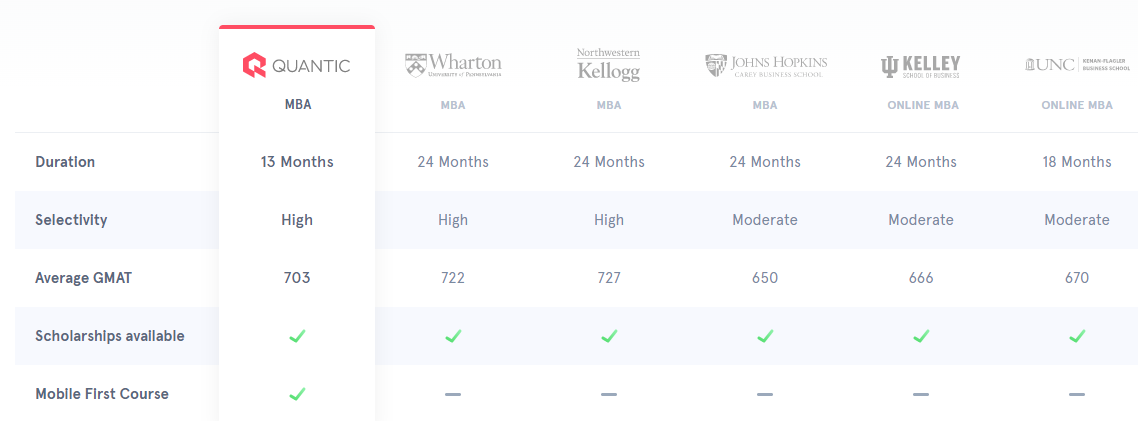
Quantic offers you some of the most flexible programs that you can come across from top accredited institutions. Not only does the program take a relatively shorter time to complete, but you can even take the first course via your mobile phone.

Have a look at how Quantic’s program compares to that offered by top business schools.
A table comparing MBA degree programs from various institutions

The Increasing Number of MBA Scholarships for Women

Scholarship programs that target women have contributed to the rise of women in MBA programs.

Many business schools and not-for-profit organizations offer scholarships to help women overcome financial barriers to their business ambitions.   

Some of these scholarship programs target specific female groups such as:

  • Women from minority communities
  • Women who own companies
  • Women who work in specific job fields

Others are conventional scholarships with a fresh emphasis on admitting more female candidates.

MBA Programs Offer an Expanded Program Portfolio

More than before, business schools today provide a broad range of master’s degree programs. 

The wide variety of programs allows you to discover and select one that best suits your needs. For instance, most business schools have added master’s programs such as Master of Accounting, Master of Finance, and Master of Management.

These additional programs provide you with new paths to full-time MBA programs, including  delayed admissions programs.

Moreover, they encourage candidates to apply while still enrolled as undergraduates.

Best MBA Programs in the USA

You can get your MBA degree from various business schools across the US.

However, if you want to stand out, you must go for the best programs that will equip you with real-world skills to excel in business.

Here are the top five business schools in the US.

1. Stanford University 

The MBA degree from Stanford ranks at the top because it’s one of the most recognized school names in the world. Thus, having a Stanford MBA makes it easy to penetrate any job market across the world.

2. University of Pennsylvania (Wharton)

An MBA from Wharton will help you secure employment quickly, given the high demand for Wharton graduates in the business world. This university also has one of the largest alumni networks in the world.

3. University of Chicago (Booth)

Chicago Booth is the country’s second-oldest business school and the first to offer the Executive MBA degree program in the US. It’s also the first business school in the world to have a Nobel Laureate on its staff. 

Chicago Booth is also known for its academic rigor, emphasis on analytics in all sectors, and proficiency in finance, economics, and marketing.

4. Harvard University

Harvard Business School (HBS) is one of the world’s most prominent business schools and provides its students with a wealth of options.

During your stay on campus, you’ll have the opportunity to meet a varied set of peers from all over the world due to the large student base. There are also student groups and elective courses to suit a wide range of interests.

5. Quantic School of Business & Technology

Quantic focuses on attracting the smartest and brightest brains and providing them with the contemporary skills and knowledge they need to improve the world.

Many online instructors have open or permissive admittance rules, which, although well-intentioned, ultimately harm students enrolled in the program, as indicated by low graduation rates and poor results.

Quantic operates differently.

Its goal is to link students to a global ecosystem of top experts and foster an atmosphere where they can communicate, cooperate, and solve difficult business challenges.

As a student, you’ll feel like you’re a member of a close-knit community of learners who can assist, encourage, challenge, and learn from one another.

Quantic isn’t part of the M7 (for now), but the affordability and flexibility of our online MBA programs make it among the best institutions to pursue your MBA.

What’s even better is that you don’t have to sacrifice your other obligations to pursue an MBA at Quantic.

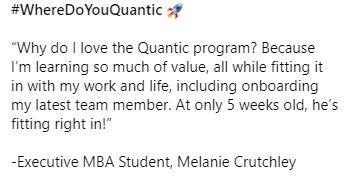
In the words of Melanie (our student), Quantic’s program is designed to fit into your busy lifestyle, not the other way around.

A review by a satisfied Executive MBA student

What’s more, Quantic believes in equal opportunities for all—both female and male. By supporting and encouraging more women in MBA programs, we can continue to foster a more inclusive and diverse business leadership environment. You can contribute to the changing tide today by contacting us and signing up for our next MBA intake.

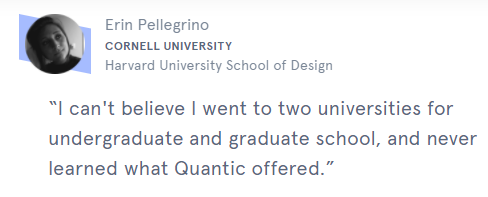
Indeed, some students, such as Erin, who attended prestigious, expensive business schools, wish they’d come across Quantic before enrolling.

A Quantic alumni’s review of the online learning platform

Frequently Asked Questions

Is Quantic’s MBA Program Accredited?

Yes.

Quantic’s program is approved by the Distance Education Accrediting Commission (DEAC), the recognized accrediting organization by the US Department of Education. Quantic’s ‘Active Learning’ technique, developed by academics from top MBA institutions, is used to give tuition via an interactive app.

How Long Does It Take to Complete an MBA at Quantic?

It will take you 15 months to complete an MBA at Quantic, about half the time you’ll take to complete an MBA in other top accredited business schools.

What is Quantic’s Selection Rate?

Quantic doesn’t have a selective target rate. The business school aims to accept as many applicants as possible without compromising the quality and consistency of its overall learning experience.

What Are Hybrid MBA Programs: Everything You Need to Know

Traditional universities offer the chance to collaborate and network with industry professionals, however, people who’ve already joined the workforce can’t deny the convenience of an online setup.

So, why not enroll in a hybrid MBA program and find time for your private and professional life?

Five of the top 20 business schools (as deemed by Fortune) offer hybrid MBAs and according to the Bureau of Labor Statistics, it leads to careers with a significant job growth rate.

However, many applicants are hesitant to take advantage of this new learning model. Despite gaining prevalence in education, hybrid learning is yet to gather significant backup evidence on efficiency.

The existing data suggests an unprecedented opportunity for working professionals, though.

So, join us for a complete overview of hybrid MBA programs, discover how they rival traditional and online systems, and how they can accommodate your work-life-education balance.

What Is a Hybrid MBA Program?

A hybrid MBA is a master of business administration program that combines online teaching methods with on-campus sessions.

While the bulk of hybrid MBA coursework happens in online environments, there’s also several face-to-face components called immersions. Immersions are set up by the school and include face-to-face seminars, lectures, and social events for networking purposes.

person taking notes from an online class

Hybrid MBA programs are becoming more common. They’re a trend that took universities by surprise at first, but research shows that prospective students mostly refuse the fully-online education.

Therefore, hybrid programs became the next big thing in postgraduate education. More schools got on board throughout the previous decade, marking a definitive shift from the in-person-only education model.

Hybrid MBA Acceptance Rate

Hybrid MBA programs welcome more applicants than campus-based classes. The online element allows universities to maintain class quality even in larger groups.

As a result, it’s easier to get into these programs, even in top-tier institutions.

The table below outlines the acceptance rates for five notable American schools in 2021-2022. We’ve compared the in-person arrangement with programs that combine online and offline elements.

UniversityAcceptance Rate—On-CampusAcceptance Rate—Hybrid MBA Program
USC Marshall30%34%
UT Dallas52%33%
Oregon State University75%93%
UMass Amherst92%95%
University of Florida23.9%71%

How Long Are Hybrid MBA Programs?

Most hybrid MBAand executive MBA programs take around two years to complete. Durations differ between schools, with some including 16 to 36 months of coursework.

The workload includes the core and elective subjects you’d get through an in-person program, so hybrid models progress at a similar rate to their on-campus counterparts.

The MBA and executive MBA at Quantic takes 15 months to complete. Our approach puts efficiency first to the full curriculum in half the time, reducing the strain on your finances and life obligations.

Apply for the Quantic MBA, get a degree, and acquire that higher salary and C-suite status sooner.

Hybrid MBA Costs

A hybrid MBA degree is more affordable than an on-campus MBA setup; the school doesn’t have to accommodate each student—except during the in-person weekends—which lowers overall tuition fees.

Nevertheless, there’s a large price variance between individual schools, depending on the quality of education and prestige of the institution.

The table below outlines the costs of hybrid MBA programs in notable schools, touching on their duration and selectivity for context, and compares them with the Quantic MBA program.

QuanticUSC MarshallUT DallasOregon State UniversityUMass AmherstUniversity of Florida
Price$950 USD per month$109,858 $95,052$52,080$34,225$59,807
Duration15 months21 months36 months30 months24 months16 months
SelectivityHighHighModerateModerateLowModerate
Average GMAT703630609530570680
ScholarshipsYesYesYesYesYesYes
Mobile-First CurriculumYes/////

Our MBA program is a better option in terms of time commitment and tuition, along with our mobile-first, tech-driven approach for a more efficient education experience

Quantic is sure to propel your career forward thanks to our strong network of academics and professionals, as well as being faster and results-oriented. Learn more about our program and how it offers an alternative to traditional postgraduate educational institutions.

Hybrid MBA Reviews

So, should you select a hybrid MBA program? The choice depends on your life situation, means, and preferences. Still, the growing popularity of blended education lends credence to this model of getting a postgraduate studying.

“The course is very convenient and flexible for the people who are confused between online MBA and classroom MBA.”

Sumit

Attendees appreciate the flexibility and convenience of online teaching, as well as the in-person dedicated qualities offered by the live events.

“As I am going into my 2nd year as a Hybrid MBA student, I can’t imagine going through a program that doesn’t have a cohort and teams model.”

Emily Huynh

“Most of my classmates are interested in building connections so we have found ways to do that virtually. I’m only 3 weeks in and I feel like I ‘know’ at least 2 dozen of my classmates pretty well.”

Slambur

Overall, the experiences with hybrid degrees are predominantly positive.

Best Online Hybrid MBA Programs

conference participants networking

University of South California—The Marshall School of Business

The USC Marshall School of Business MBA delivers an intimate student experience through mostly online tools. The professors are engaged, teaching a well-organized class schedule to advance professional careers.

The school further streamlines their process through frequent checkups and making resources available through various outlets, offering an education worth the considerable investment.

The curriculum covers real-world skills across five business management fields. The cross-disciplinary approach seeks to provide a deeper understanding of the entire industry.

The University of Texas at Dallas—Naveen Jindal School of Management

The UT Dallas management school offers a hybrid MBA program that allows students to self-organize and take courses and exams at a suitable pace.

This solution is suitable for attendees with frequent family commitments and numerous professional out-of-school obligations.

Courses are available through a multi-platform learning technology system, with diverse electives to tailor each participant’s resume. Online and live classes are given by trained professors who teach on-campus lessons.

Teamwork is encouraged, especially among applicants from mixed backgrounds, and all participants have extensive working experience, adding diversity to the networking opportunities.

University of Massachusetts Amherst—Isenberg School of Management

A hybrid MBA from UMass Amherst offers a blend of academic rigor and flexibility. The university has been at the forefront of online education, ironing out the issues stemming from mostly-online setups.

Professors and students alike report that the multi-platform approach doesn’t hinder learning and lets attendees and staff connect even outside the immersions.

The school offers the flexibility of self-organization and the opportunity for students to combine their online course load with in-person lectures and collaborations in three Massachusetts-based locations.

Despite these positive experiences, not every professional fares best in a hybrid environment. Recent developments in online communication are pushing more applicants to consider 100% online options, which are swiftly catching up to their hybrid competitors.

Online Business MBA vs. Hybrid MBAs

Online and hybrid MBA programs are replacing the in-person model of pre-coronavirus days. Leading residential business institutions are opting for a fully-online format, while elite schools are applying a hybrid method of teaching.

Where did this discrepancy originate?

Hybrid programs used to offer more advantages to attendees. Since online immersion was still clunky a decade ago, applicants benefited from in-person networking events. It’s no wonder that top-paying, top-50 company employees chose them for their postgraduate education.

However, today, numerous students believe that a hybrid setup offers equal quality to an online MBA. Pricing, thus, becomes the primary differentiating factor—face-time hybrid elements add thousands of dollars to your yearly fees. 

Paying extra is inevitable if you’re striving for an elite degree, and even schools outside the Ivy League might be pushing away potential applicants with their unjustified higher costs.

On top of that, research indicates that attending campus in a hybrid format doesn’t significantly improve learning outcomes; results are mostly a matter of motivation and dedication.

Therefore, the primary perk of blended programs stems from attending sessions that expand career connections. 

However, more schools have begun organizing virtual meet-and-greets and platform networking. 

Here are some more advantages of online MBA programs:

  • Lower costs than traditional classrooms and hybrid formats
  • Asynchronous curriculum delivered at the attendees’ schedules
  • Interactive online environments and virtual events
  • Shortest time to course completion and degree acquisition

These benefits are driving more professionals towards online-only setups. These degrees are increasing in value with more top-level working professionals carrying them. We expect to see a matching level of prestige between online and hybrid setups in the years to come.

The Best Online Business School?

The MBA marketplace is shifting with the advent of new technologies and learning approaches. The value of postgraduate education isn’t diminishing, but the traditional brick-and-mortar format is. Flexible, high-tech, virtual programs are quickly gaining precedence.

The Quantic School of Business is the epitome of this new approach, and the Financial Times agrees. Our MBA and EMBA programs mirror the curriculums of full-time B-school programs and are covered in significantly less time.

We’ve seen over 2,000 graduates in the past four years, all with excellent results. Our automated teaching setup increases interactivity, boosts retainment, and promotes a practical application of theoretical terms.

Our goal is to democratize postgraduate education. Our program is extremely affordable, costing only the necessities to expand our network and continue providing quality. We also offer three sponsored education options for students who need budgetary assistance.

We maintain an education standard confirmed by the Distance Education Accreditation Commission (DEAC), delivering a formal educational recognition in a smaller, more manageable package. Read our press releases to stay up-to-date.

Apply to the MBA and start furthering your education today.

How to Make Hybrid Work a Success in Your Organization

The coronavirus pandemic forced business owners and HR directors to adapt overnight to ensure their employees could work efficiently from home.

Consequently, hybrid working arrangements have been the norm for many organizations over the last two years.

In fact, a Microsoft report showed that 73% of respondents wanted flexible remote work options to continue in the future, while another survey showed that 40% of workers will consider quitting if made to return to the office full-time. 

With this in mind, employers now need to build a hybrid workplace strategy that allows employees to enjoy the best of both worlds. 

Today, we help you to understand the benefits, challenges, and practicalities of hybrid working.

What is Hybrid Working?

hybrid workplace

Hybrid working is a more flexible model of working where employees work both in the office and remotely. However, every company’s hybrid setup will be unique and depend on the company. 

Therefore, each business owner and HR director develops a hybrid working model or schedule based on: 

  • The needs of the company
  • The needs of the individual employee
  • The work being performed

Hybrid Working Benefits and Advantages

hybrid work team

Employers and employees benefit from hybrid work in the following ways:

  • Improved productivity and employee satisfaction
  • Talent from different locations, economic backgrounds, cultures, and skill sets
  • Improved talent retention because of flexible work schedules

Advantage/Benefit #1 – Increased Productivity and Employee Satisfaction

Most business owners and human resource directors believe that employees will do less work if they’re allowed to pick their own work hours.

Far from it, though, employees who have autonomy over how and where they work are more productive and satisfied with their jobs. After all, working remotely is associated with less distractions, less in-person micromanagement, and an improved quality of life.

In fact, recent studies have shown a rise in productivity among employees working from home:

  • 90% of workers stated that they were equally or more productive working from home compared to the office.
  • 32.2% of hiring managers say overall productivity has gone up among remote employees. 
  • 48% of workers want to work from home permanently.

Advantage/Benefit #2 – Broader Talent Pool 

Hybrid working opens the doors to new talent pools beyond what hiring managers deem a commutable distance to their office space. 

This allows you to fill skill gaps in your organization and acquire top talent from across the globe. 

Also, the Work Trend Index 2021 Annual Report showed that 46% of remote workers were willing to move to a new location to be able to work remotely.

LinkedIn data also shows that remote job postings grew by 2.4x between May 2020 and May 2021. 

These trends indicate that talent pools are no longer restricted by location or a candidate’s capacity to relocate.

Advantage/Benefit #3 – Improved Employee Retention 

A hybrid working environment leads to enhanced employee retention because:

  • Younger employees prefer a greater degree of control over their working location and hours. 
  • Young parents and caregivers embrace the opportunity to work from home as it allows for more time with family and flexibility with childcare.
  • People who feel their work-life balance is supported are less likely to leave your organization.

According to a Gallup poll, 54% of workers were willing to leave their current job for one that allowed for more flexibility in their schedule.

Disadvantages and Challenges of Hybrid Working

The possible challenges of hybrid working include:

  • Reduced social participation 
  • Cybersecurity risks
  • Exhaustion 

Disadvantage/Challenge #1 – Reduced Social Participation

Hybrid work policy reduces opportunities for employees to get together in social situations. 

A survey conducted to assess the psychological well-being of respondents who worked 41–60 hours from home showed that: 

  • 20% of employees felt more isolated compared to 14% who worked the same hours at their employer’s premises

Another study found that 61% of respondents missed office interactions.

Disadvantage/Challenge #2 – Cybersecurity Risks in the New Hybrid Work Environment

76% of companies adopted cloud services faster than they had anticipated due to the pandemic. This didn’t only increase attack vectors, but created vulnerabilities for hackers to exploit. 

Emerging data shows that the FBI reported a 400% increase in cybersecurity complaints since the onset of the pandemic. That’s about 4,000 complaints per day, as compared to 100 complaints before COVID-19. 

In addition, about 30% of companies reported an increase in the number of cyber-attack attempts since the start of the pandemic. 

Disadvantage/Challenge #3 – Exhaustion 

The lack of an established structure can result in irregular working hours, procrastination, and ultimately, exhaustion. 

Exhaustion can also arise due to increased digital collaboration, including:

  • Remote meetings
  • Emails and online chats
  • Groups working on documents together

According to a Microsoft study — high productivity tends to mask an exhausted workforce — as shown in the stats below:

  • 54% of the interviewees reported feeling overworked frequently.
  • 39% tend to feel exhausted. 
  • 60% of Gen Z claim they survive, rather than live.
  • 62% of meetings aren’t planned in advance.

How to Make Hybrid Working a Roaring Success

Define Your Hybrid Working Policy

To ensure your hybrid working policy makes an impact and promotes best practices:

  • Clearly set out which roles are eligible for hybrid working and why they are to mitigate future disputes.
  • Clarify the expectations you have when employees are working in the office and remotely, such as working hours, breaks, and sickness reporting.
  • Explain how to request hybrid work.
  • Clarify roles and responsibilities for hybrid workers and their managers. 
  • Review other related policies such as homeworking, health and safety, expenses, IT usage, and data protection. 

The policies appropriate for your organization will depend on your specific context. In addition, remember to issue your hybrid working policy with supporting guidance and information to enable effective implementation.

Communication, communication, communication

With team members working in different locations and possibly on different schedules, clear and consistent communication is more important than ever.

Here are some ways you can address this:

  1. Set Clear Expectations: It’s important to establish clear expectations for communication from the outset. Determine the preferred communication methods and frequency for team meetings, individual check-ins, and other forms of communication. Make sure everyone is on the same page about when and how to use each channel, and what to expect in terms of response time.
  2. Utilize Technology: Technology can be a game-changer when it comes to communication in a hybrid work environment. Consider using messaging apps like Slack, video conferencing tools like Zoom or Microsoft Teams, and project management software like Asana or Trello to keep everyone connected and on the same page. Be sure to provide training and support to ensure that all team members are comfortable and proficient with the tools.
  3. Foster Connection: Hybrid work environments can lead to feelings of isolation and disconnection, so it’s important to take steps to foster connection among team members. Encourage social interaction through virtual team building activities or informal chat channels. Consider scheduling regular virtual coffee breaks or happy hours to allow team members to connect on a personal level.
  4. Practice Active Listening: Active listening is a crucial skill for effective communication in any setting, but it’s especially important in a hybrid work environment. When communicating virtually, it’s easy to become distracted or miss important cues. Make a conscious effort to practice active listening by focusing on the speaker, asking clarifying questions, and paraphrasing to ensure understanding.
  5. Provide Feedback: In a hybrid work environment, it can be more difficult to provide feedback and offer constructive criticism. Make a point to provide regular feedback, both positive and negative, to team members. Encourage open and honest communication, and provide specific examples and actionable suggestions for improvement.

Experiment With Different Hybrid Remote Working Models

There’s no one-size-fits-all type of hybrid workplace. Therefore, experimenting with different hybrid remote working models has the following benefits:

  • Opportunity to customize according to employees and the organization’s preferences and needs
  • Ability to define work according to specific time commitments, work type, and worker categories 
  • Gives employees the flexibility they desire
  • Maximizes employee productivity and engagement

The table below shows the most common types of hybrid remote working models: 

Type of Hybrid Remote Working Models Characteristics 
Remote Some employees occasionally visit a physical workspace such as an office or coworking space
Split Splits the week between working from home 2–3 days per week and working onsite 2–3 days per week
In-person Employees may report to the physical workplace but can work remotely
Week-by-week Employees alternate working from home and working in the office on a weekly basis

Combine It With Professional Development

Business owners and HR directors who don’t focus on corporate training and development will lose out on:

  • Performance 
  • Engagement 
  • Retention 

Therefore, Quantic’s online programs are an essential training method for hybrid workforces. Our online MBA and online EMBA programs offer employers the advantage of our Tuition Reimbursement Program, which allows you to reimburse your employees.

Quantic’s online MBA program is also the only program that will give your employees the skills they need for long-term growth, and free access to top of the line training in the skills they need to compete.

Quantic’s students perform as well as or better than MBA students from HBS and UNC. The quality of education also rivals that of the top 10 business schools worldwide.

For more information on how we can help integrate the online MBA into your workplace, contact us today.

“Participating in Quantic’s EMBA influenced how I approached my current role and contributed to me receiving a promotion prior to completing the program.”

Marcus Gilmore, New York University

Create Hybrid Working Best Practices

The benefits of creating hybrid working best practices are:

  • They provide the best course of action in a certain situation.
  • They serve as the roadmap for how to operate a hybrid workplace. 

Examples of hybrid working best practices include:

  • Lead by example: Encourage transparency in how teams use their time and be flexible in coordinating how work gets done. 
  • Stipulate expectations for in-person meetings: Set the location in advance to ensure you have the technology required to effectively communicate with those on Zoom or teams.
  • Recognize the signs of burnout for yourself and others: These can include measurable declines in the quality of work, withdrawal, irritability, and poor concentration.
  • Build a learning culture: Implement an elearning platform to kickstart the learning process.

Build a Productive Hybrid Working Environment

One of the main reasons employees dislike hybrid working is that they change environments frequently. 

Here are ways employees can boost productivity and reduce the friction that comes with maintaining multiple workspaces:

  • Go paperless as much as possible to avoid carrying files back and forth between home and office.
  • Invest in a second external keyboard, mouse, and laptop charger, so you don’t have to plug and unplug everything all the time.
  • Determine which tasks need to be done exclusively in the office. 

Business owners and HR directors support a productive hybrid working environment by ensuring that employees are well-cared for. A team’s performance may also be enhanced through upskilling, coaching, recognizing others’ needs, patience, and providing others time to perform a task. 

If you’re ready to supercharge your team and enhance their performance and loyalty, set up tuition reimbursement for Quantic’s degree programs today. 

“Quantic is pedagogy done right for the modern omni-learner……..I could really see the best practices so often talked about…..”

Samuel Miles, Yale University

7 Best Careers After Having a Baby: Reinvent Yourself Today

Congratulations on your baby! 

Motherhood is a life-changing experience. You’re now stronger, have developed immense patience, time management, and other skills, and your priorities have shifted tremendously. 

Perhaps you feel it’s time to begin working towards a career or you want to seek a change in your current career path. Whatever your situation, you know that you want a more intentional and purpose-driven life. 

To help, we’ve compiled a list of the best careers for working moms in 2023 and ordered them by flexibility and earning potential for your convenience.

Although some of these career options don’t require higher education, you should consider pursuing an MBA to increase your opportunities. With improved technology, you can easily get this accredited degree from the comfort of your home. 

Assess Your Current Situation First

mother holding baby

Before you begin your career journey as a mom, it is important to:

  • Understand the difference between a career and a job 
  • Assess your individual situation and opportunities

The difficulty in differentiating between a job and a career has resulted in  widespread job dissatisfaction and feelings of purposelessness. 

Therefore, you must remember that a job is mainly for financial stability, while a career is driven by your passions and made up of a combination of roles, experiences, education, and pathways. The table below further outlines some of the key differences between a job and a career.

CharacteristicsJobCareer
RequirementsBasic educationTraining in a specific field
FocusRegular incomeInnovations and learning
DurationShort-termLong-term
PaySteady paycheckLong-term financial security
StabilityAffected by external conditions like technology advancementsSecure due to skills and qualifications

Starting a Career After Having a Baby

Aside from shifted sleep patterns and changes to your social life, you now need to provide for your new bundle of joy and yourself . If you were working a regular job for stability, you may now feel the urge to seek a purpose-filled career that provides job satisfaction and financial security.

However, before making any decision on your career path, there are a few things to consider: 

  • Earning potential 
  • Flexibility
  • Skills and experience

Although you may have limited professional experience, the good news is that this creates numerous avenues and career options for you to choose from. To that end, consider further education to gain relevant skills and knowledge to increase your opportunities and earning potential.

Thanks to digital advancement, you can now pursue a higher degree from the comfort of your home, at your own time, and in easily digestible formats.

Career Change After Baby

Maternity leave is important as it allows you to bond with your newborn child. However, for professional women, it’s also a necessary break from the stress and pressure that comes with any career. During this time, you may get a fresh perspective that makes you desire something different. 

However, unlike before, where you had more time to yourself and could take risks without major consequences, you must now consider the effects of your decisions on your newborn child. 

Luckily, a career change after having a baby is very possible. Because you already have professional experience, you can easily use your transferable skills, qualifications, and network to cushion you as you start down your new path.

You can also consider applying for an MBA to further increase your earning potential.

“ My journey with Quantic has been incredible. The material equipped me with knowledge that led to a 66% salary increase.”

Robin Lu

7 Best Careers For Moms 2023

Mothers looking to launch new careers face many competing priorities, from finding a fulfilling job with good pay and benefits, to creating a good work-life balance, it can all be extremely draining but we’re here to help.

Our list is organized according to the level of flexibility, earning potential, and includes educational requirements. Regardless of your situation—single, married, stay-at-home—you will find the perfect career.

Job #1 – Web Developer

woman working in front of three screens

It’s a fact that technology is hot these days, yet there are not that many people with careers in this field. This means that there are plenty of job opportunities with extremely high earning potential.

You’ll be involved in the design, creation, and maintenance of websites ensuring that they are functioning appropriately and allow the company to achieve its online goals. 

This is a highly remote job—though you will be required to meet with the clients occasionally—that favors stay-at-home and single moms. 

Education:

  • Bachelor’s degree/diploma in IT is highly preferred.
  • Higher education will be useful for self-employed moms.

Salary Expectations: 

Job #2 – Market Research Analyst

magnifying glass on a document of graphs

In this career, you will be conducting regular trend analyses and using the collected information to advise businesses on what direction they should take. 

The role requires an interest in behavior as well as keen observation and analytical skills, which makes this an exciting career choice for working mothers.

There is great demand for this role and it has a high projected growth rate of 22% within the next 10 years. Another great benefit is the flexibility to choose a schedule that suits your needs.

Education: 

  • Bachelor’s degree in marketing, market research, statistics, computer science
  • MBA for leadership positions

Salary expectations:

Job #3 – Human Resource Specialist

woman interviewing man in black hat

By nature this career has straightforward hours and requires a balance between empathy and efficiency—skills that you already have—making it the perfect family-friendly career for mothers.

You’ll be recruiting, interviewing, and placing workers with employers as well as handling tasks related to employee relations, compensation, benefits, and training.

If you enjoy working with people and want a position that allows you to leverage your natural skills, then this is perfect for you. 

Education:

  • Bachelor’s degree in human resources, business, communications

Salary Expectations: 

Job #4 – Nutritionist

nutritionist with a chart on vegetables

Employment of nutritionists has been projected to grow by 11% within the next 10 years. For working mothers who are fascinated by food and enjoy helping others, this is an excellent career choice. 

After taking the necessary courses and licensing examinations, you’ll be an expert in food and nutrition. Career options are wide as you can choose to focus on a specific demographic, for example, teenagers or children, or a specific diet, for example keto, as your specialty. 

Your work will involve educating your audience about healthy food choices, and helping them on their journey to achieving their health and fitness goals. Advancement in technology makes this an exciting career as you can leverage social platforms to easily grow your business from the comfort of your home at your time.

Education: 

  • Bachelor’s degree (preferably food and nutrition)
  • Supervised training
  • Licensing from local authority

Salary Expectations: 

Job #5 – Graphic Designer

woman looking for inspiration online

Are you creative and drawn to art beyond coloring books and glue? If you answered yes, a career in graphic design may be the perfect choice. 

In this career you’ll be creating visuals to communicate ideas that attract customers. Success will be dependent on using your existing time-management skills, accommodation of different perspectives in your work, and ability to understand complex briefs and produce quality work.

This career is perfect for stay-at-home moms as it can suit your schedule, and has diverse opportunities in almost every field so you can be sure of a high level of satisfaction while on the job.

Education: 

  • Bachelor’s degree or diploma in graphic design 
  • A portfolio of work

Salary Expectations:

Job #6 – Realtor

woman holding a for sale sign

If you enjoy meeting new people, have strong sales skills, and are interested in real estate, then this is the career choice for you. Your high organization and smooth negotiation skills will come in handy in this role, where you’ll assist clients in buying, selling, and renting properties.

Although the hours can be long, you have the option to choose how you work—either employed, consultant, or part-time—which is exactly the kind of flexibility you want in your new career.

Education: 

  • Bachelor’s degree, high school diploma, or equivalent
  • Local licenses 
  • At least 60 hours of real estate classes (region-specific)

Salary Expectations:

Job #7 – Medical Assistant

medical assistant measuring patient’s blood pressure

A medical assistant is a professional who helps physicians, hospitals, clinics, and other healthcare facilities complete administrative tasks. In this role, you will be tasked with: 

  • Measuring signs of blood pressure
  • Preparing samples for testing
  • Scheduling appointments
  • Recording patient information

As a mother, you’ll likely have medical skills and information picked up either during hospital visits or through self-learning. With further training and education, you’ll be on the path to a purposeful career. This role has a standard 9–5 workday which leaves your evenings free to spend with your family.

Education:

  • Postsecondary non-degree award
  • Medical assistant training (not compulsory)

Salary Expectations: 

Having a Baby Without a Job

Babies are precious and it’s perfectly fine if you find yourself having a baby while unemployed. Though at first, this period may be difficult, you can transform it completely to your advantage. 

The time you spend nursing your child can be used as a self-reflection period where you assess your passions, interests and search for career paths that align with them. Additionally, you can pick up short courses to further deepen your interests or small projects that can help you build relevant skills.

Once you’ve decided on a career path, you can open up further opportunities by getting an accredited MBA from the comfort of your home and at your time. This is a great way to turn what you may have seen as an obstacle into a massive opportunity for yourself and your child’s future. 

Get Ahead With an MBA

So, there you have it; 7 amazing careers for working mothers to help you feel purposeful while caring for your child. Choose to stand apart from your competition and increase your career opportunities by improving your skills, deepening your knowledge, and connecting with peers on a global stage through an online MBA. 

Barbara Meyer, pursued an Executive MBA program with Quantic while balancing her responsibilities as a single parent and working professional. Her student spotlight article highlights the challenges that mothers face in pursuing higher education and career advancement, and how Quantic’s online MBA program provided a flexible and accessible option that allowed her to achieve her goals without sacrificing time with her child.

Barbara’s experience may serve as inspiration and encouragement for other mothers who are considering pursuing an MBA or other career advancement opportunities.

You can take your first step towards your dream job today. Apply for the online MBA program here.

10 Hyper-Successful Female Entrepreneurs: Did an MBA Help?

Ellen Kullman is the former CEO of DuPont and an accomplished business leader. However, at one point in her career, a male colleague mistook her for an assistant and sent her for coffee.

Why? 

She was the only woman in a high-level meeting.

Her story exemplifies the continuing underrepresentation of women in business, despite the collective global efforts to close this gap.

In the following sections, we’ll delve deeper into female entrepreneurship and its challenges, and look at these 10 hyper-successful female entrepreneurs who made it big despite those challenges.

  • Lillian Lincoln Lambert
  • Sheila Lirio Marcelo
  • Eva Michalkova
  • Kaitlyn Yang
  • Anne Michael
  • Paige Drobny
  • Olivia Lin
  • Cindy Mi
  • Ramona Hood
  • Melaye Ras-Work

What Percent of Entrepreneurs Are Female?

There are 13,000,00 women-owned businesses in the US, representing 42% of all businesses in 2023.

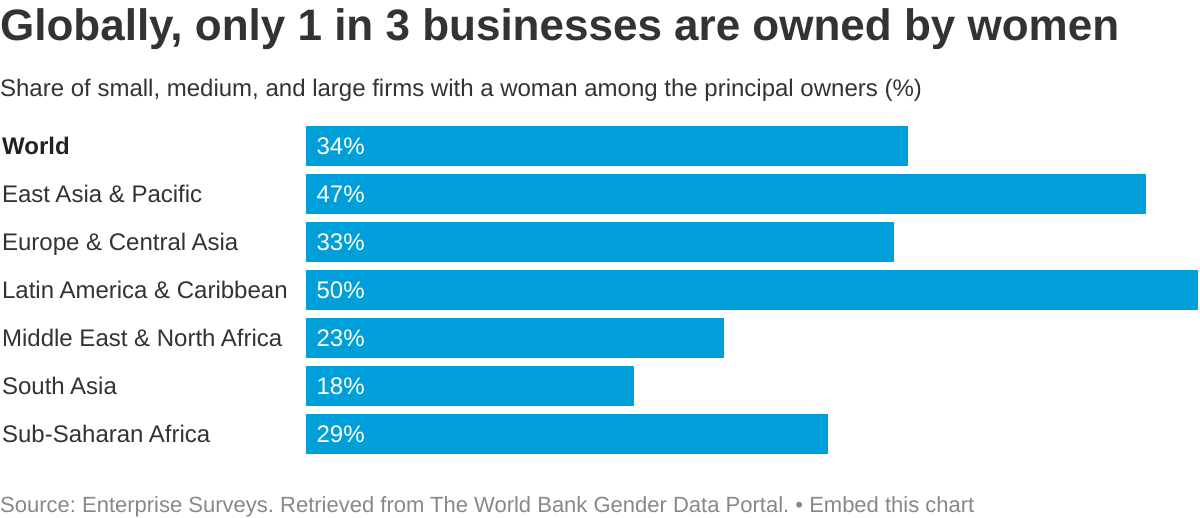
This figure is higher than the global total of 34% but lower than the regional totals of Latin America and The Caribbean—with 50% female ownership. 

The following graph compares the percentage of women-owned businesses by region.

World Bank report on female entrepreneurs

As you can see, the percentage of female entrepreneurs varies across regions with a low of 18% in South Asia and a high of 50% in Latin America & The Caribbean.

A World Bank study on why there are fewer female entrepreneurs in particular regions revealed a correlation between female business ownership and a country’s income level.

Low-income countries have fewer female-owned businesses (1 in 4) than middle and high-income countries (1 in 3). This is because women in low-income countries have far less access to credit and are less likely to borrow. 

The following table compares the probability of borrowing between men and women from low, middle, and high-income countries.

CountryWomen
Low-income5%
Middle-income7%
High-income24%

Source: The World Bank

What Is the Percentage of Successful Business Men to Women in the United States

42% of the businesses in America are owned by females. Men own the other 58%.

This was a drastic increase of female owners from 1972 when there were 96.4% male-owned businesses to 4.6% female-owned businesses.

This steady rise of women entrepreneurs reflects changing attitudes towards women, with more support from the private sector and the government. For instance:

  • In 1994, the US government allocated a minimum of 5% of contracts to women-owned businesses.
  • Today, more than 30% of S&P 500 board directors are women.

What Are the Challenges Faced by Female Entrepreneurs?

Over the years, the growing number of female entrepreneurs has come to represent a changing business landscape—one that’s favorable towards women. However, women still face unique obstacles.

Limited Access to Networks

Networks impact entrepreneurial success. They are avenues for accessing information, mentorship, funding, and business referrals, usually through meetings outside working hours.

Unfortunately, with the majority of businesses owned and managed by men and our human tendency to be drawn to similar individuals, few women get invited to such gatherings. This keeps female entrepreneurs from such opportunities as access to loans and venture investment.

A recent report by the US Senate Committee on Small Business and Entrepreneurship found that:

  • Women account for 16% of conventional small business loans.
  • Women account for 4.4% of loans from all sources.
  • Women-owned businesses get $1 out of every $23 in conventional business loans.

Work-Life Balance

Society places unequal responsibility for family and childcare on women.

This extra burden of balancing work and family pushes some female entrepreneurs to avoid long working hours or ambitious goals, limiting their entrepreneurial potential.

A 2014 study found that women-owned businesses have significantly lower rates of capital returns than male-owned businesses.

The good news is that several successful businesswomen have proven these challenges are manageable.

10 Hyper-Successful Female Entrepreneurs

Entrepreneur 1 – Lillian Lincoln Lambert, Centennial One

Lilian Lincoln Lambert, the first African-American woman MBA from Harvard, is an inspiring female entrepreneur who started with nothing and built Centennial One, a million-dollar cleaning services company. 

In the early years of Centennial One, Lambert struggled to find contracts. This was during segregated America when such contracts were hard to find for minorities.

Fortunately, Lambert had a network to turn to. Established during her MBA years when she started an advocacy group for black enrollment, her network gave her access to government contracts through the SBA (Small Business Administration) program for minorities.

Today, the business world remembers Lambert for her dedication to helping fellow entrepreneurs and her strong belief in education.

Entrepreneur 2 – Sheila Lirio Marcelo, Care.com

Sheila Lirio Marcelo puts paid to the idea that work and kids are a hard balance. This Havard MBA started with nothing and built a million-dollar enterprise, all while raising a family.

Her company, Care.com, helps families find a wide range of care services, inspired by her time at Harvard Business School when she couldn’t find help caring for her son.

Marcelo graduated with an MBA degree that facilitated her climb from consultant at Monitor Company to vice president and general manager at Ladders Inc.

This exposure helped Marcelo expand her network and secure funding for Care.com, which InterActiveCorp(IAC) later acquired in a deal worth $500 million.

Today, Marcelo is working on a new project, Proof of Learn, a platform that promotes learning by awarding users with cryptocurrency and NFT credentials.

Entrepreneur 3 – Eva Michalkova, No F-ears & MIRAIO

When Eva started No F-ears, a live chat tool that facilitates real-time conversation between a hearing doctor and a deaf patient, she was met with overwhelming success. 

The company won multiple awards, which encouraged her to start MIRAIO, a more significant solution than just communication, but running this business was more challenging.

MIRAIO had a larger global customer base with a variety of social and cultural influences, which complicated marketing. She had to figure out the best marketing channel for each group, measure returns, localize content matter, and stay within the budget. 

So, Eva decided to pursue an MBA with Quantic to acquire the necessary business skills for international business without taking time off work.

Today, MIRAIO is a global brand that has massively changed how deaf and hard-of-hearing people access information and health care.

“To succeed in the fast-paced business world, I aspired to obtain the business skills I needed to accelerate my career.”

Eva Michalkova, Quantic MBA

Entrepreneur 4 – Kaitlyn Yang, Alpha Studios

Kaitlyn Yang has her own post-production company, Alpha Studios, and more than 40 visual effects credits, including:

  • Robot Chicken
  • Falling Skies
  • The Walking Dead

She also has an MBA from Quantic and was recently featured on Forbes 30 Under 30.

 However, as a disabled, Chinese-American woman in a male-dominated creative industry, recognition was always an uphill battle. While on set, Yang often got the question, “Who are you visiting?”

There just weren’t enough women with Yang’s background in the industry.

Determined to change the narrative, Yang worked harder at building her brand, Alpha Studios. A Quantic MBA added to her business acumen and accelerated the growth of her company.

Today, Kaitlyn Yang is one of the biggest names in her industry and an inspiration to other female entrepreneurs.

“If you’ve got that 9-5 locked down, figure out what you can do to use that opportunity to add other skills.”

Kaitlyn Yang, Quantic MBA

Entrepreneur 5 – Anne Michael, Focused Software

Anne Michael became VP of operations at Focused Software and realized that she needed to improve her business skills to be successful. She was going to be in charge of determining strategy and managing client needs, which was much different from her previous role as a physician.

This led her to the MBA program at Quantic. The curriculum was highly structured to accommodate work and travel, so all she needed was 5–15 hours each week. The program was  comprehensive and featured courses on:

  • Leading organizations
  • Data & decisions 
  • Strategy
  • Markets and economies
  • Supply chain & operations

Today, Focused Software is a leading applications developer for special needs companies, with clients from multiple US states.

Entrepreneur 6 – Paige Drobny, Squid Acres

When Paige Drobny purchased a ski lodge off the Denali Highway—a remote, scenic location in Alaska—she recognized she needed help getting the business running.

As a newcomer to the tourism business with a background in science, Drobny needed foundational knowledge in accounting, business law, and marketing—in a nutshell, an MBA education.

She also needed it delivered remotely to her new lodge, which had 50 sled dogs and property that required constant managing.

This led her to the MBA program by Quantic, which featured a mobile platform for remote access and a comprehensive curriculum for deep learning. The coursework came in bit-size video sessions which were easy to fit into her busy schedule to ensure completion.

Today, Paige Drobny is a successful entrepreneur with multiple businesses.

Entrepreneur 7 – Olivia Lin, Studio 1 Labs

Olivia Lin started Studio 1 Labs, a textile technology company, but soon realized she had gaps in knowledge of business and strategy. Lin found it difficult to keep up in important conversations with executives and possible partners about her company.

This undermined her efforts to generate interest for her smart blankets capable of reading patients’ vitals.

Lin, thus, decided to apply for an executive MBA from Quantic to gain a better understanding of finance, marketing strategy, and accounting within the context of starting a tech company. 

Today, Olivia Lin is a recognized entrepreneur who recently won the Markham Board of Trade Aspire Startup Award and was featured in Girls in Tech.

Entrepreneur 8 – Cindy Mi, VIPKid

Cindy Mi is an avid educator, entrepreneur, and founder of VIPKid, an online tutoring company from China worth billions of dollars. 

However, the climb to the top was arduous.

Cindy Mi started with ABC English, a language-teaching school based entirely in China. Though the company was profitable, the industry was hyper-competitive. She needed to scale her idea and go global to stay competitive but had no experience running a multinational. 

This inspired Cindy Mi to undertake an MBA from Cheung Kong Graduate School where she learned how to run an international business and expanded her network. Soon after, VIPKid was established with investments from Sequoia Capital, Tencent, and Yunfeng Capital.

Today, Cindy Mi is a world-famous entrepreneur and often advises on building a global company.

Entrepreneur 9 – Ramona Hood, FedEx

19-year-old Ramona Hood was a single mom working a 9-to-5 job when she landed a receptionist role at Roberts Express, which later became FedEx Custom Critical.

FedEx exposed Hood to various roles and positions, leading her to develop an interest in business leadership. Her interest inspired her to obtain a Bachelor in Business Management from Walsh and later an executive MBA from Case Western.

With her business experience and education, Ramona Hood rose to senior management and later became the first ever black woman to lead FedEx. 

Today, Ramona Hood is glass ceiling-shattering proof that women can have both a successful business career and a family.

Entrepreneur 10 – Melaye Ras-Work, Efficio Consulting

Melaye Ras-Work has an MBA from INSEAD, a Bachelor in Economics from Brown, and is co-founder of Efficio Consulting, the largest global consultancy focused entirely on procurement.

In the early years of Efficio, Melaye struggled to find funding due to the 2000 dotcom crash when there was little interest in financing a professional services startup.

So, Melaye drew on her MBA training and restructured her expenses and cash flows while organically growing her client base. This strategy solved their funding problem and turned Efficio into a global brand.

Today, the company has a talent pool of 500 experts and serves clients across Europe, North America, and the Middle East.

How Can Women Be More Successful in Getting Business Leadership Positions?

Marilyn Chew, Quantic alumna

It’s no coincidence that the most innovative companies are also the most diverse.

Men and women experience the world differently which informs their approaches to business. Working together facilitates exchange of ideas and promotes the creativity that pushes organizations forward.

In particular, women have a unique insight into the “female economy” and a better understanding of purchase motivations. Any organization with female customers needs this knowledge to compete effectively.

This is why it’s critical to have more female corporate leaders, and an MBA is an excellent way to achieve this.

Quantic MBA is an accredited online program that will help you break into the business world, whether you’re looking to start your venture or work your way up to senior leadership.

An MBA from Quantic will give you:

  • A deep understanding of key business principles and entrepreneurship
  • The perspective and analytical skills of senior leadership
  • A high caliber student and alumni network; spanning over 150 countries. This will help you expand your professional horizons. 

Apply for the Quantic MBA today and jump-start your career.


MBA Mom Ultimate Guide – Practical Advice for Moms Pursuing MBA

More than half a century after women began pouring into the American workplace, only a handful have made it to the C-suite.

In 2023 only 10% of Fortune 500 CEOs are women. The number translates to 53 women running Fortune 500 businesses. 

Considering that 56.8% of the US workforce is female, the number of women reaching the top is disappointingly dismal. Even so, the paltry figure represents remarkable progress. In 2011, the percentage of female CEOs in Fortune 500 companies stood at 2.4%. 

There are many reasons why so few women reach the top of the corporate ladder. Some of the main reasons include unconscious gender bias and the fact that women at the top tend to be concentrated in roles that are less likely to track towards being CEO. 

For many women, a big hindrance to their career growth is the challenges that come with motherhood. While motherhood is rewarding in many ways, studies show that it can have a detrimental effect on women’s career progression.

In the face of these challenges, earning an MBA is one of the best ways for mothers to stay ahead of the game. An MBA gives you the skills and confidence to take up Profit/Loss positions, leads to valuable connections, and opens doors to entrepreneurial and career success.

You may be wondering, “How can I manage to study for an MBA while still being a great mom?

MBA Working Mom’s Survival Guide and Practical Advice

MBA Working mom studying for an online MBA

Balancing the demands of work and family leaves many women with little time to focus on pursuing other goals, such as an MBA. 

However, with preparation, determination, and the right program, you can attain your educational and career goals. 

Read on for practical advice for working moms pursuing an MBA. 

Build a Support Network

Building a support network at the office as an MBA working mom

Your network is critical to your professional and social development. As a working mom, you’ll especially need to have understanding and supportive people around you as you pursue your MBA. 

Your network might include your partner or co-parent, extended family members who can help with the kids, close friends, and neighbors. It’s also important to get your boss and colleagues on board—they’ll have to be accommodating to your schedule. 

On the homefront, discuss with your partner how they can be more supportive. Do you need them to take on more domestic chores? Will they have to shoulder more financial responsibility?

To further improve your career prospects, you also have to invest in developing valuable professional networks. Fortunately, pursuing an MBA allows you to connect with like-minded individuals, such as alumni and classmates, who can help you take your career to the next level. 

While at it, remember that it’s especially important to build close relationships with other women. Studies show that to achieve executive positions with the highest levels of authority and pay, women have to have an inner circle of close female contacts.

Networking isn’t merely about meeting people and introducing yourself in the hopes that they’ll connect you with opportunities. It means building meaningful, mutually beneficial relationships.

Here are some tips on how to build a strong support network:

  • Be of value: Approach networking as a “giver” instead of a “taker”. As a giver, you are focused on how you can be of value to others. When you extend a helping hand, the people you connect with are likely to reciprocate whenever they can.
  • Create friendships: When networking for professional reasons, it may seem counterintuitive to focus on building friendships, but you should aim to connect beyond professional interests. Look for ways to connect through hobbies and shared interests for fruitful long-term friendships.
  • Ask for advice: When you connect with people, especially mentors, prioritize asking for advice instead of jobs. Ask probing questions that will help you gain insight into your industry. Guidance and referrals that come from asking for advice will go a long way towards helping you get your dream job. 
  • Attend relevant events: MBA programs usually organize or host networking events such as dinners, coffee chats, cocktail receptions, and presentations. Make a strategic plan to attend events that will connect you with the right people. 

If you decide to take an online MBA, make sure that the program provides learners with opportunities to meet and connect. 

Quantic is an excellent choice for students who want to maximize their networking potential while taking an online MBA. Quantic’s Network enables students and alumni to discover peers in their geographical area who share their interests. 

The Network Events tab allows learners to peruse community events where they can make real-world connections with their classmates. The events, which are held in cities around the world, range from in-person conferences, meetups, and book clubs.

Get Social 

Getting social while studying for a full-time MBA with family

Studying for a full-time MBA with family can be overwhelming, especially when you’re juggling it with work. However, don’t forget to socialize and build a community—it will help you maintain psychological and emotional balance. 

As you’ll be interacting with the same group of people for many months, you might as well build relationships that can give you lifelong benefits. 

How you socialize depends on whether your program is online or offline. In offline programs, socializing may take the form of getting coffee together, going on weekend hikes, or attending parties. 

If you’re taking an online MBA, socialization may look a little different and require more effort. You can plan video hangouts with your classmates, host virtual watch parties, and plan for offline meetups. 

Whether online or offline, bear in mind that interactions with peers can at times be more competitive than cooperative. Instead of competing, focus on building a positive community and forging lifelong relationships. 

However, navigating the fine line between cooperation and competition can be tricky. The following tips will help you socialize effectively during your online or offline MBA program:

  • Introduce yourself: Do you find introductions intimidating? Overcome the intimidation and make the first move. While introductions can be awkward, they are the most important part of making a connection. 
  • Form study groups: Your classmates have a shared objective: getting good grades. Instead of working alone, you can work together with your peers to help everyone achieve their objectives. 
  • Organize social outings: Another way to take the initiative is by organizing social outings where true friendships and networks can be formed. For instance, you can invite your classmates for happy hour, to go on a hike, or watch a movie. Social events build a team feeling that everyone will appreciate. 
  • Enjoy diversity: You’ll probably be studying with students from all over the world. Each person will bring their unique perspective, which will enrich your MBA experience. Take full advantage of this by connecting with people from different backgrounds and ethnicities. Take it a step further by organizing cultural events where learners get to share parts of their culture, such as music, dance, and cuisine. 

Socializing will strengthen your networking efforts as an MBA working mom. When you make friends with your classmates, they are more likely to share useful information about your MBA assignments and relevant opportunities.

Quantic uses Slack to make it easier for online MBA learners to connect and socialize. Through the Quantic Slack community, you’ll be able to:

  • Interact with your classmates
  • Sign up for group projects
  • Engage in discussions on course material
  • Receive notifications about course administrative topics

In the week before your course’s start date, you’ll receive a link to your cohort’s Slack group. You’ll have access to Quantic staff to answer any questions you might have.

Choose the Right Program

Quantic Active Learning method MBA

To have an easier time juggling work, school, and family, it’s important to choose the right program. As a professional mom, you’ll need a program that will work with your demanding schedule and responsibilities right out of the gate. 

If you’ll be working full time, you should look for a program that will fit in with your work schedule while also leaving you with enough time to attend to your parental responsibilities. 

Plenty of working moms opt for an online MBA program. Studying online gives you the flexibility to take your classes, review course materials, and complete assignments when your schedule allows. 

For instance, you can concentrate on your studies early in the morning before your kids wake up. Alternatively, you can make the late evenings your special MBA time while the kids are sleeping. You can even study when younger kids are napping or during lunch breaks at your job. 

If you go for a traditional offline program, make sure that it provides adequate support for working moms. Do they have a lactation room? Do they offer child care on campus? What other support programs do they have for mothers? 

For moms considering an online MBA, Quantic should be at the top of your shortlist. Quantic MBA courses are delivered in bite-sized, interactive lessons that you can easily fit into your schedule. Our award-winning “Active Learning” method enables us to teach faster and more effectively than traditional lecture-based MBA programs. 

[Insert video]

Alt: Quantic Active Learning method 

Consider the Affordability of the Program

Consider the affordability of your MBA program

Getting an MBA can be an expensive affair. A traditional two-year MBA program will cost you more than $60,000. If you take an MBA at one of the top business schools, you could end up paying as much as $100,000 or more. 

With the financial demands of parenthood, you are likely to have a tight budget. It makes sense, therefore, to look for an affordable program.

Fortunately, online MBA programs tend to be more cost-friendly. According to AffordableCollegesOnline, the average cost of a fully-online MBA is $29,037. In addition, you won’t have to spend on transportation, parking, hard-copy textbooks, and on-campus living expenses. 

To make the costs even more manageable, you can opt for a part-time rather than a full-time online MBA program. Studying for a part-time MBA with kids will give you more flexibility. Alternatively, you can go for an accelerated MBA program where you can complete the entire program in less time. 

Through an innovative employer-funded tuition model, Quantic is dedicated to reducing and often eliminating the learner’s cost. 

Hundreds of companies have approved our MBA and Executive MBA programs for tuition reimbursement, which can offset as much as 100% of your tuition costs. We’re open to working with your company’s HR department as needed. 

Tuition for both the Executive MBA and MBA programs at Quantic is just $950 USD per month over the 15-month duration of the program. You’ll also be eligible to apply for partial or full tuition assistance based on both need and merit. 

The table below compares the average costs of offline and online MBAs with Quantic’s MBA programs.

Program TypeAverage Cost
Traditional MBA$60,000 – $ 100,00
Online MBAs$29,037
Quantic MBA and Executive MBA$950 USD per month, 15 months

Use a Career Network 

Use a career network to get hired as an MBA working mom

An MBA can help you get job interviews, but it doesn’t guarantee that you’ll land the job. You will still need to develop the necessary skills, establish valuable networks, and demonstrate passion in your chosen field.

With MBA job placement rates decreasing since 2020, learners should improve their employment prospects by using their program’s career network. To overcome gender bias and snag your dream job, you need all the help you can get.

Quantic MBA Mom’s Real Life Success Stories 

Quantic understands how hectic it can be to balance work, studies, and family. That is why we are dedicated to designing one of the best MBA programs for working moms. 

Don’t just take our word for it. Let’s look at what some of the moms who have taken Quantic’s MBA have to say about their experience. 

These two busy, single working moms found Quantic to be fun, affordable, and flexible. With our MBA programs, they were able to advance their careers.

Barbara Meyer, South32 Connectivity & Cyber Security Program Manager: Completed an Executive MBA with Kids

Q: Why did you join Quantic?

Although business schools have been encouraging more women to join master’s programs, many of them don’t provide programs that are conducive for moms. 

As a single mother of a toddler, I realized that in supporting my daughter’s growth as a strong, independent, educated woman, I needed to be a role model for her. I had to be the best version of myself and advance my professional career. How could I do that without missing precious time with my daughter?

Traditional MBA courses seemed to be daunting. They were costly, had lengthy course durations, and required one to attend fixed on-site lectures. When I came across an online invitation to an MBA with Quantic, I was excited.

Unlike traditional MBAs, Quantic was flexible, mobile, and affordable. In addition, the learning method was pedagogically sound, ensured active student participation, and could be completed in 15 months.

Q: What was your experience like as a mother?

The pace and schedule of the program were manageable. Fortunately, I had flexible working hours and plenty of support from my employer. 

With bite-sized lessons available on mobile, I used every spare five minutes to complete a learning unit. I had enough time to study during lunch breaks, waiting in queues, or after tucking my little one into bed. It was an interesting and enjoyable journey that’s definitely worth the effort. 

Q: How did it change your life?

I have been able to incorporate what I learned into my day job, applying some of the principles to make innovative changes. I hope that this will encourage other moms out there. You can complete the Quantic EMBA while tending to your family and working full-time. I’m grateful to Quantic for going the extra mile to make moms feel welcome in the MBA and Executive MBA programs. 

Read more about Barbara’s story here.

Sabrina C. (Switzerland): Completed a Full-time MBA with Kids

Q: Why did you join Quantic?

The Quantic program was perfect for me! I juggle a very intense job with being a single parent and joining a local university was no option for me because of these two factors. 

Q: What was your experience like as a mother?

I was looking for a program that allowed me the freedom to study whenever it suited my schedule. Even while on vacation, I was able to study poolside using the Quantic app. 

Q: How did it change your life?

I feel like it enriched my knowledge. I feel much better prepared for the next step in my career. Thank you Quantic!

Why Quantic Is the Best MBA Program for Working Moms 

Quantic Business School for the best MBA programs for working moms

An MBA can help working moms upskill and gain valuable connections to advance their professional careers or entrepreneurial goals. 

The challenge, however, is that most traditional MBA programs aren’t designed to accommodate the unique challenges that parents face. Here is where Quantic comes in. 

Here’s a summary of why Quantic is the best MBA program for working moms:

  • Flexibility: With decades of experience in education technology, we have developed an interactive learning method. This method delivers bite-sized lessons and individualized feedback every 8 seconds. That allows working moms to study fast and effectively whenever they find the time. 
  • Cost: Tuition for our Executive MBA and MBA programs is just $950 USD per month over the 15-month duration of the program —way below the estimated average cost of $29,037 for other online MBAs. We also partner with employers to reduce or eliminate learners’ costs and offer full or partial scholarships based on need and merit. 
  • Learning Management System (LMS): Our award-winning LMS is pedagogically engineered to make learning fast and effective. There are no boring lecture videos or tedious textbooks, just fun, interactive instruction. 

Apply for our MBA here.

Quantic’s Dr. Nan Zhang examines the science and psychology of online reviews

Quantic faculty member, Dr. Nan Zhang had her research “Enhancing consumer online reviews: the role of moral identity”recently published in the Journal of Research in Interactive Marketing.

Her research aims to provide a theory-based means for firms to improve customers’ likelihood to provide reviews and elicit reviews that are more accurate accounts of customers’ consumption experience. The research also examined the moderating impact of type of review (whether the reviews are anonymous or identified) on the effect of moral identity on the likelihood to provide reviews and accuracy of the reviews. Two experiment studies were used to collect measurements for variables. Data were analyzed with structural equation models.

The research shows that moral identity positively impacts the likelihood that customers will agree to provide reviews and the accuracy of the reviews. Also, the type of review moderates the effect of moral identity for those whose moral identity was not activated (i.e. uninfluenced). However, the type of review did not moderate the effect of moral identity when participants’ moral identity was activated or primed.
Strategies currently used to elicit online reviews yield low conversion rates or elicit reviews that potential customers do not trust. This research provides an empirically tested, theory-driven means for managers of digital platforms to improve customer engagement behaviors such as “liking”, tweeting, sharing and product reviews.

Dr. Nan Zhang is a marketing Subject Matter Expert at Quantic.

Dr. Zhang is a leading marketing Subject Matter Expert at Quantic School of Business and Technology. She has worked in multiple roles as researcher, consultant, and professor. Her research focus is the impact of consumer’s identify on social media communication. She received her PhD in marketing from Southern Illinois University.

Dr. Zhang’s publications can be seen in leading marketing journals such as Journal of Research in Interactive Marketing. She presented as keynote speaker at American Marketing Association and Society of Marketing Advances, and has been working on the editorial board of Journal of Consumer Research. Dr. Zhang has worked extensively with business practitioners and serves as marketing strategic consultant and mentor to help startups and small and medium enterprises.

She is certified in project-based teaching by the Association of College and University Educators. She is also a certified analyst in marketing stack tools such as Google Analytics and Tableu.

Out of work, she is an enthusiastic VR gamer. Her favorite game is Room VR. She also enjoys water sports, especially kayaking and diving.

Hear more about Dr. Zhang’s work and research in her recent Quantic Conversations interview:

8 Ways to Motivate Employees to Embrace or Engage in Training

If you don’t invest in training, employees will think you’re not interested in their growth. When you make training available, it’s considered a waste of time.

What do you do? 

It’s common for employee training programs to turn into frustrating fiascos. After all, it doesn’t matter whether the training was magnetic or not. When it’s time to transfer learning, your return on investment goes missing if the old practices live on.

Why? At Quantic, our experience with human resource training shows that attendance is only one side of the equation. The other half involves motivation to learn. Without it, employee training is a waste of resources and a missed opportunity.

For your training to deliver its expected benefits, you’ll need more effective training strategies that are employee-centered, exciting, and affordable. 

It is for this reason that we have curated the most effective employee training techniques. We’ll address:

  • The role of training programs for employees
  • Tips to motivate training
  • How to conduct an effective training session
  • How organizational culture influences training attitudes in employees 

With these strategies, your staff will feel motivated to attend training, gain new skills, and transfer learning in ways that benefit your business.

Purposes of Training

An effective training strategy benefits both the employee and the employer. It is a win-win affair.

The below table shows the benefits of training employees with corresponding employer gains.

Employees Benefits Corresponding Employer Benefits
Improves role clarity and other managerial expectationsFacilitates efficiency, effectiveness, and performance management 
Gains skills and knowledge about the job, organization, and marketAdapts to shifting market and organization needs
Upgrades competencies  Improves output economics and quality
Improves productivity, morale, and engagementIncreases loyalty to organizational goals, reduces absenteeism and turnover, and improves the quality and economics of output 

Impact of Training on Employee Motivation

Motivation is a behavior, argues Brendon Burchard in his book, The Motivation Manifesto. Motivation starts as a feeling towards something and ends up as a conscious commitment towards that objective.

Burchard also asserts that motivation is a choice. However, people with clinical and mental health issues have little control over their motivation. As such, they need therapy and medication.

An employee’s motivation is no different. Your firm’s culture can become an obstacle to employee motivation, while effective training is therapeutic.

For example, well-trained employees have the knowledge, skills, and confidence to handle their duties. However, untrained employees struggle with role clarity because they don’t know what’s expected of them.

Without this clarity, it’s hard to feel motivated. Without motive, the employee feels disconnected from the firm’s goals, mission, and structure. 

This disconnection is expensive. For example, a Gallup report indicates employee disengagement costs the US economy $450 billion to $550 billion annually in lost productivity, motivation, collaboration, and overall profitability.

Therefore, employers need to invest more in activities that drive engagement and motivation, such as effective training programs for employees.

Using Strengths to Increase Motivation

According to a Gallup study, effective managers focus on strength-based training. A strength-based approach aims to help people identify and improve their potential, capabilities, and strengths relative to organizational goals. 

It also involves aligning an employee’s duties and responsibilities with what they bring to the table. This way, employees can see how their skills and work fit into the organizational structure and objectives. When implemented strategically, it:

  • Increases employee engagement by 7% to 23%.
  • Improves performance by 8% to 18%.
  • Enhances team productivity by 17%.
  • Reduces turnover rates by 20% to 73%.
  • Increases profitability by 21%.

To develop a strength-based training culture, you’ll need to: 

1 – Conduct a Strengths Analysis

Suppose you must introduce a new marketing strategy. A strength assessment test will help you identify employees that are flexible, fast-adapting, and have leadership potential. 

Training should start with this group.

2 – Perform Resource Analysis

Many traditional strength-finding tests, such as CliftonStrengths, come with additional training. Whether they are enough depends on your organizational and training needs.

You can also create your own resource center, such as a learning management system (LMS). The question is, do you have the technological and professional know-how to createan LMS? Or, should you involve a professional trainer with a solid track record in human resource training, such as Quantic? 

3 – Conduct a Culture Analysis

The Harvard Business Review (HBR) study indicates that the primary hindrance to long-term change is anti-change organizational leadership and management.

Does your organization’s culture support and demand strength-based managerial expectations? Do you unleash trained employees in an environment that’s rigid to change or one based on a culture of learning?

How to Motivate Employees to Attend Training: 8 Ways

Use a Learning Management System (LMS)

LMS software documents, administers, delivers, tracts, and automates training, learning, and other development programs. It offers:

  • Individualized, self-paced online training available 24/7 on various platforms, including mobile phones.
  • Centralized data collection, which gathers analytics on each employee, such as training progress, performance, growth, and development.
  • Collected data helps you identify skills gaps or aspirations and recommend supplemental resources to help an employee advance.
  • Consolidated information makes it easier to create, develop, modify, maintain, and deliver training from one place.
  • Integrated social learning allows you to link to social media groups, create peer-to-peer learning experiences, and market your courses online to attract more learners.

Yes, you can build your own LMS. There are also numerous LMS software creators you can hire. 

But then, you’ll also need to hire a specialist to determine the training resources needed and instructors to design the courses. You’ll also have to stay updated in various fields to keep the course content fresh and relevant. 

But what assurance do you have concerning solid LMS and instructional designs that make e-learning mobile-first and interactive? Additionally, what other benefits can you offer your employees to keep them hooked on training? 

There are many unknowns in creating your own LMS. That’s why you should consider a trendsetter in LMS and human resource training, such as Quantic. 

Quantic Executive MBA Review | President & Founder, SPRING

Quantic offers the following benefits: 

  • An LMS approved by world-class institutions, such as Google, JP Morgan, and Amazon.
  • Competitive training that can match and outperform industry giants like Harvard and Duke.
  • A chance at a partially or fully funded MBA for those with outstanding academic records.
  • Lifetime access to up-to-date content, virtual and in-person meetings, exclusive conferences remotely and in cities around the globe, and a high-caliber alumni and career network.
  • Social learning through peer-to-peer training resources and transfer of training through case studies and collaborative group work.

Employ Active Learning

Active learning promotes engagement with the material in ways that encourage inquiry, synthesis, and appraisal, and, consequently, performance. 

For example, research on active learning in underrepresented STEM students (who cannot afford to take preparation classes before college) indicates a 33% and a 43% increase in achievement and passing rates, respectively. 

With active learning, students worked on relevant tasks, participated in scaffolding, received immediate feedback, and were exposed to deliberate repetition to increase engagement with content.

Quantic’s active learning is based on how the mind learns, primarily on online platforms. Hence, it’s learner-friendly.

Specifically, the platform drives engagement with content every eight seconds through quizzes and instant feedback. The storytelling techniques make learning interactive such that learners learn progressively and by applying knowledge and critical thinking.

Not yet convinced about the Quantic method? How about trying the 47 free introductory courses?

What about class size? Quantic can take as many as 200 per class and still deliver world-class learning.

Use Gamification

According to the TalentLMS 2019 survey, gamification increases motivation by 83%. When training is not gamified, over 60% of employees report boredom.

Gamification is effective because it’s human nature to find pleasure in games, competitions, and winning. Often, these activities encourage learning through a rewards system, deliberate repetition to perfect one’s moves and increase chances of winning, and short-timed activities that facilitate information uptake and engagement.

For example, Quantic’s gamified LMS uses:

  • Stories to stage the concept
  • Find-a-word to reinforce keywords
  • Quizzes and polls every eight seconds with instant feedback to drive engagement
  • Rewards, such as certificates and merits, can qualify one for a partially sponsored or free MBA

Make it Mobile

As of 2021, mobile phones accounted for over 54.8% of global website traffic. In the US, 48% of online searches occurred via smartphones.

Going mobile is a must!

But how do you capitalize on this strategy? After all, your employee training resource center isn’t a blog where you can churn out well-intended but ill-executed content. It’s a sacred site deserving the best courses, coaches, and interactions.

With Quantic, you don’t have to worry about the technical stuff. Our mobile-first gamified LMS delivers active learning and microlearning in one swoop to your smartphones. Our proven track record in training human resources makes learning feel personal, interactive, and convenient.

Use Microlearning

Microlearning refers to bit-size learning. It’s a feature of highly effective LMS, active learning, and gamified learning platforms, such as Quantic.

Progressive learning can also be applied to in-person training.

For example, let’s say you base training on quarterly analytics. Instead of scheduling an entire day to train about quality issues, how about a quick 30-minute session addressing a recent event? 

Then, follow it up with a lesson a few days later to give feedback and address other concerns. 

Also, consider converting the short meeting into an article and uploading it to your company’s resource center. That way, your employees can access it if and when needed.

Have Rewards

Incentives are motivating by nature. That’s why good food drives training attendance.

However, reward with caution. You don’t want to spend a fortune on extrinsic motivation only for employees to revert to pre-training practices because they learned little to nothing.

For more substantial ROI, focus on the “what’s-in-it-for-me” type of motivation. If you can establish a personal connection, the promised growth will motivate your employees to embrace training.

Extrinsic rewards, such as food, will get people through the door. Intrinsic rewards, such as personal value, will get people to embrace and engage in training. 

For example, our MBA program uses intrinsic motivation to encourage training. As employees train, they earn points to qualify for a partially or fully funded MBA. Who wouldn’t want a free MBA from an institution giving universities like Harvard a run for their money?

Additionally, we have a reimbursement strategy that motivates employees to pay for their training. This refund policy encourages employees to attend training and learn new skills. 

Train on Real-Time Issues

Do you have a training needs analysis (TNA) strategy in your firm to identify the skills needed most urgently by your employees with what your business needs? 

According to the Society for Human Resource Management (SHRM), a TNA is a four-step process involving a: 

  • Needs analysis to determine the why behind the TNA – clarity enhances intention.
  • Gap analysis to identify the existing status quo and the desired destination.
  • Training analysis to classify the firm’s training needs by their importance relative to the gaps and needs.
  • Recommendation analysis to identify the most needed training, including budgeting and scheduling.

TNA-based training will motivate attendance because it’s staff-centered. This data will also help you target specific employees and conduct more effective training sessions. 

Make Time for Training

Often, training comes with time-luggage your employees cannot afford.

When you don’t make time for training, it means more (hurried through) work, overtime, or taking work home to compensate. The result is an overworked, frustrated, and unengaged workforce.

Additionally, such oversights communicate your inability to value your employee’s time and welfare. With time, these minor disregards increase the intention of leaving.

An effective LMS, such as Quantic learning, resolves the time factor by bringing learning to employees’ fingertips and making skill acquisition a personal endeavor.

How to Motivate Employees to Learn New Skills

Your last training was terrific. Everyone seemed excited about the new marketing strategy. Then, within one month, it’s as if the training never existed.

What happened? 

According to HBR, companies in the US spend at least $160 billion on training annually. Yet, ROI remains unrealized as most employees soon revert to pre-training methods because of anti-change management and leadership. When management is anti-change, training will, of course, feel like a waste of time. 

The question is, as an employer, how can you motivate managers to play a more active role in ensuring the transfer of training?

For managers to facilitate the post-training application of knowledge, they need to: 

  • Perform a resource and culture analysis before any training to ensure employees have the resources they need to apply the training.
  • Conduct a post-training analysis to assess the transfer of training, including factors promoting or inhibiting organizational change. 
  • Attend training on how to conduct an effective training session and submit reports concerning the transfer of this knowledge.
  • Change beliefs concerning employees, employee training, and organizational change as indicated in the table below. 
Out-Dated Leadership and Managerial BeliefsMore Effective Leadership and Managerial Beliefs
Employees make or break a companyA firm’s leadership and management can make or break it 
Training employees makes a company more effectiveOrganizational culture should promote a culture of learning and curiosity. For example, every training should 
Organizational change starts with the employeesOrganizational change is a top-down affair because employees are often a reflection of a firm’s leadership and management 

What Can be Done to Motivate Companies to Evaluate Training Programs?

Have you ever heard of the ostrich management style? It goes like this:

Once upon a time, there was an ostrich. It would bury its head in the sand whenever there was an issue and hope for the best.

STOP!

Your business doesn’t rely on happenstance. It’s here to make money, not waste resources.

If you’re not evaluating training programs, you’re:

  • Not learning. Why? Learning involves knowing what’s working and what’s not, and the whys behind each outcome. 
  • Not taking accountability. Although you’re the employer, taking accountability means taking responsibility and being response-able. If you don’t, you’ll end up assigning blame and getting more frustrated. 
  • Putting your company, your employees, and yourself at a disadvantage. By the time employees feel motivated to learn a functional skill on their own, the ocean will also be red with the competition. Everyone in the firm will have to work twice as hard for the bare minimum ROI.

Making training effective may seem intimidating. But with a trusted partner like Quantic, you can make it engaging and interactive, such that employees will feel intrinsically motivated to embrace and engage in training. 

How does Quantic keep the motivation to train and learn alive, heightened, and channeled in the most productive way possible?

  • Quantic removes the managerial headaches of creating effective training, including the motivational techniques to facilitate knowledge uptake and application. We have an interactive LMS that uses active learning, gamification, and microlearning, and is mobile-first. 
  • Quantic has a data center that records all activities of the integrated workforce. With this data, you can learn about your crew, including the most in-demand courses, skills acquired or desired, and academic and professional aspirations.
  • You can use the collected data to make decisions. For example, do you need to fill a position on the sales team? Which analytics show an interest in sales, customer acquisition, blue ocean strategies, or account management? 
  • You’ll have access to a high-caliber talent network. Do you need to hire in-house or recruit from our career network for fresh or seasoned talent? Our pool of talent will open up your firm to a world of quality, productivity, and effectiveness.
  • Your employees will also have access to an MBA or EMBA that’s partially or fully funded and only takes a year. This probability heightens motivation to learn and improves loyalty to the employer. 

Ready to get started?

Book a call with our team so we can discuss how to train your workforce at scale with our unique and affordable program.

The Top 10 Relevant Blockchain University Courses in 2024

Blockchain experts are in such high demand that some companies will cover the fees of graduate courses, student debt, and even tuition reimbursement for their employees.

But as much as blockchain technology has advanced over the years, universities are still slow to implement comprehensive courses that can keep up with the evolving industry.

When they do, the courses often fail to reflect emerging changes in pedagogy, and therefore lack any real-world business context.

For a blockchain course to be relevant, it needs to include modules that cover smart contracts, financial services, energy trading, and supply chains as well as how to use that knowledge.

A relevant course should also be:

  • Practical and allow students to test their knowledge as they learn
  • Personalized with progress based on a student’s individual aptitude
  • Integrated with peer-based discussion and collaboration

We’ve compiled a list of 10 blockchain university courses that are relevant and taught with pedagogical advancements in mind.

This list also explains why each university course stands out and what you can gain from enrolling in it.

Before diving into the courses, let’s first define the meaning and uses of blockchain technology. 

What Is Blockchain Technology and How Does It Work?

Blockchain technology is a database system that can best be compared to a public ledger. The main difference between a blockchain and a regular database is how the information is organized.

While the latter structures information into tables, a blockchain collects data into groups called “blocks.” Each block has a finite storage capacity, and once full, the block is encrypted and linked to other previously filled blocks. New records are then stored in a fresh block and so on.

Eventually, the blocks form a chain of information—hence the name blockchain. In the table below, you’ll see more differences between blockchain and traditional databases:

Traditional DatabaseBlockchain
Stored data can be alteredData is immutable and cannot be edited or deleted
Information is centralized with no transparencyData is verified publicly which promotes transparency
Prioritizes speed and accuracyPrioritizes verification, automation, and trust
Best use cases include enterprise systems that use a continuous flow of dataBest use cases include supply chain, transaction management, and smart contracts

Blockchain is considered one of the most secure digital technologies in the world because of its ability to secure data without the need of a third party.

While a blockchain can store various types of information (smart contracts, title deeds, product inventory data), its most common use has been as a ledger for cryptocurrency transactions.

Blockchain Uses in Business

IBM built its Food Trust on a blockchain so that they could track food products until they reached their destination. They did this to reduce the risk of food poisoning and to enhance accountability across their food supply chain.

This is one of the many practical blockchain uses in business (and outside of cryptocurrency). Companies like Walmart, Unilever, and Pfizer have also adopted this technology to make their supply chains more transparent.

Aside from asset tracking and management, Statista reports that the most popular blockchain use case was for secure information exchange.

Blockchain is revolutionizing retail, financial services, and government services.

Smart Contracts

The main difference between a smart contract and a regular contract is that the former is stored as a computer code that can be secured on a blockchain.

A smart contract can automatically facilitate and verify the terms of an agreement between participants.

Let’s say you’re a tenant who wants to lease a commercial building. When you draft a smart contract with your landlord, they agree to give you the code that unlocks the property as soon as you pay the security deposit.

No attorneys, mediators, or fees involved—just a simple smart contract.

If you don’t pay the deposit, you don’t receive the code. And if the landlord fails to send the code after you pay the deposit, you get an immediate refund.

Financial Services

Financial institutions operate during business hours, usually five days a week, and it can take some time for your transaction to be verified.

Blockchain, on the other hand, is always on the clock. Here’s how financial services stand to benefit from the integration of this technology:

  • Instead of days, consumer transactions can be verified in 10 minutes
  • Blockchain can expedite international fund transfers
  • The transfer of funds between institutions is quicker and more secure
  • Reduction in the costs and risks involved in financial transactions

Energy Trading 

Blockchain is a promising tool for recording transactions between the generators and users of energy.

Power Ledger, in collaboration with OP Properties, announced a project for a 5-story complex in Australia. It was to be equipped with solar rooftop PVs as well as local battery storage, and apartment owners would be able to sell excess solar electricity back to the grid without the need of a retailer.

This kind of peer-to-peer electricity trading is just one of the many use cases of blockchain in the energy sector.

Companies like eMotorWerks have succeeded in connecting private owners of charging stations to drivers of electric cars using blockchain technology.

Supply Chain Management 

A blockchain provides all the parties in a supply chain with access to the same information, reducing duplication and communication errors.

De Beers, a diamond producer, developed a blockchain program called Tracr that successfully tracked 100 diamonds from miner to jeweler. 

Participants in the blockchain were required to upload photos at every stage and update information regarding the mining location and quality of each diamond.

This level of transparency enhances trust while safeguarding De Beer’s reputation among investors, employees, customers, and other stakeholders.

How to Learn Blockchain

The best cryptocurrency course is the one that covers everything—from the basics of what cryptocurrency is and how it works to advanced tips on how to develop a cryptocurrency portfolio. It’s even better if the course provides you with personalized advice on how to make money with cryptocurrency.

But did you know that 66% of students prefer distance learning to the traditional classroom?

That said, most online courses come with disadvantages such as:

  • They take more time than on-campus classes.
  • They lack academic collaboration and discussion.
  • They have a reduced opportunity for networking.

With online courses, you’re essentially learning in a bubble without translating your skills to the real world. The same goes for blockchain courses and certifications.

Most digital learning platforms are focused on reaching more students instead of making their content better. So while an online blockchain certification can give you a bit of credibility with employers, you might find yourself lacking when it comes to applying the knowledge you acquired to real-world situations.

Current eLearning trends point to the fact that learning is best when it’s built around doing.

This is why the best way to learn blockchain is through university courses. They come with more opportunities for exposure—both to your peers and to potential employers. High-level university courses prioritize collaboration, practice, and discussion, making them more suitable for business applications.

Alt: Quantic introduction to blockchain course

Best Universities for Blockchain

The 2022 Coindesk blockchain university ranking is based on the following criteria:

  • Scholarly impact (published research papers)
  • Employment outcomes and industry placement
  • Campus blockchain offerings (blockchain clubs and research centers)
  • Cost of attendance

While their selection criteria is comprehensive, Coindesk fails to examine one crucial factor: the relevancy of the blockchain courses in a business context.

The content of a course points to its quality and usefulness in the real world.

As with the case of IBM’s food supply and Power Ledger’s energy trading, blockchain has proven its relevance in solving day-to-day problems of both business and personal life.

We take this into account when ranking the best universities for blockchain.

#1: Quantic

In the words of the Financial Times, Quantic is “... one of a new breed of digital education companies seeking to challenge the supremacy—and business model—of established institutions.”

Our Introduction to Blockchain module covers everything from blockchain and cryptocurrency basics to bitcoin mining and transactions. You’ll also learn about supply chain management.

Apart from a comprehensive learning experience, Quantic also offers advantages such as:

  • Access to a built-in career network
  • Collaborative group study
  • Interactive and app-based technology
  • Flexible learning schedules

Quantic’s selective admission culminates in an unmatched student experience that enables learners to form lasting professional relationships. What’s more, you can opt to attend our in-person workshop and networking events in cities around the world and put your knowledge to use.

Quantic’s Active Learning method challenges students to think and make decisions as they would in the real world. 

“What I learned will stick with me far longer than a standard lecture-based curriculum could.”

Veronica Shea Salkin

Apply to our MBA Program to get started now. You can also acquire the talent management skills you need to lead at a top level with our Executive MBA course.

#2: Massachusetts Institute of Technology

MIT’s Digital Currency Initiative is emerging as one of the world’s authorities on blockchain.

Their 6-week Cryprocurrecy course will teach you about the limitations and capabilities of cryptocurrency, its underlying blockchain technology, and how the two function within the current economic environment.

You’ll acquire the skills necessary to:

  • Assess the viability of crypto projects
  • Understand how finance, tech, and banking industries respond to blockchain and cryptocurrencies
  • Compete with other professionals in the crypto space
  • Understand how blockchain technology operates in moving value via the internet
  • Understand smart contracts, crypto markets and exchanges, and trading on a blockchain

#3: University of Nicosia

The University of Nicosia was one of the first institutions to offer a Master of Science degree in Blockchain and Digital Currency.

The program is designed for business professionals, entrepreneurs, and public administrators to better understand how blockchain is likely to interact with existing financial systems.

The course includes modules such as:

  • Emerging topics in blockchain and digital currency
  • Smart contract programming
  • Emerging fintech topics
  • Token economics
  • Decentralized financial systems
  • Law and regulation in blockchain

#4: Cornell University

Business and technology leaders, software engineers, or anyone else seeking a broader understanding of blockchain can enroll in Cornell’s Blockchain Essentials Certificate Program.

Some of the key takeaways include:

  • The use of smart contracts today
  • Promising future use cases for smart contracts
  • How and when smart contracts might apply to business challenges

#5: University of Zurich

The Blockchain course at the University of Zurich provides professional practitioners in various industries with hands-on experience in the blockchain space.

Students take part in academic blockchain projects and consulting activities that provide them the economic knowledge and legal tools necessary to navigate the industry.

The modules cover real-world applications of blockchain such as:

  • Smart contracts
  • Data protection and property law
  • Enterprise blockchains

#6: Georgetown University

The Blockchain Technologies Management course at Georgetown University will provide you with the critical insight and practical knowledge required to operate blockchain technologies.

After completing this course, you’ll be able to:

  • Define blockchain technology and how it works
  • Use smart contracts and blockchain applications in your industry
  • Compare different crypto assets and cryptocurrency mining methods
  • Study specific cases and learn how blockchain can be integrated into your business strategy

#7: Royal Melbourne Institute of Technology

The Royal Melbourne Institute of Technology offers a graduate certificate course in Blockchain Enabled Business.

This course equips students with the skills to manage blockchain technologies both in public and private enterprises. You will learn about:

  • Fintech and cryptofinance
  • Building and using smart contracts
  • Uses of blockchain for trade
  • Legal, ethical, and regulatory aspects of blockchain

#8: University of Cambridge

The University of Cambridge offers a Distributed Ledger Technologies: Foundations and Application course that teaches students how to integrate blockchain technologies into their own research.

This course also covers cryptocurrency, smart contracts, and other relevant applications for distributed ledger technology.

To qualify for this course, students must have a prior understanding of computer networking, distributed systems, cryptography, and cryptocurrency.

#9: University of Oxford

The Oxford Blockchain Strategy Programme is a 6-week program designed to help busy executives drive innovation for their companies through blockchain.

The best part is that you can integrate their program with your organization’s learning strategy.

By the end of module 6, you will have learned:

  • The basics of how a blockchain works
  • Use cases of blockchain across industries
  • How data, privacy, and tax laws impact the use of blockchain
  • How to evaluate the benefits and risks of introducing blockchain technology into a business
  • What the future of regulation will look like for blockchain

#10: University of California Berkeley

There’s a huge demand for blockchain developers. The University of California Berkeley sought to fill this gap by introducing a course that will equip learners with industry-relevant blockchain experience.

Their Blockchain Developers course takes a deep dive into the fundamentals of blockchain, smart contract development and security, and cryptocurrency.

This course specifically targets students with a background in programming.

Over to You Now…

So there you have it: the best blockchain university courses to help you advance your career.

If you’re looking for the best student experience, interactive learning, and comprehensive content to put you a step ahead of the rest, apply to the Quantic MBA today.