Bit Bio, the U.K.-based startup, only needed three weeks to raise $41.5 million in a Series A funding round that will be used to support the company’s goal to transition biology into engineering.
This synthetic biology team was founded by stem cell biologist and neurosurgeon, Mark Kotter, in 2016 to commercialize biotechnology that can reduce the cost and increase the production capacity for differentiated human cells. These cells can be used in targeted therapies and as a method to accelerate pharmaceutical drug discovery. Bit Bio’s goal is to be able to reproduce every human cell type, boosting basic research and enabling a new generation of cell therapies.
How can this type of cell therapy specifically help? By generating every cell type in the human body, this biotechnology will help unlock solutions for tackling cancer, autoimmune diseases and neurodegenerative disorders. Bit Bio’s approach will also help reduce expenses, aid drug discovery, and decrease the reliance on animal studies.
Quantic alum, Grant Belgard, is the Head of Bioinformatics at Bit Bio. The company’s website explains the centrality of computation: “Bit Bio represents the two fields: coding and biology that determine the identity of every human cell. Ultimately, bits are the building blocks of code, just as cells are the building blocks of life. This is reflective of what Bit Bio does: precise reprogramming of human stem cells.”
Belgard is also the Chief Scientist and CEO of The Bioinformatics CRO. The company was developed as the subject of his Capstone project in Quantic’s Executive MBA program. The flexibility of the curriculum enabled Belgard to learn, while simultaneously building his new company and pursuing his professional goals.
Now, Belgard’s goal for The Bioinformatics CRO is to streamline biomedical research worldwide. This represents a new breed of contract research organization that offers quality customized bioinformatics services to global biotechnology companies.
Biotechnology companies, like Bit Bio and The Bioinformatics CRO, will help merge biology and engineering and can help bring about long-awaited precision for stem cell research and help improve the lives of millions.
The Quantic community is thrilled for Grant and his colleagues. We can’t wait to see what he does next and how this combination of data science and biology will help code cells for the well-being of humanity.
Ready to become a CTO? In most cases, that’s the pinnacle of a tech professional’s career and there are a lot of challenges to get there. From identifying what degrees or certifications you need to figuring out what position you should hold next, you’re going to overcome a lot as you aspire to that executive status.
You can do it. We believe in you. We even put together this guide with the answers to every question you might have.
We’re going to break down the steps of how to become a CTO, take a look at the skills you must possess, and show you how choosing certain education paths over others will deliver the biggest advantages in your career.
Read on to indulge that inner strategist and get planning the next big step in your career.
What is a CTO?
A chief technology officer (CTO) is an executive-level position that oversees all of the technology that an organization uses. His or her primary responsibility is to make sure that the hardware and software an organization uses are secure, helpful, and supports business effectively.
Sometimes known as a Chief Technical Officer, or Chief Technologist, it’s among the highest-ranking IT positions in business. A CTO keeps pace with technological advances, then uses their executive powers to make decisions and investments that further the objectives of the company to stay competitive.
For example, organizations may bring a CTO on board during or immediately following digital transformation. This process sees the wholesale digitization or update of business processes and may change the way a company is organized. It requires the oversight of a professional who can plan and execute such a process, in addition to identifying whether a technological solution is appropriate, cost-effective, and helps the organization meet its goals in the long run.
The CTO vs. the CIO
CTOs typically work with CIOs (Chief Information Officer), but the roles aren’t the same. A CIO typically has a much more hands-on role in the IT department. For example, they may work directly with IT staff to innovate and develop solutions that keep things running on a daily basis.
In contrast, the CTO is much more business minded. They will make decisions regarding the overarching technological infrastructure. (The CTO is considered one of the three heads of engineering leadership in a corporation.)
In the example of digital transformation, a CTO may develop the overall plan for upgrading a company’s technology in a way that will help the company adapt to the future. A CIO may handle the details on the ground-level, overseeing the implementation of specific technology.
The Career Outlook for CTOs: Necessary and In-Demand
According to the U.S. Bureau of Labor Statistics, computer and information system management occupations are growing by about 16 percent annually (that’s much faster than the average growth rate for all occupations). This category includes CTOs, who are becoming increasingly desirable in corporate leadership.
Technology is increasingly taking a front and center role in business, making technological disruption both a threat and opportunity for any organization – and they’re taking note. According to the Spiceworks 2023 state of IT report, around 51% of companies intend to raise their IT budgets in 2023, while only 6% plan to reduce their expenditure on technology.
Despite this, most companies do not consider themselves prepared for the major technological shifts already occurring in the world. A survey by McKinsey found that as much as 79 percent of North American companies consider themselves “not ahead of the curve” when it comes to such shifts.
All of that puts CTOs in demand – big time. According to McKinsey, every company needs one if it wants to adapt, innovate, and thrive.
What Does It Earn? CTO Salary Statistics
CTOs are valued in their company, and it shows.
According to PayScale, the average salary for a CTO in 2023 was $171,653. Salaries compiled by Glassdoor generally concur but note that some executives earn as much as $260,825 per year.
The Digital Business Leader: The person who emphasizes digital business strategies over manual ones.
The Business Enabler: The person who ensures the technology operates as intended.
The IT Innovator: The forward-looking person who leads the company in staying competitive by using technology.
The Chief Operating Officer of IT: The person who helps keep it all running (often working with a CIO).
Those “types” overlap with each other and even with the role of the CIO. That often leads to job descriptions full of vague descriptions of key duties – it’s not uncommon to see the CTO role tasked with responsibilities such as “driving innovation” or “identifying disruptive technologies.”
Those descriptions aren’t super helpful for those of us unraveling how to become a CTO. However, understanding what these job descriptions hint at can help us build a plan of action to eventually land the position.
Ultimately, it’s the CTO’s duty to align technology with organizational goals. A solid executive bridges the business and technology worlds to help a company move forward. Depending on the company, a CTO may find themselves accomplishing that by:
Leading technology teams for a variety of goals.
Managing technological research and development.
Planning and implementing infrastructure.
Working with the CIO to enact a digital transformation.
Allocating resources and overseeing funding for technology investments.
Guiding strategic business decisions from a technological standpoint.
Monitoring technology management and conducting reviews or audits.
The range of responsibilities and roles a CTO may fulfill demands an array of hard and soft skills. You’ll need to demonstrate technical expertise while proving you are versed in business skills and leadership. Here’s a closer look at each.
Technical Skills for a CTO
A CTO needs a strong grasp of a range of technologies. The U.S. Bureau of Labor Statistics notes that most CTOs possess around 15 years of experience in the IT field before even being considered for the job. Likewise, many CTOs start out as engineers in their chosen field, working their way up the ranks.
Either way, expect to require competencies in topics that may include:
Cybersecurity and information security management
Network architecture
Big data engineering and architecture
The Internet of Things
Artificial intelligence and machine learning
Industry-specific disruptive technologies
CTO Business & Management Skills
On the day-to-day scale, a CTO may find themselves engrossed with activities related to business management. That’s because they’re tasked with making decisions that will fundamentally impact the company’s future. To ensure those decisions are sound, CTOs need a firm foundation in the following:
Finance, statistics, and marketing. Like all executive-level professionals, a CTO will read reports and business documents, make financial decisions regarding resource allocation, and use metrics to track the success of an initiative. These are core business skills that directly affect the success of a company.
Strategic and visionary thinking. CTOs are concerned with top-level business strategy. They help drive the company into uncontested market spaces where they possess the greatest advantage.
Data-driven decision-making. A CTO should know how to apply insights from data and statistics to plan and execute decisions.
Team management and leadership. Working with teams represents a core responsibility for any CTO. A solid grasp on organizational behavior and team management facilitates success.
Communication and diplomacy. While much of the CTO’s duties will focus on customer-centric technology initiatives, skills such as negotiation are also critical. A CTO can expect to manage vendors, meet the needs of external key stakeholders, and occasionally work with clients or customers directly.
Overseeing Technology Infrastructure Development: This includes hardware, software, networks, data centers, and more. The CTO must ensure these components are designed to be scalable and secure while meeting current and future requirements.
Collaborating with the CIO on Tech Strategy: Aligning technology strategy with business goals is essential for an organization to remain competitive in the ever-changing digital landscape.
Making Informed Financial Decisions: These may include budget allocations for new projects or determining which technologies should be prioritized based on potential return on investment (ROI).
Who Will the CTO Manage? Positions Under Their Supervision
A successful CTO is also an effective leader who can manage diverse teams of professionals such as software developers, IT support staff, and data analysts.
They are responsible for setting performance expectations, providing guidance and mentorship, fostering collaboration among team members, and ensuring that projects are completed on time and within budget.
The CTO is also responsible for recognizing any skill deficiencies within their organization and procuring highly-skilled personnel to fill those roles.
Having a strong background in computer science, software engineering, and business administration is essential for a CTO. Technical skills are important, but management skills and decision-making abilities are equally crucial. Soft skills such as communication, leadership, and problem-solving are also essential for success in this role.
If you are interested in pursuing a CTO career path, it is important to develop these essential skills and gain experience in software development and management. Consider taking courses or pursuing an MBA with Quantic.
Although the CTO executes plans and initiatives at a top-level, they’re also sometimes the head of a department or active participants on task forces. Expect to manage:
Software architects
Senior developers
DevOps engineers
System administrators
Security specialists
Talent management is often one of the biggest challenges for CTOs. For example, the connection between a CTO and software development might not always be obvious. Unless the CTO demonstrates strong technical leadership, engineers or developers may create challenges during project management, especially if they’re accustomed to operating a certain way.
The Steps to Become a CTO: An Executive Career Path
Becoming a CTO is no small feat, but with the right education and experience, it’s attainable. Generally, anyone who wishes to become a CTO will need to:
1. Earn a Bachelor’s Degree
A four-year degree in a computer science-related field will lay the technical foundation for becoming a CTO and give you that critical entry into a preferred industry or field.
2. Gain Relevant Work and Industry Experience
All CTOs boast strong technical skills as well as deep industry insight. For most, that develops over a decade or longer – very often at the same company or within the same industry. For those just starting out:
Take on projects at your job that allow you to expand your skills and leave you with demonstrated expertise on your resume.
Consider leadership opportunities on special teams and projects as they arise.
Embrace continued education through certifications, regular training, and courses applicable to not only your technical specialty, but also business.
(Also consider joining a career network to start developing the connections you’ll need.)
3. Pursue a Master’s Education
According to the U.S. Bureau of Labor Statistics, C-level executives increasingly have master’s degrees. A 2019 study from MIT found that over 50 percent of respondents had a master’s degree or higher. Business-related degrees are among the most popular, followed by public administration, law degrees, and occasionally, liberal arts.
4. Take Steps to Prepare for an Executive Position
Consider things like social media presence, civic involvement, digital brand, and other features that can reflect well or poorly.
Education Requirements for a CTO
Quantic CTO, Ori Ratner received a timely heads-up about a business education for technical specialists: “Early on, one of my mentors suggested that developing a sense of ‘business acumen’ would be just as important as growing my technical skillset.”
Imagine being a software engineer for a startup, and you walk into a meeting with an angel investor to give a presentation on an app your team is developing. When the conversation turns towards financials and business growth, you’re lost. What happens if there are follow-up questions within this new context?
The higher you move up the ranks of a company, the more likely you’ll face situations that require skills and knowledge outside of your technical expertise. From managing horizontal teams to deciphering marketing lingo, get ready to evolve your skillset if you intend to take it to the next level.
Here’s a closer look at what education a professional requires to be considered for the CTO role.
Industry-specific software certifications such as Certified ScrumMaster or Google Developers Certification.
Project management certifications such as CompTIA Project+ or PMI Agile.
An advanced degree.
When the position of CTO gained prominence in the early 2000s, it was estimated by InfoWorld Magazine that around 12 percent of them held advanced degrees. By 2019, research from MIT suggested this trend has reversed, with most CTOs holding master’s degrees or higher. Among the most common master’s degrees for CTOs, however, include:
To become a successful Chief Technology Officer (CTO), candidates must possess several qualifications that demonstrate their expertise and knowledge in the field. To excel as a CTO, one must possess the requisite qualifications, including an advanced level professional degree in computer science or related field.
Bachelor’s Degree in Computer Science or Related Field
The foundation of any aspiring CTO’s education should be a bachelor’s degree in computer science or another closely related field such as software engineering or information technology. This undergraduate degree equips students with core programming skills, an understanding of algorithms, data structures, and other critical concepts necessary for success in the world of technology.
Industry-Specific Software Certifications
In addition to holding a bachelor’s degree, it is crucial for aspiring CTOs to obtain industry-specific software certifications. These certifications showcase your proficiency with various tools and technologies commonly used within your chosen sector. Examples include Amazon Web Services (AWS) Certification, Microsoft Certified Solutions Expert (MCSE), and Cisco Certified Network Professional (CCNP). Acquiring these credentials can significantly boost your credibility among potential employers.
Master’s Degree or Higher Education
MBA: A Master of Business Administration (MBA) program can provide aspiring CTOs with the business acumen and leadership skills necessary to excel in their roles. Many MBA programs offer concentrations in information systems or technology management, allowing students to tailor their education towards a CTO career path.
Masters in Computer Science: A master’s degree in computer science can further deepen your understanding of advanced computing concepts and techniques. This higher-level education is particularly beneficial for those who wish to specialize in specific areas such as artificial intelligence, cybersecurity, or data analytics.
Ph.D.: While not required for most CTO positions, pursuing a Ph.D. demonstrates an exceptional level of dedication and expertise within your field. It may also open doors to more research-oriented roles within organizations or academia.
Why an MBA is a Smart Move for the Future CTO
Like our CTO said, developing business acumen sooner rather than later can give you a major leg up in your career.
An advanced degree in business can provide a competitive edge when pursuing the CTO position. Besides strong technical skills and deep industry knowledge, a CTO must demonstrate the ability to bridge the technical and business worlds. An MBA does exactly that.
We’ve also found that many professionals initially overlook the value of an MBA. Many potential CTOs start with a technical background with the intent of becoming an engineer or other specialist. It may not have occurred to them to seek out business, finance, or marketing education. However, without these holistic business credentials, it can be difficult – if not impossible – to move into the upper echelons of a company’s management.
What to Consider when Choosing an MBA Program
There’s a lot to weigh when making the decision to return to school. While pursuing an MBA is certainly a commitment, doing it without quitting work is paramount for any professional in a technology field. Some questions individuals might consider include:
Is the program flexible enough to continue working full time? Unlike other fields, STEM professionals don’t have the luxury of putting a career on hold to pursue an MBA.
Is the program broad enough to cover several skills? Many technology specialists return to school because they’re lacking the business skills they need to advance professionally.
Are online options available? Online courses can eliminate burdens on a schedule and improve access to education.
Is an executive MBA appropriate? An EMBA lets professionals develop their leadership skills beyond what an MBA will offer.
Is the program in touch with current technology? Programs that reflect a technology-driven future will best prepare their participants.
🏆 Student success: Does the program have past students that you can see yourself emulating. Quantic’s MBA has dozens of success stories like…
Quantic MBA alum and computer science PhD, Patrick Glauner, demonstrates how combining academic degrees and work experience can lead to success in both academia and entrepreneurship. Aspiring CTOs can follow his lead by pursuing technical education and business management to gain the skills needed for management and complex projects.
Finding the time to get the knowledge and credentials to move forward can be tricky, but that’s where an online MBA shines. An online MBA can:
Deliver the information in a way that works for you. Whether business administration from a technical background without the vocabulary or tackling your greatest achievement, a good program will meet you where you are.
Promote holistic business and leadership skills. Enjoy a well-rounded education that promotes long-term professional growth by exposing you to topics you might not have considered.
Inspire networks and connections. Take advantage of the digital space to create a network to draw upon and connect with other professionals.
Summary: Which Degree is Best for Your Career Growth?
As more and more companies embrace sophisticated technology, the position of CTO is growing in prominence. We’ve taken a closer look at what it takes to become one, and what sort of education potential executives can expect to pursue.
The long road to becoming a CTO requires planning – it doesn’t happen overnight. However, with the right combination of skills and credentials, it lies within your reach.
Ready to take that leap into one of the hottest roles in the boardroom? No matter your industry, opportunities abound for aspiring chief financial officers. This fast-paced, forward-thinking, and well-paid position will challenge and thrill you every single day.
We’ve got the ultimate guide on how to become a CFO right here.
Like all executive positions, becoming a CFO requires a commitment to the long-haul and careful planning along the way. We’ll help you figure out where you stand and what you need to do to accelerate your path forward while avoiding common pitfalls by making smart choices about your education and career experience.
By the time you’re through, you’ll have the foundations for your strategy to secure that coveted executive position. Let’s get started!
CFOs Are in Demand: A Sunny, Competitive Career
If you’re envisioning your future as a CFO, make it a bright one.
According to the U.S. Bureau of Labor Statistics, financial managers at every level have experienced a 16 percent growth rate in their job outlook since 2018, with that rate projected to stay steady through 2028. That’s four times the national average of similar careers, such as sales managers (5 percent) or even other executive roles (6 percent).
CFO Salary
What does a highly skilled executive like the CFO earn?
According to Indeed, the average salary is $149,399 per year (plus benefits) in 2023. However, it’s possible to earn closer to $200,000 per year if you’re located in an area like New York City, where demand for CFOs is particularly high.
Determining the salary of a Chief Financial Officer (CFO) also depends on various factors such as company size, industry, and education level.
Firstly, the size of the company plays a significant role in determining the salary of a CFO. A CFO in a large company typically earns a higher salary than a CFO in a small company. This is because larger companies typically have more complex financial operations, which require a higher level of expertise and experience to manage effectively.
Secondly, the industry in which a company operates also impacts the CFO’s salary. Some industries, such as finance and technology, tend to offer higher salaries to CFOs compared to other industries. This is because these industries typically have higher revenues and require a greater level of financial management and oversight.
Thirdly, education level is also a crucial factor in determining the salary of a CFO. CFOs with advanced degrees such as an MBA, a finance degree, or a CPA certification, typically earn higher salaries than those without. This is because such advanced qualifications demonstrate a higher level of expertise and knowledge in financial management, which is highly valued by employers.
What Is a CFO? Responsibilities and Role
A CFO is the senior financial manager responsible for overseeing and managing the financial actions of a company. Like a treasurer or financial controller, CFOs often manage an organization’s finance or accounting departments.
However, unlike a controller, the CFO makes decisions that have an impact on the overall direction of the company. For example, a controller may review financial statements to audit them for accuracy and adherence to regulatory compliance. In contrast, the CFO reviews those same financial statements to analyze them before making recommendations to improve the company’s financial performance.
Nonetheless, you’ll sometimes see a CFO referred to as a top-level financial controller, where their primary responsibility lies in overseeing all cash flow and financial planning in an organization.
The Duties of a CFO
As a CFO, you’ll wear many different hats throughout the day. Expect to:
Lead, direct, and manage the organization’s finance or accounting teams.
Advise the CEO or other executive members on the financial implications of business plans or current events.
Review formal finance, H.R., or IT-related financial procedures to enforce policies or internal controls.
Manage or oversee independent auditors.
Plan, execute and oversee upgrades to financial systems, processes, or technologies.
Relate with investors or shareholders to gain a deeper understanding of their needs and expectations.
Provide data-driven analyses and recommendations related to the financial goals of a company.
Who Does a CFO Manage?
Traditionally, the CFO heads the finance or accounting department. Here, you may manage a range of professionals, including:
Accountants
Controllers
Tax professionals
Analysts
Human resources
Investor relations specialists
However, any financial hierarchy within a company will fall under your leadership. In general, if any planning or analysis requires the input of an expert on the financial impacts, you can expect to be tapped for your advice.
The Skills & Qualifications of a CFO
Get ready to showcase your flexibility, adaptability, and willingness to be proactive in supporting sustainable growth. The CFO is one of the fastest evolving positions at the executive level thanks to rapidly advancing technology and shifting expectations about the way we do business.
But technology isn’t the only arena in which you’ll need to demonstrate competence. You’ll need a range of hard and soft skills to navigate your position effectively. You can break those skills down into four distinct categories:
1. Leadership and management skills. Almost everything you do as a CFO involves some form of leadership. Whether it’s managing a team to implement new financial infrastructure or getting other executives on board with a plan, understanding leadership fundamentals is crucial to success.
2. Accounting skills. CFOs are expected to demonstrate technical expertise in accounting and financial topics. Additionally, you’ll need to have a solid grasp on abstract subjects that have concrete impacts in the business world, such as the time value of money.
3. Data skills. According to Deloitte, businesses increasingly expect CFOs to handle business and financial analytics, using it to make highly data-driven decisions. At least 18 percent of CEOs who responded to their survey believed those responsibilities belonged solely to CFOs.
4. Strategy skills. The CFO is responsible for laying the financial foundation to help a company reach its goals. Expect others to turn to you when it comes time to find that uncontested market space that makes competitive and financial sense.
Deloitte identifies four key skill sets that CFOs must possess. They are:
Steward: Protects vital assets, closes the books correctly, ensures compliance.
Operator: Emphasizes efficiency and effectiveness in the organization’s finances.
Strategist: Develops long-term plans to improve the company’s financial performance.
Catalyst: Drives business improvement initiatives to keep the company competitive.]
The Most Common Degrees for CFOs
You’ll need a bachelor’s degree to become a CFO. The U.S. Bureau of Labor Statistics notes that the most common are finance, public accounting, economics, public administration, and business administration.
A master’s degree – usually in one of those same fields – also comes highly preferred due to the level of management you’ll demonstrate every day. Common master’s degrees include:
Master of Business Administration
Master of Science in Accounting
Master of Public Administration
Master of Accounting for Financial Analysts
Master of Accounting for Financial Managers
Getting an MBA Is a Very Smart Move
Strongly consider getting an MBA along the way. According to Russell Reynolds Associates, 62 percent of all CFOs hold advanced degrees, with the vast majority opting for an MBA. (Plus, executives possessing one can expect a pay bump by as much as 16 percent, according to research by Wayne State University in Detroit.)
However, an MBA is valuable because it increases the breadth of your business knowledge. Imagine trying to understand why a product is underperforming but having no grasp on whether it’s the product itself or the result of a failed marketing campaign.
Or, imagine leading a company restructuring to reduce overhead and improve cost-effectiveness, but proposing a recommendation that inadvertently cuts the company’s most valuable talent.
Both scenarios could break the company and end your career super-fast.
As a financial executive, your decisions and recommendations directly impact the course and wellbeing of the company. An MBA will help you expand your perspective to contextualize your decisions within the organization better.
Today, many different types of MBAs exist. Traditional MBAs can provide more hands-on guidance, while an online MBA is great for self-motivated people who want to work while they go to school. We’ve covered the advantages of each to help you determine which path is right for you.
Here’s a list of just a few of the elite-level CFOs who have earned an MBA:
MBAs are expected in the boardroom now. So, taking your education a step further can set you apart. An Executive MBA (EMBA) is specifically designed for mid-career professionals and entrepreneurs who want to keep working full-time while developing more advanced skills.
An EMBA curriculum is slightly different from a traditional MBA in that it emphasizes leadership and strategy skills in the context of a corporation. At the same time, you’ll still learn everything that you would in an MBA curriculum; an EMBA is explicitly geared towards professionals seeking an executive position.
Avik Bhowmick, a Quantic Advocate, currently holds the position of Vice President and Global Team Lead at JPMorgan Chase. He has faced personal challenges in his life, but has been driven by his passion for education and strong work ethic. Avik has demonstrated a growth mindset and an unrelenting thirst for knowledge.
Do You Need to Become a CPA?
Technically no, but many CFOs started out as CPAs. The position requires a solid understanding of accounting, so it will give you an advantage. However, according to organizational consulting firm Korn Ferry, the percentage of CFOs who are also CPAs has fallen over the past decade. In 2014, some 46 percent of CFOs were certified public accountants. In 2019, that number had dropped to 36 percent.
A CFA Can Become a CFO
A chartered financial analyst shares some of the technical expertise of a CPA, but a CPA typically has a much stronger grasp on accounting, taxes, audits, and other skills a CFO needs. That said, if you’re a CFA, you’ll stand the best chance at becoming a CFO by pairing your current degrees and certifications with an MBA. To take this route, look for an MBA program with a strong emphasis on accounting fundamentals to gain the technical skills you’ll need.
The CFO Career Path
If serving as a CFO is on your professional bucket list, be prepared for the long-haul. According to one interview with a CFO, potential prospects typically have around 10 years of related background and experience before seeking the position. If you’re laying out your career planning early in your professional development, you can take steps to accelerate your trajectory – such as picking out a business school with a proven track record in helping students achieve their career goals faster.
How to Become a CFO
Attaining the top position in the financial role takes careful preparation. Whether you’re just starting or are looking to advance your career, here are a few tips to help you out.
1. Choose Your Degrees Wisely
You’ll need a bachelor’s degree. Most likely, you’ll also need an advanced degree to carry you forward. Pay special attention to degrees and programs that give you a solid grasp in accounting plus other financial skills.
Actively choose jobs that broaden your financial experience. In addition to accounting, consider positions that demonstrate budgeting, analysis, risk management, investing, and more. The more well-rounded you are, the stronger candidate you become.
You can do this in a variety of jobs, or you can work your way through one company. If the former, it’s wise to stay in the same industry to deepen that experience as well. Many people also pursue a CPA license for this purpose.
3. Take on Roles that Expand Your Skillset
You’ll need to know more than just finances. Look for opportunities to widen your customer service experience, business and operational expertise, technological literacy, and leadership skills.
4. Join a career network.
Career networks can put you in touch with the right people when you’re ready to become a CFO. Join one sooner than later to begin forming connections. Consider the presence of network opportunities when you pursue your MBA or advanced degree. Some programs have career networks which you can leverage while you study.
5. Pursue Board-Readiness Training
Done everything above? Think about sharpening yourself with a board-readiness program. Deloitte recommends that professionals seeking an executive position attend board-specific training to develop a deeper understanding of what’s expected of you in the C-suite.
Summary: How to Become a Great CFO
The Chief Financial Officer is a staple in the board room, playing a vital role in keeping the company compliant and profitable. Yet, the route to achieving that coveted role can seem confusing, leading many people to feel as though it remains just out of reach.
With the right preparation and strategy, you can absolutely become a CFO. We’ve outlined what it takes to become one, the skills you will need, and provided some pointers in the steps you can take right now no matter where you are in your career.
A guest post written by MBA Student, Ong Shen Kwang:
On November 20 2019, I woke up to an email from Quantic School of Business and Technology: “Congratulations! I’m so pleased to notify you of your acceptance into the Quantic MBA – January 2020 class!”
I was overwhelmed with joy. Prior to the application outcome, I had heard about the school’s highly selective acceptance criteria and its average acceptance rate of only 7% per batch. Hence, I had never imagined myself embarking on this MBA journey. It came as a huge pleasant surprise.
My wonderful experience has passed by quickly. Since enrollment, I have now been on this MBA journey for close to half a year. I am so thankful to have been given this opportunity to be part of the Quantic community that I wanted to share my top five reasons for why I love this modern MBA so much.
Reason #1: Learn From Anywhere
First, it provides a state-of-the-art digital platform for students to learn on the go. With a fully online platform, learners like myself are digitally enabled to access the portal anywhere, through our mobile devices. This is particularly advantageous for me as I spend about two hours commuting to and from work. Being able to learn on the move allows me to put my idle time into meaningful use. Also, with all learning materials being digital, I do not have to fret over carrying heavy books or having stacks of lecture notes with me. More importantly, this is a great commitment towards environmental sustainability.
Reason #2: Flexible Schedule
Second, I am able to learn at my own comfortable pace. As working professionals, managing our work and life commitment can prove to be challenging. Hence, having the autonomy to manage our own schedules is pivotal. Sometimes, if I knew that I would get busier over the following weeks, I would attempt to complete a few more lessons ahead of the recommended schedule. This allows me to keep up with the curriculum and stay on track. During the course of learning, we are also required to undertake several assignments and major examinations. The good thing is: these assessments are appropriately paced, and we are given a generous time frame to complete each of them. This is a huge relief for most of us, because then we need not fluster over meeting tight deadlines that could potentially compromise our quality of deliverables.
Reason #3: Interactive Learning
Third, the interactive learning and quality content help to reinforce our knowledge. In every lesson, we learn and apply new concepts through a case study that is built on an interesting and creative storyline. There will never be a time that you will feel disengaged in the learning – in fact, you will realise that you will keep wanting more!
After every major topic learned, there will be “Smart Cases” – a graded component of the MBA course – to test our knowledge. I particularly like this segment because it allows us to reinforce our learning by putting our fresh knowledge to test. There is also no limit on the number of attempts; so, we could keep challenging ourselves until we fully internalise what we have learned. In addition, summary notes, supplementary resources and exercises are readily available for us to download for reference. Essentially, it is a wealth of knowledge!
Reason # 4: Passionate Team
Fourth, I love how the Quantic team is so passionate. Even though I live in Singapore, there was never a day I felt like a stranger to the Quantic team in the United States. Whenever I needed clarification – even before I got accepted in the MBA programme – the team was always there to promptly assist, guide, and patiently lead the way. As a Quantic MBA student, I am overwhelmingly grateful for the team. Their genuineness and passion to help the student community is the reason why I am so motivated to put in my best in this MBA journey – they are just like my family, and I feel like I could always have their back.
Reason #5: Dynamic and Engaged Community
Fifth, being part of the Quantic community is like living in a world without strangers.
On the first day of orientation on Slack, I got to know many of my cohort classmates that live across the globe. That gave me the networking opportunity to know them better at both the professional and personal level. We also frequently engage with each other on this platform, where we contribute new ideas, exchange our thoughts and share newsworthy articles to help one another to grow. It feels like there is an invisible psychological safety net for everyone to feel comfortable speaking up.
At this point of writing, it dawned on me that half a year from now, I will be graduating with a Quantic MBA and I look forward to that day. But I know that the completion of my MBA is not the end of my journey with the school. In fact, it will mark the beginning of a new exciting phase with the Quantic community, where I will continue to render support and contribute as an alum.
Our Quantic community is always at the forefront of creative innovations and this has been especially evident during the COVID-19 pandemic. To spotlight these incredible efforts, we asked students and alumni to share stories about what they’re doing to #ChangeTheCourse and help their communities and industries during these unprecedented times.
Across the globe, Quantic students truly are making a difference. In their industries, they are developing apps to make curbside takeout possible for restaurants, enabling video conferences for grade school classrooms, and even inventing medical blankets to monitor patients’ vitals. They are helping their communities with fundraisers, virtual trivia nights, and connecting with peers to make sure hospital workers receive needed medical supplies.
Students and alumni even created the #kindoutcovid19 campaign where hundreds of leaders volunteered to give free career advice and share professional expertise. Acts like these are the silver linings throughout this pandemic. Not only are they lifting up individual communities, they are investing their time, energy, and expertise to help other professionals.
We are not alone in saying how much we appreciate all of these creative efforts to instill hope in a time of anxiety and uncertainty. The pandemic may not be over, but we will all continue to play our part to demonstrate the power of kindness, creativity, and innovation to make for a better, brighter future.
The COVID-19 pandemic has swiftly and completely turned the world on its head. Businesses shuttered and those who were able, transitioned to working from home. New challenges arose and managers and executives around the world have been forced to adapt in order to lead their teams remotely. Quantic surveyed these leaders — over 450 managers, executives, and professionals who also happen to be students and alumni of our MBA and Executive MBA programs. The emphasis of this survey was on the 90 percent who went from working in an office to working and managing their teams from home.
The move to working from home comes with a distinct set of challenges — coincidentally, these challenges are frequently cited as benefits of working in an office. For example, some of the top challenges faced by leaders as they worked from home were communication, collaboration, productivity, and creativity — all aspects that were seen as highly valuable to working in an office environment.
There were also some hopeful results — most Quantic students felt relatively confident in their employment status and had optimism about the future, with nearly half (49 percent) saying that while they felt COVID-19 was changing their industry forever, 38 percent felt it was evolving into something new, and 33 percent feel their industry is changing for the better.
Watch the video for a look at the top insights on career and industry outlooks, and what it’s been like to lead and manage remotely during the COVID-19 pandemic.
Wondering what it’s like to be a Quantic student? To start, Quantic’s award-winning active-learning platform is much more than an app. As a student, you’ll engage with a global network of highly driven professionals who are leaders in their respective fields. You’ll have opportunities to discuss coursework and case studies and share perspectives with classmates virtually and in person at meetups and Executive MBA conferences held around the world.
In addition to collaborating with classmates, Quantic students can take advantage of a variety of resources to help further their learning and prepare them with the skills needed to excel in today’s business world. The library includes membership to paid databases and you’ll have lifelong access to many courses — including some that have yet to be added to the curriculum so you’ll always be equipped with the latest in-demand skill sets.
Quantic is committed to helping students reach their goals post graduation, too. To support you, Quantic has an in-house research advisor who can help guide your studies and make sure you’re getting the most out of your experience. And our resume and cover letter consultations ensure you’re putting your best foot forward with future career moves.
Interested in the #ModernMBA? See what the Quantic experience is all about.
An MBA will change your career—and your life—for the better.
You can leverage it to achieve promotions, a wealth of new job opportunities, a paradigm-shifting career change, or an increase in salary. For others, an MBA is a springboard for their entrepreneurial efforts.
But choosing the right one is key.
There are a lot of options. Sifting through them is overwhelming. Especially as exciting new options emerge.
The most exciting new option is a fully online MBA.
While an online MBA often sounds attractive to students in our increasingly flexible, digital-first, and remote-friendly workplace, many business professionals wonder if it’s a smart choice.
Will potential employers take my online degree seriously?
Do traditional MBA’s actually offer more networking opportunities?
We’ll clear up some common myths and misconceptions in this article.
To help you decide between a brick-and-mortar business school and an online MBA, we’ll go through some of the main differences between the two. From cost comparisons and admissions requirements to employers’ opinions of each one.
We will also introduce you to Quantic’s innovative online MBA program and online Executive MBA program. More specifically, how they overcome any concerns you may currently have.
Online MBA vs Traditional (On Campus) MBA – What’s the difference?
When it comes to an MBA program, many potential graduate business students think of a traditional, on-campus MBA at a brick-and-mortar school. There are over 1,000 MBA programs in the United States. Some are full-time, while others are part-time, often offering classes on nights and weekends.
But, just like the world of business itself, MBA programs are changing rapidly. There are now over 330 online MBAs offered in the U.S. Many of these programs are affiliated with long-standing, top-tier business schools, while others are completely digital degrees that approach online learning in a variety of ways — some more effective than others.
There is a clear trend towards online learning. Applications for campus based MBA’s over the last two years fell. While demand is growing for online programs.
No one knows if this trend will continue. But we do know that we live in an unstable world. One that has already become more digitized after CoVid-19. There are now more remote workers than ever before. MBA’s may continue to follow suit.
Despite their differences there is one big similarity.
All accredited programs are rigorous and intellectually demanding. Period.
Both tend to have similar educational requirements and similar coursework.
Quantic’s online MBA program, for example, includes courses in accounting, finance, leadership, marketing, supply chain and operations, data analysis and decision-making, strategy and innovation, economics, and entrepreneurship.
Meanwhile, Quantic’s online executive MBA (EMBA) program adds additional coursework in operations management, corporate strategy and other areas of study that help working, mid-career professionals level up their leadership skills. These curriculum paths are comparable to those you’ll see at any top-tier business program, whether online or on-campus.
Ok – now that’s out of the way, let’s dive into some pros and cons…
Online MBA Pros and Cons
As a business professional, you already know the best way to make a tough decision is through a cost-benefit analysis. So let’s examine the pros and cons of getting an online MBA vs. those of an on-campus master’s in business administration degree.
Online MBA Pros
The biggest reason that many students choose an online MBA is flexibility. Unlike traditional MBA programs, whether full- or part-time, most online graduate business degrees allow you to work on your own time, from anywhere. While some classes may be synchronous, most online MBAs are incredibly flexible.
This learning environment is ideal for working professionals who don’t want to quit their already lucrative jobs or satisfying careers to bolster their education. It’s also perfect for students with other family responsibilities and obligations, such as spouses and kids. For example, former Quantic student Barbara Meyer knew she wanted to earn her MBA. But being a working mom, she needed a program that would fit into her busy schedule, you can read about her Quantic experience here.
If you’re an especially ambitious, self-motivated person, you’ll also appreciate the efficiency of an online MBA program.
Most traditional full-time MBA programs take around two years to complete, while part-time MBA programs take around four years. By contrast, online MBA programs tend to be shorter, ranging from a year to 18 months in many cases. Quantic’s MBA and EMBA take just 15 months to complete.
Online MBA programs also tend to be more technology-driven, which in turn can help you develop your own technical acumen and understanding of the digital marketplace.
For example, Quantic’s interactive software offers interactive feedback every eight seconds and allows you to work at your own pace in a mobile-first online environment. This fluid-yet-structured approach to learning customizes your educational experience as you go along.
Online MBA Disadvantages
One disadvantage of an online MBA program is a lack of in-person community and connection. Students often benefit from in-person conversations with peers and instructors, whether in terms of academic collaboration or socializing.
Another common objection to an online MBA is a smaller pool of networking contacts. Most brick-and-mortar graduate business programs offer happy hour networking events, Q&As, and career fairs throughout the year. Many potential online business students worry they might miss out on these crucial opportunities to launch their careers and expand their professional circles.
Quantic’s online MBA addresses this common problem proactively in three ways.
Online network and collaboration
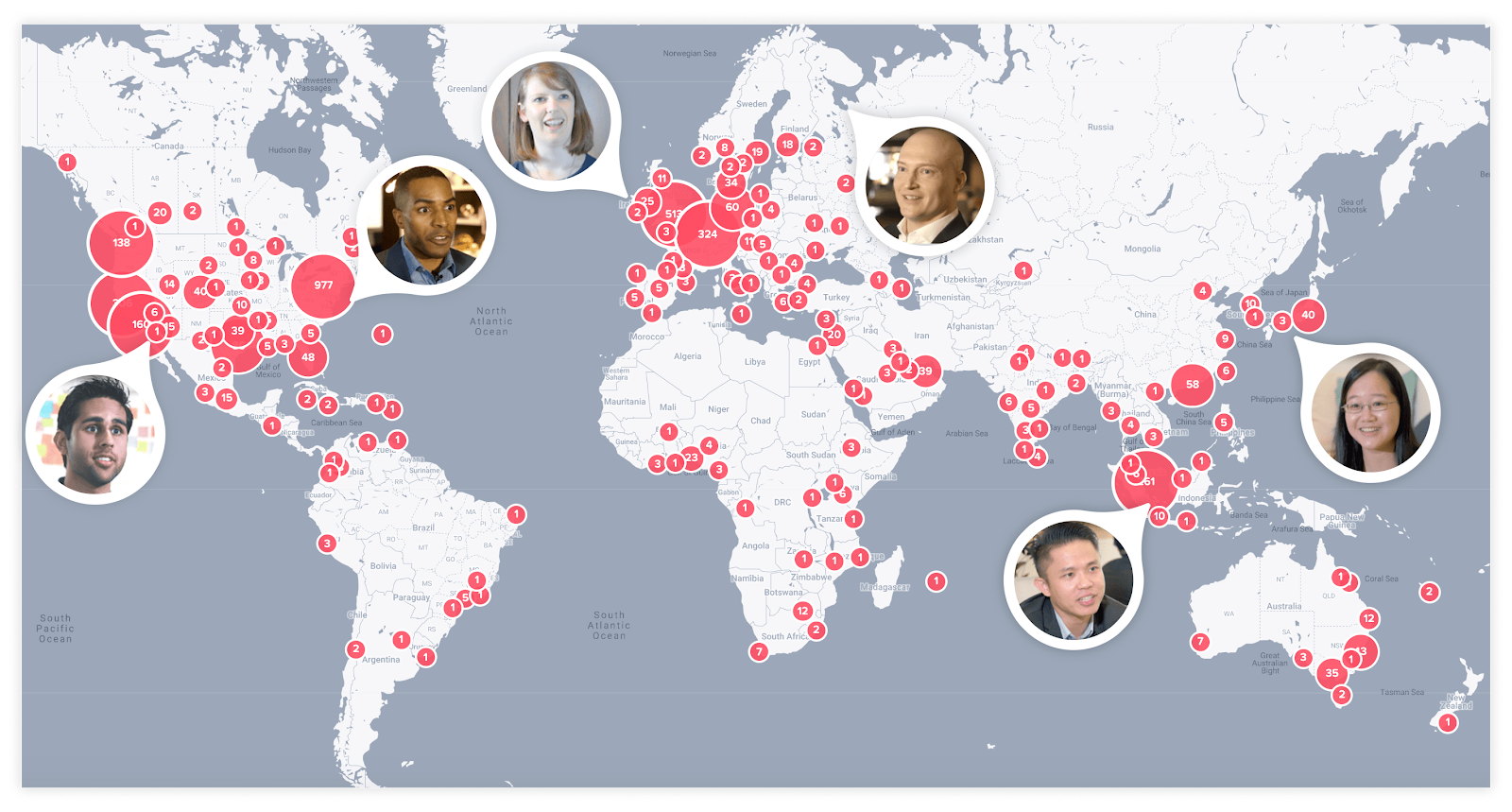
Students connect with peers around the world via our interactive network. Ambitious, driven people from 80 countries and counting…
You and your cohorts will move along your curriculum sequence together, actively collaborating on group projects, case studies, and assignments as you go.
Offline Events
“Extracurriculars” and social events are also available in Quantic’s MBA. Virtual and in-person meetups, both online and around the world, will allow you to rub shoulders with your classmates, instructors, and established alumni students.
The Executive MBA also offers multiple weekend-long conferences held in cities around the world. These conferences provide opportunities for students to meet face-to-face with peers during workshops, case studies, and meetings with local business leaders. Recent conferences were held in Washington, DC, Dublin, and Singapore.
Here’s what one looks like…
Career Network
You get access to a built-in Career Network. Top-tier employers use it to recruit our students and alumni. It serves as a career hub for graduates. MBA grads’ profiles stay active, so employers can browse alumni profiles whether they’re already employed or not.
Here are a few of the companies our grads work at…
Traditional On-Campus MBA Pros
Traditional on-campus MBA programs often appeal to students who need or want a little more structure and hands-on guidance. Students just out of an undergraduate business program, for example, might prefer the additional in-person attention offered by a brick-and-mortar school, as well as the familiar daily routine of face-to-face classes.
Brick-and-mortar business schools also have the opportunity to offer more bells and whistles when it comes to activities, facilities, and clubs. If you love the idea of getting together with your cohorts every week for dinner, for example, or catching up with your colleagues at the on-campus gym, the community of an on-campus environment might be more your style when selecting an MBA program.
Traditional On-Campus MBA Disadvantages
Of course, the most significant disadvantage of on-campus MBA programs is the lack of flexibility.
If you have a family at home, existing business obligations, or a burgeoning career, it can be difficult to justify starting a full-time MBA program. Even part-time MBA programs can be draining, as you’ll have to work your schedule around theirs (not the other way around) and possibly take on a frustrating commute.
On-campus MBA programs often also lack the cultural and demographic diversity of online programs. On-campus MBA students tend to be younger on average, for example, and there aren’t as many international students at any given on-campus program.
Working alongside and learning from diverse colleagues can help you build your cultural competency, leadership, and collaboration skills. It can also position you to take on an increasingly global marketplace with more confidence and finesse.
Online MBA vs Traditional MBA Comparison (table)
Now, let’s get down to the nitty-gritty details of how an on-campus MBA program differs from an online MBA with a point-by-point comparison of typical student demographics, average tuition cost, average salary growth after graduation, and more.
$23,918 average cost at a regionally accredited university — $36,166 average cost at AACSB online business schools — $11,972 average cost at nationally accredited online business schools
vary between programs, but roughly the same as online
MBA and EMBA: $950 USD per month over the 15-month duration of the program
Due to Quantic’s innovative tuition model, MBA and EMBA students pay just $950 USD per month over the 15-month duration of the programs, with employee reimbursement and scholarship options available.
Completion Time
Traditional MBA programs, as we described earlier, take around two years to complete. Accelerated programs may take 18 months or even a year, while some programs take up to three years. Part-time programs may take four or more years to complete.
Many online programs take slightly less time to complete than on-campus programs, making them a more efficient choice in many cases if you want to get the ball rolling on your business career faster. Quantic’s online MBA and EMBA programs take 15 months to complete.
Average Salary Growth
Average salary growth for both traditional and online MBA students varies widely. Still, it’s clear that the available data suggests that online MBA students tend to see a substantial return on their investment.
These salary bumps usually come through a promotion or raise at an existing company, a lateral move to a higher-paying job at the same level, or by taking on a higher position in a new industry.
The Value of Accreditation in Salary Outcomes
In order for an online MBA program’s graduates to achieve similar or even greater salary outcomes compared to traditional MBAs, it is crucial for the program itself to be accredited by reputable organizations such as the Association of MBAs (AMBA) or the Association to Advance Collegiate Schools of Business (AACSB). Accreditation ensures that the program meets rigorous quality standards and provides a valuable education for its students.
Quantic School of Business and Technology, for example, is accredited by the Distance Education Accrediting Commission (DEAC), which is recognized by both the U.S. Department of Education and Council for Higher Education Accreditation. This accreditation not only validates Quantic’s online MBA program but also contributes to graduates’ higher salary prospects.
Factors Influencing Salary Outcomes
While completing an online MBA may lead to higher salaries on average compared to traditional programs, it’s important to note that individual outcomes will vary based on factors such as:
Career Experience: Professionals with more work experience prior to pursuing their MBA are likely to command higher salaries upon graduation.
Industry: Salaries can differ significantly depending on the industry in which one works; finance and technology sectors often offer some of the highest post-MBA salaries.
Negotiation Skills: Graduates who effectively negotiate their starting salary or raises throughout their career can increase their overall earning potential over time.
Admissions Requirements
One of the main concerns some employers might have about students with an online MBA is that online MBA programs tend to be less selective than traditional ones.
You might wonder, for example, “Do I need a GMAT for my MBA?” The answer varies by program. Only 54.6% of online graduate business programs require GMAT/GRE scores from applicants. Meanwhile, a whopping 94% of conventional MBA programs require GMAT/GRE scores from their prospective students.
The requirements for test scores and undergraduate GPAs are also sometimes a little more lax when it comes to online business schools. This contrast can worry some employers, who might think that the lack of selectivity of a school suggests less dedication and rigor in an applicant.
But Quantic’s online MBA and its Executive MBA are highly selective, admitting only a small percentage of applicants each year. And around 80% of Quantic’s online MBA students graduated from top-30 undergraduate institutions (including Harvard, Duke, Stanford, UPenn, to name a few ..).
In turn, the program’s selectivity translates into higher completion rates, more engaged (and more impressive) colleagues and network contacts, and higher perceived value by employers.
Comparing Selectivity between Online MBAs vs Traditional MBAs
Selectivity varies among both online and traditional MBA programs. While some prestigious brick-and-mortar institutions have highly selective admissions processes similar to Quantic’s standards, others may be more lenient in accepting applicants.
It is crucial for prospective students to research each institution thoroughly before making a decision on which program best aligns with their goals and aspirations. A few factors worth considering include:
Average GMAT or GRE scores for admitted students
Acceptance rates
Career outcomes post-graduation such as salary increases or job placements within desired industries
Rankings from reputable sources like Financial Times or U.S News & World Report
The selectivity of online MBAs offers students a higher completion rate due to the more rigorous screening process, while providing an engaged learning environment with colleagues that contribute to effective networking.
What do Employers Think of an Online MBA?
Many prospective MBA students think an online MBA sounds like the ideal fit for them in terms of their schedule and learning style. But some worry that employers won’t take an online MBA program seriously.
Luckily, the available data doesn’t suggest that to be the case. In fact, some employers consider an online MBA to be an asset in that it showcases a student’s independent, autonomous approach to learning and their mastery of technology.
Kathryn Lee, human resources director for North America at Fiat Chrysler, told Seb Murray at the Financial Times that most employers now considered online MBA students to be just as competitive as traditional students.
“Online MBA students are equally as competitive as those attending classes on campus”
Lee added that online students’ drive to succeed and excellent time management skills illustrated their ambitious nature and commitment. “They display qualities that are important in people we hire — a strong work ethic, project management and critical thinking skills,” she said of online MBA grads in the same interview.
According to Jordan Friedman at U.S. News and World Report, many employers think far more about an online business school’s coursework, reputation, and opportunities for student-faculty interaction than about the format in which classes are delivered. That’s why it’s so crucial to ensure the MBA program you choose has ample opportunities for networking, collaboration, and interactive learning.
Many employers who have recruited MBA grads through Quantic’s Career Network see an online MBA from a reputable school as proof an applicant is creative, adaptive, and flexible.
Greg Buechler, a talent acquisition specialist, shared his thoughts about the value of Quantic’s MBA for employers.
“Quantic has allowed us to hire executive talent from around the world in the shortest time I have ever experienced in my 30 years of recruiting,” he said. “I am almost unwilling to share this gem of a tool!”
Overall, the higher salaries enjoyed by online MBA grads and the growing demand for online business schools indicates that there’s no shortage of employers who view online business degrees favorably. According to Jonathan Moules at the Financial Times, online business school growth is far outpacing that of traditional MBA programs. As the workplace becomes increasingly digital, higher education in business administration is following suit.
Summary – Which Degree for Your Career Growth?
Both traditional and online MBA programs can expand your career opportunities substantially. In addition to providing you with the critical thinking skills and key knowledge you’ll need to move up in your existing business career or launch a new one, an MBA program can bolster your confidence as a leader and widen your network of contacts.
Traditional MBA programs are sometimes preferable for students who require more structure and guidance. Some traditional graduate business programs offer more on-campus facilities and activities. However, they are not as flexible as most online MBA programs, and they tend to attract younger students with less work experience on average.
Meanwhile, online MBA programs like the ones offered at Quantic are best for self-motivated, independent thinkers who work well at their own pace. They can also benefit students who want to complete a graduate business degree faster, who have family or work obligations they can’t interrupt, or who thrive in a flexible, technology-driven learning environment. Interested in learning more about how Quantic’s online MBA program can be a game-changer in your business career? Read on to learn how Quantic’s disruptive approach to learning and global scope helped one student become a Forbes 30 Under 30 recipient.
FAQs
Is an Online MBA Taken Seriously?
Yes, online MBA programs are increasingly being recognized and respected by employers. Many top universities offer accredited online MBA programs that provide the same rigorous curriculum as their on-campus counterparts. As long as you choose a reputable program, your degree will be valued in the job market. Online MBA programs have gained significant respect over recent years.
Is an Online MBA Respectable?
An online MBA from a well-regarded institution is highly respectable. Employers often value candidates with degrees from accredited institutions, regardless of whether they were earned in-person or online. To ensure your degree is respected, research each program’s accreditation status and reputation before enrolling. Forbes lists some of the best online MBA programs for 2023.
How Demanding is an Online MBA?
The level of demand for an online MBA depends on factors such as course load, time management skills, and personal commitments outside schoolwork. While flexibility can make it easier to balance work and study schedules compared to traditional programs, students must still dedicate substantial time towards coursework completion and engagement with peers. Time management tips can help manage demands during your online MBA program.
Is an Online MBA as Good as an In-Person MBA?
The quality of an online MBA depends on the institution and program. Many reputable universities offer online MBAs that are equivalent to their traditional counterparts in terms of curriculum, faculty, and learning outcomes. However, networking opportunities and face-to-face interactions may differ between formats. Comparing Online vs Traditional MBAs can help you make an informed decision.
The coronavirus has a lot of us sitting around the house these days, scrolling through our phones or tablets. Skimming Instagram and Twitter have become common ways to pass the time, and while you may not think more screen time is the answer to the quarantine blues, some apps are proving to have benefits for the mind, body, and improving daily life. Quantic students have developed apps that help make dinner possible, ease anxiety, and get you back on track with your fitness goals during this crisis.
Kyoo
In direct response to the global COVID-19 crisis, Quantic MBA Alum, Albert Brown, and his team launched Kyoo Curbside. Kyoo has helped hundreds of businesses rapidly set up online ordering with no-contact, curbside pickup orders. Because of its popularity, it was fast-tracked by Square to become an official ordering partner and it is now the only free product listed. Merchants can set up their store in a snap. Items import automatically from their Square menu and they can accept orders right away. Customers can place orders on mobile, web, kiosk, or simply by text message. They receive instant text message updates to keep them moving through the queue and provide clear instructions to get their order fulfilled.
Hero Trainer
Staying home? Stay active! Quantic MBA Alum, Yash Jain, developed Hero Trainer to help us reach our fitness goals. The mobile app allows users to earn rewards in their favorite video games for exercising. A little walk around the house, or on the treadmill can earn people premium paid reward codes. The app tracks your steps on a walk or run. You earn points for each step and exchange those for reward codes to your favorite games.
Mooditude
We could all use a little mood boost to help cope with quarantine. EMBA Learner, Kamran Qamar, developed a clinically designed self-help app for depression and anxiety. Mooditude helps you identify and change your thinking using transformative Cognitive Behavioral Therapy (CBT). For lasting cure, you can build mood-lifting habits using goals and routines. When you feel stuck, go deep and find solutions to your specific problem within the dozens of psychiatrist developed programs.
It’s exciting and uplifting to see our students take action and find ways to stay productive, engaged, and mindful while life — in some respects — stands still. Here’s to those who #ChangeTheCourse.
When we think of blankets, we often think of cozy nights and hot chocolate. But what if they had the power to change the course of healthcare technology, especially during the coronavirus pandemic? Executive MBA student, Olivia Lin, had this exact same thought. She wanted to combine her strong tech background and desire to create textiles with a purpose. Olivia and fellow EMBA student, Edward Shim, soon launched their start-up, Studio 1 Labs, specializing in cutting-edge textile technology.
Their first product? A “smart” bed sheet that can be used in hospitals to monitor patients’ vitals. This has been crucial during the COVID-19 crisis because it continuously monitors for respiratory distress. The bed sheet detects respiratory patterns and transmits the data to a computer terminal for healthcare workers. With advanced data accuracy and analytics, this technology can also predict the onset of health decline and emergencies like apnea, heart attack and stroke.
Olivia is originally from Taipei, Taiwan and grew up in Canada. She studied psychology at the University of Toronto, and earned a Master’s and later a Ph.D. in cognitive psychology from the University of Waterloo. While studying psychology, Olivia was drawn to subject matter known as Human Factors, a field focused on the application of psychology in society.
When asked how and why she made the transition from psychology to starting a textile tech company, Olivia laughed — the transition even surprised her. She had a friend who worked in textile technology and saw how she combined fabric, art, and modern technology to create clothing with a purpose. This sparked Olivia’s interest and curiosity and she asked for her friend’s help in learning how to sew fabrics infused with tech.
While completing her Ph.D., Olivia met Edward, and her hobby soon turned into a business idea as the two began researching the commercialization of fabric sensor technology. They had identified a growing trend in healthcare of using everyday objects as tools for monitoring vitals and felt that textiles might just be the perfect canvas for such a device. This kind of application had particular relevance to Edward, who, when serving in the military, sustained an injury which left him experiencing respiratory issues. He was well aware of the processes in place for patients to have their breathing monitored and knew there had to be a better way. Both he and Olivia saw a need for improvement in this space and after enlisting the help of a few more colleagues, Studio 1 Labs was born.
“There was a lot of exploration and experimentation and finally we found an application that really works,” said Olivia.
Studio 1 Labs’ fabric sensor bed sheets are a glimpse at the future of health technology. These sensors monitor a patient’s respiration pattern, location, movement, and prolonged pressure. The patient does little more than lie in bed and his or her vitals are measured and reported. This is especially important for elderly patients, who are less able to adjust their lives for doctors to gather the data they need to make an informed diagnosis and treatment plan.
Beyond product development, Olivia had also recognized the need to increase her knowledge of business and strategy. This is when she decided to pursue an Executive MBA. With Studio 1 Labs having locations in both Canada and Taiwan, Olivia was constantly traveling and Quantic’s mobile-first design enabled her to learn no matter where she was.
“Being an entrepreneur, I felt like I had gaps in my knowledge and I couldn’t keep pace in conversations with executives and potential partners to the degree I needed to. I wanted more of the knowledge that would enable me to carry on and lead these conversations.” said Olivia.
Olivia’s impressive efforts in creating this business have not gone unrecognized. She was featured by Girls in Tech Taiwan 40 Under 40 and Studio 1 Labs won the Markham Board of Trade Aspire Startup Award in 2018. Outside of being the Executive Director of Studio 1 Labs, Olivia was a mentor for the City of Waterloo’s initiative, Girls in STEAM, a program that promoted tech and other STEAM careers to local girls to spark their interest at a young age. Olivia now lives in Taiwan, as she continues her rewarding (and challenging) entrepreneurial journey and helps to continue to #ChangeTheCourse of healthcare technology.